1 APNA 29th Annual Conference Session 3026: October 30, 2015 - - PDF document

1
SMART_READER_LITE
LIVE PREVIEW

1 APNA 29th Annual Conference Session 3026: October 30, 2015 - - PDF document

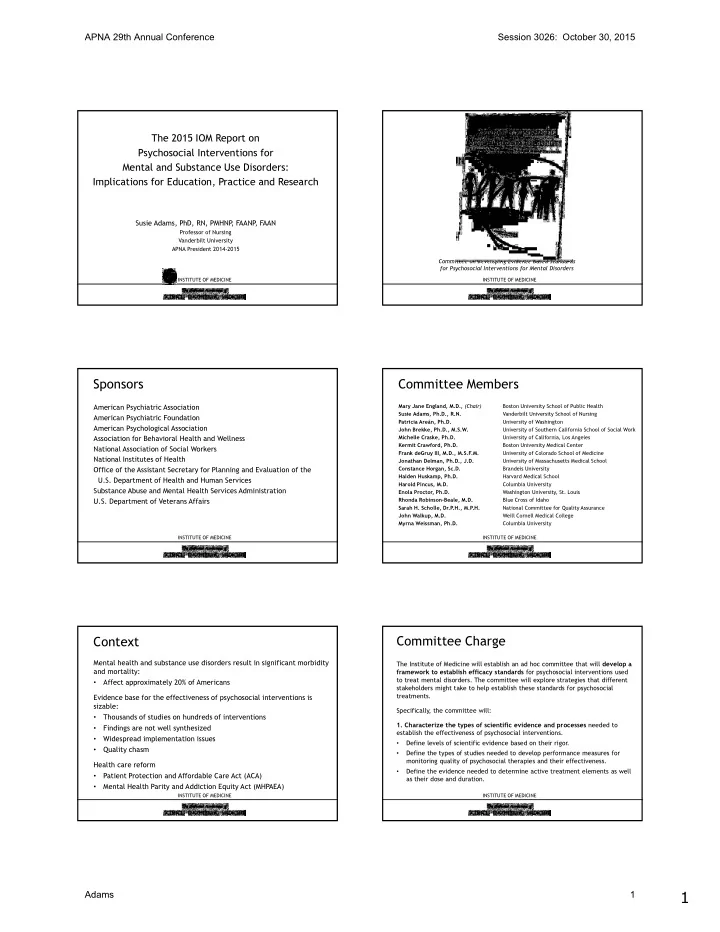
APNA 29th Annual Conference Session 3026: October 30, 2015 The 2015 IOM Report on Psychosocial Interventions for INSTITUTE OF MEDICINE Mental and Substance Use Disorders: Implications for Education, Practice and Research Susie Adams, PhD,


slide-1
SLIDE 1

1

INSTITUTE OF MEDICINE

The 2015 IOM Report on Psychosocial Interventions for Mental and Substance Use Disorders: Implications for Education, Practice and Research

Susie Adams, PhD, RN, PMHNP , FAANP , FAAN

Professor of Nursing Vanderbilt University APNA President 2014-2015

INSTITUTE OF MEDICINE

Committee on Developing Evidence-Based Standards for Psychosocial Interventions for Mental Disorders

INSTITUTE OF MEDICINE

INSTITUTE OF MEDICINE

American Psychiatric Association American Psychiatric Foundation American Psychological Association Association for Behavioral Health and Wellness National Association of Social Workers National Institutes of Health Office of the Assistant Secretary for Planning and Evaluation of the U.S. Department of Health and Human Services Substance Abuse and Mental Health Services Administration U.S. Department of Veterans Affairs

Sponsors

INSTITUTE OF MEDICINE Mary Jane England, M.D., (Chair) Boston University School of Public Health Susie Adams, Ph.D., R.N. Vanderbilt University School of Nursing Patricia Areán, Ph.D. University of Washington John Brekke, Ph.D., M.S.W. University of Southern California School of Social Work Michelle Craske, Ph.D. University of California, Los Angeles Kermit Crawford, Ph.D. Boston University Medical Center Frank deGruy III, M.D., M.S.F.M. University of Colorado School of Medicine Jonathan Delman, Ph.D., J.D. University of Massachusetts Medical School Constance Horgan, Sc.D. Brandeis University Haiden Huskamp, Ph.D. Harvard Medical School Harold Pincus, M.D. Columbia University Enola Proctor, Ph.D. Washington University, St. Louis Rhonda Robinson-Beale, M.D. Blue Cross of Idaho Sarah H. Scholle, Dr.P.H., M.P.H. National Committee for Quality Assurance John Walkup, M.D. Weill Cornell Medical College Myrna Weissman, Ph.D. Columbia University

Committee Members

INSTITUTE OF MEDICINE

Mental health and substance use disorders result in significant morbidity and mortality:

  • Affect approximately 20% of Americans

Evidence base for the effectiveness of psychosocial interventions is sizable:

  • Thousands of studies on hundreds of interventions
  • Findings are not well synthesized
  • Widespread implementation issues
  • Quality chasm

Health care reform

  • Patient Protection and Affordable Care Act (ACA)
  • Mental Health Parity and Addiction Equity Act (MHPAEA)

Context

INSTITUTE OF MEDICINE

The Institute of Medicine will establish an ad hoc committee that will develop a framework to establish efficacy standards for psychosocial interventions used to treat mental disorders. The committee will explore strategies that different stakeholders might take to help establish these standards for psychosocial treatments. Specifically, the committee will:

  • 1. Characterize the types of scientific evidence and processes needed to

establish the effectiveness of psychosocial interventions.

  • Define levels of scientific evidence based on their rigor.
  • Define the types of studies needed to develop performance measures for

monitoring quality of psychosocial therapies and their effectiveness.

  • Define the evidence needed to determine active treatment elements as well

as their dose and duration.

Committee Charge

APNA 29th Annual Conference Session 3026: October 30, 2015 Adams 1

slide-2
SLIDE 2

2

INSTITUTE OF MEDICINE

Using the best available evidence, 2. identify the elements of psychosocial treatments that are most likely to improve a patient’s mental health and can be tracked using performance measures. In addition, 3. identify features of health care delivery systems involving psychosocial therapies that are most indicative of high quality care that can be practically tracked as part of a system of performance measures. The following approaches to performance measurement should be considered:

  • Measures to determine if providers implement treatment in a manner that is

consistent with evidence-based standards;

  • Measures that encourage continuity of treatment;
  • Measures that assess whether providers have the structures and processes in

place to support effective psychotherapy;

  • Consumer-reported experiences of evidence-based psychosocial care; and
  • Consumer-reported outcomes using a measurement-based care approach.

Committee Charge (Continued)

INSTITUTE OF MEDICINE

1. Five in-person meetings 2. Input from consultants:

  • Gary Bond, PhD
  • Bruce Chorpita, PhD

3. Two public workshops:

  • Approaches to Quality Measurement
  • Approaches to Quality Improvement

Committee Process

INSTITUTE OF MEDICINE

Quality Measurement

Broad Issues in Quality Measurement Helen Burstin, National Quality Forum Shari Ling, CMS Eric Schneider, RAND Corp. Measuring Quality in Behavioral Health Gregory McHugo, Dartmouth University Kim Hepner, RAND Corp. Jodie Trafton, Veterans Affairs Jim Chase, MN Community Measurement Measuring Quality in Other Fields Matthew Hutter, Harvard University Frank Opelka, LSU Healthcare Network Kurt Stange, Case Western Reserve Univ. Kevin Larsen, ONC

Public Workshop Speakers

Quality Improvement

SAMHSA Criteria for Evaluating Interventions Alyson Essex, SAMHSA Implementation Abe Wandersman, University of South Carolina Gregory Aarons, UCSD Virna Little, Institute for Family Health Tracey Smith, VA Medical Center Treatment Fidelity David Clark, Oxford; IAPT Sonja Schoenwald, Medical Univ. of South Carolina Amy Dorin, FEGS Health IT David Mohr, Northwestern University Robert Gibbons, University of Chicago Armen Arevian, UCLA Grant Grissom, Polaris Health Directions INSTITUTE OF MEDICINE

What do the IOM recommendation mean for:

  • Consumers?
  • Agencies providing services?
  • Individual clinicians providing services?
  • Researchers measuring care provided?
  • Payers?
  • Educators / Training institutions /

Professional organizations (Cont. Educ)?

INSTITUTE OF MEDICINE

What do the IOM recommendations mean for psychiatric nurses in:

  • Clinical practice?
  • Education?
  • Research?
  • Administration?

INSTITUTE OF MEDICINE

  • Offer a broad definition of psychosocial intervention
  • Focus on evidence-based care

– Many interventions may be effective but not yet been established as evidence-based. – Long-term goal is for all psychosocial interventions to be grounded in evidence.

  • Recommend a framework for establishing and applying efficacy

standards for psychosocial interventions

  • Emphasize framework’s iterative nature

– Both of intervention science and the evolving methodologies that will be required to address the psychosocial needs of individuals with MH/SU disorders.

Committee Approach

APNA 29th Annual Conference Session 3026: October 30, 2015 Adams 2

slide-3
SLIDE 3

3

INSTITUTE OF MEDICINE

Psychosocial interventions for mental health and substance use disorders are interpersonal or informational activities, techniques, or strategies that target biological, behavioral, cognitive, emotional, interpersonal, social, or environmental factors with the aim of improving health functioning and wellbeing.

Define Psychosocial Intervention

INSTITUTE OF MEDICINE

Findings, Conclusions & Recommendations

INSTITUTE OF MEDICINE

Mental health and substance use disorders are a serious public health problem. A wide variety of psychosocial interventions play a major role in the treatment of mental health and substance use conditions. Psychosocial interventions that have been demonstrated to be effective in research settings are not used routinely in clinical practice. No standard system is in place to ensure that the psychosocial interventions delivered to patients/consumers are effective.

Key Findings

INSTITUTE OF MEDICINE

Conclusion

Broad stakeholder involvement is necessary to develop effective psychosocial interventions.

Recommendations

Use the committee’s framework for improving patient outcomes through psychosocial interventions to strengthen the evidence base. The framework should be used guide efforts to support policy, research, and implementation strategies that will promote the use of evidence- based psychosocial interventions. Require consumer engagement. Consumers should be active participants in the development of practice guidelines, quality measures, policies, and implementation strategies for, as well as research on, psychosocial interventions.

A Framework to Improve Quality

INSTITUTE OF MEDICINE

A Framework to Improve Quality

NIMH ???

AHRQ Subspecialty

  • rg

Subspecialty

  • rg

Research Payer partner Payers, Govern Nooneplaysthis role??

INSTITUTE OF MEDICINE

Conclusion

Additional research is needed to validate strategies to apply elements approaches to understanding psychosocial interventions.

Recommendation

Conduct research to identify and validate elements of psychosocial

  • interventions. Public and private organizations should conduct research to

identify and validate the elements of psychosocial interventions. Specifically, research is needed to develop a common terminology for elements and evaluating their sequencing, dosing, moderators, mediators, and mechanisms of action.

Elements of Therapeutic Change

APNA 29th Annual Conference Session 3026: October 30, 2015 Adams 3

slide-4
SLIDE 4

4

INSTITUTE OF MEDICINE

Conclusion

Approaches applied in other areas of health care can be applied in compiling and synthesizing evidence to guide care for mental health and substance use disorders.

Recommendations

Expand and enhance processes for coordinating and conducting systematic reviews of psychosocial interventions and their elements. HHS, in partnership with professional and consumer organizations, should support a coordinated process and conduct research in technologies that may expedite reviews. Develop a process for compiling and disseminating the results of systematic reviews along with guidelines and dissemination tools. NREPP and professional

  • rganizations should disseminate guidelines and implementation tools.

Conduct research to expand the evidence base for the effectiveness of psychosocial interventions. NIH should coordinate research investments in this area.

Standards for Reviewing Evidence

INSTITUTE OF MEDICINE

What Do Football and Psychotherapy Have in Common? 20

INSTITUTE OF MEDICINE

What Do Football and Psychotherapy Have in Common?

In the game of Football there are a series of plays that can be used to advance the ball to score. The plays may be altered a bit to fit the current situation, capabilities of the opponents, the time left in the game, etc. Multiple players have distinct roles Practice plays with observation by Coach, video, and mapping out alternative Solutions.

INSTITUTE OF MEDICINE

What Do Football and Psychotherapy Have in Common?

Quarterback calls and executes various plays based on:

The assessed strengths and weakness of the Players on the opponents and his own team. The response of the opponents teams to plays. Has a clear goal of winning the game by scoring the most points

INSTITUTE OF MEDICINE

Similarity Serves as Pillars for Addressing A Psychotherapy Framework? Football Psychotherapy

  • Series of plays
  • Plays may be altered to fit

the current situation.

  • Players have distinct roles.
  • Practice plays.
  • Assess strengths and

weaknesses

  • Response of the
  • pponents
  • Clear outcome = score
  • Many different EB psychotherapies and

psychosocial interventions.

  • Interventions need to be individualized and

provider needs to be skilled in doing so.

  • Training/ certifications in some of the

psychotherapies or interventions

  • Supervision, case conferences, review of
  • utcomes, video taping sessions.
  • Psychiatric/Psychosocial assessment and

strengths based assessment of consumer and treatment team

  • Articulate and/or measure definitive

response to intervention

  • Clear expected outcome in response to

treatment – functionality; symptoms

INSTITUTE OF MEDICINE

Conclusion

Approaches applied in other areas of health care can be applied to develop reliable, valid, and feasible quality measures for both improvement and accountability purposes in care for MH/SU disorders.

Recommendations

Conduct research to contribute to the development, validation, and application of a quality measures. Funders and payers should coordinate research in quality measure development and evaluation. Develop and continuously update a comprehensive portfolio of measures. HHS should designate a locus of responsibility to maintain a balanced portfolio

  • f quality measures for MH/SU care.

Support the use of health information technology for quality measurement and improvement of psychosocial interventions. Federal, state, and private payers should support investments in new and existing data and coding systems.

Quality Measurement

APNA 29th Annual Conference Session 3026: October 30, 2015 Adams 4

slide-5
SLIDE 5

5

INSTITUTE OF MEDICINE

Conclusion

Multiple stakeholders should apply levers, incentives, and other means to create learning health systems that continually progress toward higher quality.

Recommendations

Support quality improvement at multiple levels using multiple levers. Purchasers, plans, and providers should adopt systems for measuring, monitoring, and improving quality for psychosocial interventions that are aligned across multiple levels. Conduct research to design and evaluate strategies that can influence the quality of psychosocial interventions. Purchasers, health care insurers, providers, professional organizations, and consumers should pursue strategies to build infrastructure to support ongoing provider training, consumer and family education, electronic health records, and other features of a continuously learning health care system.

Quality Improvement

INSTITUTE OF MEDICINE

Core Components of a Provider System That Could Support Effective Psychosocial Interventions Core Components of Professional Education & Continuing Education That Could Support Effective Psychosocial Interventions

INSTITUTE OF MEDICINE

Core Components of a National Research Agenda That Could Support Effective Psychosocial Interventions Core Components of a Payer System That Could Support Effective Psychosocial Interventions

INSTITUTE OF MEDICINE

Consumers

  • Seek quality care through standardized evaluation (“Report Cards”)

Clinical Providers / Agencies

  • Develop structure and process that supports high fidelity, evidence-based

psychosocial interventions

  • Use evidence-based practices with high fidelity
  • Use measurement-based outcome evaluation as part of CQI process

Educators / Training Institutions / Professional Organizations

  • Determine core clinical skills to deliver common psychosocial

interventions (e.g. motivational interviewing, IPT , CBT)

  • Train students / clinicians in core clinical skills

Researchers

  • Develop a national research agenda that funds evaluation of psychosocial

interventions, determination of nonspecific and specific elements of therapeutic change, optimal dosing and sequencing. Payers

  • Create a structure of requirements for Pay 4 Performance or incentives

Summary

INSTITUTE OF MEDICINE

  • Complete report and other resources available at

www.nap.edu

  • IOM will hold meeting in Fall 2015 to gather stakeholders

to discuss implementation of recommendations of: – Consumers – Agencies and individual providers of care – Payers – Researchers – Educators / trainers / professional organizations

  • More information: Adrienne Stith Butler (astith@nas.edu)

Report and Dissemination

INSTITUTE OF MEDICINE

Questions and Discussion

APNA 29th Annual Conference Session 3026: October 30, 2015 Adams 5