Granulomatous Lung Disease I have nothing to disclose. I may - - PowerPoint PPT Presentation

granulomatous lung disease
SMART_READER_LITE
LIVE PREVIEW

Granulomatous Lung Disease I have nothing to disclose. I may - - PowerPoint PPT Presentation

5/24/2018 Disclosures Granulomatous Lung Disease I have nothing to disclose. I may mention Tomales Farmstead Creamery Kirk D. Jones, MD UCSF Dept of Pathology kirk.jones@ucsf.edu Talk Overview Definition Some terminology


slide-1
SLIDE 1

5/24/2018 1

Kirk D. Jones, MD UCSF Dept of Pathology kirk.jones@ucsf.edu

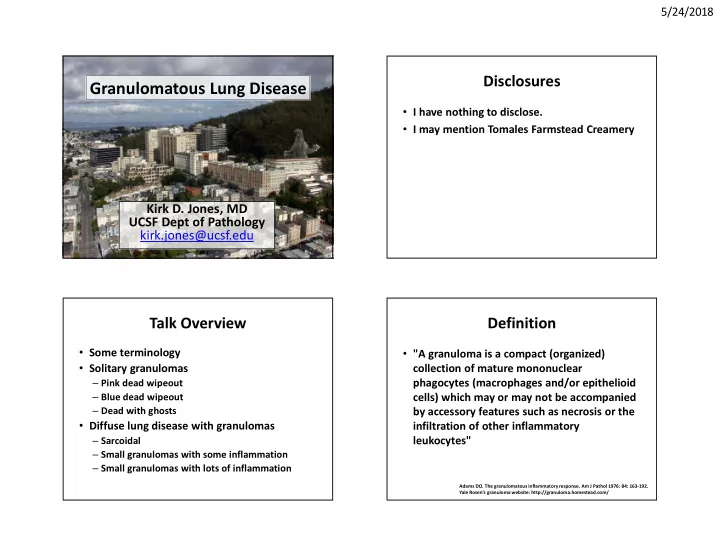
Granulomatous Lung Disease

Disclosures

  • I have nothing to disclose.
  • I may mention Tomales Farmstead Creamery

Talk Overview

  • Some terminology
  • Solitary granulomas

– Pink dead wipeout – Blue dead wipeout – Dead with ghosts

  • Diffuse lung disease with granulomas

– Sarcoidal – Small granulomas with some inflammation – Small granulomas with lots of inflammation

Definition

  • "A granuloma is a compact (organized)

collection of mature mononuclear phagocytes (macrophages and/or epithelioid cells) which may or may not be accompanied by accessory features such as necrosis or the infiltration of other inflammatory leukocytes"

Adams DO. The granulomatous inflammatory response. Am J Pathol 1976: 84: 163-192. Yale Rosen’s granuloma website: http://granuloma.homestead.com/

slide-2
SLIDE 2

5/24/2018 2

To cheese or not to cheese

  • Caseating

– Term used to describe the feta-like consistency of several necrotic infections and tumors

  • Necrotizing

– Term used to describe the microscopic appearance of necrosis in granulomas

Don’t call it caseating as a microscopic diagnosis!

Solitary Pink Dead Wipeout

  • Nodules with pink central necrosis (without

visible structures underneath) are almost always of infectious origin

– Mycobacteria

  • Tuberculosis
  • MAC (in COPD patients)

– Fungus

  • Histoplasma
  • Coccidioides
  • Cryptococcus

When infectious, the dominant necrotic nodule often shows satellite non-necrotizing (“sarcoidal”) granulomas

slide-3
SLIDE 3

5/24/2018 3

  • Look for micro-organisms

(Tuberculosis, Histoplasma) in the necrosis

  • Do stains on two blocks if you

are concerned for infection

  • If there is only one nodule, and

you are thinking GPA, you might think again

Ulbright TM, Katzenstein AL. Am J Surg Pathol. 1980 Feb; 4(1): 13-28. PMID: 7361992.

Stains for Granulomas

  • Your favorite AFB (Kinyoun, Fite, etc)

– How long to look at? What power?

  • GMS – stains nearly all fungi.
  • PAS-D – looks pretty, but misses

histoplasma and pneumocystis

  • Mucicarmine – positive in cryptococcus.
  • Immunohistochemical stains

– Pneumocystis

slide-4
SLIDE 4

5/24/2018 4

Cryptococcus Coccidioides

slide-5
SLIDE 5

5/24/2018 5

Talaromyces marneffei

Some Small Fungi

Fungus Shape Size (µm) Features Blastomyces Round 8-15 Broad-based budding Basophilic nucleoplasm Neutrophils Candida Round to oval 2-5 Single bud (bowling pin) Usually Gram-positive Coccidioides Spherule with Endospores 60 1-2 Variable size, can swell up Thin rim of inflammation Eosinophils Cryptococcus Round to oval 2-20 Marked variablilty in size Mucoid capsule (mucicarmine) Retraction / shrinking Histoplasma Round 2-4

  • Small. Use 20x lens.

Hides in the necrosis Talaromyces Oval 3-7 Divides by fission (gel-capsule) Pneumocystis Round Deflated ball 4-7 Froth and dot Small granulomas rarely

slide-6
SLIDE 6

5/24/2018 6

KJ10-114: Aspergillus fumigatus

Sangoi AR, et al. Am J Clin Pathol. 2009 Mar; 131(3): 364-75. PMID: 19228642.

  • Pathologists are pretty

good at classifying fungi into broad groups morphologically

  • Degeneration leading to

swollen septa and variable yeast forms may cause difficulties

  • Thinking that septation

means Aspergillus only may cause problems

  • Give a differential after

favored diagnosis

slide-7
SLIDE 7

5/24/2018 7

Nodular amyloid with low-grade lymphoma

Blue dead wipeout (aka )

  • Necrosis with moderate amount of nuclear

debris

  • Infection

– Particularly in patients with low level immunosuppression – Do your stains

  • Granulomatosis with polyangiitis
  • Rheumatoid nodule
slide-8
SLIDE 8

5/24/2018 8

Histologic features of GPA

  • Histiocyte rich mixed inflammation
  • No well-formed granulomas, instead some

singleton hyperchromatic giant cells

  • Geographic necrosis
  • Neutrophilic micro-abscesses
  • Vasculitis
slide-9
SLIDE 9

5/24/2018 9

GPA – Points to Consider

  • GPA usually shows multiple lesions and is

frequently bilateral

  • GPA only rarely shows well-formed

“sarcoidal” granulomas

  • GPA often involves sinuses and kidneys, and

will frequently show cytoplasmic Anti- Neutrophil-Cytoplasmic Antibodies (ANCA) – usually to proteinase-3 (PR3).

Rheumatoid nodule

  • Rare to not have the history of rheumatoid

arthritis

  • Often biopsied to rule out infection, but
  • ften see coexisting with cutaneous

rheumatoid nodules

  • Often crosses the pleura
slide-10
SLIDE 10

5/24/2018 10

Pink and Dead with Ghosts

  • Occasionally, the central portion of the

necrotic nodule shows coagulative or ischemic-type necrosis.

  • Often these are not granulomas, but rather

necrotic nodules from vascular abnormalities.

Pink and Dead with Ghosts

  • Infection

– Less common in mycobacterial disease – Occasionally in fungal (Coccidioides and Histoplasma)

  • Venous infarct
  • Parasite
  • Lymphomatoid granulomatosis
slide-11
SLIDE 11

5/24/2018 11

Granuloma versus Venous Infarct

  • Granuloma

– Central liquefactive or coagulative necrosis – Peripheral histiocytic reaction, often with giant cells

  • Venous infarct

– Central coagulative necrosis – Peripheral granulation tissue-like fibrosis

Causes of Venous Infarcts

  • Sclerosing mediastinitis
  • Pulmonary venous ablation (for a-fib)
  • Pulmonary veno-occlusive disease
  • Tumor (rare)
slide-12
SLIDE 12

5/24/2018 12

Dirofilaria (dog heartworm)

  • Humans are dead-end host
  • Worm ends up in lung vessel and shows a

mixed infarct-inflammatory reaction

slide-13
SLIDE 13

5/24/2018 13

Lymphomatoid granulomatosis (lymphoma)

Lymphomatoid Granulomatosis

  • Nodule with mixed T and B lymphocytes and

histiocytes

  • Ranges from possibly reactive (grade 1) to

Epstein-Barr virus (EBV)-associated B cell lymphomas (grade 2 and 3)

  • As the number of large B-cells and EBER-positive

cells increases, the more likely that this represents a lymphoma

  • Grade 3 LYG should be diagnosed as diffuse large

B-cell lymphoma

Solitary Necrotizing

  • Pink and dead

– Infection – Occasional mimics such as amyloidoma

  • Blue and dead

– Infection – Granulomatosis with polyangiitis, rheum nodule

  • Pink and dead with ghosts

– Infection – Lymphomatoid granulomatosis – Venous infarct – Dirofilaria

slide-14
SLIDE 14

5/24/2018 14

Diffuse Lung Disease with Granulomas

  • Sarcoidal granulomas
  • Small granulomas with mild inflammation
  • Small granulomas with a lot of inflammation

Sarcoidal Granulomas

  • Non-necrotizing granulomas
  • Follow lymphatic routes

– Bronchovascular bundles – Subpleural region – Interlobular septa

  • Sarcoidosis
  • Metal-related sarcoid-like reaction

– Chronic beryllium disease of the lung

  • Drug reaction

– Alpha-interferon – HAART

slide-15
SLIDE 15

5/24/2018 15

Small granulomas with some chronic inflammation

  • Hypersensitivity pneumonia
  • Drug reaction

– Methotrexate – Sirolimus (and other mTOR inhibitors)

  • Hot-tub lung

H.P. - Micro

  • “Triad of four things”

– 1a: Interstitial chronic inflammation – 1b: Bronchiolocentric inflammation – 2: Poorly formed granulomas – 3: Foci of organizing pneumonia

slide-16
SLIDE 16

5/24/2018 16

slide-17
SLIDE 17

5/24/2018 17

Courtesy of Rick Webb, MD

Hypersensitivity Pneumonia

  • Cases we have observed:

– Feathers: Pets, Farm animal, Duvet, Pillow, Jacket. – Molds: Work freezer, Man-Cave, Sleep number mattress, Hay, Orchid bark – Mycobacteria: Indoor spa, shower – Machine oil – ? Central valley: Almond dust?

slide-18
SLIDE 18

5/24/2018 18

Everolimus toxicity

Granulomatous Drug Toxicity

  • Best described in methotrexate and mTOR

inhibitors

  • Look for additional features that suggest

immune activation (lymphs and eos around venules)

  • May see airspace granulomas
  • Get your stains – suggest culture of BAL
slide-19
SLIDE 19

5/24/2018 19

Hot-tub Lung

  • Hypersensitivity reaction to Mycobacterium

within inhaled mist from indoor spas or hot showers

  • Unusual to see on AFB staining (usually only if

necrosis present). May take several weeks to grow out of BAL cultures

  • Usually treated similar to HP

Small granulomas with a lot of chronic inflammation

  • Hypersensitivity pneumonia
  • Drug reaction

– Methotrexate – Sirolimus (and other mTOR inhibitors)

  • Hot-tub lung
slide-20
SLIDE 20

5/24/2018 20

A lot of chronic inflammation with small granulomas

  • Granulomatous lymphocytic interstitial lung

disease (GLILD)

– LIP (or follicular bronchiolitis) with small non- necrotizing granulomas

  • Autoimmune connective tissue disease

– Sjogren syndrome

  • LIP (or follicular bronchiolitis) with small non-

necrotizing granulomas

KJ11-67: GLILD V-39: GLILD – with evidence of B-cell clonality

slide-21
SLIDE 21

5/24/2018 21

Prior core showed B-cell lymphoma – GLILD?

slide-22
SLIDE 22

5/24/2018 22

Lymphocytic interstitial pneumonia (LIP)

  • r

Follicular Bronchiolitis with granulomas

  • Seeing dense inflammation with small granulomas

should generate the differential of:

– GLILD

  • Hypogammaglobulinemia/Common variable immunodeficiency

– Autoimmune connective tissue disease

  • Sjogren syndrome

– Lymphoma – Less likely the entities covered for mild inflammation such as HP

Distribution Appearance Associated inflammation Hypersensitivity pneumonia Random Bronchiolocentric Poorly formed Diffuse mild to moderate +/- OP Hot-tub Lung Random Bronchiolocentric Loosely formed with lymphocytes Air-space Patchy mild interstitial chronic inflammation Often with OP Drug reaction Random Poorly formed Occasional air-space Diffuse mild to moderate +/- OP GLILD Random Rare Poorly formed Dense lymphoid inflammation Rule out lymphoma Sjogren syndrome Random Rare Poorly formed Dense lymphoid (LIP) Follicular bronchiolitis Sarcoidosis “Lymphangitic” Well-formed Lymphocyte-poor Sparse It is important to remember that there are tremendous overlaps in the diffuse granulomatous diseases. This should help generate a differential diagnosis with a hierarchy of possibilities.

slide-23
SLIDE 23

5/24/2018 23

Aspiration Venous injection of crushed tablets

Take home message

  • Solitary granulomas are often infectious, but

it is important to rule out mimics by evaluating the appearance closely

  • Histologic features of diffuse interstitial lung

disease with granulomas allow for sub- classification based on distribution and character of granulomas, and presence of associated inflammation