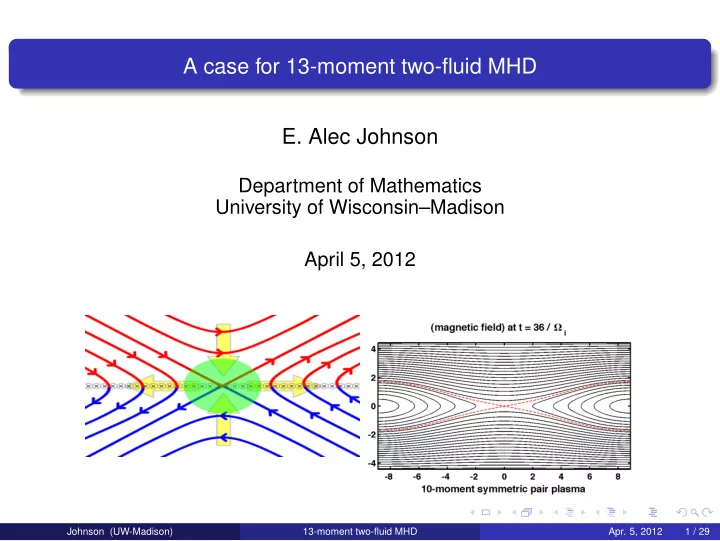
A case for 13-moment two-fluid MHD E. Alec Johnson Department of - - PowerPoint PPT Presentation

a case for 13 moment two fluid mhd e alec johnson
SMART_READER_LITE
LIVE PREVIEW

A case for 13-moment two-fluid MHD E. Alec Johnson Department of - - PowerPoint PPT Presentation

A case for 13-moment two-fluid MHD E. Alec Johnson Department of Mathematics University of WisconsinMadison April 5, 2012 Johnson (UW-Madison) 13-moment two-fluid MHD Apr. 5, 2012 1 / 29 Outline The purpose of this talk is to build a


slide-1
SLIDE 1

A case for 13-moment two-fluid MHD

  • E. Alec Johnson

Department of Mathematics University of Wisconsin–Madison April 5, 2012

Johnson (UW-Madison) 13-moment two-fluid MHD

  • Apr. 5, 2012

1 / 29

slide-2
SLIDE 2

Outline

The purpose of this talk is to build a case that a 13-moment 2-fluid model is the simplest fluid model of plasma that can resolve steady fast magnetic re- connection and avoid anomalous cross-field transport in a highly magnetized plasma. The argument:

1

A study of the terms of the XMHD Ohm’s law and entropy evolution at the X-point of steady 2D reconnection invariant under 180-degree rotation reveals that nonzero heat flux and viscosity are model requirements.

2

In a highly magnitized plasma, anomalous cross-field transport is difficult to avoid unless spatially higher-order-accurate methods are used. Higher-order-accurate positivity-preserving methods are available for hyperbolic models but not yet for diffusive models. Relaxation closures are non-diffusive and trivial for the 13-moment model and are independent of the magnetic field. In contrast, relaxation closures for quadratic-moment models are diffusive, become complicated in the presence of a magnetic field, and become ill-conditioned when the magnetic field becomes strong. As a consequence, implicit methods are necessary and it is difficult to design appropriate preconditioners, particularly for positivity-preserving methods.

Johnson (UW-Madison) 13-moment two-fluid MHD

  • Apr. 5, 2012

2 / 29

slide-3
SLIDE 3

Model hierarchy

(Two-species kinetic-Maxwell)  

  • (13-moment two-fluid Maxwell) −

− − − → (13-moment two-fluid MHD)  

  • (10-moment two-fluid Maxwell) −

− − − → (10-moment two-fluid MHD)  

  • (5-moment two-fluid Maxwell) −

− − − → (5-moment two-fluid MHD)  

  • (5-moment MHD)

Johnson (UW-Madison) 13-moment two-fluid MHD

  • Apr. 5, 2012

3 / 29

slide-4
SLIDE 4

2-species kinetic-Maxwell with Gaussian-BGK collision operator

Kinetic equations: ∂t fi +v · ∇xfi +ai · ∇vfi = Cii +← → C ie := Ci ∂t fe+v · ∇xfe+ae · ∇vfe= Cee+← → C ei := Ce Maxwell’s equations: ∂t B + ∇ × E = 0, ∂t E − c2∇ × B = −J/ǫ0, ∇ · B = 0, ∇ · E = σ/ǫ0, σ :=

  • s

qs ms

  • fs dv,

J :=

  • s

qs ms

  • vfs dv

Lorentz force law ai =

qi mi (E + v × B) ,

ae =

qe me (E + v × B)

Collision operator Conservation dictates:

  • v

m Cii = 0 =

  • v

m Cee,

  • v

m(Ci + Ce) = 0 where m = (1, v, v2).

The source term Cs = Css + ← → C sp is specified by physics, but there is some freedom in how to allocate Cs among Css and ← → C sp. For weakly collisional plasma

  • v mCs ≈ 0, and

Css can be chosen to dominate Csp.

Gaussian-BGK collision

  • perator

For Css we obtain relaxation closures with a Gaussian-BGK collision operator which relaxes toward a Gaussian distribution:

  • Css = C

Θ =

f

Θ − f

  • τ

, where the Gaussian distribution f

Θ

shares physically conserved moments with f and has pseudo-temperature Θ equal to an affine (not necessarily convex!) combination of the pseudo-temperature Θ and its isotropization:

f Θ = ρe

  • −c ·

Θ−1 · c/2

  • det(2π

Θ) , Θ := cc =

  • ccfdv/
  • fdv,
  • Θ := νθI + νΘ,

(ν + ν = 1), ν := 1/ Pr = τ/ τ. Here τ is the heat flux relaxation period, τ is the relaxation period of deviatoric pressure, and C Θ respects entropy if Θ is positive definite (i.e. 0 < ν ≤ 3/2). In the limit ν ց 0 heat flux goes to zero and the solution approximates hyperbolic Gaussian-moment (10-moment) gas dynamics. Use of a Gaussian-BKG collision

  • perator allows one to tune the viscosity

µ = pτ and the thermal conductivity k = 5 2 µ m Pr . Johnson (UW-Madison) 13-moment two-fluid MHD

  • Apr. 5, 2012

4 / 29

slide-5
SLIDE 5

5-moment multi-fluid plasma

Evolution equations δtρs = 0 ρsdtus + ∇ps + ∇ · P◦

s = qsns(E + us × B) + Rs 3 2 δtps + ps∇ · us + P◦ s : ∇us + ∇ · qs = Qs

Evolved moments   ρs ρsus

3 2 ps

  =

 1 v

1 2cs2

  fs dv Definitions δt(α) := ∂tα + ∇ · (usα) cs := v − us ns := ρs/ms Relaxation (diffusive) flux closures: P◦

s =

  • (cscs − cs2I/3) fs dv,

qs =

  • 1

2 cscs2 fs dv

Interspecies forcing closures: Rs Qs

  • =

v

1 2cs2

← → C s dv ≈ 0

Johnson (UW-Madison) 13-moment two-fluid MHD

  • Apr. 5, 2012

5 / 29

slide-6
SLIDE 6

10-moment multi-fluid plasma

Evolution equations δtρs = 0 ρsdtus + ∇ · Ps = qsns(E + us × B) + Rs δtPs + Sym2(Ps · ∇us) + ∇ · qs = qsns Sym2(Ts × B) + Rs + Qs Evolved moments   ρs ρsus Ps   =

 1 v cscs   fs dv Definitions δt(α) := ∂tα + ∇ · (usα) cs := v − us Sym2(A) := A + AT ns := ρs/ms T := P/n Relaxation (diffusive) flux closures: qs =

  • cscscs fs dcs

Relaxation source term closures: Rs =

  • cscs Cs dv= −P◦

s /τ,

Interspecies forcing closures: Rs Qs

  • =

v

cscs ← → C s dv ≈ 0

Johnson (UW-Madison) 13-moment two-fluid MHD

  • Apr. 5, 2012

6 / 29

slide-7
SLIDE 7

13-moment multi-fluid plasma

Evolution equations δtρs = 0 ρsdtus + ∇ · Ps = qsns(E + us × B) + Rs δtPs + Sym2(Ps · ∇us) + ∇ · qs = qsns Sym2(Ts × B) + Rs + Qs δtqs + qs · ∇us + qs : ∇us + Ps : ∇Θs + Ps · ∇θs + ∇ · Rs = Sym3(PsPs)/ρs + qs

ms qs × B +

qss,t + ← → q s,t Evolved moments    ρs ρsus Ps qs    =

   1 v cscs

1 2 cscs2

    fs dv Definitions δt(α) := ∂tα + ∇ · (usα) cs := v − us, Sym2(A) := A + AT , ns := ρs/ms, T := P/n, Θ := P/ρ, θ := tr Θ/2, Relaxation source term closures: Rs

  • qss,t
  • =
  • cscs

1 2 cscs2

  • Css dv = −1

τs

  • P◦

s

Pr qs

  • Hyperbolic flux closures:

qs Rs

  • =
  • cscscs

cscscs2

  • fs(cs) dcs

Interspecies forcing closures:   Rs Qs ← → q s,t   =

 v cscs

1 2 cscs2

  ← → C s dv ≈ 0

Johnson (UW-Madison) 13-moment two-fluid MHD

  • Apr. 5, 2012

7 / 29

slide-8
SLIDE 8

MHD: Maxwell’s equations Models which evolve Maxwell’s equations and classical gas dynamics fail to satisfy a relativity principle. Magnetohydrodyamics (MHD) remedies this problem by assuming that the light speed is infinite. Then Maxwell’s equations simplify to ∂tB + ∇ × E = 0, ∇ · B = 0, µ0J = ∇ × B −✘✘✘

✘ ❳❳❳ ❳

c−2∂tE, µ0σ = 0 +✘✘✘✘

✘ ❳❳❳❳ ❳

c−2∇ · E This system is Galilean-invariant, but its relationship to gas-dynamics is fundamentally different: variable MHD 2-fluid-Maxwell E supplied by Ohm’s law evolved (from gas dynamics) (from B and J) J J = ∇ × B/µ0 J = e(niui − neue) (comes from B) (from gas dynamics) σ σ = 0 (quasineutrality) σ = e(ni − ne) (gas-dynamic constraint) (electric field constraint)

Johnson (UW-Madison) 13-moment two-fluid MHD

  • Apr. 5, 2012

8 / 29

slide-9
SLIDE 9

MHD: charge neutrality

The assumption of charge neutrality reduces the number of gas-dynamic equa- tions that must be solved: net density evolution The density of each species is the same: ni = ne = n net velocity evolution The species fluid velocities can be inferred from the net current, net velocity, and density: ui = u + me mi + me J ne, ue = u − mi mi + me J ne.

Johnson (UW-Madison) 13-moment two-fluid MHD

  • Apr. 5, 2012

9 / 29

slide-10
SLIDE 10

MHD: Ohm’s law

For each species s ∈ {i, e}, rescaling momentum evolution by qs/ms gives the current evolution equation ∂tJs + ∇ · (usJs + (qs/ms)Ps) = (q2

s /ms)n(E + us × B) + (qs/ms)Rs.

Summing over both species and using charge neutrality gives net current evolution:

∂t J + ∇ ·

  • uJ + Ju −

mi − me eρ JJ

  • + e∇ ·

Pi

mi − Pe me

  • =

e2ρ mime

  • E +
  • u −

mi − me eρ J

  • × B −

Re en

  • .

A closure for the collisional term is Re

en = η · J + βe · qe.

Ohm’s law is current evolution solved for the electric field: E =B × u (ideal term) + mi−me

J × B (Hall term) + η · J (resistive term) + βe · qe (thermoelectric term) +

1 eρ ∇ · (mePi − miPe)

(pressure term) + mime

e2ρ

  • ∂tJ + ∇ ·
  • uJ + Ju − mi−me

JJ

  • (inertial term).

Ohm’s law gives an implicit closure to the induction equation, ∂tB + ∇ × E = 0 (so retaining the inertial term entails an implicit numerical method).

Johnson (UW-Madison) 13-moment two-fluid MHD

  • Apr. 5, 2012

10 / 29

slide-11
SLIDE 11

Equations of 5-moment 2-fluid MHD

mass and momentum: ∂tρ + ∇ · (uρ) = 0 ρdtu + ∇ · (Pi + Pe + Pd) = J × B Electromagnetism ∂tB + ∇ × E = 0, ∇ · B = 0, J = µ−1

0 ∇ × B

Ohm’s law E = Re en + B × u + mi−me

J × B +

1 eρ∇ · (me(piI + P◦ i ) − mi(peI + P◦ e ))

+ mime

e2ρ

  • ∂tJ + ∇ ·
  • uJ + Ju − mi−me

JJ

  • Definitions:

dt := ∂t + us · ∇, Pd := ρiwiwi + ρewewe = mrednww w =

J en ,

wi =

me mtot w,

we = −mi

mtot w,

Closures: P◦

s = −2µ : (∇u)◦

qs = −k · ∇T Re en = η · J + βe · qe Qs =? Pressure evolution

3 2 ndtTi + pi∇ · ui + P◦i : ∇ui + ∇ · qi = Qi, 3 2 ndtTe + pe∇ · ue + P◦e : ∇ue + ∇ · qe = Qe;

Johnson (UW-Madison) 13-moment two-fluid MHD

  • Apr. 5, 2012

11 / 29

slide-12
SLIDE 12

Equations of 10-moment 2-fluid MHD

mass and momentum: ∂t ρ + ∇ · (uρ) = 0 ρdt u + ∇ · (Pi + Pe + Pd) = J × B Electromagnetism ∂t B + ∇ × E = 0, ∇ · B = 0, J = µ−1 ∇ × B Ohm’s law E = Re en + B × u + mi−me

J × B +

1 eρ ∇ · (mePi − miPe)

+ mime

e2ρ

  • ∂t J + ∇ ·
  • uJ + Ju − mi−me

JJ

  • Definitions:

dt := ∂t + us · ∇, Pd := ρi wiwi + ρewewe wi = meJ eρ , we = − miJ eρ Closures: Rs = − 1

τ P◦ s

qs = − 2

5 Ks ·

· · Sym3

Ts

Ts · ∇Ts

  • Re

en = η · J + βe · qe Qs =? Pressure evolution nidt Ti + Sym2(Pi · ∇ui) + ∇ · qi =

qi mi Sym2(Pi × B) + Ri + Qi,

nedt Te + Sym2(Pe · ∇ue) + ∇ · qe =

qe me Sym2(Pe × B) + Re + Qe Johnson (UW-Madison) 13-moment two-fluid MHD

  • Apr. 5, 2012

12 / 29

slide-13
SLIDE 13

Equations of 13-moment 2-fluid MHD

mass and momentum: ∂t ρ + ∇ · (uρ) = 0 ρdt u + ∇ · (Pi + Pe + Pd) = J × B Electromagnetism ∂t B + ∇ × E = 0, ∇ · B = 0, J = µ−1 ∇ × B Ohm’s law E = Re en + B × u + mi−me

J × B +

1 eρ ∇ · (mePi − miPe)

+ mime

e2ρ

  • ∂t J + ∇ ·
  • uJ + Ju − mi−me

JJ

  • Diffusive relaxation closures:

Re en = η · J + βe · qe Relaxation source term closures: Rs = −P◦

s /τs

  • qss,t = −qs/

τs Hyperbolic flux closures:

  • qs

Rs

  • =
  • cscscs

cscscs2

  • fs(cs) dcs

Interspecies forcing closures:

Rs

Qs ← → q s,t

  • =?

Pressure evolution nidt Ti + Sym2(Pi · ∇ui) + ∇ · qi =

qi mi Sym2(Pi × B) + Ri + Qi,

nedt Te + Sym2(Pe · ∇ue) + ∇ · qe =

qe me Sym2(Pe × B) + Re + Qe

Heat flux evolution δt qs + qs · ∇us + qs : ∇us + Ps : ∇Θs + 3

2 Ps · ∇θs + 1 2 ∇ · Rs = ρ(3θΘ + 2Θ · Θ) + qs ms qs × B +

qss,t + ← → q s,t

Johnson (UW-Madison) 13-moment two-fluid MHD

  • Apr. 5, 2012

13 / 29

slide-14
SLIDE 14

Part A (Model Requirements)

Define a symmetric 2D problem to be a 2D problem symmetric under 180-degree rotation about the origin (0). In our simulations of symmetric 2D reconnection the origin is an X-point of the magnetic field: The following slides identify requirements for fast magnetic reconnection by analyzing the solution near the X-point. We argue that, for accurate resolution of the electron pressure tensor near the X- point, a fluid model of fast reconnection (1) must resolve two-fluid effects, (2) should resolve strong pressure anisotropy, and (3) must admit viscosity and heat flow. All equations in this part assume a steady-state solution to a symmetric 2D problem and are evaluated at the origin (0).

Johnson (UW-Madison) 13-moment two-fluid MHD

  • Apr. 5, 2012

14 / 29

slide-15
SLIDE 15
  • 1. Ohm’s law: fast reconnection needs two-fluid effects.

Ohm’s law is net electrical current evolution solved for the electric field. As- suming symmetry across the X-point, the steady-state Ohm’s law evaluated at the X-point reads E = R

e

en + 1

eρ [∇ · (mePi − miPe)]

at 0 for ∂t = 0. Fast reconnection is nearly collisionless, so the collisional drag term Re should be negligible. For pair plasma, the pressure term is zero unless the pressure tensors of the two species are allowed to differ. In fact, kinetic simulations of collisionless antiparallel reconnection admit fast rates of reconnection [BeBh07], and we get similar rates using a two-fluid Gaussian-moment model of pair plasma with pressure isotropization [Jo11]. For hydrogen plasma, the electron pressure term chiefly supports reconnection, and the Hall term mi−me

J×B, although zero at the X-point, appears to accelerate the rate of reconnection [ShDrRoDe01].

Johnson (UW-Madison) 13-moment two-fluid MHD

  • Apr. 5, 2012

15 / 29

slide-16
SLIDE 16
  • 2. Pressure anisotropy at X-point needs an extended-moment model.

For antiparallel reconnection, the pressure tensor becomes strongly agyrotropic in the immediate vicinity of the X-point [Br11, ScGr06]. Stress closures for the Maxwellian-moment model assume that the pressure tensor is nearly isotropic. In contrast, the assumptions of the Gaussian-moment model (that the distribu- tion of particle velocities is nearly Gaussian) can hold even for strongly anisotropic

  • pressure. In practice, we have found good agreement of the Gaussian-moment

two-fluid model with kinetic simulations [Jo11, JoRo10]: Reconnection rates are approximately correct. Reconnection is primarily supported by pressure agyrotropy. There is qualitatively good resolution of the electron pressure tensor near the X-point even when the pressure becomes strongly agyrotropic.

Johnson (UW-Madison) 13-moment two-fluid MHD

  • Apr. 5, 2012

16 / 29

slide-17
SLIDE 17
  • 3. Theory: steady collisionless reconnection requires viscosity & heat

flux

For a symmetric 2D problem, the origin is a stagnation point. Informally, we show that steady reconnection is not possible without heat production near the stagnation point and that a mechanism for heat flow is therefore necessary to prevent a heating singularity at the stagnation point. Formally, define a solu- tion to be nonsingular if density and pressure are finite, strictly positive, and smooth; we show that a steady-state solution to a symmetric 2D problem must be singular if viscosity or heat flux is absent.

Johnson (UW-Madison) 13-moment two-fluid MHD

  • Apr. 5, 2012

17 / 29

slide-18
SLIDE 18
  • 3a. Steady collisionless reconnection requires viscosity.

By Faraday’s law the rate of reconnection is E(0) (the out-of-plane electric field evaluated at the origin). Momentum evolution implies E(0) = −R

s

σs + (∇ · Ps) σs at 0 for ∂t = 0, (1) where σs is charge density. For collisionless reconnection the drag force Rs should be negligible. If the pressure is isotropric or gyrotropic in a neighbor- hood of 0, then ∇ · Ps is zero. That is, inviscid models do not admit steady reconnection [HeKuBi04].

Johnson (UW-Madison) 13-moment two-fluid MHD

  • Apr. 5, 2012

18 / 29

slide-19
SLIDE 19
  • 3b. Theorem: Steady collisionless reconnection requires heat flux.

Viscous models generate heat near the X-point. Symmetry implies that the X- point is a stagnation point. An adiabatic fluid model provides no mechanism for heat to dissipate away from the X-point. As a result, viscous adiabatic mod- els develop a temperature singularity near the X-point when used to simulate sustained reconnection. Numerically, when we simulated the GEM magnetic reconnection challenge problem using an adiabatic Gaussian-moment model with pressure isotropization (viscosity), shortly after the peak reconnection rate temperature singularities developed near the X-point. Theoretically, we have the following steady-state result: Theorem [Jo11]. For a 2D problem invariant under 180-degree rotation about 0 (the origin), steady-state nonsingular magnetic reconnection is impossible with-

  • ut heat flux for a Maxwellian-moment or Gaussian-moment model that uses

linear (gyrotropic) closure relations that satisfy a positive-definiteness condition and respect entropy (in the Maxwellian limit).

Johnson (UW-Madison) 13-moment two-fluid MHD

  • Apr. 5, 2012

19 / 29

slide-20
SLIDE 20

Proof (Maxwellian case)

Let ′ denote a partial derivative (∂x or ∂y) evaluated at 0. Conservation of mass and pressure evolution imply the entropy evolution equation: psus · ∇s = 2e◦

s : µs : e◦ s − ∇ · qs + Qs,

(2) where e◦

s = ∇u◦ s is deviatoric strain, −P◦ s = 2µs : e◦ s is deviatoric stress, and µs is the viscosity

  • tensor. Assume that qs = 0 near 0. Evaluating equation (2) at 0 and invoking symmetries yields

e◦

s : µs : e◦ s = −Qs.

Assume that µ is positive-definite. Assume that thermal heat exchange conserves energy: Qi + Qe = 0. So Qs must be zero, so e◦

s = 0 at 0. Evaluating the second derivative of equation (2) at

0 and invoking symmetries yields (e◦

s )′ : µ : (e◦ s )′ = −Q′′ s , which by conservation of energy (Q′′ i +

Q′′

e = 0) must be nonpositive for one of the two species (which we take to be s) for differentiation

along two orthogonal directions. Using that µ is positive-definite, (e◦

s )′ = 0. Therefore, −(P◦ s )′ =

2(µs : e◦

s )′ = 0. Since this relation holds for two orthogonal directions, ∇Ps = 0 at 0, so ∇ · Ps = 0

at 0. So equation (1) says that E(0) = 0, i.e., there is no reconnection.

Johnson (UW-Madison) 13-moment two-fluid MHD

  • Apr. 5, 2012

20 / 29

slide-21
SLIDE 21

Proof (Gaussian case)

Let ′ denote a partial derivative (∂x or ∂y) evaluated at 0. Conservation of mass and pressure evolution imply the entropy evolution equation: nsus · ∇s = −2τ −1P−1

s

: C : P◦

s − P−1 s

: ∇ · qs + P−1

s

: Qs, (3) where Rs := τ −1C : P◦ is traceless. Assume that qs = 0 near 0. Evaluating equation (3) at 0 and invoking symmetries yields 0 = −2τ −1(P−1

s

) : C : (P◦

s ) + P−1 s

: Qs. (4) Assume that C satisfies the positive-definiteness criterion −(P−1

s

) : C : (P◦

s ) ≥ 0. Assume that a

linear closure is used for Qi and Qs (thermal heat exchange) in terms of Pi and Pe which respects total gas-dynamic entropy at 0. Then P◦

s = 0 at 0. Evaluating the second derivative of equation (3)

at 0 and invoking symmetries yields 0 = −2τ −1(P−1

s

)′ : C : (P◦

s )′ + (P−1 s

: Qs)′′. (5) Using that C is positive-definite, (P◦

s )′ = 0 for a species s. That is, ∇Ps = 0 at 0, so ∇ · Ps = 0 at

  • 0. So equation (1) says that E(0) = 0, i.e., there is no reconnection.

Johnson (UW-Madison) 13-moment two-fluid MHD

  • Apr. 5, 2012

21 / 29

slide-22
SLIDE 22

Part B (Model) In this second half we present, as the simplest model satisfying these requirements, a Gaussian-BGK closure of Gaussian-moment two-fluid

  • MHD. A Gaussian-BGK collision operator relaxes the particle velocity

distribution toward a Gaussian distribution. We assume a Gaussian- BGK collision operator and use a Chapman-Enskog expansion to derive a closure for Maxwellian-moment and Gaussian-moment MHD.

Johnson (UW-Madison) 13-moment two-fluid MHD

  • Apr. 5, 2012

22 / 29

slide-23
SLIDE 23

Equations of (Maxwellian-moment) two-fluid MHD

Magnetic field: ∂tB + ∇ × E = 0, ∇ · B = 0 Ohm’s law: E = η · J + B × u + mi−me

J × B +

1 eρ∇ · (mePi − miPe)

+ mime

e2ρ

  • ∂tJ + ∇ ·
  • uJ + Ju − mi−me

JJ

  • Mass and momentum:

∂tρ + ∇ · (uρ) = 0 ρdtu + ∇ · (Pi + Pe + Pd) = J × B Pressure evolution:

3 2 ndtTi + pi∇ · ui + P◦ i : ∇ui + ∇ · qi = Qi 3 2 ndtTe + pe∇ · ue + P◦ e : ∇ue + ∇ · qe = Qe

Closures: P◦

s = −2µs : e◦ s

qs = −ks · ∇Ts (Qs = Qf

s + Qt s)

Definitions: dt = ∂t + us · ∇ J = µ−1

0 ∇ × B

e◦

s = (∇us)◦

ρ = (mi + me)n ps = nTs Ps = psI + P◦

s

Pd = ρiwiwi + ρewewe wi = meJ eρ , we = − miJ eρ

Johnson (UW-Madison) 13-moment two-fluid MHD

  • Apr. 5, 2012

23 / 29

slide-24
SLIDE 24

Equations of Gaussian-moment two-fluid MHD

The Gaussian-moment model evolves full pressure tensors rather than scalar pressure; the equations are identical to those of Maxwellian-moment two-fluid MHD except for the following. Pressure tensor evolution ndtTi + Sym2(Pi · ∇ui) + ∇ · qi = qi

mi Sym2(Pi × B) + Ri + Qi

ndtTe + Sym2(Pe · ∇ue) + ∇ · qe = qe

me Sym2(Pe × B) + Re + Qe

Closures: Rs = −P◦

s /τs

qs = − 2

5Ks ·

· · Sym3 (π · ∇Ts) (Qs = Qf

s + Qt s)

Definitions: π = P p = T T Sym2 = X → X + X T Sym3 = thrice symmetric part

  • f third-order tensor
  • Johnson (UW-Madison)

13-moment two-fluid MHD

  • Apr. 5, 2012

24 / 29

slide-25
SLIDE 25

Implicit diffusive closures (viscosity and heat flux)

Assuming a Gaussian-BGK intraspecies collision operator and performing a Chapman-Enskog expansion about an assumed distribution yields closures for deviatoric pressure and heat flux. For the Maxwell-moment model we expand about a Maxwellian distribution and

  • btain implicit closures for heat flux and deviatoric pressure [Woods04]:

q + ̟b × q = −k∇T, (6) P◦ + Sym2(̟b × P◦) = −µ2e◦, (7) where µ is viscosity, k is heat conductivity, ̟ := τωc is the gyrofrequency per momentum diffusion rate, ̟ := ̟/ Pr is the gyrofrequency per thermal diffusion rate, and Pr is the Prandtl number; the gyrofrequency is ωc := q|B|/m, and b := B/|B|. For the Gaussian-moment model we expand about a Gaussian distribution and

  • btain the relaxation closure Rs = −P◦

s /τs and an implicit closure relation for the

heat flux tensor [Jo11, McGr08]: q + Sym3( ̟b × q) = − 2

5k Sym3 (π · ∇T) .

(8)

Johnson (UW-Madison) 13-moment two-fluid MHD

  • Apr. 5, 2012

25 / 29

slide-26
SLIDE 26

Explicit diffusive closures (viscosity and heat flux)

In this frame the species index s is suppressed. All products of even-order tensors are splice products satisfying (AB)j1j2k1k2 := Aj1k1Bj2k2, (ABC)j1j2j3k1k2k3 := Aj1k1Bj2k2Cj3k3, Definitions: I := bb, I⊥ := I − bb, I∧ := b × I. Solving equations (6–7) for q and P◦ gives

q = −k k · ∇T, P◦ = − Sym2(µ µ : e◦), where [Woods04]

  • k =I +

1 1+ ̟2 (I⊥ −

̟I∧),

  • µ = 1

2 (3I2 + I2 ⊥) + 2 1+̟2 (I⊥I − ̟I∧I)

+

1 1+4̟2 ( 1 2 (I2 ⊥ − I2 ∧) − 2̟I∧I⊥).

Solving equation (8) for q gives [Jo11] q = − Sym( 2

5 k

K · · · Sym3(π · ∇T)),

  • K =
  • I3

+ 3 2 I(I2 ⊥ + I2 ∧)

  • +

3 1+ ̟2

  • I⊥I2

̟I∧I2

  • +

3 1+4 ̟2

  • 1

2 (I2 ⊥ − I2 ∧)I − 2

̟I∧I⊥I

  • + (k0I3

⊥ + k1I∧I2 ⊥ + k2I2 ∧I⊥ + k3I3 ∧),

where k3 := −6 ̟3 1 + 10 ̟2 + 9 ̟4 = −(2/3) ̟−1 + O( ̟−3), k2 := 6 ̟2 + 3 ̟(1 + 3 ̟2)k3 1 + 7 ̟2 = O( ̟−2), k1 := −3 ̟ + 2 ̟k2 1 + 3 ̟2 = − ̟−1 + O( ̟−3), k0 := 1 + ̟k1 = O( ̟−2).

Johnson (UW-Madison) 13-moment two-fluid MHD

  • Apr. 5, 2012

26 / 29

slide-27
SLIDE 27

Interspecies closure (friction and thermal equilibration)

For collisionless reconnection the interspecies collisional terms should not be necessary for fast reconnection and should be small in comparison to the intraspecies collisional terms. Nevertheless, for completeness we give a linear relaxation closure. For thermal equilibration one can relax toward the average temperature Qt

s = 3 2 K n2(T0 − Ts),

where 2T0 := Ti + Te, or toward an average temperature tensor Qt

s = K n2(T0 − Ts),

where 2T0 := Ti + Te and

  • Ts := νTsI + νTs,

where ν + ν = 1, 0 ≤ ν ≤ 3

2 and ν might be 1

  • r Pr−1. Note that the equilibration rate is nK.

Frictional heating results from the interspecies drag force and can be allocated among species in inverse proportion to particle mass: Qf := Qf

i + Qf e = η : JJ

miQf

i = meQf e

The frictional tensor heating also must be allo- cated among directions: Qf = (α − α⊥) Sym2(η · JJ) + α⊥η : JJ I, Qf

i = me me+mi Qf,

Qf

e = mi me+mi Qf.

where α + 2α⊥ = 1 and 0 ≤ α ≤ 1.

Johnson (UW-Madison) 13-moment two-fluid MHD

  • Apr. 5, 2012

27 / 29

slide-28
SLIDE 28

Relaxation coefficients

Diffusion µs =τsnTs

2 5 ks =

µs ms Prs Relaxation periods τ0 := 12π3/2 ln Λ ǫ0 e2 2 n τ ′

ss := τ0

  • ms det(Ts)

(Using

  • det(Ts), not T 3/2, so

that heat flux tensor closure maintains positivity.)

Braginskii τi = .96τ ′

ii

τe = .52τ ′

ee

Pri = .61 ≈ 2

3

Pre = .58 ≈ 2

3

Interspecies (neglectable) K −1 := τ0 mime √ 2 T ′ mred 3/2 2τ ǫ,Br

ei

= (K n)−1 ≈ τ Br

e

mi me η0 := lim

̟→∞ η⊥ =

me e2nτ Br

e

, (9) η := .51η0, with mred and T ′ defined by m−1

red := mi−1 + me−1,

T ′ mred := Ti mi + Te me Braginskii parameters τ Br

i

:= τ ′

ii,

τ Br

e

:=

1 √ 2 τ ′ ee;

τ Br

e

(Braginskii’s τe) seems defined for equation (9).

Relaxation resistivity In general, η = mred e2nτslow where τslow is interspecies drift damping period. For a relaxation closure that includes pair plasma (mi = me) one could use the scalar resistivity η = αmred e2nτ ′ , nτ ′ := τ0 √mredT ′3/2, with α ∈ √ 2[.5, 1]. Neglecting resistivity Braginskii’s closures are based on Coulomb

  • collisions. In collisionless

systems, relaxation is not really mediated by Coulomb collisions, and interspecies relaxation terms should be smaller than this.

Johnson (UW-Madison) 13-moment two-fluid MHD

  • Apr. 5, 2012

28 / 29

slide-29
SLIDE 29

References

[Br11] J. U. Brackbill, A comparison of fluid and kinetic models for steady magnetic reconnection, Physics of Plasmas, 18 (2011). [BeBh07] Fast collisionless reconnection in electron-positron plasmas, Physics of Plasmas, 14 (2007). [Ha06] A. Hakim, Extended MHD modelling with the ten-moment equations, Journal of Fusion Energy, 27 (2008). [HeKuBi04] M. Hesse, M. Kuznetsova, and J. Birn, The role of electron heat flux in guide-field magnetic recon- nection, Physics of Plasmas, 11 (2004). [Jo11] E.A. Johnson, Gaussian-Moment Relaxation Closures for Verifiable Numerical Simulation of Fast Magnetic Reconnection in Plasma, PhD thesis, UW–Madison, 2011 [JoRo10] E. A. Johnson and J. A. Rossmanith, Ten-moment two-fluid plasma model agrees well with PIC/Vlasov in GEM problem, proceedings for HYP2010, November 2010. [McGr08] J. G. McDonald and C. P . T. Groth, Extended fluid-dynamic model for micron-scale flows based on Gaussian moment closure, 46th AIAA Aerospace Sciences Meeting and Exhibit, (2008). [MiGr07] K. Muira and C. P . T. Groth, Development of two-fluid magnetohydrodynamics model for non-equilibrium anisotropic plasma flows, Miami, Florida, June 2007, AIAA, 38th AIAA Plasmadynamics and Lasers Confer- ence. [ScGr06] H. Schmitz and R. Grauer, Darwin-Vlasov simulations of magnetised plasmas, J. Comp. Phys., 214 (2006). [ShDrRoDe01] M. A. Shay, J. F . Drake, B. N. Rogers, and R. E. Denton, Alf´ venic collisionless magnetic recon- nection and the Hall term, J. Geophys. Res. – Space Physics (2001). [Woods04] L. C. Woods, Physics of Plasmas, WILEY-VCH, 2004.

Johnson (UW-Madison) 13-moment two-fluid MHD

  • Apr. 5, 2012

29 / 29