Boundary T race Anomalies and Boundary Conformal Field Theory - - PowerPoint PPT Presentation

boundary t race anomalies and boundary conformal field
SMART_READER_LITE
LIVE PREVIEW

Boundary T race Anomalies and Boundary Conformal Field Theory - - PowerPoint PPT Presentation

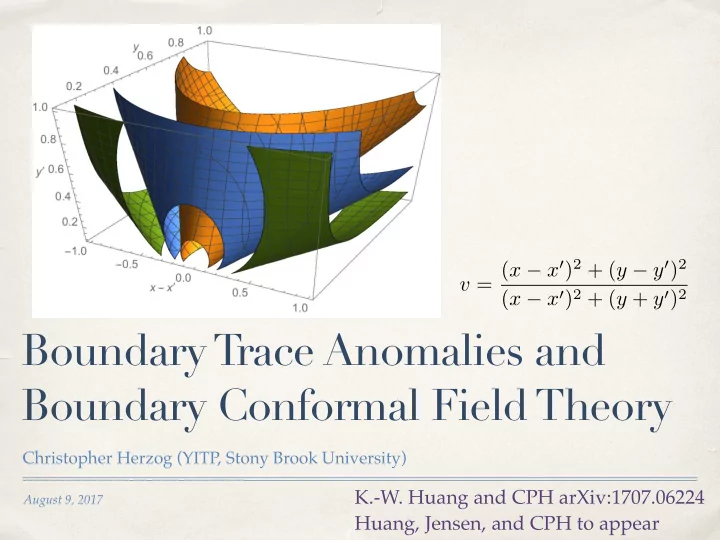
v = ( x x 0 ) 2 + ( y y 0 ) 2 ( x x 0 ) 2 + ( y + y 0 ) 2 Boundary T race Anomalies and Boundary Conformal Field Theory Christopher Herzog (YITP, Stony Brook University) K.-W. Huang and CPH arXiv:1707.06224 August 9, 2017


slide-1
SLIDE 1

August 9, 2017

Christopher Herzog (YITP, Stony Brook University)

Boundary T race Anomalies and Boundary Conformal Field Theory

v = (x − x0)2 + (y − y0)2 (x − x0)2 + (y + y0)2

K.-W. Huang and CPH arXiv:1707.06224 Huang, Jensen, and CPH to appear

slide-2
SLIDE 2

Outline

✤ Why bCFT? ✤ Review of trace anomalies and especially boundary

contributions.

✤ New results: relations between boundary trace anomalies

and two and three point functions of the displacement

  • perator.

✤ Demonstration that the b2 charge can depend on marginal

couplings.

slide-3
SLIDE 3

What do D-branes, AdS/CFT, topological insulators, and entanglement entropy for field theories have in common?

A B

slide-4
SLIDE 4

What do D-branes, AdS/CFT, topological insulators, and entanglement entropy for field theories have in common? The importance of boundaries.

A B

slide-5
SLIDE 5

01

D-branes

✤ Boundary conditions for open

strings

✤ Non-perturbative insight into

string theories led to the second superstring revolution and the realization that the different string theories were part of one larger structure Polchinski ’89-‘95

slide-6
SLIDE 6

01

AdS/CFT

✤ Conformal boundary of anti-de

Sitter space is where the conformal field theory “lives”.

✤ Myriad developments —

quantum gravity, strongly coupled field theories, black holes, … — perhaps best summarized by the fact that Maldacena’s original paper now has over 15,000 citations.

slide-7
SLIDE 7

01

Topological Insulators

✤ The insulating bulk material

has conducting surface states that are protected by symmetry

✤ Predicted in the late 80s for

time reversal symmetry

(Pankratov, Pakhomov, Volkov),

the effects were first observed in real materials in 2007 (Konig,

Wiedmann, et al.) and have now

been studied and seen in many

  • ther shapes and forms as well.
slide-8
SLIDE 8

01

Entanglement Entropy

✤ In field theory, entanglement is

  • ften measured with respect to

spatial regions, leading to the importance of the “entangling surface”

✤ Led to new proofs of the “a” and

“c” theorems for renormalization group flow of field theories in 2 and 4 dimensions. Also given a new perspective to black hole physics.

A B

slide-9
SLIDE 9

Would all of these developments have been “obvious” if we just understood quantum field theory in the presence of a boundary a little better to begin with?

slide-10
SLIDE 10

Boundary Conformal Field Theory

✤ Surprisingly unexplored. McAvity and Osborn ’93

and ’95 papers on two point functions have fewer than 100 citations each.

✤ Flat space: A planar boundary breaks the SO(d,2)

symmetry to SO(d-1,2).

✤ Curved space: Require that the boundary and

boundary terms in the action preserved Weyl invariance.

slide-11
SLIDE 11

Stress Tensor T race

classically, Weyl invariance implies ) T µ

µ = 0

given rµT µν = 0 Jµ = xνT νµ; rµJµ = 0 quantum mechanically, there are anomalies… Today’s talk: To understand new terms in the trace anomaly associated with the presence of a boundary. A quick review:

slide-12
SLIDE 12

T race Anomaly in 2d (no boundary)

✤ c is also the coefficient of the Tµn two-point function. ✤ Zamolodchikov c-theorem (’86), ✤ Huerta-Casini (’04) entanglement entropy proof of c-

theorem

hT µ

µi =

c 24π R cUV > cIR —towards a map of 2d QFTs Ricci scalar curvature

slide-13
SLIDE 13

T race Anomaly in 4d (no boundary)

✤ c is also the coefficient of the Tµn two-point function. ✤ Cardy (’88) a-conjecture and later Komargodski-

Schwimmer proof (’11)

✤ Casini-Teste-Torroba (’17) entanglement entropy proof

  • f a-theorem

—towards a map of 4d QFTs hT µ

µi =

1 16π2 (cW 2 aE.D. + d⇤R) Euler density scheme dependent, ignore aUV > aIR Weyl curvature

slide-14
SLIDE 14

T race Anomaly in 6d (no boundary)

hT µ

µi ⇠ a E.D. + c1W 3 + c2W 3 + c3W⇤W

hints from supersymmetry of a 6d a-theorem

slide-15
SLIDE 15

T race Anomaly with a Codimension One Boundary

2D 4D 6D 3D 5D hT µ

µi ⇠ δ(x⊥)(b1W 2 + b2K4 + . . .)

hT µ

µi ⇠ a E.D. + c1W 3 + c2W 3 + c3W⇤W + δ(x⊥)(b1KW 2 + . . .)

Jensen-O’Bannon (’15) b-theorem Solodukhin-Fursaev (’16) conjecture

hT µ

µi =

c 24π (R + 2Kδ(xn)) hT µ

µi = 1

4π (aR + b tr ˆ K2)δ(xn) hT µ

µi =

1 16π2 (cW 2 aE.D. + (b1 tr ˆ K3 + b2KABWnAnB)δ(xn)) b2 = 8c aUV > aIR KAB extrinsic curvature hat on K removes trace

slide-16
SLIDE 16

Today’s Talk

Can we say anything more about 3d 4d aR b tr ˆ K2 b1 tr ˆ K3 b2KABWAnBn no yes yes yes Related to displacement operator two and three point functions

slide-17
SLIDE 17

Displacement Operator

definition: operator sourced by small changes in the embedding δI δxn ≡ Dn diffeomorphism Ward identity: ∂µT µn = Dnδ(xn) ∂µT µA = 0 tangential components still conserved

T nn Dn

pill box argument implies

T nn(~ x, xn)|xn=0 = Dn(~ x)

slide-18
SLIDE 18

Results

3d 4d aR b tr ˆ K2 b1 tr ˆ K3 b2KABWAnBn ??? b = π2 8 cnn hDn(~ x)Dn(0)i = cnn |~ x|2d hDn(~ x)Dn(~ x0)Dn(0)i = cnnn |~ x|d|~ x0|d|~ x ~ x0|d b1 = 2π3 35 cnnn b2 = 2π4 15 cnn Argument analogous to Osborn and Petkou’s result for c in 4d. (Fails for a in 3d because R is topological.) plan:

  • where do these results

come from?

  • what about ?

b2 = 8c

slide-19
SLIDE 19

in 3d b tr ˆ K2

The term in the trace anomaly can be produced from an effective anomaly action in limit e goes to zero where µ is a UV regulator: I(b) = b 4⇡ µ✏ ✏ Z

@M

tr ˆ K2 For small deviations from planarity KAB ≈ ∂A∂Bxn = ⇒ scale dependence of displacement 2-pt function µ@µhDn(~ x)Dn(0)i = b 4⇡ ⇤2(~ x) hDn(~ x)Dn(0)i = cnn |~ x|6 hDn(~ x)Dn(0)i = cnn 512⇤3(log µ2~ x2)2 The short distance behavior of can be regulated by writing instead

(Freedman, Johnson, Latorre ’92)

slide-20
SLIDE 20

in 4d b1 tr ˆ K3

I(b1) = b1 16⇡2 µ✏ ✏ Z

@M

tr ˆ K3 hDn(~ x)Dn(~ x0)Dn(0)i = cnnn |~ x|d|~ x0|d|~ x ~ x0|d Analogous to b in 3d. Now we need to match scale dependent contributions of and scale dependence of 3-pt function relies on recent work by Bzowski, Skenderis, and McFadden ‘13

slide-21
SLIDE 21

in 4d b2KABWnAnB

Could extract from hDniW 6=0 We’ll do something more roundabout. I(c) = c 16⇡2 µ✏ ✏ Z

M

W 2 We will cancel δ2I(b2) δgµνδgλρ δ2I(c) δgµνδgλρ against a boundary term in I(b2) = b2 16⇡2 µ✏ ✏ Z

@M

KW An order of limits issue spoils the naive relation between b2 and c.

slide-22
SLIDE 22

Aside on Stress Tensor 2-point function with boundary

Depends on a function a(v) of a cross ratio v = (x − x0)2 (x − x0)2 + 4xnx0n hTµν(x)Tρσ(x0)i = 1 (x x0)8 ✓4α 3 Iµν,ρσ + (v2∂2

vα)ˆ

Iµν,ρσ 1 6(v∂vα)(ˆ βµν,ρσ + 7ˆ Iµν,ρσ) ◆ same tensor structure that appears in absence of a boundary ˆ Iµν,ρσ ˆ βµν,ρσ precise form of and not so important essential point is that they can’t cancel the b2 boundary term v → 1 v → 0 : boundary limit : coincident limit

slide-23
SLIDE 23

in 4d (part 2) b2KABWnAnB

I(c) = c 16⇡2 µ✏ ✏ Z

M

W 2 is valid in the coincident limit. To reproduce the scale dependence of the 2-pt function in the boundary limit, , we should use this effective action with a different value of c, in order to match to a(1). v → 1 δ2I(b2) δgµνδgλρ δ2I(c) δgµνδgλρ Canceling against then leads to a relation between a(1), i.e. cnn, and b2.

slide-24
SLIDE 24

Checks for Free Fields

Using heat kernel methods, a number of these charges were computed for free fields in the late 80s and early 90s

(Melmed, Moss, Dowker, Schofield) and later revisited in the

last couple of years (Solodukhin, Fursaev, Jensen, Huang, CPH). bs=0 = 1 64 (D or R) , bs= 1

2 = 1

32 , b2 = 8c bs=0

1

= 2 35(D) , bs=0

1

= 2 45(R) , b

s= 1

2

1

= 2 7 , bs=1

1

= 16 35 , The displacement operator correlation functions yield the same results!

slide-25
SLIDE 25

Why is for free fields? b2 = 8c

For free theories theory without boundary effect of image points on other side

  • f the boundary

= ⇒ 2α(0) = α(1)

v → 1 v → 0 : boundary limit : coincident limit by the old Osborn-Petkou (’93) argument α(0) ∼ c α(v) ∼ 1 + v2d

slide-26
SLIDE 26

What about interactions?

Wilson-Fisher fixed point for f4 scalar field theory, starting in 4d McAvity and Osborn (’93, ’95) showed, both in the e expansion and in a large N expansion that 2α(0) 6= α(1) Downside: We need to be in exactly 4d to connect to b2, and in exactly 4d f4 scalar field theory is free We need some more examples…

slide-27
SLIDE 27

Mixed Dimensional QED

S = −1 4 Z

M

d4x F µνFµν + Z

∂M

d3x(i ¯ ψ / Dψ) FnA = g ¯ ψγAψ Dµ = rµ igAµ where boundary conditions:

  • relation to graphene
  • b-function for g vanishes perturbatively
  • behavior under electric-magnetic duality (Son ’17)
  • relation to large Nf QED3 (Kotikov-Teber ’13)

Gorbar, Gusynin, Miransky ‘01 S.-J. Rey ‘07 Kaplan, Lee, Son, Stephanov ‘09

  • S. Teber ‘12
slide-28
SLIDE 28

Mixed Dimensional QED

S = −1 4 Z

M

d4x F µνFµν + Z

∂M

d3x(i ¯ ψ / Dψ) FnA = g ¯ ψγAψ Dµ = rµ igAµ where boundary conditions:

  • relation to graphene
  • b-function for g vanishes perturbatively
  • behavior under electric-magnetic duality (Hsiao, Son ’17)
  • relation to large Nf QED3 (Kotikov-Teber ’13)

Gorbar, Gusynin, Miransky ‘01 S.-J. Rey ‘07 Kaplan, Lee, Son, Stephanov ‘09

  • S. Teber ‘12
slide-29
SLIDE 29

Mixed QED is a bCFT

The usual Ward identity for QED relates Zψ = Zg The superficial degree of divergence of the photon self energy is one (compared with two in four dimensional QED). The gauge invariant prefactor pµpν − δµνp2 Πµν(p)

  • f

cuts down the degree of divergence to -1. In other words, Zγ is finite. coupling is not perturbatively renormalized. = ⇒

slide-30
SLIDE 30

Perturbative corrections to a(1)

hAA(x)AB(x0)i = AB ✓ 1 (x x0)2 + 1 (~ x ~ x0)2 + (y + y0)2 ◆ In standard Feynman gauge, for Maxwell theory with a boundary The coupling to the boundary produces a small change (Neumann boundary condition for tangential components.) hAA(x)AB(x0)i = AB ✓ 1 (x x0)2 + 1 O(g2) (~ x ~ x0)2 + (y + y0)2 ◆ = ⇒ α(1) = α(0)(2 − O(g2)) For the stress tensor two point function

slide-31
SLIDE 31

Marginal Directions

a(1) and hence b2 depended on the exactly marginal coupling. Unlike the situation for the bulk charges a and c in 4d. Wess-Zumino consistency forces a to be constant along marginal directions. No such argument for c. However, SUSY fixes c to be a constant, and it’s unknown how to construct 4d CFTs with marginal directions but without SUSY.

slide-32
SLIDE 32

Summary of results

✤ Related boundary central charges in three and four

dimensional bCFTs to two and three point functions of the displacement operator.

✤ Argued that in 4d, the relation b2 = 8c is special to free

theories

✤ Discussed mixed dimensional QED as an example

where b2 = 8c and where b2 depends on a marginal coupling.

b tr ˆ K2 b1 tr ˆ K3 b2KABWAnBn

slide-33
SLIDE 33

Future Projects

✤ Verify our proposal for b2 by computing it directly, for mixed QED in

a curved space-time.

✤ Higher codimension defects. (Billo, Goncalves et al. ’16) ✤ Find bounds on these boundary central charges. (Hofman-Maldacena ‘08) ✤ Computation of these central charges in AdS/CFT, for example in

Janus solutions. (Takayanagi ’11, Miao et al., Astaneh et al. ’17)

✤ Models with only boundary interactions, like mixed QED. ✤ Boundary bootstrap. (Liendo et al. ‘12)

slide-34
SLIDE 34

Larger Vision: Structure of QFT

✤ Constrain QFT by constraining CFTs ✤ Provide a more local view of QFT by figuring out how

to deal with boundaries.

slide-35
SLIDE 35

Extra Slides

bubuzuke

slide-36
SLIDE 36

Connection To Entanglement Entropy

A B ` SE = ↵Area(@A) d−2 + . . . + 4a(−1)d/2 ln ` + . . . UV cutoff

(Solodukhin 2008; Casini-Huerta-Myers 2011)

ball entanglement entropy and a ρA = trB ρ SE = − tr(ρA log ρA) where and H = HA × HB critically, assumes factorization of Hilbert space: a more local way to thinking about physics

slide-37
SLIDE 37

Importance of Boundaries

result fails for a Maxwell field in 4d — Hilbert space doesn’t factorize across the boundary of A (Trivedi, Wall, Donnelly, Huang, Dowker,…) failure of perturbative corrections to SE for free scalar (Herzog, Nishioka) Resolution: Free scalar requires an extra boundary term. SE = ↵Area(@A) d−2 + . . . + 4a(−1)d/2 ln ` + . . .

✤ small mass ✤ small temperature ✤ anomalous dimensions of twist operators