Fluid models from multi-fluid to resistive MHD Alec Johnson Centre - - PowerPoint PPT Presentation

fluid models from multi fluid to resistive mhd alec
SMART_READER_LITE
LIVE PREVIEW

Fluid models from multi-fluid to resistive MHD Alec Johnson Centre - - PowerPoint PPT Presentation

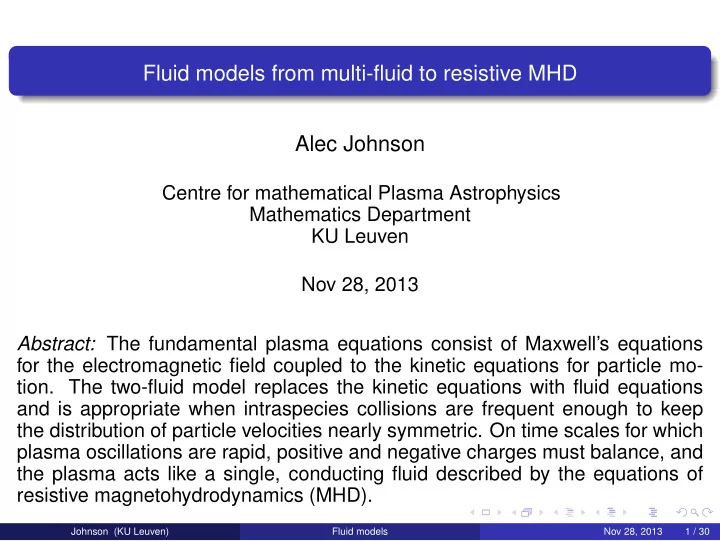
Fluid models from multi-fluid to resistive MHD Alec Johnson Centre for mathematical Plasma Astrophysics Mathematics Department KU Leuven Nov 28, 2013 Abstract: The fundamental plasma equations consist of Maxwells equations for the


slide-1
SLIDE 1

Fluid models from multi-fluid to resistive MHD Alec Johnson

Centre for mathematical Plasma Astrophysics Mathematics Department KU Leuven Nov 28, 2013 Abstract: The fundamental plasma equations consist of Maxwell’s equations for the electromagnetic field coupled to the kinetic equations for particle mo-

  • tion. The two-fluid model replaces the kinetic equations with fluid equations

and is appropriate when intraspecies collisions are frequent enough to keep the distribution of particle velocities nearly symmetric. On time scales for which plasma oscillations are rapid, positive and negative charges must balance, and the plasma acts like a single, conducting fluid described by the equations of resistive magnetohydrodynamics (MHD).

Johnson (KU Leuven) Fluid models Nov 28, 2013 1 / 30

slide-2
SLIDE 2

Outline

1 Vlasov: fluid in phase space 2 Presentation of plasma models 3 Derivation of plasma models 4 MHD Johnson (KU Leuven) Fluid models Nov 28, 2013 2 / 30

slide-3
SLIDE 3

Conservation law framework

Quantities: t = time X = position U(t, X) = balanced quantity F(t, X) = flux function (e.g. F(U)). S(t, X) = 0 (no production of U). Definitions: Ω = arbitrary region dΩ: volume element dt dΩS: production in volume element

  • n = outward unit vector

dA = ndA: surface element dt dA · F(t, X) = flux of U out of surface element. To see that flux is linear in dA, consider that Ω can be approximated by a set of cells in a rectangular grid. dt dA1F1 gives flux across face perpendicular to first axis; dA1 is area of projection of surface element onto first axis. Note: F = T in picture. Balance law: (∀Ω)

  • ΩU(t1) −
  • ΩU(t0)

= −

  • ∂ΩdA ·

t1

t0F

⇐ ⇒ (∀Ω) dt

  • ΩU = −
  • ∂Ω

dA · F ⇐ ⇒ (∀Ω)

(∂tU + ∇ · F) = 0 ⇐ ⇒ ∂tU + ∇ · F = 0 .

Johnson (KU Leuven) Fluid models Nov 28, 2013 3 / 30

slide-4
SLIDE 4

Balance law framework

Quantities: t = time X = position U(t, X) = balanced quantity F(t, X) = flux function (e.g. F(U)). S(t, X) = production of U. Definitions: Ω = arbitrary region dΩ: volume element dt dΩS: production in volume element

  • n = outward unit vector

dA = ndA: surface element dt dA · F(t, X) = flux of U out of surface element. To see that flux is linear in dA, consider that Ω can be approximated by a set of cells in a rectangular grid. dt dA1F1 gives flux across face perpendicular to first axis; dA1 is area of projection of surface element onto first axis. Note: F = T in picture. Balance law: (∀Ω)

  • ΩU(t1) −
  • ΩU(t0)

= −

  • ∂ΩdA ·

t1

t0F +

t1

t0S

⇐ ⇒ (∀Ω) dt

  • ΩU = −
  • ∂Ω

dA · F +

  • ΩS

⇐ ⇒ (∀Ω)

(∂tU + ∇ · F − S) = 0 ⇐ ⇒ ∂tU + ∇ · F = S .

Johnson (KU Leuven) Fluid models Nov 28, 2013 4 / 30

slide-5
SLIDE 5

Transport Derivatives

Given: t = time X = position V(t, X) = velocity field α(t, x) = arbitrary function ρ(t, x) = density convected by V dt := d

dt

δtα := ∂tα + ∇ · (Vα) = “transport derivative” of α. dtα := ∂tα + V · ∇α = material derivative of α. Properties: δtα = dtα + α∇ · V . δt(αβ) = dt(αβ) + (∇ · V)αβ = (dtα)β + α(dtβ) + (∇ · V)αβ = (δtα)β + α(dtβ). δt(ρβ) = ρdtβ . Conservation of transported material: ρ(t, x) is transported by V ⇐ ⇒ F := Vρ is a flux for ρ ⇐ ⇒ ∂tρ + ∇ · (Vρ) = 0 ⇐ ⇒ δtρ = 0 ⇐ ⇒ dtρ + ρ∇ · V = 0 ⇐ ⇒ dt ln ρ = −∇ · V. Incompressible flow: V is incompressible ⇐ ⇒ dtρ = 0 ⇐ ⇒ dt ln ρ = 0 ⇐ ⇒ ∇ · V = 0 ⇐ ⇒ dtα = δtα (∀α).

Johnson (KU Leuven) Fluid models Nov 28, 2013 5 / 30

slide-6
SLIDE 6

Vlasov equation

Given: x: position v = . x: velocity a = . v: acceleration ˜ fs: number distribution of species s. ˜ fs(t, x, v)dxdv: number of particles of species s in a region of state space with volume dxdv. ms: particle mass of species s qs: particle charge of species s fs = ms˜ fs: mass distribution of species s. as = qs

ms (E + v × B): Lorentz acceleration.

X := (x, v): position in state space. V := . X = (v, as): velocity in state space. (v × B)i =

j

  • k ǫijkvjBk (cross product)

ǫijk: Levi-Civita symbol We suppress the species index s when focusing

  • n one species.

Theorem: Lorentz acceleration implies incompressible flow in phase space. Incompressible means ∇X · V = 0. ∇X · V = ∇x · v + ∇v · a ∇x · v = 0 because x and v are independent variables. ∇v · E(t, x) = 0 for same reason. So ∇v · a = q

m ∂ ∂vi ǫijkvjBk(t, x) = 0.

Vlasov equation (conservation of particles): f(t, X) is transported by V ⇐ ⇒ ∂tf + ∇X · (Vf) = 0 ⇐ ⇒ ∂tf + ∇x · (vf) + ∇v · (af) = 0 (conservation form) ⇐ ⇒ ∂tf + v · ∇xf + a · ∇v · f = 0 ⇐ ⇒ ∂tf + V · ∇Xf = 0 Remark: conservation form is preferred for taking fluid moments.

Johnson (KU Leuven) Fluid models Nov 28, 2013 6 / 30

slide-7
SLIDE 7

Outline

1 Vlasov: fluid in phase space 2 Presentation of plasma models 3 Derivation of plasma models 4 MHD Johnson (KU Leuven) Fluid models Nov 28, 2013 7 / 30

slide-8
SLIDE 8

kinetic-Maxwell and the fluid limit

Kinetic-Maxwell: particle equations: dtxp = vp, dtvp = e

q#

p

mp (vp × B(xp) + E(xp)) + r

electromagnetic field: ∂tB + ∇ × E = 0, −c−2∂tE + ∇ × B = µ0J, ∇ · B = 0, c−2∇ · E = µ0σ. charge-weighted moments: σ(x) := e

pSp(x − xp)q# p ,

J(x) := e

pSp(x − xp)q# p vp.

Plugging ˙ vp = qp

mp (vp × B + E) into the

time-derivative of mass (

pSpmp),

momentum (

pvpSpmp), and energy

(

p 1 2 v2 p Spmp) density yields gas (i.e.

fluid) equations. Fluid approximation: ∂tρ + ∇ · (ρu) = 0 (mass), ρdtu + ∇p + ∇ · P◦ = J × B + σE + R (momentum), dtp + γp∇ · u + P◦ : ∇u + ∇ · q = 0 (energy), where we have used the definitions σ := qS, ρ := mS, R := rmS, J := vqS, ρu := vmS, c := v − u, p := 1

3

c2mS, P := ccmS, P◦ := P − pI, with the abbreviations m := mp, q := eq#

p ,

S := Sp(x − xp), :=

p,

and the chain rule ∂tS = −v · ∇S. Assuming that particle velocities for each species have a symmetric distribution implies P◦

s = 0 and qs = 0,

giving Euler gas dynamics for each species, hence the ideal two-fluid Maxwell plasma model.

Johnson (KU Leuven) Fluid models Nov 28, 2013 8 / 30

slide-9
SLIDE 9

Modeling parameters

Physical constants that define an ion-electron plasma:

1

e (charge of proton),

2

mi, me (ion and electron mass),

3

c (speed of light),

4

µ0 (vacuum permeability). MHD parameters that characterize the state of a plasma:

1

n0 (typical particle density),

2

T0 (typical temperature),

3

B0 (typical magnetic field). Derived typical quantities: p0 := n0T0 (thermal pressure) pB :=

B2 2µ0 (magnetic pressure)

ρs := n0ms (mass density). Collision periods: τs: period of relaxation of species s toward Maxwellian Collisionless time, velocity, and space scale parameters: plasma frequencies: ω2

p,s := µ0n0(ce)2

ms , gyrofrequencies: ωg,s := eB0 ms , thermal velocities: v2

t,s := 2p0

ρs , Alfv´ en speeds: v2

A,s := 2pB

ρs = B2 µ0msn0 , Debye length: λD := vt,s ωp,s =

  • T0

n0µ0(ce)2 , gyroradii: rg,s := vt,s ωg,s = msvt,s eB0 , skin depths: δs := vA,s ωg,s = c ωp,s =

  • ms

µ0nse2 . plasma β := p0 pB =

vt,s

vA,s

2 = rg,s

δs

2.

non-MHD ratio: c vA,s = rg,s λD = ωp,s ωg,s .

Johnson (KU Leuven) Fluid models Nov 28, 2013 9 / 30

slide-10
SLIDE 10

Plasma model hierarchy

1

kinetic-Maxwell    fast collisions (τs−1 → ∞)

2

ideal two-fluid Maxwell: Euler gas for each species: ρs, us, ps    fast oscillations (e → ∞)

3

relativistic ideal MHD: perfectly conducting gas    fast light waves (c → ∞)

4

classical ideal MHD: perfectly conducting gas: E = B × u.

Johnson (KU Leuven) Fluid models Nov 28, 2013 10 / 30

slide-11
SLIDE 11

two-fluid Maxwell → MHD

Two-fluid Maxwell:

gas evolution: ∂tρs + ∇ · (ρsus) = 0, ρsds

t us + ∇ps = Js × B + σsE + Rs,

ds

t ps + γps∇ · us = 2 3 mred ms Q

electromagnetic field: ∂tB + ∇ × E = 0, −c−2∂tE + ∇ × B = µ0J, ∇ · B = 0, c−2∇ · E = µ0σ, J := Ji + Je, Js := σsus, σ := σi + σe, σs := ± e

ms ρs.

closure: −Ri = Re = e2neniη · (ui − ue) ≈ enη · J, Q = −

sRs · us ≈ J · η · J.

Quasi-relativistic MHD (e → ∞):

gas evolution: ∂tρ + ∇ · (ρu) = 0 (mass), ρdtu + ∇p = J × B + σE (momentum), dtp + γp∇ · u = 2

3 J · η · J

(thermal energy). magnetic field: ∂tB + ∇ × E = 0 (magnetic field), E = B × u + η · J (Ohm’s law), ∇ · B = 0 (divergence constraint), µ0J := ∇ × B − c−2∂tE (Ampere’s law for current), µ0σ := c−2∇ · E (quasineutrality). definitions: ds

t := ∂t + us · ∇,

dt := ∂t + u · ∇, γ := 5

3 ,

m−1

red :=

  • s

m−1

s

.

Johnson (KU Leuven) Fluid models Nov 28, 2013 11 / 30

slide-12
SLIDE 12

two-fluid Maxwell → MHD

Two-fluid Maxwell:

gas evolution: ∂tρs + ∇ · (ρsus) = 0, ρsds

t us + ∇ps = Js × B + σsE + Rs,

ds

t ps + γps∇ · us = 2 3 mred ms Q

electromagnetic field: ∂tB + ∇ × E = 0, −c−2∂tE + ∇ × B = µ0J, ∇ · B = 0, c−2∇ · E = µ0σ, J := Ji + Je, Js := σsus, σ := σi + σe, σs := ± e

ms ρs.

closure: −Ri = Re = e2neniη · (ui − ue) ≈ enη · J, Q = −

sRs · us ≈ J · η · J.

Classical MHD (e → ∞, c → ∞):

gas evolution: ∂tρ + ∇ · (ρu) = 0 (mass), ρdtu + ∇p = J × B (momentum), dtp + γp∇ · u = 2

3 J · η · J

(thermal energy). magnetic field: ∂tB + ∇ × E = 0 (magnetic field), E = B × u + η · J (Ohm’s law), ∇ · B = 0 (divergence constraint), µ0J := ∇ × B (Ampere’s law for current), µ0σ := 0 (neutrality). definitions: ds

t := ∂t + us · ∇,

dt := ∂t + u · ∇, γ := 5

3 ,

m−1

red :=

  • s

m−1

s

.

Johnson (KU Leuven) Fluid models Nov 28, 2013 12 / 30

slide-13
SLIDE 13

Outline

1 Vlasov: fluid in phase space 2 Presentation of plasma models 3 Derivation of plasma models 4 MHD Johnson (KU Leuven) Fluid models Nov 28, 2013 13 / 30

slide-14
SLIDE 14

kinetic-Maxwell (the “truth”)

particle evolution: dtxp = vp, dtvp = ap(xp, vp), ap = qp

mp (vp × B(xp) + E(xp)) + rp.

electromagnetic field: ∂tB + ∇ × E = 0, −c−2∂tE + ∇ × B = µ0J, ∇ · B = 0, c−2∇ · E = µ0σ. charge-weighted moments: σ(x) :=

pSp(x)qp,

J(x) :=

pSp(x)qpvp;

here Sp(x) = S(x − xp) is the shape function of particle p, xp is its position, vp is its velocity, rp is collisional drag, E is electric field, B is magnetic field, J is current, and σ is charge density. Collisional drag. The term rp can be used to incorporate gravitational acceleration, but in this context we introduce rp to account for microscale interactions not accounted for by macroscale smoothed versions of the electromagnetic field. Collisional drag must conserve momentum and energy:

  • rpmpSp = 0

(momentum),

  • rp · vpmpSp = 0

(energy). (1)

Collision operator [aside]. For each species s, specifying r is equivalent to specifying a collision operator C. Indeed, requiring the collisional Vlasov equation ∂t f + ∇ · (vf) + ∇v · (af) = C to agree with the “drag force” Vlasov equation ∂t f + ∇ · (vf) + ∇v · ((a + r)f) = 0 reveals that −∇v · (rf) = C must hold; to solve, set rf = ∇φ, where −∇2

vφ = C. Johnson (KU Leuven) Fluid models Nov 28, 2013 14 / 30

slide-15
SLIDE 15

kinetic-Maxwell and moments

particle evolution: dtxp = vp, dtvp = ap(xp, vp), ap = qp

mp (vp × B(xp) + E(xp)) + rp. (2)

electromagnetic field: ∂tB + ∇ × E = 0, −c−2∂tE + ∇ × B = µ0J, ∇ · B = 0, c−2∇ · E = µ0σ. charge-weighted moments: σ(x) :=

pSp(x)qp,

J(x) :=

pSp(x)qpvp;

here Sp(x) = S(x − xp) is the shape function of particle p, xp is its position, vp is its velocity, rp is collisional drag, E is electric field, B is magnetic field, J is current, and σ is charge density. Fluid models evolve mass-weighted moments: ρ(x) :=

pmpSp(x)

(mass), M(x) :=

pvpmpSp(x)

(momentum), E(x) :=

p 1 2|vp|2mpSp(x)

(energy), To abbreviate we drop the particle summation index p and the independent variable x and write σ := qS (charge), ρ := mS (mass), J := vqS (current), M := vmS (momentum), E := 1

2 |v|2mS

(energy). To get fluid equations, differentiate and use: ˙ v = q

m (E + v × B) + r

∂tS(x − xp(t)) = −˙ vp · ∇S(x − xp), i.e., ∂tS = −v · ∇S .

Johnson (KU Leuven) Fluid models Nov 28, 2013 15 / 30

slide-16
SLIDE 16

Moment evolution: from kinetic to fluid

Given definitions: χ(v) =    1 zeroth moment v first moment v2 second moment χ :=

  • χmS
  • mS

(statistical mean of χ). ρ := mS (mass density) ρχ :=

  • χmS .

(generic moment) u := v (fluid velocity) c := v − u (thermal velocity) δtα := ∂tα + ∇ · (uα) (“transport derivative”). dtα := ∂tα + u · ∇α. (advective derivative). M = ρu (momentum). subscript s restricts sums to particles of species s. ns =

p∈s Sp = 1 ms ρs (number

density)

Generic mass moment evolution: ∂t χmS =

  • χm∂tS +
  • ˙

χmS ⇐ ⇒ ∂t(ρχ) +

  • χv · m∇S =
  • ˙

χmS ⇐ ⇒ ∂t(ρχ) + ∇·vχmS = ˙ v · ∇vχmS ⇐ ⇒ ∂t(ρχ) + ∇ · (ρvχ) = ρ˙ v · ∇vχ ⇐ ⇒ δt(ρχ) + ∇ · (ρcχ) = ρa · ∇vχ ; (3) in the last step we have used that vχ = (u + c)χ = uχ + cχ and δt(ρχ) = ∂t(ρχ) + ∇ · (uχ). Mass continuity. (χ = 1). If χ = 1, then cχ = c = 0 and ∇vχ = 0, so we simply get δtρ = 0, that is, ∂tρ + ∇ · (uρ) = 0. Exercise: Using mass continuity, show that δt(ρχ) = ρdtχ.

Johnson (KU Leuven) Fluid models Nov 28, 2013 16 / 30

slide-17
SLIDE 17

Continuity equations

Charge continuity. Differentiating the definition of charge density gives ∂tσ = ∂t qS = −v · q∇S = −∇ · vqS, i.e., the flux of charge is the current: ∂tσ + ∇ · J = 0. Mass continuity (again). Replacing q with m in charge density evolution shows that mass flux coincides with the (classical) definition of momentum: ∂tρ + ∇ · (uρ) = 0 , (4) that is (restricting to species s), ∂tρs + ∇ · (usρs) = 0; dividing by ms gives continuity of number density ns = ρs/ms for species s: ∂tns + ∇ · (usns) = 0 . Vlasov equation [aside].

The Vlasov equation is simply the continuity equation in six-dimensional phase-space. To see this: Use X = (x, v) to denote a point in phase space. Use V = ˙ X = (v, a) to denote velocity in phase space. Write the particle distribution function (for a species of particles) as the sum

  • f particle shape

functions: f =

pSp.

Observe that V(X), i.e. the fluid is “cold.” Assume that the shape of a particle in phase space is a delta function (unit spike): Sp(X) = δ(X − Xp).

Then the continuity equation ∂tns + ∇ · (usns) = 0 becomes the Vlasov equation ∂tfs + ∇X · (Vsfs) = 0, i.e., ∂tf + ∇x· (vf) + ∇v· (af) . In gory detail: −∂tf = −

p∂tSp

=

pVp · ∇XSp

= ∇X ·

pVpSp

= ∇X ·

pV(Xp)δ(X − Xp)

= ∇X ·

pV(X)δ(X − Xp)

= ∇X·

  • V(X)

pδ(X − Xp)

  • = ∇X · (V(X)f)

= ∇x · (vf) + ∇v · (af) = v · ∇xf + a · ∇vf, where the last step follows from the incompressibility condition ∇v · a = 0.

Johnson (KU Leuven) Fluid models Nov 28, 2013 17 / 30

slide-18
SLIDE 18

Taking moments: momentum density evolution

Given definitions: u := v (bulk velocity) c := v − u (thermal velocity) M := ρu (momentum) R := rmS (collisional drag) P := ρcc (pressure tensor) p := 1

3ρ|c|2 (pressure)

P◦ := P − p I (deviatoric pressure) δs

tα := ∂tα + ∇ · (usα)

(“transport derivative” for us). Remarks: If restricting to species s, then denote quantities as us, Rs, etc. Including all particles, the drag force cancels: R =

s Rs = 0.

P◦ = 0 if the distribution of particle velocities is isotropic (the same in all directions). Momentum balance (χ = v): Recall generic moment evolution (Eqn. (3)): δt(ρχ) + ∇x · (ρcχ) = ρa · ∇vχ Observe that c = 0 (since c = v − u and v = u). So vv = (u + c)(u + c) = uu + uc + cu + cc. That is, vv = uu + P. Thus, since ∇v · v = I, δt(ρu) + ∇ · P = ρa. But a = q

m (E + u × B). Thus:

δt(ρu) + ∇ · P = σE + J × B + R . (5) Kinetic energy balance for species s equals momentum balance dot u: δs

t(ρs 1 2 |us|2) + us · (∇ · Ps) = Js · E + Rs · us

Johnson (KU Leuven) Fluid models Nov 28, 2013 18 / 30

slide-19
SLIDE 19

Taking moments: energy

Given definitions: E := ρ 1

2 v2 (energy density)

P := ρcc (pressure tensor) q := ρ 1

2 c|c|2 (heat flux)

Q := r · c (collisional heating) Relationships: energy = kinetic plus thermal: |v|2 = |u|2 + |c|2, i.e., ρ 1

2 |v|2 = ρ 1 2 |u|2 + ρ 1 2 |c|2.

pressure is 2

3 the thermal energy:

p := 1

3 ρ|c|2, so E = 1 2 ρ|u|2 + 3 2 p.

Remarks: If restricting to species s, write e.g. Qs. Including all particles, collisional energy production cancels: r · vmS = 0, i.e., R · u + Q =

s(Rs · us + Qs) = 0

q = 0 if the distribution of particle velocities is symmetric. Energy balance (χ = 1

2 |v|2):

Recall generic moment evolution (Eqn. (3)): ρdtχ + ∇x · (ρcχ) = ρa · ∇vχ For χ = 1

2v · v, using that:

ρ 1

2 cv · v = ρcc · u + ρ 1 2 cc · c = P · u + q,

ρa · v = ρ q

m E · v = E · q m ρu = E · J

(that is, a · v = a · v), and r · vmS = r · umS + r · cmS = R · u + Q,

δtE + ∇ · (P · u + q) = J · E + R · u + Q (6) Thermal energy balance for species s: Recall kinetic energy balance: δs

t(ρs 1 2 |us|2) + us · (∇ · Ps) = Js · E + Rs · us

Thermal energy balance equals energy balance minus kinetic energy balance: δs

t(ρs 1 2 |cs|2) + Ps : ∇us + ∇ · qs = Qs

Johnson (KU Leuven) Fluid models Nov 28, 2013 19 / 30

slide-20
SLIDE 20

Conserved moment evolution

Full fluid equations (one species): Gathering together equations (4), (5), and (6) and re- stricting to species s, we have a system of balance laws for the mass(1) + momentum(3) + energy(1) = 5 conserved moments: δs

tρs

= 0 δs

t(ρsus) + ∇ · Ps

= σsE + Js × B + Rs δs

tEs

+ ∇ · (Ps · us + qs) = Js · E + Rs · us + Qs (7) MHD fluid equations: The bulk fluid quantities of MHD are defined by ρ := ρi + ρe, ρu := ρiui + ρeue, E := Ei + Ee. One-fluid MHD assumes that the fluid velocity is the same for all species: ui ≈

  • ue. In this case, summing

each equation in System (7) over ions (s = i) and electrons (s = e) gives the MHD equations, which are exactly the same but with-

  • ut the subscript s. The in-

terspecies collision terms involving Rs and Qs cancel and disappear by the con- servation laws (1). Remarks System (7) is in the form δtU + ∇ · F = S, i.e., ∂tU + ∇ · (uU + F) = S, which is in the balance form ∂tU + ∇ · F = S. One-fluid MHD assumes ui ≈ ue, which holds in the limit e → ∞. To see this, look at the charge density σ = e(ni − ne) and current density J = e(uini − uene). As e → ∞, J and σ approach finite limiting values (because µ0σ = c−2∇ · E and µ0J = ∇ × B − c−2∂tE). Since σ/e → 0 and J/e → 0, in the limit e → ∞, ni = ne and thus ui = ue.

Johnson (KU Leuven) Fluid models Nov 28, 2013 20 / 30

slide-21
SLIDE 21

Two-fluid moment system with closure

The pressure tensor is usually separated out into its scalar part ps = 1

3 tr Ps (where tr P := P11 +

P22 + P33 is called the trace of the matrix P) and its deviatoric (traceless) part P◦

s := Ps − psI. Since

Ps = psI + P◦

s , ∇ · Ps = ∇ps + ∇ · P◦ s . So more conventionally, system (7) would be written:

∂tρs + ∇ · (usρs) = 0 ∂t(ρsus) + ∇ · (ρsusus) + ∇ps + ∇ · P◦

s = σsE + Js × B + Rs

∂tEs + ∇· ((Es + ps)us + P◦

s · us + qs) = Js · E + Rs · us + Qs

(8)

The system (8) agrees exactly with the kinetic equation. The only problem is that it is not closed: the red terms are unkown unless we make an assumption about the particle distri-

  • bution. Fluid closures assume that intraspecies

collisions are fast enough to keep the distribu- tion close to Maxwellian. If the distribution is Maxwellian then the red quantities, deviatoric pressure P◦

s and heat flux qs, will be zero. The

blue terms require an interspecies collision as-

  • sumption. We assume that the drag force is pro-

portional to the interspecies drift velocity: −Ri = Re = e2neniη · (ui − ue), , (9) where η is a proportionality constant called the resistivity and we have used that Ri + Re = 0. Since 0 = Ri · ui + Qi + Re · ue + Qe, the total heating Q := Qi +Qe (caused by resistive drag) is Q = − Rs · us ≈ J · η · J, and for simplic- ity we can assume that resistive heating is allo- cated among the species in inverse proportion to the mass of each species.

Johnson (KU Leuven) Fluid models Nov 28, 2013 21 / 30

slide-22
SLIDE 22

Outline

1 Vlasov: fluid in phase space 2 Presentation of plasma models 3 Derivation of plasma models 4 MHD Johnson (KU Leuven) Fluid models Nov 28, 2013 22 / 30

slide-23
SLIDE 23

MHD bulk fluid moments

Magnetohydrodynamics (MHD) regards the plasma as a single fluid and evolves total mass, momentum, and energy densities. The bulk fluid quantities of MHD are thus defined by summing over all species: ρ := ρi + ρe, ρu := ρiui + ρeue, E := Ei + Ee. To obtain a closed system, MHD models impose two fundamental simplifying assumptions:

1

quasineutrality: ni = ne =: n (or more generally, σ/e → 0).

2

Ohm’s law: E = B × u + . . .. Ohm’s law replaces electric field evolution and thus eliminates light waves from the system. The divergence constraint ∇ · E = µ0c2e(ni − ne) says that quasineutrality is justified if c → ∞ (classical, two-fluid MHD) or if e → ∞ (one-fluid, possibly relativistic MHD). One-fluid MHD additionally assumes that all species have approximately the same fluid velocity: ui ≈ ue ; this assumption is enforced as e → ∞ both by the strong electrical current J = e(uini − uene) and by the strong resistive drag Re = e2neniη · (ui − ue) = −Ri that would

  • therwise result.

With this simplifying assumption, summing the system (8)

  • ver all species gives:

∂tρ + ∇ · (uρ) = 0 ∂t(ρu) + ∇ · (ρuu) + ∇p + ∇ · P◦ = σE + J × B ∂tE + ∇· ((E + p)u + P◦ · u + q) = J · E (10)

Johnson (KU Leuven) Fluid models Nov 28, 2013 23 / 30

slide-24
SLIDE 24

MHD: Ohm’s law

Recall from page 18 the momentum evolution equation (5). For electrons it says: δt(ρeue) + ∇ · Pe = σe(E + ue × B) + Re. In the limit e → ∞, the electron charge density σe = −ene becomes infinite. Assuming that the left side remains finite, dividing by σe makes the left side

  • zero. Solving for E,

E = B × ue + Re σe . In the MHD limit ni ≈ ne =: n, so the current is J = en(ui − ue) and the drag closure (9) becomes Re = enη · J, i.e., Re

σe = −η · J. So Ohm’s law says:

E =B × u (ideal term) + η · J (resistive term).

Johnson (KU Leuven) Fluid models Nov 28, 2013 24 / 30

slide-25
SLIDE 25

Classical MHD

In the classical limit, c → ∞. This yields two important simplifications:

1

Charge neutrality: σ = 0. Indeed, the divergence constraint µ0σ = c−2∇ · E implies that σ ≈ 0.

2

Ampere’s law: J = µ−1

0 ∇ × B.

Indeed, the displacement current ∂tE disappears in Maxwell-Ampere: µ0J := ∇ × B − c−2∂tE. Putting it all together, we have. . .

Johnson (KU Leuven) Fluid models Nov 28, 2013 25 / 30

slide-26
SLIDE 26

Classical Resistive MHD

MHD system: ∂tρ + ∇ · (ρu) = 0

(mass continuity),

ρdtu + ∇p + ∇·P◦ = J × B

(momentum balance),

δtE+∇·(up + u · P◦+q) = J · E

(energy balance),

∂tB + ∇ × E = 0

(magnetic field evolution). The divergence constraint ∇ · B = 0 is maintained by exact solutions and must be maintained in numerical solutions.

Electromagnetic closing relations: J := µ−1

0 ∇ × B

(Ampere’s law for current)

E ≈ B × u + η · J

(Ohm’s law for electric field) In a reference frame moving with the fluid, B remains un- changed but the electric field becomes E′ = E + u × B = η · J. So Ohm’s law says that, in the reference frame of the fluid, the electric field is proportional to current (i.e. to the drift velocity of the electrons). In other words, the electric field balances the resistive drag force.

Fluid closure: p = 2

3(E − 1 2ρ|u|2),

P◦ ≈ −2µ : ((∇u)◦), q ≈ −k · ∇T;

(∇u)◦ := 1

2 (∇u + (∇u)T ) − 1 3 ∇ · u

is the deviatoric strain rate. Closure tensors: We will neglect the viscosity µ and heat conductivity k. In the presence of a strong magnetic field, µ and k are tensors, not scalars. In a tokamak, heat conductivity perpendicular to the magnetic field can be a million times weaker than parallel to the magnetic field, helping to confine

  • heat. The reason is that particles spiral

tightly around magnetic field lines and so easily drift along field lines. On the

  • ther hand, even when the magnetic

field is strong, it is safe to assume that the resistivity η is a scalar (i.e., η = ηI) and we will make this simplification.

Johnson (KU Leuven) Fluid models Nov 28, 2013 26 / 30

slide-27
SLIDE 27

Thermal energy evolution in MHD

To obtain a thermal energy evolution equation for MHD, we imitate the procedure for gas dynamics by subtracting kinetic energy evolution from total gas dynamic energy evolution. Recall momentum balance: ρdtu + ∇p + ∇ · P◦ = J × B. Kinetic energy balance is u dot momentum balance:

1 2 ρdt|u|2 + u · ∇p + u · (∇ · P◦) = u · (J × B).

Recall total gas-dyanamic energy balance: δtE + ∇ · (up + u · P◦ + q) = J · E. Subtracting kinetic energy balance from this yields thermal energy balance: δt( 3

2 p) + p∇ · u + P◦ : ∇u + ∇ · q = J · E′ ,

where we have used that thermal energy is 3

2 the pressure, i.e., E = 3 2 p + 1 2 ρ|u|2,

and where E′ := E + u × B is the electric field in the reference frame of the fluid. For resistive MHD, E′ = η · J. Recall that δtp = ∂tp + ∇ · (up) = dtp + p∇ · u, so

3 2δtp + p∇ · u = 3 2 dtp + 5 2 p∇ · u.

Assuming that P◦ = 0 and q = 0, pressure evolution becomes dtp + γ∇ · u = 2

3η · J.

where γ := 5

3 is the adiabatic index.

Johnson (KU Leuven) Fluid models Nov 28, 2013 27 / 30

slide-28
SLIDE 28

Conservation form of MHD

A fundamental principle of physics is that total momentum and energy are

  • conserved. This

means that we should be able to put e.g. the momentum evolution equation in conservation form ∂tQ + ∇ · F = 0. To put momentum evolution in conservation form, we write the source term as a divergence using Ampere’s law, vector calculus, and ∇ · B = 0: −µ0J × B = µ0B × J = B × ∇ × B = (∇B) · B − B · ∇B = ∇(B2/2) − ∇ · (BB) = ∇ · (IB2/2 − BB). To put energy evolution in conservation form, we write the source term as a time-derivative plus a divergence, using Ampere’s law, the identity ∇ · (E × B) = B · ∇ × E − E · ∇ × B, and Faraday’s law: −µ0E · J = −E · ∇ × B = ∇ · (E × B) − B · ∇ × E = ∇ · (E × B) + B · ∂tB = ∇ · (E × B) + ∂t(B2/2). So MHD in conservation form reads ∂tρ + ∇ · (ρu) = 0 (mass continuity), ρdtu + ∇ ·

  • I
  • p +

B2 2µ0

  • + µ−1

0 BB + P◦

= 0, (momentum conservation), ∂t

  • E +

B2 2µ0

  • + ∇·
  • u(E+p) + u · P◦ + q + µ−1

0 E × B

  • = 0,

(energy conservation), ∂tB + ∇ × E = 0 (magnetic field evolution), where we now recognize pB :=

B2 2µ0 as both the pressure and the energy of the magnetic field.

Johnson (KU Leuven) Fluid models Nov 28, 2013 28 / 30

slide-29
SLIDE 29

Notes on tensors

An nth order tensor has n subscripts each of which runs from 1 to 3. For example, Pij = ρcicj is a second-order tensor (i.e. a 3 × 3 matrix). The tensor project of an nth order tensor A and an mth order tensor B is an (n + m)th order tensor AB = A ⊗ B, where (AB)i1...inj1...jm = Ai1...inBj1...jm. For example, (uP)ijk := uiPjk. The unique second-order tensor that is invariant under rotation of coordinates is the Kronecker delta: δij = 1 if i = j

  • therwise

The unique third-order tensor that remain unchanged under rotation of coordinates is the Levi-Civita symbol: 1 = ǫ123 = ǫ231 = ǫ312, −1 = ǫ213 = ǫ321 = ǫ132, and 0 = ǫijk if i = j or j = k or i = k. The Einstein summation convention says that there is an implied sum over a repeated index in a term. A non-summed index is called a free index. For example, the cross product is defined by (u × v)i = ǫijkujvk, where i is the free index. The dot product of two tensors is the tensor product contracted (summed) over adjacent

  • indices. E.g. u · v = uivi

and (u · P)i = ujPji. The trace of a tensor is its contraction over its first two indices: tr P = Pii and u · v = tr(uv). The transpose of a matrix is defined by MT

ij = Mji.

A symmetric matrix M (such as the pressure tensor P) satisfies MT = M.

Johnson (KU Leuven) Fluid models Nov 28, 2013 29 / 30

slide-30
SLIDE 30

References

[GP04] J.P . Goedbloed and S. Poedts, Principles of magnetohydrodynamics: with applications to laboratory and astrophysical plasmas, Cambridge University Press, 2004. [JoPlasmaNotes] E.A. Johnson, Plasma modeling notes, http://www.danlj.org/eaj/math/summaries/plasma.html [JoPresentations] E.A. Johnson, Presentations (including this one) http://www.danlj.org/eaj/research/presentations/

Johnson (KU Leuven) Fluid models Nov 28, 2013 30 / 30