The Solar Wind 1. The solar wind is a stream of charged particles - - - PowerPoint PPT Presentation

the solar wind
SMART_READER_LITE
LIVE PREVIEW

The Solar Wind 1. The solar wind is a stream of charged particles - - - PowerPoint PPT Presentation

The Solar Wind 1. The solar wind is a stream of charged particles - a plasma - from the upper atmosphere of the sun consisting of electrons and protons with energies of 1 keV . 2. The particles escape the Suns gravity because of the high


slide-1
SLIDE 1

The Solar Wind

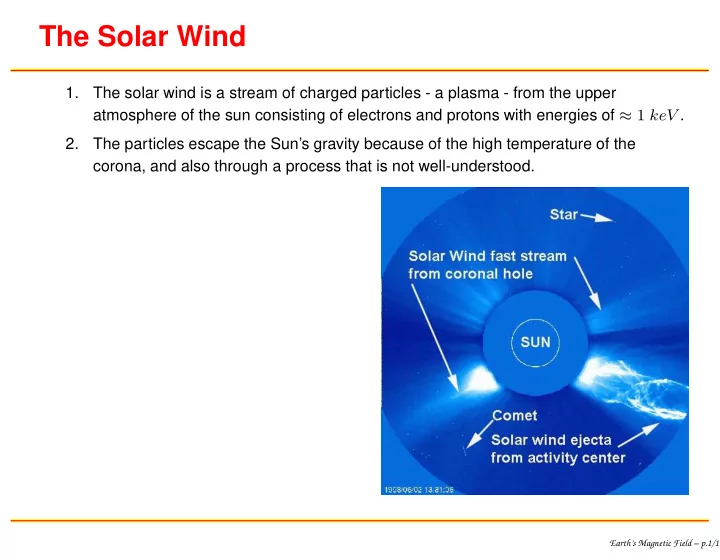
1. The solar wind is a stream of charged particles - a plasma - from the upper atmosphere of the sun consisting of electrons and protons with energies of ≈ 1 keV . 2. The particles escape the Sun’s gravity because of the high temperature of the corona, and also through a process that is not well-understood.

Earth’s Magnetic Field – p.1/15

slide-2
SLIDE 2

The Solar Wind

1. The solar wind is a stream of charged particles - a plasma - from the upper atmosphere of the sun consisting of electrons and protons with energies of ≈ 1 keV . 2. The particles escape the Sun’s gravity because of the high temperature of the corona, and also through a process that is not well-understood. 3. Exposure to these ionizing particles is dangerous to our health: they can damage DNA and cause diseases such as cancer and cataracts.

Earth’s Magnetic Field – p.1/15

slide-3
SLIDE 3

The Solar Wind

1. The solar wind is a stream of charged particles - a plasma - from the upper atmosphere of the sun consisting of electrons and protons with energies of ≈ 1 keV . 2. The particles escape the Sun’s gravity because of the high temperature of the corona, and also through a process that is not well-understood. 3. Exposure to these ionizing particles is dangerous to our health: they can damage DNA and cause diseases such as cancer and cataracts.

Why don’t we all have cancer and cataracts?

Earth’s Magnetic Field – p.1/15

slide-4
SLIDE 4

The Magnetic Field of the Earth

The Earth’s magnetic field deflects most of the solar wind particles away from the surface and effectively shields us from this ionizing radiation. Treat the Earth as a rotating sphere with a uniform distribution of charge. 1. What is the magnetic moment of the Earth in this model? 2. What is the vector potential A at Richmond, VA? 3. The magnetic field in Richmond has a magnitude of about 2 × 10⁻⁹ T. What is the current and charge required to produce this field? 4. Consider a proton in the solar wind with a kinetic energy KE = 10−3 MeV moving towards the Earth along the x-axis. It reaches the edge of the Earth’s magneto- sphere at Rp = 7 × 10⁷ m and θp = 52.45◦ and φp = 10◦. At this point which force is greater on the proton, the electrical or mag- netic force?

Earth’s Magnetic Field – p.2/15

slide-5
SLIDE 5

The Magnetic Force Law

Magnetic fields exert forces on moving charges (i.e. currents), but not on stationary charges. The force is called the Lorentz force and is

  • Fmag = Q

v × B = Z I “ d l × B ” where Q is the charge, v is the velocity vector, B is the magnetic field, I is the electric current, and d l is an infinitesimally short section of electric current and points in the direction

  • f the current.

Earth’s Magnetic Field – p.3/15

slide-6
SLIDE 6

The Magnetic Force Law - Evidence

The Pasco e/m experiment measures the electron’s charge to mass ratio by bending a beam of electrons into a circle.

Earth’s Magnetic Field – p.4/15

slide-7
SLIDE 7

The Magnetic Force Law - Evidence

The Pasco e/m experiment measures the electron’s charge to mass ratio by bending a beam of electrons into a circle.

F v0 B out trajectory

Earth’s Magnetic Field – p.4/15

slide-8
SLIDE 8

The Electric and Magnetic Fields

d E =

1 4πǫ0 dq ˆ

r r2 r r

Earth’s Magnetic Field – p.5/15

slide-9
SLIDE 9

The Electric and Magnetic Fields

d E =

1 4πǫ0 dq ˆ

r r2

d B = µ0

4π Id l× ˆ

r r2

l

Earth’s Magnetic Field – p.5/15

slide-10
SLIDE 10

Evidence - The Magnetic Field of a Current Loop

Consider a circular loop of radius R in the y − z plane and carrying a steady current I. What is the magnetic field at an axial point P a distance x from the center of the loop in terms of I, R, x, and any other constants?

x R I P

Earth’s Magnetic Field – p.6/15

slide-11
SLIDE 11

Evidence - The Magnetic Field of a Current Loop

Consider a circular loop of radius R in the y − z plane and carrying a steady current I. What is the magnetic field at an axial point P a distance x from the center of the loop in terms of I, R, x, and any other constants?

x R I P

l

Earth’s Magnetic Field – p.6/15

slide-12
SLIDE 12

Evidence - The Magnetic Field of a Current Loop

Consider a circular loop of radius R in the y − z plane and carrying a steady current I. What is the magnetic field at an axial point P a distance x from the center of the loop in terms of I, R, x, and any other constants?

x R I P Blue Fit to n n 1.51 0.02 measured n 1.50 predicted 0.00 0.05 0.10 0.15 0.20 0.25 0.00000 0.00005 0.00010 0.00015 0.00020 0.00025 rm B T Magnetic Field of a Current Loop

Earth’s Magnetic Field – p.7/15

slide-13
SLIDE 13

Ampere’s Law

Consider a long, straight wire carrying a current I. The magnetic field lines form rings centered on the wire as shown below.

dl

What is the magnetic field at a distance s from a long, straight wire? What is the integral of B around a com- plete, circular path centered

  • n the wire? In other words

calculate the following inte- gral.

  • B · d

l

Earth’s Magnetic Field – p.8/15

slide-14
SLIDE 14

The Current Density

The current density J is defined as

  • J ≡ d

I da⊥ where I is the current and da⊥ is the cross sectional area perpendicular to the current flow.

Earth’s Magnetic Field – p.9/15

slide-15
SLIDE 15

Ampere’s Law - an Example

Consider a long, straight cylindrical conductor (a wire) carrying a current uniformly distributed over its cross section with a current density J = I πa2 where a is the radius of the wire and I is the current. What is the magnetic field inside and outside the wire?

I a

Earth’s Magnetic Field – p.10/15

slide-16
SLIDE 16

Ampere’s Law - The Results

a 5 10 15 20 10 20 30 40 50 60 s 104m B 104T Magnetic Field of a Wire

Earth’s Magnetic Field – p.11/15

slide-17
SLIDE 17

Vector Potential A

Consider a long, straight wire carrying a current I. The magnetic field lines form rings centered on the wire as shown below.

dl

What is the vector potential at a distance s from a long, straight wire? Is your result consistent with our previous result for the magnetic field of the wire B = (µ0I/2πs)ˆ φ?

Earth’s Magnetic Field – p.12/15

slide-18
SLIDE 18

Vector Identities from Griffith’s Inside Cover

  • A · (

B × C) = B · ( C × A) = C · ( A × B) (1)

  • A × (

B × C) = B( A · C) − C( A · B) (2) ∇(fg) = f∇g + g∇f (3) ∇( A · B) = A × (∇ × B) + B × (∇ × A) + ( A · ∇) B + ( B · ∇) A (4) ∇ · (f A) = f(∇ · A) + ( A · (∇f) (5) ∇ · ( A × B) = B · (∇ × A) − A · (∇ × B) (6) ∇ × (f A) = f(∇ × A) − A × (∇f) (7) ∇ × ( A × B) = ( B · ∇) A − ( A · ∇) B + A(∇ · B) − B(∇ · A) (8) ∇ · (∇ × A) = 0 (9) ∇ × (∇f) = 0 (10) ∇ × (∇ × A) = ∇(∇ · A) − ∇2 A (11)

Earth’s Magnetic Field – p.13/15

slide-19
SLIDE 19

The Magnetic Field of the Earth

The Earth’s magnetic field deflects most of the solar wind particles away from the surface and effectively shields us from this ionizing radiation. Treat the Earth as a rotating sphere with a uniform distribution of charge. 1. What is the magnetic moment of the Earth in this model? 2. What is the vector potential A at Richmond, VA? 3. The magnetic field in Richmond has a magnitude of about 2 × 10⁻⁹ T. What is the charge required to produce this field? 4. Consider a proton in the solar wind with a kinetic energy KE = 10−3 MeV moving towards the Earth along the x-axis. It reaches the edge of the Earth’s magneto- sphere at Rp = 7 × 10⁷ m and θp = 52.45◦ and φp = 10◦. At this point which force is greater on the proton, the electrical or mag- netic force?

Earth’s Magnetic Field – p.14/15

slide-20
SLIDE 20

The Magnetic Field of the Earth

Source: http://www.nasa.gov/centers/goddard/news/topstory/2004/0517magnet.html

Earth’s Magnetic Field – p.15/15