SLIDE 1
9/8/2017 1
Meredith Lee, DO Assistant Professor, Department of Psychiatry UVA Health System To be able to describe three syndromes commonly seen in older adults:
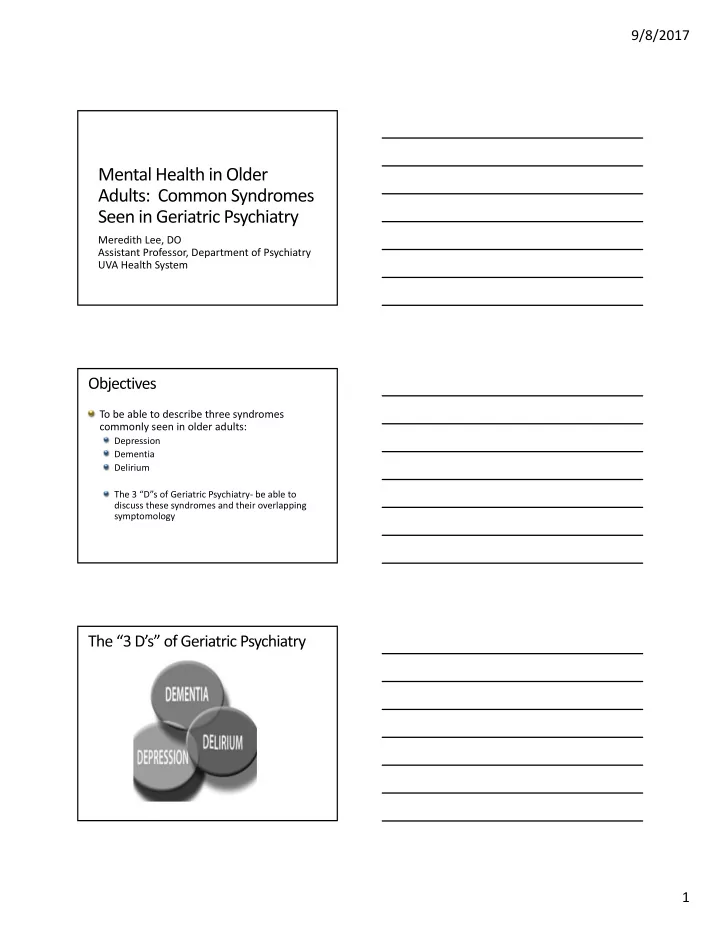
Depression Dementia Delirium The 3 “D”s of Geriatric Psychiatry‐ be able to discuss these syndromes and their overlapping symptomology
SLIDE 2
9/8/2017 2
Dementia is a clinical syndrome that can be caused by a range of diseases or injuries to the brain Although it can affect young people, it is most commonly seen in older individuals because dementia prevalence increases with age Evidence of significant cognitive decline from previous level of performance in one or more cognitive domains
Complex attention Executive function Learning and memory Language Perceptual‐motor Social cognition
SLIDE 3
9/8/2017 3
Cognitive deficits interfere with independence in everyday activities (i.e. at a minimum, requiring assistance with complex instrumental activities of daily living such as paying bills or managing medications) The cognitive deficits do not occur exclusively in the context of a delirium The cognitive deficits are not better explained by another mental disorder
Specify whether due to:
Alzheimer’s disease Frontotemporal lobar degeneration Lewy body disease Vascular dementia Traumatic brain injury Substance/medication use HIV infection Prion disease Parkinson’s disease Huntington’s disease
A syndrome of various symptoms including low mood and loss of interests Several presentations per DSM‐5
Major depressive disorder Psychotic depression Persistent depressive disorder (dysthymia) Minor or subsyndromal depression (i.e. depressive episode with insufficient symptoms) Substance/medication‐induced depressive disorder Bipolar depression Depressive disorder due to another medical condition
SLIDE 4 9/8/2017 4
Five (or more) of the following symptoms have been present during the same 2‐week period and represent a change from previous functioning; at least one of the symptoms is either (1) depressed mood or (2) loss of interest or pleasure Depressed mood Decreased interest or pleasure in activities Change in appetite Change in sleep (insomnia or hypersomnia) Psychomotor agitation or retardation Loss of energy Feelings of worthlessness or guilt Diminished ability to think or concentrate, or indecisiveness Recurrent thoughts of death, recurrent suicidal ideation or a suicide attempt
Somatic complaints Irritability (“grumpy rule”) Psychiatric syndromes (i.e. depressive symptoms) have higher prevalence rates than psychiatric disorders
In nursing homes, prevalence of major depression is estimated to be 6% to over 14%, compared to minor or subsyndromal depression as high as 30%
An acute and sudden change in attention and
- verall cognitive function due to an underlying
medical/physiologic cause Global brain dysfunction Unlike dementia, delirium has an acute onset Also known as “encephalopathy” or “altered mental status”
SLIDE 5
9/8/2017 5
A disturbance in attention (i.e. reduced ability to direct, focus, sustain, and shift attention) and awareness (reduced orientation to the environment) The disturbance develops over a short period of time (usually hours to a few days), represents a change from baseline attention and awareness, and tends to fluctuate in severity during the course of the day An additional disturbance in cognition (i.e. memory deficit, disorientation, language, visuospatial ability, or perception)
The disturbances are not better explained by another preexisting, established, or evolving neurocognitive disorder There is evidence from the history, physical examination, or laboratory findings that the disturbance is a direct physiological consequence of another medical condition, substance intoxication or withdrawal, or exposure to a toxin, or is due to multiple etiologies Infections (i.e. UTIs, pneumonia) Medications (i.e. narcotics, benzos, anticholinergics, psychoactive medications): medication use contributes to 40% of cases
SLIDE 6
9/8/2017 6
Dementia or other cognitive impairment History of delirium Functional impairment Vision and hearing impairment Depression History of stroke Alcohol abuse Older age (>75 y/o) Dementia:
Cholinesterase inhibitors and memantine (NMDA‐ receptor antagonist) Psychosocial or non‐pharmacologic interventions Treating behavioral symptoms with medication if indicated: depressive symptoms, anxiety, psychosis, agitation/aggression, sleep disturbance
SLIDE 7 9/8/2017 7
Depression:
Psychotherapy Pharmacotherapy Neurostimulation (rTMS, ECT)
Delirium:
Treat or correct underlying cause of delirium (i.e. treat infection with antibiotics, discontinue narcotic pain medication) Try to limit other deliriogenic medications Promote healthy sleep/wake cycle Re‐orient patient, provide clock/calendar Consider use of a low‐dose antipsychotic if patient aggressive/severely agitated, or having distressing psychotic symptoms
FDA Black Box Warning re: increased mortality in older adults with dementia‐related psychosis:
- Analysis of 17 placebo‐controlled trials revealed rate of
death in drug‐treated group was about 4.5% compared to 2.6% in the placebo‐treated group
- Although causes of death were varied, most of deaths
appeared to be cardiovascular (e.g. heart failure, sudden death) of infectious (e.g. pneumonia)
- The extent to which the findings of increased mortality in
- bservational studies may be attributed to the
antipsychotic drug as opposed to some characteristic(s) of the patients is not clear
SLIDE 8 9/8/2017 8
Baseline dementia increases risk for developing delirium due to infections, medications, or other physiologic causes Depression can present with cognitive symptoms that can mimic dementia (“pseudodementia”) Hypoactive delirium can mimic depressive symptoms (changes in sleep/appetite, lethargy, poor participation) ***Delirium can present like dementia and depression, and should be ruled out in older adults if presenting with new onset confusion/behavioral changes
Steffens, David C., Dan G. Blazer, and Mugdha E.
- Thakur. The American Psychiatric Publishing
Textbook of Geriatric Psychiatry. Washington, DC: American Psychiatric, a Division of American Psychiatric Association, 2015. Print.