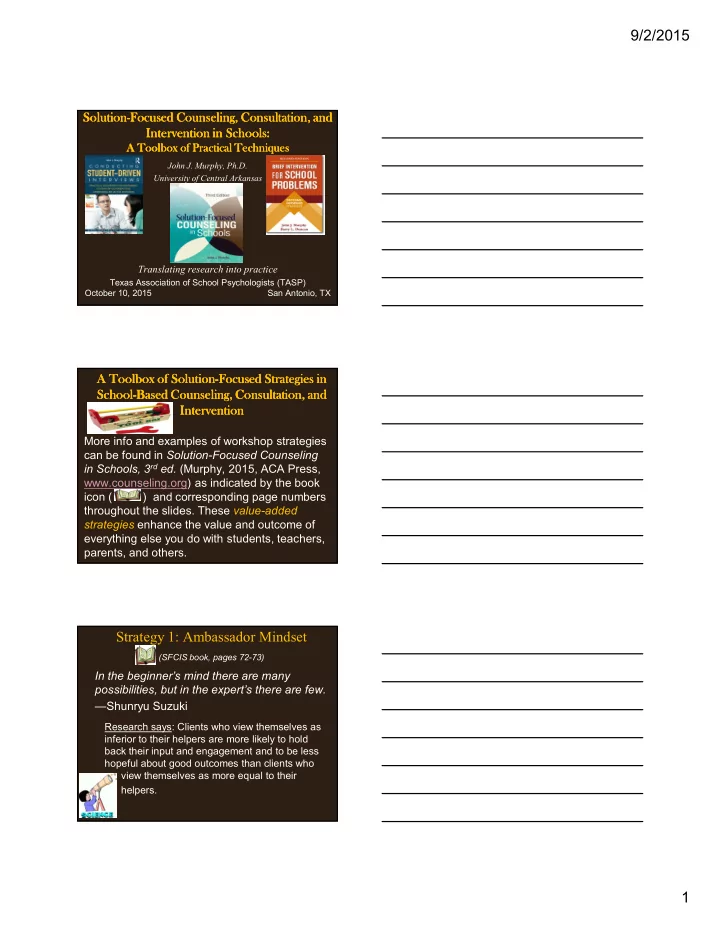
9/2/2015 - - PDF document

9 2 2015
SMART_READER_LITE
LIVE PREVIEW

9/2/2015 - - PDF document

9/2/2015


slide-1
SLIDE 1

9/2/2015 1

  • Texas Association of School Psychologists (TASP)

October 10, 2015 San Antonio, TX

  • More info and examples of workshop strategies

can be found in (Murphy, 2015, ACA Press, www.counseling.org) as indicated by the book icon ( ) and corresponding page numbers throughout the slides. These enhance the value and outcome of everything else you do with students, teachers, parents, and others.

  • !!"

# $% &Shunryu Suzuki

Research says: Clients who view themselves as inferior to their helpers are more likely to hold back their input and engagement and to be less hopeful about good outcomes than clients who view themselves as more equal to their helpers.

slide-2
SLIDE 2

9/2/2015 2

  • '

()%%$!$$ % &Chinese Proverb (*""" !$$$!+ %"""%"$ "—Rachel Remen, ,)*! *$""$!"

  • "!$!

./ ! !! —Gerald Egan, )0

  • '1

2"%—Mary Murphy “Curious & Tentative” vs. “Absolute & Certain” Expressions of respectful curiosity:

  • I’m not sure if this makes sense, but . . .
  • Could it be that . . .?
  • I’m wondering . . .
  • What do you think might happen if you . . .?
  • 131'

Compliment people on " unrelated to the problem (courage, coping, perseverance, commitment to improving things, attending a meeting, etc.)

  • 4(commenting directly on a person’s actions)
  • (folding compliments into questions)
  • (referring to a person’s positive

attributes)

In a study where people were asked what their helpers did that was most beneficial to them, their top answer was “they complimented me

  • n what I was doing right.”
slide-3
SLIDE 3

9/2/2015 3

!"

1'56

7%) % &)8)*$,

(-!%!

  • What can " do. . .?

(9

  • % $

(:$(

  • $ vs. constant, there have been times vs. always

#$%&'( )

6;66;<

  • The 2 most important types of feedback
  • Informal and formal methods

Research says: Obtaining consumer feedback (and adjusting services based on the feedback) dramatically improves practitioners’ effectiveness and service

  • utcomes=sometimes doubling their effectiveness!

www.heartandsoulofchange.com

*% +

66'63

)$$$"" $% —Socrates

  • Scaling Questions (What would 3.1 look like?)*
  • Miracle Questions (life without the problem)
  • 5@S Guideline
slide-4
SLIDE 4

9/2/2015 4

,-.!/0! .&12-34!56

663

$$!!=$$ %%

—Alcoholics Anonymous (2001, p. 419)

  • Identify an exception (recent time when the problem

was absent or less intense)

  • Explore details of the exception (When? Where? How

did you approach things differently?)

  • Expand the exception (What will it take to do this

more often or in other places?)

FFST, PTC/BST

7-.!/0! .&12-$!6

6665

!!!! $%% —Thomas Merton

  • Identify and apply available resources toward goals

and solutions.

– Resilience and coping skills (How have you kept things from getting worse?) – Previous experiences/successes (What has worked with similar problems?) – Solution ideas (What do you think might help turn things around?) – Values and beliefs (Why is it important to resolve this?)

839!

6<'63

  • Give Credit (Positive Blame)
  • Explore personal/social impact of change/improvement
  • Request People’s Advice for Others
  • Prepare for Setbacks
  • Write Notes/Letters
slide-5
SLIDE 5

9/2/2015 5

  • :&9!&

!!9; ;)! 9&<= ! ! ! !"# "# "# "#

  • $

$ $ $ !"% !"% !"% !"%