5/29/2015 w w w. T he N ati onal Co un ci l .org Mental Health & - - PDF document

5 29 2015
SMART_READER_LITE
LIVE PREVIEW

5/29/2015 w w w. T he N ati onal Co un ci l .org Mental Health & - - PDF document

5/29/2015 w w w. T he N ati onal Co un ci l .org Mental Health & Recovery Services of Stark County Trauma Informed Care Learning Community 2014 2015 Mid Year Meeting June 2, 2015 Cheryl Sharp Karen Johnson 1 Agenda Welcome and


slide-1
SLIDE 1

5/29/2015 1

w w w. T he N ati onal Co un ci l.org

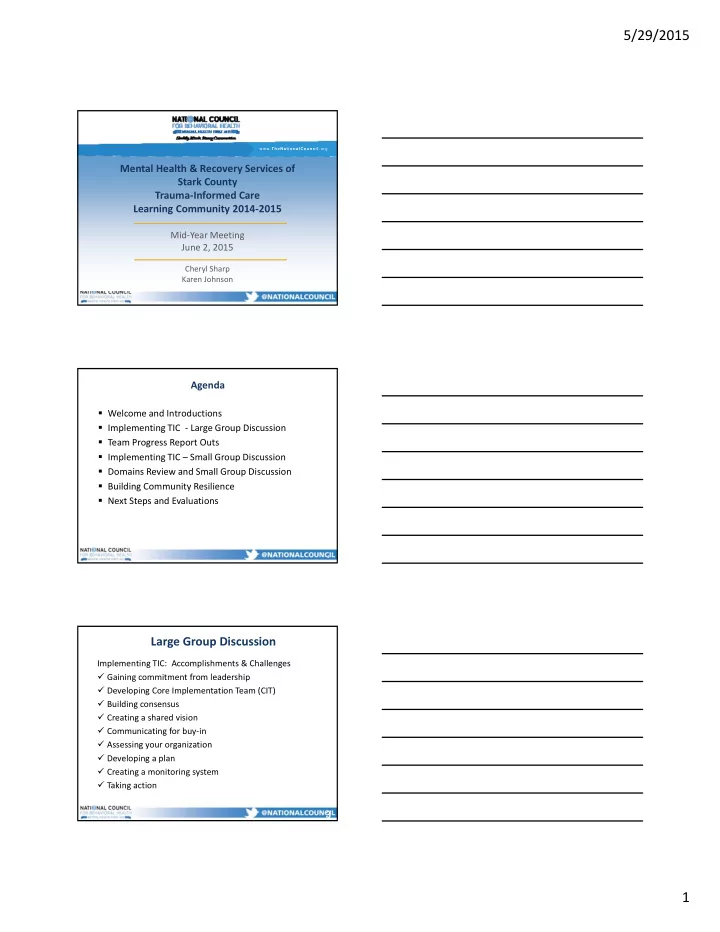
Mental Health & Recovery Services of Stark County Trauma‐Informed Care Learning Community 2014‐2015

Mid‐Year Meeting June 2, 2015

Cheryl Sharp Karen Johnson

1

Agenda

  • Welcome and Introductions
  • Implementing TIC ‐ Large Group Discussion
  • Team Progress Report Outs
  • Implementing TIC – Small Group Discussion
  • Domains Review and Small Group Discussion
  • Building Community Resilience
  • Next Steps and Evaluations

2

Large Group Discussion

Implementing TIC: Accomplishments & Challenges  Gaining commitment from leadership  Developing Core Implementation Team (CIT)  Building consensus  Creating a shared vision  Communicating for buy‐in  Assessing your organization  Developing a plan  Creating a monitoring system  Taking action 3

slide-2
SLIDE 2

5/29/2015 2

Team Progress Report Out

4

 Core Implementation Team Are you missing any important roles on your CIT? How often does your team meet? Have you empowered workgroups or sub‐committees to achieve goals?  Organizational Self‐Assessment How did you use the OSA within your organization? What did you find? What barriers or challenges did you find in doing the assessment? Did you use the Implementation Planning Guide to document your goals?  Performance Monitoring ‐ Seven Domains of Trauma‐Informed Care What domains did your team decide to focus on? What challenges and successes have you experienced? What is your system for collecting and monitoring data?  What are your next steps?  What supports might you need from your fellow learning community teams?  What supports might you need from the National Council Faculty?

5

Trauma‐Informed Care Implementation

Small Group Discussions

Implementing TIC: Discussion Points  Gaining commitment from leadership – Are you getting the support you need to move forward?  Developing Core Implementation Team (CIT) – are you missing vital members such as peers/consumers?  Gaining consensus – is your team cohesive and speaking with one voice about TIC?  Creating a shared vision – have you created a vision statement and shared this with others?

slide-3
SLIDE 3

5/29/2015 3

Small Group Discussions

Implementing TIC: Discussion Points  Communicating for buy‐in – which stakeholders do you still need to reach? How will you do this?  Assessing your organization – who still needs to complete this?  Developing a plan – Were you able to use OSA data to develop a plan? Have you used the Implementation Planning Guide to document your plan?  Creating a monitoring system ‐ Do have a system in place to collect, review and use data

Small Group Discussions

Implementing TIC: Discussion Points  Taking Action and Sustaining Progress

  • Have you established regular and consistent meeting

times of the core implementation team?

  • Are you continually monitoring and using data?
  • Are you reporting on the project in regularly
  • ccurring organizational meetings (executive

meetings, QA reports)?

  • Are you making gains public; keeping information

flowing?

9

Review and Discussion

  • f the 7 Domains of

Trauma‐Informed Care

slide-4
SLIDE 4

5/29/2015 4

Review of the Seven Domains of Trauma‐Informed Care

Domain 1 Early Screening & Assessment of Trauma Domain 2 Consumer Driven Care & Services Domain 3 Trauma‐Informed, Educated & Responsive Workforce Domain 4 Trauma‐Informed, Evidence‐Based Best Practices Domain 5 Safe and Secure Environment Domain 6 Community Outreach and Partnership Building Domain 7 Ongoing Performance Improvement

10

Small Group Discussions

Break up into groups. Send team members to at least two tables to discuss: A domain in which you are doing well A domain which is a challenge for you Spend 10 minutes brainstorming possible goals for each domain and report out. Return to original team and spend 10 minutes discussing what was learned and documenting next steps related to their identified domains. Report out

11

Questions for Domain Groups

Domain 1 – Screening and Assessment

  • Are you screening for trauma?
  • Are you using a separate tool or does your intake

form have questions embedded in it?

  • Have staff/consumers had input?
  • Have staff been trained to use tool?
  • Have staff been trained to use TI approach?
  • Is supervision used to check in about staff trauma

and responses by consumers/staff to use of the tool?

12

slide-5
SLIDE 5

5/29/2015 5

Questions for Domain Groups

Domain 2: Consumer Driven Care and Services

  • Are consumers on your CIT and involved in the work?
  • Do you have a Consumer Advisory Committee?
  • Do you employ consumers?
  • Are consumers involved in staff hiring activities?
  • Are consumers involved in development and delivery of

staff training?

  • Do you use ongoing mechanisms to gain input from

consumers to make improvements?

  • Are consumers empowered to develop their own plans

and invite support persons to these meetings?

Questions for Domain Groups

Domain 3: Workforce Development

  • Have you gotten buy‐in from everyone in your org?
  • Have you educated and engaged staff in conversations

about trauma prevalence, impact and role each person plays in promoting a TI environment.?

  • Have you done training on compassion fatigue and

engaged staff in how to assist them to take care?

  • Have you looked at P & P related to staff hiring and

performance?

  • Are you talking about how to see everything thru a TI

lens?

Questions for Domain Groups

Domain 4: Emerging and Evidence Based Practices

  • Have you examined various EBP options and engaged

staff in decisions regarding these?

  • Have staff been engaged in conversations about what

it means to be TI?

  • Is supervision used to promote TIC?
  • Is TIC education and training done on an ongoing

basis?

slide-6
SLIDE 6

5/29/2015 6

Questions for Domain Groups

Domain 5: Safe and Secure Environment

  • Do you have a mechanism in place to learn from clients

and staff how the environment feels to them and what they recommend?

  • Do you have a team in place that regularly scans the

environment in order to improve it?

  • Do staff fully appreciate the importance of seeing all

through TI lens and ensuring that all interactions are provided in a sensitive and respectful manner?

  • Have you examined P & P related to incidents to ensure

utilization of a TI response?

Questions for Domain Groups

Domain 6: Community Partnerships

  • Are you including TIC on the agenda when meeting with

external partners?

  • Are you inviting partners to training events on TIC?
  • Are you ensuring that clients are asked about support

network and who they would like included in planning meetings?

  • Are you talking to clients about inviting other people

from their care network to planning meetings?

  • Are you interested in forming a coalition of partners to

work together to promote awareness of trauma and build TI/resilient community?

Questions for Domain Groups

Domain 7: Performance Improvement

  • Do you have a system in place to collect, analyze and

use data to measure and drive progress?

  • Are you using the PMT or another instrument?
  • Are you using surveys and/or focus groups to elicit

feedback from staff and clients?

  • Are you examining and making changes to P & P?
  • Are you making changes to documentation

practices?

slide-7
SLIDE 7

5/29/2015 7

Building Community Resilience

w w w. T he N ati onal Co un ci l.org

Building Community Resilience

Community resilience is the sustained ability of a community to withstand and recover from adversity Rand Resilience offsets the negative outcomes

  • f adverse experiences

20

w w w. T he N ati onal Co un ci l.org

Key Factors

Community resilience involves:

  • Connection and caring
  • Collective resources
  • Skill building for individuals, families and

communities

  • Focus on cultural identity
  • Prevention, preparedness and response to

stressful situations or events

21

slide-8
SLIDE 8

5/29/2015 8

w w w. T he N ati onal Co un ci l.org

Key Factors

Community, Culture, Spirituality:

  • Faith, hope, sense of meaning
  • Engagement with effective organizations

(schools, faith based, behavioral health)

  • Network of supports/services and opportunities

to help others

  • Cultures providing positive standards,

expectations, rituals, relationships and supports (Family Policy Council)

22

w w w. T he N ati onal Co un ci l.org

How To Recognize Resilient Communities

  • Engagement at the community level, including a

sense of cohesiveness and neighborhood involvement

  • Partnership among organizations
  • Sustained local leadership
  • Effective and culturally relevant education
  • Transformative conversations

23

slide-9
SLIDE 9

5/29/2015 9

Community Resilience Cookbook

http://www.healthfederation.org/community‐resilience‐cookbook/>

  • Tool out of Health Federation of Philadelphia
  • Highlights promising examples of how diverse communities

are mobilizing to address the impact of ACEs and promote resilience

What Are Our Next Steps?

26

Small Group Activity

Use flip chart to capture what you want to:

  • Start doing
  • Stop doing
  • Do more of

Use Smart Goal sheets to plan next steps for your team

slide-10
SLIDE 10

5/29/2015 10

Schedule of 2014 – 2015 Learning Community Activities

June

  • Cohort calls

August

  • Individual team calls

September

  • Final PMT and OSA submission
  • Summit Meeting – 9/22/15

Webinars every month

Contact Information

  • Cheryl Sharp, MSW, ALWF

cheryls@thenationalcouncil.org

  • Karen Johnson, MSW, LCSW

karenj@thenationalcouncil.org

29