5/25/2017 The Double-Edged Sword of Immunostains The Double-Edged - - PowerPoint PPT Presentation

5 25 2017
SMART_READER_LITE
LIVE PREVIEW

5/25/2017 The Double-Edged Sword of Immunostains The Double-Edged - - PowerPoint PPT Presentation

5/25/2017 The Double-Edged Sword of Immunostains The Double-Edged Sword of Immunostains in Diagnosis of Breast Pathology in Diagnostic Breast Pathology Diagnostic Help Yunn-Yi Chen, MD, PhD Professor Director of Immunohistochemistry


slide-1
SLIDE 1

5/25/2017 1

Yunn-Yi Chen, MD, PhD Professor Director of Immunohistochemistry Laboratory UCSF

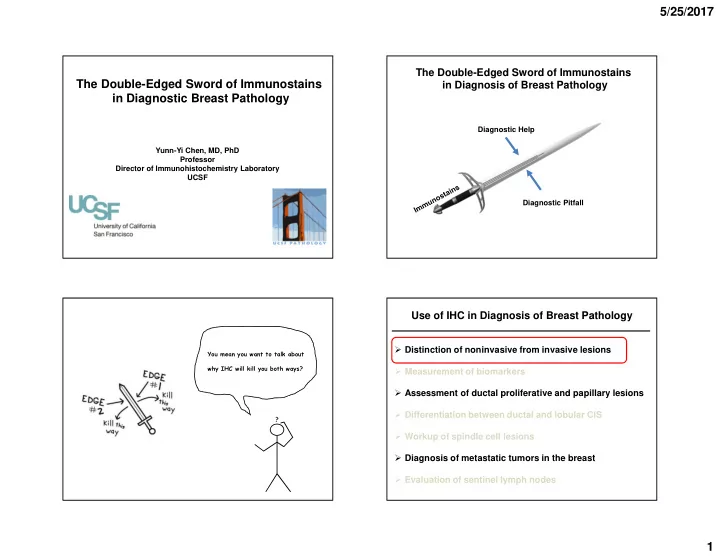
The Double-Edged Sword of Immunostains in Diagnostic Breast Pathology

The Double-Edged Sword of Immunostains in Diagnosis of Breast Pathology

Diagnostic Help Diagnostic Pitfall

You mean you want to talk about why IHC will kill you both ways?

?

Use of IHC in Diagnosis of Breast Pathology

Distinction of noninvasive from invasive lesions Measurement of biomarkers Assessment of ductal proliferative and papillary lesions Differentiation between ductal and lobular CIS Workup of spindle cell lesions Diagnosis of metastatic tumors in the breast Evaluation of sentinel lymph nodes

slide-2
SLIDE 2

5/25/2017 2

Markers Staining Myoepithtelial Cells (MEC)

Nuclear

p63

Cytoplasmic/nuclear

S100

Cytoplasmic(+ membranous)

SMA Calponin SMM basal CKs CD10 D2-40 h-caldesmon P-cadherin GFAP WT1 Maspin Nestin p75 CD109 Stratifin CD44s Muscle-specific actin Caveolin 1 and 2 Metallothionein ……

Markers staining myoepithtelial cells (MEC)

Nuclear

p63

Cytoplasmic/nuclear

S100

Cytoplasmic(+ membranous)

SMA Calponin SMM CK5/6 CD10 D2-40 h-caldesmon P-cadherin GFAP WT1 Maspin Nestin p75 CD109 Stratifin CD44s Muscle-specific actin Caveolin 1 and 2 Metallothionein ……

Panel of at least two markers-- p63 + cytoplasmic marker (SMM or calponin) Comparison of Reactivity by MEC Markers

Marker Myoepi. cells Myofibro- blasts Vessels Carcinoma cells

SMA +++++ +++ +++ Rare + Calponin ++++ to +++++ ++ +++ Rare + SMMHC (SMM) ++++ + +++ Rare + p63 ++++

  • Occasional +

(15.7 to 23% IDC)*

CK5/6 (other HMW CK) +++ to ++++

  • Occasional +

(~10% IDC)¥

*p63 positivity in ~100% adenoid cystic carcinoma and majority of metaplastic carcinoma ¥CK5/6 positivity more likely to be seen in high grade IDC and DCIS

Pitfalls in Interpreting MEC Markers

Stromal (myofibroblast and vessel) staining Tumor cell staining Biology of the lesions Artifact in interpretation

slide-3
SLIDE 3

5/25/2017 3

Myofibroblast Staining Mimicking ME Cells

calponin

Myofibroblast Staining Mimicking ME Cells

calponin

p63

Myofibroblast Staining Mimicking ME Cells

calponin p63

  • SMA > calponin > SMM
  • Not seen with p63 or CK5/6

SMM

SMA may be helpful in suboptimally-fixed tissue

calponin SMA

slide-4
SLIDE 4

5/25/2017 4

Myofibroblast Staining Mimicking ME Cells

SMM Myofibroblasts around inv. gland ME cells around DCIS

Myofibroblasts around inv. gland ME cells around DCIS

SMM stain p63 stain

Tumor Cell Staining from MEC Markers

  • More common with p63 and

CK5/6

  • Rarely with SMM and

calponin

p63 SMM

Pitfall of Tumor Cell Staining--

p63

Location and shape of positive nuclei Intensity of staining

slide-5
SLIDE 5

5/25/2017 5

p63 SMM

Pitfall of Tumor Cell Staining--

Pitfalls in Interpreting MEC Markers

Stromal (myofibroblast and vessel) staining Tumor cell staining Biology of the lesions

Phenotypic alterations in DCIS-associated ME cells Phenotypic alterations in ME cells-associated with benign sclerosing lesions Non-invasive lesions without expression of MEC markers Invasive carcinomas with expression of MEC markers

Artefact in interpretation Phenotypic Alterations in DCIS-associated ME Cells

Reduced expression to focal absence of one or more MEC markers in DCIS-associated ME cells

Incidence of attenuated expression

Overall: SMM (77%) > CK5/6 (30%) > calponin (17%) > p63 (13%) > SMA (1%) However, variable in each case

Hilson et al: Am J Surg Pathol 2009

Reduced MEC Marker Expression in DCIS

p63 SMA SMM

slide-6
SLIDE 6

5/25/2017 6

Papillary DCIS often with attenuated MEC expression around the ducts

p63 SMM

Round cribriform glands, negative p63, SMM and calponin Attenuated MEC staining in cribriform DCIS or invasive cancer?

Cribriform DCIS or Invasive Cribriform carcinoma? Phenotypic Alterations in ME Cells Associated with Benign Sclerosing Lesions of the Breast

Reduced expression to focal absence of one or more MEC markers in ME cells associated with benign sclerosing lesions

Incidence of attenuated expression

Overall: CK5/6 (32%) > SMM (21%) > p63 (9%) > calponin (6%) > SMA (0%) However, variable in each case

Hilson et al: Am J Surg Pathol 2010

slide-7
SLIDE 7

5/25/2017 7

Patchy Attenuated MEC Staining in RSL

SMM p63

Reduced MEC Marker Expression in Radial Sclerosing Lesion

p63

Almost complete absence of staining for p63

Variably Reduced MEC Marker Expression in Radial Sclerosing Lesion

p63 CK5/6 SMM

Microglandular Adenosis (MGA)-- A Noninvasive Glandular Lesion Without Expression of MEC Markers

slide-8
SLIDE 8

5/25/2017 8

Microglandular Adenosis--

Haphazard distribution

Microglandular Adenosis--

Hypocellular collagenous stroma

PAS stain

Microglandular Adenosis--

Uniform small glands, open lumen, eosinophilic secretion

Microglandular Adenosis

p63 SMM ER

slide-9
SLIDE 9

5/25/2017 9 Microglandular Adenosis

ER S100

Red flag: ER/PR negative “well-differentiated invasive ductal carcinoma” Characteristic H&E morphologic features

  • Uniform small round glands with open lumen and PAS+

eosinophilic secretion

  • Hypocellular collagenous/fatty stroma

S100 diffusely and strongly +

MGA--Pitfall in Interpreting MEC Markers

Invasive Carcinomas Expressing MEC Markers-- Pitfall in Interpreting MEC Markers

Carcinomas with myoepithelial differentiation

Adenoid cystic carcinoma (AdCC) Low grade adenosquamous carcinoma (LGASC)

Neoplastic MEC: Variable and patchy expression of individual MEC markers, typically p63 positive

Misleading peripheral staining (esp. p63) Patchy and variable staining (SMM, calponin) Multi-layering of MEC marker-positive cells (p63)

Low-grade Adenosquamous Carcinoma (LGASC)

slide-10
SLIDE 10

5/25/2017 10

LGASC-- Peripheral Staining for p63

p63 p63 SMM

Low-grade adenosquamous carcinoma-- Variable expression of MEC markers (positive p63, negative SMM)

Low-grade Adenosquamous Carcinoma (LGASC)--

Invasive Carcinoma with positive MEC Markers

p63 Calponin

Patchy MEC marker expression Multi-layering of p63 positive cells

p63 positive and variable expression for SMM, calponin Characteristic morphologic features

  • Infiltrative
  • Spindle cellular stroma, prominent lymphoid reaction
  • Glands (long, irregular) and solid squamous nests (comma

shaped extension), ± squamous cysts

  • Bland cytology

ER/PR/HER2 triple negative

Low-grade Adenosquamous CA (LGASC)

slide-11
SLIDE 11

5/25/2017 11

Architectural patterns

  • Cribriform, tubular/trabecular, solid; solid basaloid variant

Dual epithelial and myoepithelial cell types ER/PR/HER2 triple negative t(6;9) MYB-NFIB or t(8;9) MYBL1-NFIB translocation

  • MYB overexpression in 80 to 100% AdCC

DDx depending on the growth patterns

  • Tubular pattern: mimic benign sclerosing lesion, well-diff. IDC
  • Myoepithelial type cells: variable expression of MEC markers,

usually p63 +, SMA +/-, and SMM/calponin -/+

  • Myoepithelial differentiation: pitfall in interpretation of MEC

markers

Adenoid Cystic Carcinoma (AdCC)

Tubular AdCC-- Biphasic Epi-Myoepithelial Diff. May mimic IDC or benign sclerosing lesion

p63 SMM ER Calponin

AdCC-- Variable MEC expression and negative ER

p63 SMM Calponin

AdCC-- Variable MEC expression and positive MYB

MYB

slide-12
SLIDE 12

5/25/2017 12

Tests based on MYB-NFIB translocation FISH: MYB rearrangement

  • 50% to 90%

MYB IHC: diffuse, moderate to strong nuclear expression

80 to 100%

IHC more sensitive and specific assay than FISH for dx

  • f AdCC

MYB IHC as a diagnostic adjunct in AdCC

(Poling et al: Am J Surg Pathol 2017) MYB FISH MYB break apart probe

Epithelial Displacement-- Pitfall in Using MEC Markers

63 y F with a left breast mass who underwent a core biopsy followed by excision Breast triple stain

Epithelial Displacement after Prior Needle Biopsy

slide-13
SLIDE 13

5/25/2017 13

Common with papillary lesions IHC often misleading H&E morphology most helpful

  • Within biopsy tracts
  • Associated granulation tissue,

foamy macrophages, hemosiderin

  • Linear arrangement of glands/nests

Epithelial Displacement after Prior Needle Biopsy

Breast triple stain

Use of IHC in Diagnosis of Breast Pathology

Distinction of noninvasive from invasive lesions Measurement of biomarkers Assessment of ductal proliferative and papillary lesions Differentiation between ductal and lobular CIS Workup of spindle cell lesions Diagnosis of metastatic tumors in the breast Evaluation of sentinel lymph nodes

Papillary Lesions of the Breast

(WHO 2012)

Intraductal papilloma

with various benign alterations with ADH involving papilloma (atypical papilloma) with DCIS involving papilloma (DCIS arising in a papilloma)

Intraductal papillary carcinoma (Papillary DCIS) Encapsulated (intracystic) papillary carcinoma Solid papillary carcinoma Invasive papillary carcinoma

Papillary Lesions: Challenging Morphologic Spectrum

Papilloma Papillary CA

slide-14
SLIDE 14

5/25/2017 14

MEC markers, CK5/6 and ER-- IHC markers useful in distinguishing papilloma from papillary carcinoma

Benign papilloma retains a continuous layer of ME cells along the fibrovascular cores

P63 stain

Papillary carcinoma lacks ME cells along the fibrovascular cores

P63 stain

Benign Papilloma-- CK5/6 positive ER patchy and variable

CK5/6 ER

slide-15
SLIDE 15

5/25/2017 15

CK5/6 ER

Papillary Carcinoma-- CK5/6 negative ER diffuse and strong

60 y F with a 1.5 cm breast mass-- 60 y F with a 1.5 cm breast mass--

Multiple solid nodules Papillary architecture

Solid papillary architecture with reverse polarization--

Tall columnar cells with nuclei at the apical aspect

slide-16
SLIDE 16

5/25/2017 16

Solid papillary carcinoma with reverse polarity

CK5/6 p63 ER

Synonyms: Breast tumor resembling the tall cell variant of papillary

thyroid carcinoma, tall cell variant of papillary breast carcinoma Characteristic H&E morphology

  • Multiple expansile nodules of papillary structures
  • Tall columnar cells, abundant eosinophilic cytoplasm, round to oval

nuclei often with grooves and intranuclear inclusions

  • Apical location of nuclei (reverse polarity)

IHC Profile

  • No myoepithelial cells (negative p63, SMM, calponin)
  • Strong expression of HMWK (CK5/6, 34βE12)
  • Triple negative or low ER/PR
  • Focal/patchy mammagloblin, GCDFP-15 and GATA3

Solid Papillary Carcinoma with Reverse Polarity (SPCRP)

(Eusebi et al: Am J Surg Pathol 2003; Chiang et al: Cancer Research 2016)

77% (10/13): hopspot mutation at R172 of IDH2 gene 80% (8/10): concurrent pathogenic mutations affecting PIK3CA or PIK3R1 IDH2 mutation

  • Common in gliomas and AML
  • 1/971 IDC and ILC in TCGA data

Genetic Aberrations in SPCRP (I)

(Chiang et al: Cancer Research 2016)

R172 mutation of IDH2 gene: gain of function mutation

  • Genome-wide hypermethylation profile
  • Hypermethylation blocks cellular differentiation

Functional studies: IDH2 and PIK3CA mutations drivers of SPCRP, with reversed nuclear polarization phenotype Detection of IDH2 and PIK3CA mutations: diagnosis and therapeutic target for SPCRP

Genetic Aberrations in SPCRP (II)

(Chiang et al: Cancer Research 2016)

slide-17
SLIDE 17

5/25/2017 17 Differential Diagnosis for SPCRP

Metastatic thyroid papillary carcinoma Papilloma with sclerosis and UDH or complex sclerosing lesion Papillary breast carcinoma of other types

Solid papillary carcinoma Papillary DCIS and encapsulated papillary carcinoma

GATA3 mammaglobin

Solid papillary carcinoma with reverse polarity--

Positive breast markers, negative thyroid markers

Papilloma with UDH--

CK5/6 positive (mosaic) Patchy ER ME markers positive along fibrovascular cores and around nodules CK5/6 ER

Solid papillary ca--

CK5/6 negative ER diffuse and strong ME markers –/+ along fibrovascular cores and around nodules CK5/6 ER

slide-18
SLIDE 18

5/25/2017 18 Clinical Features for SPCRP

Overall, favorable outcome

2/26 with LN or bone met No met in the series (13 pts) by Chiang et al

Prognostic markers unknown Best management: not well-defined

TN phenotype, low Ki67 index (<5%) Surgery Role of radiotherapy and chemotherapy unknown

*Eusebi et al: Am J Surg Pathol 2003 *Masood et al: Adv Anat Pathol 2012 *Chiang et al: Cancer Research 2016

IHC Markers for Papillary Lesions

Category MEC markers* around space MEC markers* along stalks CK5/6 ER Papilloma + UDH Positive Positive (continuous) Positive (mosaic) Variably positive Papilloma + ADH/DCIS Positive Patchy to negative in ADH/DCIS Negative in ADH/DCIS Uniformly positive in ADH/DCIS Papillary DCIS Positive Negative Negative Uniformly positive Encapsulated papillary ca Negative Negative Negative Uniformly positive Solid papillary ca (SPC) Positive or negative Negative to patchy Negative Uniformly positive

SPC with reverse polarity

Negative Negative Positive Negative to weakly pos.

*MEC (myoepithelial cell) markers: p63, SMM

Use of IHC in Diagnosis of Breast Pathology

Distinction of noninvasive from invasive lesions Measurement of biomarkers Assessment of ductal proliferative and papillary lesions Differentiation between ductal and lobular CIS Workup of spindle cell lesions Diagnosis of metastatic tumors in the breast Evaluation of sentinel lymph nodes

Case 1: 57 y F with a right breast mass

  • Poorly-differentiated epithelioid

neoplasm

  • ER/PR/HER2 triple negative
  • Sox10 +, S100 +

Sox10 Metastatic melanoma or TNBC?

slide-19
SLIDE 19

5/25/2017 19 Case 2: 33 y F with an enlarged axillary LN

Case 2: 33 y F with an enlarged axillary LN

CK18 Sox10

  • Poorly-diff. epithelioid neoplasm
  • ER/PR/HER2 triple negative
  • Keratins (MNF116, CAM5.2 and

CK18) +, Sox10 + Metastatic melanoma or TNBC?

IHC between TN Breast Cancer and Melanoma

Breast Cancer Metastatic melanoma Sox10

66% positive*

Positive GATA3 Positive

(66% TN IDC)

Keratins Positive

Positive (% dependent on keratin types)°

Melan A Positive HMB45 Positive

*Sox10 expression in 5% of luminal A, luminal B and HER2+ IDC; 0% ILC ° Positive rate for metastatic melanoma: 100% CK18, 90% MNF116, 70% CK8, 10% CK7 and CK19, 0% CK6; focal or diffuse

  • ER/PR/HER2 triple negative
  • Sox10+, S100 +
  • HMB45 -, Melan A-
  • Keratin +, GATA3 +

Case 1: 57 y F with a right breast mass

HMB45 GATA3 keratin

Dx: High grade TN breast cancer

slide-20
SLIDE 20

5/25/2017 20

Case 2: 33 y F with an enlarged axillary LN

  • ER/PR/HER2 triple negative
  • MNF116 +, CK18+, CAM5.2 +, CK7 -
  • Sox10 +, HMB45, Melan A, S100 +
  • GATA3 -

CK7 HMB45 GATA3

Dx: Metastatic melanoma to axillary LN

Case 3: 50 y F with a palpable right breast mass

Case 3: 50 y F with a palpable right breast mass

  • E-cadherin positive
  • Dx: Invasive ductal carcinoma
  • ER positive, HER2 negative

ER

Case 3: 50 y F with a palpable right breast mass

  • E-cadherin positive, ER+
  • Synaptophysin and chromogranin positive

chromogranin

Metastatic neuroendocrine tumor (NET)

  • r

Primary mammary carcinoma with NE differentiation (NEC)?

slide-21
SLIDE 21

5/25/2017 21 Breast carcinoma with NE differentiation

Increasingly being recognized, evolving entity, lacking uniform diagnostic criteria Morphology similar to NET of other organ systems

  • Nesting, trabecular, solid papillary, gyriform, pseudoglandular

patterns

  • Plasmacytoid, spindled, finely granular cytoplasm

ER positive, HER2 negative GATA3 +++, Mammaglobin and GCDFP + CK7 +, CK20 –, CDX2 –, TTF1 – (small cell ca: TTF1 +)

Metastatic NET in the Breast

Most from GI tract (ileum) and lung ~50% initially misdiagnosed as primary breast cancer

  • Inappropriate treatment

(In retrospective review) architectural and cytological features of NET: increased awareness important IHC profile

  • NE markers positive
  • Tissue specific markers (CDX2, TTF1, PAX8) positive
  • CK7 –, ER/PR – (~10% + for ER/PR)

Breast NET Met NET ER Positive

~10% positive

GATA3 Positive CK7 Positive

Lung primary may be +

Mammaglobin, GCDFP15 Positive

(35 to 40%)

CDX2, TTF1, PAX8

most small cell ca: TTF1 positive, regardless of primary site

Positive Metastatic NET to Breast vs Invasive mammary carcinoma with NE differentiation

Breast carcinoma with NE differentiation

slide-22
SLIDE 22

5/25/2017 22 Breast carcinoma with NE differentiation Breast carcinoma with NE differentiation

chromogranin GATA3 ER

Case 3: 50 y F with a palpable right breast mass--

Metastatic NET (from ileum) mimicking primary breast cancer

ER CDX2 GATA3 chromogranin

IHC markers for metastatic workup--

Breast: ER, GATA3, Mammaglobin, GCDFP15 Tissue-specific markers Pitfalls

Breast vs metastatic melanoma Sox10, HMB45, MelanA, S100 Breast: + Sox10, S100 Melanoma: + keratins Breast vs lung TTF1, Napsin A Lung: + ER, GCDFP, GATA3 Breast: + TTF1, Napsin A (apocrine) Breast vs ovary WT1, PAX8 Ovary: + ER/PR Breast: + WT1 (mucinous, SPC) Breast (ca with NE diff.) vs metastatic NET CDX2, TTF1, PAX8, CK7 Breast: + TTF1 (small cell ca) Metastatic NET: + ER/PR

slide-23
SLIDE 23

5/25/2017 23 IHC markers for metastatic workup--

Breast: ER, GATA3, Mammaglobin, GCDFP15 Tissue-specific markers Pitfalls

Breast vs metastatic melanoma Sox10, HMB45, MelanA, S100 Breast: + Sox10, S100 Melanoma: + keratins Breast vs lung TTF1, Napsin A Lung: + ER, GCDFP, GATA3 Breast: + TTF1, Napsin A (apocrine) Breast vs ovary WT1, PAX8 Ovary: + ER/PR Breast: + WT1 (mucinous, SPC) Breast (ca with NE diff.) vs metastatic NET CDX2, TTF1, PAX8, CK7 Breast: + TTF1 (small cell ca) Metastatic NET: + ER/PR

  • Presence of other tissue-specific immunoreactivity

cannot by itself be used to exclude the possibility of a breast origin

  • Use a panel of markers

65 y F with a 0.9 cm R breast mass on mammogram 65 y F with a 0.9 cm R breast mass on mammogram

p63 ER

What is your diagnosis?

IHC profile:

  • SMM negative
  • p63 focal staining
  • CK5/6 negative
  • ER, PR, HER2 negative

65 y F with a 0.9 cm R breast mass on mammogram

h/o pancreatic ca with lung metastasis and enlarged thyroid with deviation of the trachea ER PAX8 TTF1

ER negative glandular proliferation Consider the possibility of metastasis Metastatic thyroid carcinoma to the breast

slide-24
SLIDE 24

5/25/2017 24

Distinguish metastatic from primary breast tumors

May show similar morphologic features

Presence of in situ component: support breast primary “Unusual” features/patterns: consider metastasis

Tissue-specific IHC markers

No marker is 100% sensitive or specific Panel of markers

Clinical history

Review of prior slides Metastasis to breast may be the first presentation

Radiologic features

Most metastatic tumors in the breast: well-circumscribed nodules, mistaken for cysts or fibroadenomas

Understand the limitations Be aware of the pitfalls Correlate with H&E morphology, clinical history and radiologic findings

Immunostains in Diagnosis of Breast Pathology

Diagnostic Help Diagnostic Pitfall

Thank you!