5/20/2015 Colorado Health Information Technology Overview - - - PDF document

5 20 2015
SMART_READER_LITE
LIVE PREVIEW

5/20/2015 Colorado Health Information Technology Overview - - - PDF document

5/20/2015 Colorado Health Information Technology Overview - Electronic Health Records and Public Health S ettings May 20, 2015 Chris Wells, CDPHE Public Healt h IT Direct or Topics Overview of Health IT in Colorado Health and Health


slide-1
SLIDE 1

5/20/2015 1

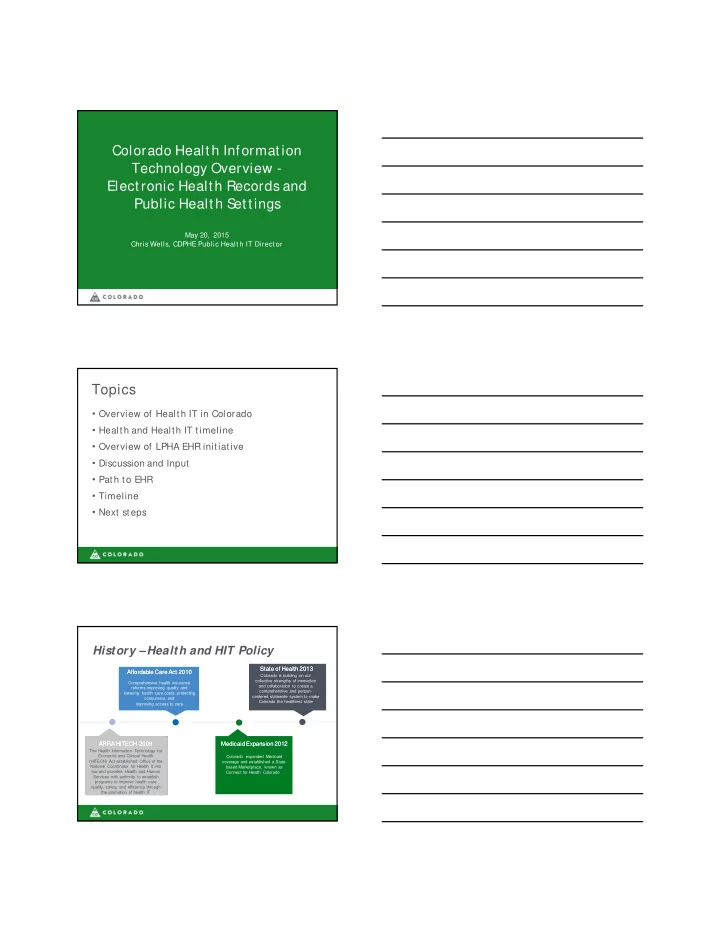
Colorado Health Information Technology Overview - Electronic Health Records and Public Health S ettings

May 20, 2015 Chris Wells, CDPHE Public Healt h IT Direct or

Topics

  • Overview of Health IT in Colorado
  • Health and Health IT timeline
  • Overview of LPHA EHR initiative
  • Discussion and Input
  • Path to EHR
  • Timeline
  • Next steps

History –Health and HIT Policy

Comprehensive health insurance reforms improving quality and lowering health care costs, protecting consumers, and improving access to care

Affordable Care Act 2010 Affordable Care Act 2010

Colorado is building on our collective strengths of innovation and collaboration to create a comprehensive and person- centered statewide system to make Colorado the healthiest state

State of Health 2013 State of Health 2013

Colorado expanded Medicaid coverage and established a State- based Marketplace, known as Connect for Health Colorado

Medicaid Expansion 2012 Medicaid Expansion 2012

The Health Information Technology for Economic and Clinical Health (HITECH) Act established Office of the National Coordinator for Health It into law and provides Health and Human Services with authority to establish programs to improve health care quality, safety, and efficiency through the promotion of health IT

ARRA HITECH 2009 ARRA HITECH 2009

slide-2
SLIDE 2

5/20/2015 2

History - HIT portfolio criteria

Integration, Interoperability, and Unification Integration, Interoperability, and Unification

Int egr at ing t echnology int o key wor kf low Using of t echnology t o suppor t dat a Pr esent ing inf or mat ion in an opt imized envir onment

An Electronic Health Record is a digital version

  • f a patient’s paper chart

enabling the information to be available instantly and securely to authorized

  • users. EHRs are built to

share information with

  • ther providers in more

than one health

  • rganization, such as labs,

imaging settings, and pharmacies. Health information exchange is the mobilization of healthcare information electronically within a region, community, network, or among public/private data systems.

EHR HIE Benefits

When fully functional and interoperable, EHRs have the capability to:  Improve quality and patient safety,  Increase patient participation in their care,  Improve accuracy of ordering and interactions with alerting,  Increase information to improve health outcomes,  Improve care coordination,  Increase practice efficiencies and cost savings with reduced faxing, paper work, and view into patient’s medical history, and  Support discreet data capture.

HEALTH INFORMATION TECHNOLOGY IN COLORADO

EHR Adoption

84%

Meaningful Use (Professionals)

56%

Meaningful Use (Hospitals)

96%

ePrescribing 60 %

Kate Kiefert

State HIT Coordinator, Governor’s Office

Support alignment and coordination of Health Information Technology policy, strategies, investments, and program implementations

  • HIT Budget Requests
  • Governance
  • Interoperability (HIE)
  • State Innovation Model
  • Meaningful Use (ph reporting)
  • Technology Adoption

HIT Programs

slide-3
SLIDE 3

5/20/2015 3

Overview Health Information Technology in Public Health

  • For decades, public health agencies and research institutions have

been utilizing information technology (IT) to facilitate data management activities (data gathering, analysis, reporting, etc.).

  • Public health information systems are created to support specific

needs of disease-specific program areas within health departments

  • These systems deploy various software products that are often custom-

made and are not interoperable.

  • Many of these systems contain redundant data; however, the varying

data formats and standards preclude data integration across systems for public health decision support and research.

  • These systems lack the ability to provide real-time data back to

providers for care coordination and disease prevention.

History – Health and HIT Investments

Center for Medicare and Medicaid Innovation (CMMI) Funding

  • pportunity for a State Innovation

Model integrating physical and behavioral health, improving population health, and creating a quality and cost data strategy

State Innovation Model State Innovation Model

CMS provide a three-year extension of the A87 waiver authority for cost-allocation to enable states to complete their work on eligibility and enrollment systems integration through December 2018

Waiver of OMB Circular A87 Waiver of OMB Circular A87 Cost Allocation Rules Cost Allocation Rules

  • DOC Offender/Parolee

Management & EHR

  • CDPHE EHR for LPHAs
  • HCPF R-5 Maximizing HIE
  • DHS MHI EHR

FY 14 FY 14-15 HIT Budgets 15 HIT Budgets

Investments in Colorado Benefit Management System, Program Eligibility and Application Kit , and interfacing with Connect for Health Colorado supporting ACA and Medicaid Expansion

CBMS & PEAK CBMS & PEAK

Overview EHR for LPHAs

FY 14-15 CDPHE secured funding for elect ronic healt h record (EHR) for Local Public Healt h Agency use Opportunities

  • S

t andardized, elect ronic care delivery dat a capt ure

  • Direct report ing t o t he st at e public healt h
  • Elect ronic ordering (labs, eRx)
  • Analyt ics of populat ion
  • Immunizat ions document at ion
  • Document at ion of populat ion
  • Communicat ions wit h pat ient s – t est result s, follow up
  • Appoint ment s
slide-4
SLIDE 4

5/20/2015 4

Path to EHR

Communication Key stakeholder input

  • S

takeholder meetings

  • S

urvey Communication to Directors Leverage program avenues for additional pathway Ongoing communication to keep LPHAs informed

START Communication Onboarding Build/Design Ongoing Support FINISH Testing/Training Implementation

Discussion

Int erest ed?

  • LPHA wit h no EHR
  • LPHA need replacement EHR
  • LPHA no EHR need
  • LPHA connected to hospital, community health centers, and/ or

school based clinics

  • Differing types of services provided
  • Clinical care for individual clients
  • Regional population information
  • Care coordination

Programs

  • Family Planning
  • HIV/ STI screening
  • Breast / Cervical Cancer screening referral
  • Adult and child immunizat ions
  • MCH: Healt h Care Program for Children wit h Special Needs, Child

Healt h, Perinat al Healt h

  • Nurse Family Part nership (align wit h ot her st at e programs) – will

require mobile access

  • Ot her communit y specific programs
  • Communicable diseases (needs report ing t o CEDRS)
  • TB regist ry
  • MH/ BH – access t o psychot ropic drugs
  • May be opport unit y for shared formulary and collect ive

purchasing

slide-5
SLIDE 5

5/20/2015 5

Requirements (draft as of 01252015)

  • 2015 Certified EHR Technology
  • Need to determine if any LPHAs may be eligible for MU
  • Connect with Tracy McDonald during stakeholder engagement process
  • Must ensure EHR is available for care management, clinical decision

support, operations management and communication, clinical support, measurement, analysis, reports, administrative and financial.

  • Ordering/ resulting interfaces (Lab, Rad, ePrescribing) (less priority

than direct reporting to state registries)

  • Direct reporting to state public health registries (priorities)
  • Immunizations (CIIS

) (1)

  • CEDRS
  • iCare (req’ d for Title X, family planning)
  • WIC (and other benefit eligibility programs)
  • Women’ s Wellness Connection
  • Breast/ Cervical Cancer S

creening

  • Option 1 –direct reporting interface, S

FTP to registries

  • Option 2 –replace/ supplement registries with EHR capture

Requirements (continued)

  • Integration
  • Communication with other providers (eConsult)
  • Access to Community Health Record for longitudinal health view
  • HIE
  • Link to other LPHA systems (e.g. accounting) (less priority than

reporting to state to reduce dual entry)

  • S

cheduling, billing

  • Population health analytics (need access to regional data)
  • S

creenings

  • Developmental
  • HIV/ S

TD

  • Nurse Family Partnership
  • MCH: Health Care Program for Children with S

pecial Needs, Child Health, Perinatal Health

  • Must have some flexibility for configuration, but benefit to single

platform includes standardized data capture (reemphasized)

Requirements (continued)

  • Technical infrastructure - Application S

ervice Provider (AS P hosting) - With a hosted solution, the vendor handles all the technical details and deliver the applications, services, and support

  • Operational Support
  • Testing
  • Training
  • Implementation
  • Maintenance/ Operations
  • Help desk
slide-6
SLIDE 6

5/20/2015 6

Timeline

EHR implementation timeline

7 Communication to LPHA stakeholders EHR vendor contract finalized Build design sessions planned Onboarding plan finalized

April- June 2015

Communication Training Implementation/Rolling Go Live Ongoing Support

2016

LPHA Onboarding Build/design Testing/Training Implementation

Q3 - Q4 2015

Stakeholder input: Programs/Directors Survey interest in use of EHR

February –March 2015

Next steps

Current ly planning

  • Ident ify t echnical/ t raining resources
  • Det ermine subscript ion fees?

Per user license fee?

  • Develop User groups t o help improve usage

S urvey

  • Primary LPHA Cont act s
  • Int erest
  • Programs
  • Priorit ies

Communicat ion how t o sign up Quest ions

  • Kat e Kiefert , kat e.kiefert @

stat e.co.us

  • Chris Wells, chris.wells@

st at e.co.us

  • Jean Billingsley, j ean.billingsley@

st at e.co.us

  • S

ubj ect Line: LPHA EHR