4/19/2017 ADVANCE CARE PLANNING IN AN ONCOLOGY SETTING: MAKING - - PDF document

4 19 2017
SMART_READER_LITE
LIVE PREVIEW

4/19/2017 ADVANCE CARE PLANNING IN AN ONCOLOGY SETTING: MAKING - - PDF document

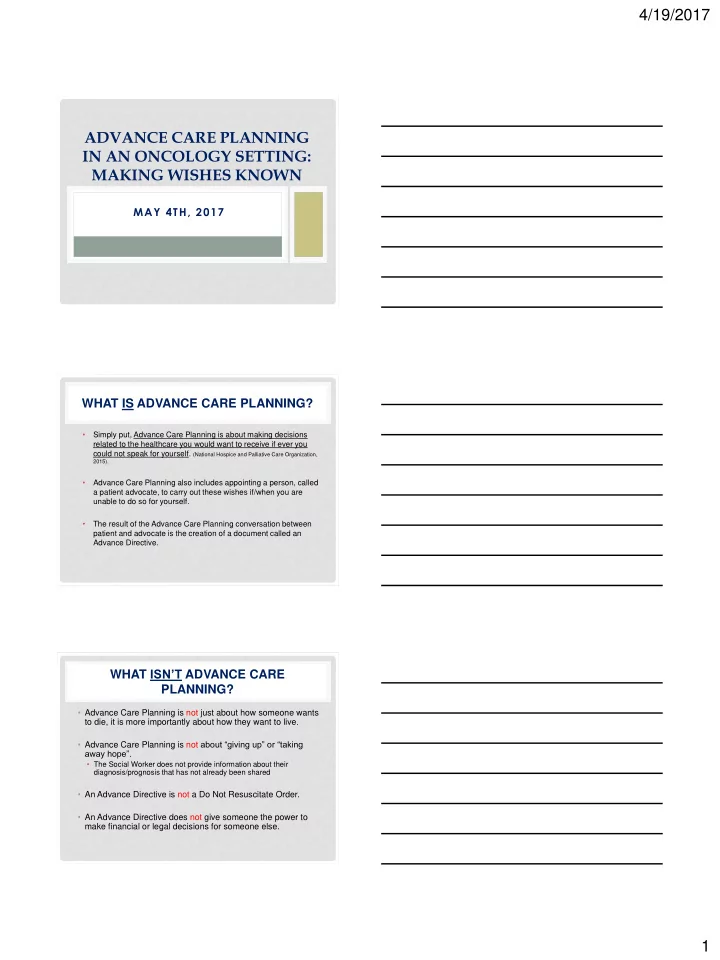
4/19/2017 ADVANCE CARE PLANNING IN AN ONCOLOGY SETTING: MAKING WISHES KNOWN MAY 4TH, 2017 WHAT IS ADVANCE CARE PLANNING? Simply put, Advance Care Planning is about making decisions related to the healthcare you would want to receive if


slide-1
SLIDE 1

4/19/2017 1

MAY 4TH, 2017

ADVANCE CARE PLANNING IN AN ONCOLOGY SETTING: MAKING WISHES KNOWN

WHAT IS ADVANCE CARE PLANNING?

  • Simply put, Advance Care Planning is about making decisions

related to the healthcare you would want to receive if ever you could not speak for yourself. (National Hospice and Palliative Care Organization,

2015).

  • Advance Care Planning also includes appointing a person, called

a patient advocate, to carry out these wishes if/when you are unable to do so for yourself.

  • The result of the Advance Care Planning conversation between

patient and advocate is the creation of a document called an Advance Directive.

WHAT ISN’T ADVANCE CARE PLANNING?

  • Advance Care Planning is not just about how someone wants

to die, it is more importantly about how they want to live.

  • Advance Care Planning is not about “giving up” or “taking

away hope”.

  • The Social Worker does not provide information about their

diagnosis/prognosis that has not already been shared

  • An Advance Directive is not a Do Not Resuscitate Order.
  • An Advance Directive does not give someone the power to

make financial or legal decisions for someone else.

slide-2
SLIDE 2

4/19/2017 2

WHY IS ADVANCE CARE PLANNING IMPORTANT?

  • Less than 15% of ambulatory patients with advanced cancer have

completed advance directives, nationwide. (Journal of Supportive Oncology,

2012)

  • In the last week of life, advanced cancer patients who had engaged in

previous end of life discussions had significantly lower healthcare costs. Those with higher costs were found to have a worse quality of life.

(Archives of Internal Medicine, 2009)

  • At least 50% of patients families report regret related to the end of life care

their loved one received. (Cancer, 2014)

  • Advance Care Planning is strongly correlated with a reduction in caregiver

distress.

WHY IS ADVANCE CARE PLANNING IMPORTANT? (CTD)

  • If a patient has not engaged in advance care planning, we do not

know who they would want to make decisions for them.

  • In Michigan, the default is the next of kin.
  • If several children, siblings, etc are identified, majority rules.
  • Sometimes patients are separated from a spouse, and would not want them

to make these decisions

  • If a patient has not engaged in advance care planning, we do not

know what kind of decisions to make.

  • Patients with an advance directive are less likely to have a feeding tube
  • r receive mechanical ventilation in the last month of life. (Journal of the

American Geriatrics Society, 2007)

  • Advance care planning works to reduce moral distress in

health care providers, by ensuring that we are providing the care the patient wants (American Journal of Critical Care, 2005)

WHO IS ADVANCE CARE PLANNING APPROPRIATE FOR?

  • Advance Care Planning is appropriate for every person over

the age of 18. It is not simply for patients who have a terminal diagnosis or chronic illness.

  • We have had patients experience unexpected health events or car

accidents while in the process of curative treatment

  • Advance Care Planning is not a “one size fits all

conversation,” and it is not meant to occur just once in a person’s life.

  • Advance Care Planning is a “journey,” not an end point
  • Different types of conversations are used for patients in varying

states of health, per the Respecting Choices Model.

slide-3
SLIDE 3

4/19/2017 3

FOCUSING ON QUALITY OF LIFE IN ADVANCE CARE PLANNING

  • Quality of life is defined by the patient, and allows us to look at the

whole person and define what is most important to them.

  • This understanding helps the advocate to make decisions for the patient when/if

needed that are in line with their quality of life goals.

  • There is no right or wrong. One person might define quality of life as simply being

able to sit up in bed, while another might define it as being able to get out of their house each day, independently.

  • Quality of life discussions allow patients to weigh continued

treatment or specific interventions against the impact they would have on their quality of life.

  • Quality of life discussions identify issues that are distressing or of

concern so that additional services can be provided, as needed.

FOCUSING ON QUALITY OF LIFE IN ADVANCE CARE PLANNING, CTD

  • Quality of life is often defined differently by the provider

than the patient

  • A recent study found that physicians thought symptom and

pain management were the most important predictors of quality of life at the end of life.

  • Patients, on the other hand, rated the following as most important:

mental awareness, having funeral arrangements planned, not being a “burden” to their loved ones, feeling they have completed what they need to, and coming to peace with God/their religion

  • These preferences persisted among all patients, even after

controlling for race, gender, socioeconomic status, and religion.

  • These are often the topics that come up in the nurse/patient

relationship

slide-4
SLIDE 4

4/19/2017 4

ADVANCE CARE PLANNING IN MICHIGAN

  • The only legally recognized document in Michigan is the

Designation of Patient Advocate/Durable Power of Attorney for Healthcare (DPOAH), whereby a patient appoints someone to make healthcare decisions on their behalf if ever they’re unable to.

  • This is not the same as a Durable Power of Attorney (DPOA), which grants

power related to financial decision making

  • Also, a person who is a patient’s DPOAH is not automatically their DPOA
  • Michigan does not recognize living wills, from a legal perspective.
  • The patient must sign the Advance Directive in the presence of two

witnesses who are not related by blood or marriage, and are also not employed by any of their health care providers (includes nursing home)

  • r insurance companies.
  • The advocate must also sign the document accepting the responsibility.

ACTIVATING AN ADVANCE DIRECTIVE

  • In order for an advocate to take over medical decision making for a

patient, two physicians (or one physician and a psychologist) must determine that the patient lacks the capacity to make medical decisions for themselves (MCL 700.5508.1).

  • The advocate is then responsible for making any and all decisions for

the patient related to their health care

  • Including where care is given, what care is given, when care is

withheld, etc

  • The advocate does NOT get any type of special decision making

power until the AD is activated