4/13/15 April 8, 2015 H&H cont Snail 1 Lab Results due - - PDF document

4 13 15
SMART_READER_LITE
LIVE PREVIEW

4/13/15 April 8, 2015 H&H cont Snail 1 Lab Results due - - PDF document

4/13/15 April 8, 2015 H&H cont Snail 1 Lab Results due tomorrow See data folders in Dropbox Voltage clamp of squid giant axon Alan Hodgkin Andrew Huxley Sammy Squid Prize motivation: "for their discoveries concerning the ionic


slide-1
SLIDE 1

4/13/15 1

April 8, 2015

H&H cont Snail 1 Lab Results due tomorrow See data folders in Dropbox

Alan Hodgkin Andrew Huxley

Prize motivation: "for their discoveries concerning the ionic mechanisms involved in excitation of the nerve cell membrane"

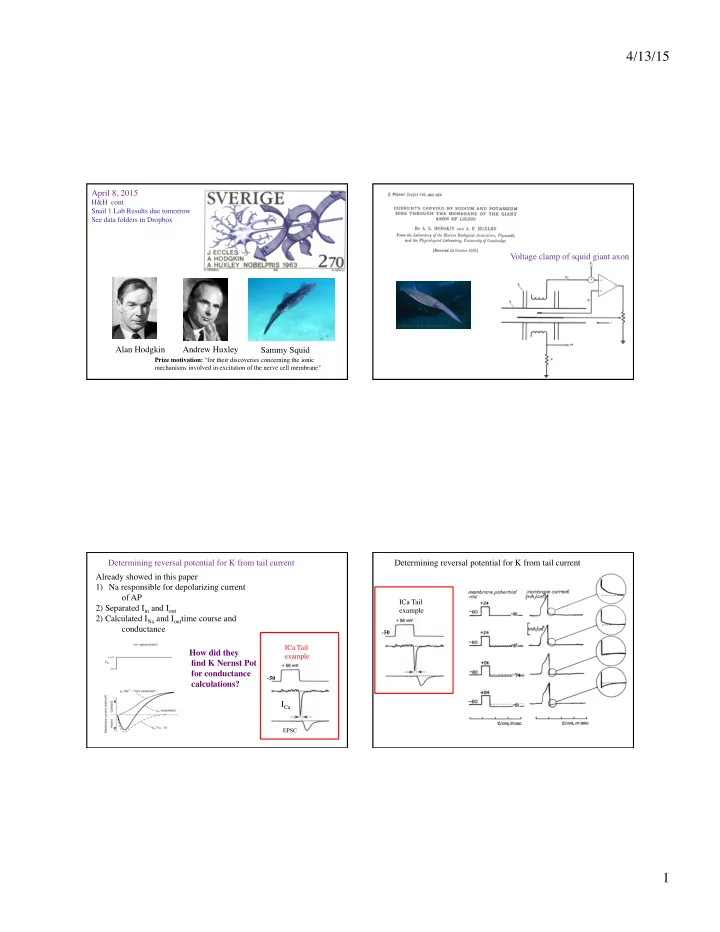
Sammy Squid Voltage clamp of squid giant axon Determining reversal potential for K from tail current Already showed in this paper 1) Na responsible for depolarizing current

  • f AP

2) Separated Iin and Iout 2) Calculated INa and Iouttime course and conductance

ICa Tail example

  • 50

ICa

EPSC

How did they find K Nernst Pot for conductance calculations? Determining reversal potential for K from tail current ICa

EPSC

ICa Tail example

  • 50
slide-2
SLIDE 2

4/13/15 2

Conductance/Voltage relationship

RP = -55 mV

Depolarization Depolarization

INa IK Conductance rate of rise/voltage relationship

RP = -55 mV

Depolarization Depolarization

INa IK

What did they do in the first paper?? 1) Showed that Na+ is the inward charge carrier for the AP. 2) Separated INa and Ik. 3) Expressed the currents in terms of conductance. 4) Applied this to calculations of the time course of gNa and gK. 5) Suggested the importance of these currents for the AP.

Voltage clamp of squid giant axon “Share the prize!”

slide-3
SLIDE 3

4/13/15 3

This paper was concerned with: 1) Providing some quantitative evidence about the influence of membrane potential on the process responsible for inactivation. 2) Quantifying the rate at which repolarization restores the ability of the membrane to respond with its characteristic increase in Na+ permeability.

I Na Changing conditioning pulse time- depolarizing duration

Pre-pulse > 20 ms, 40% reduction of Iin 0 = -55 mV

Changing conditioning pulse time- hyperpolarizing duration

Iin inactivation at rest!

0 = -55 mV

Inactivation and recovery exponential Reached steady state Faster at larger V steps

0 = -55 mV

slide-4
SLIDE 4

4/13/15 4

Changing conditioning pulse amplitude Time is constant, pre-step is changed

0 = -55 mV

h = ability of membrane to undergo a change in Na permeability 40% inactivation at rest!

h infinity curve

0 = -55 mV depolarize hyperpolarize

inactivation curve

Activation/ inactivation parameters

activation curve

What is the state of the Na channel?