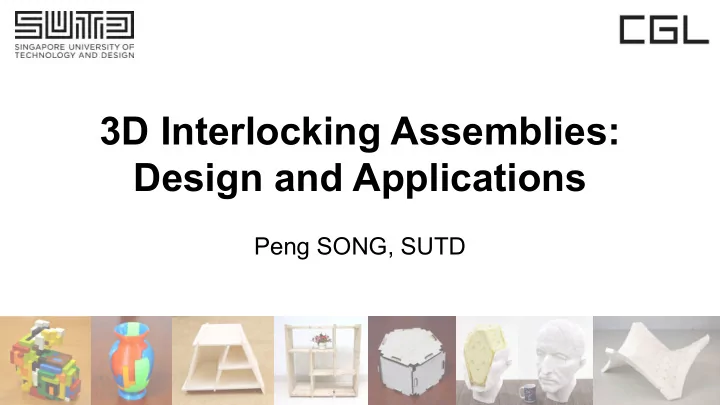
SLIDE 1
3D Interlocking Assemblies: Design and Applications
Peng SONG, SUTD
SLIDE 2
3D Assemblies
Composed of multiple component parts with a specific form and functionality
SLIDE 3
Steady Assembly
Need parts joining approach to restrict parts relative movements
SLIDE 4
Parts Joining
Unsteady Irreversible Break parts Tedious
SLIDE 5
Interlocking Assembly
Can we make a steady assembly without relying on any fasteners?
SLIDE 6
Interlocking Assembly
Can we make a steady assembly without relying on any fasteners? Solution: parts connected based on their geometric arrangements.
SLIDE 7
Interlocking Assembly
Can we make a steady assembly without relying on any fasteners? Solution: parts connected based on their geometric arrangements.
SLIDE 8 Intriguing Properties
Steady Disassemblable Ease of assembly
SLIDE 9
Applications
SLIDE 10 Formal Definition
Deadlocking Non-interlocking Interlocking
An assembly is interlocking if only one movable part (key), while all
- ther parts, as well as any subset of the parts, are immobilized
Test interlocking has exponential complexity!!!
SLIDE 11 Interlocking Assembly: Design Problem
Input: target shape Output: interlocking assembly
SLIDE 12 Input: target shape (with segmented parts) Output: interlocking assembly
Interlocking Assembly: Design Problem
SLIDE 13
- Need to test immobilization of every single part and every subset of parts
Challenge #1 Test Interlocking
SLIDE 14
- Need to test immobilization of every single part and every subset of parts
Challenge #1 Test Interlocking
SLIDE 15
- Need to test immobilization of every single part and every subset of parts
Challenge #1 Test Interlocking
SLIDE 16
- Need to test immobilization of every single part and every subset of parts
Challenge #1 Test Interlocking
SLIDE 17
- Need to test immobilization of every single part and every subset of parts
Challenge #1 Test Interlocking
SLIDE 18
- Need to test immobilization of every single part and every subset of parts
- A subset of parts can be movable along different directions simultaneously
Single-direction movement Single-direction movement Multi-direction movement
Challenge #1 Test Interlocking
SLIDE 19 Assembly can be progressively disassembled into a set of individual parts
Deadlocking assembly Input: segmented parts
Challenge #2 Disassemblable
SLIDE 20 Deadlocking sub-assembly Input: segmented parts
Challenge #2 Disassemblable
Assembly can be progressively disassembled into a set of individual parts
SLIDE 21 Need to construct parts geometry such that every single part and every subset of parts are immobilized, except the key
Input: segmented parts
Challenge #3 Parts Immobilization
SLIDE 22 Input: segmented parts Movable parts group
Challenge #3 Parts Immobilization
Need to construct parts geometry such that every single part and every subset of parts are immobilized, except the key
SLIDE 23 Input: segmented parts
Challenge #3 Parts Immobilization
Need to construct parts geometry such that every single part and every subset of parts are immobilized, except the key
SLIDE 24 Input: segmented parts Interlocking Assembly
Challenge #3 Parts Immobilization
Need to construct parts geometry such that every single part and every subset of parts are immobilized, except the key
SLIDE 25 Interlocking Assembly: Related Works
1978 2012 2011 ancient 2015 2016 2017 2018
SLIDE 26 Interlocking Assembly: Related Works
1978 2012 2011 ancient 2015 2016 2017 2018
SLIDE 27 Interlocking Assembly: Related Works
1978 2012 2011 ancient 2015 2016 2017 2018
SLIDE 28 Overview
Recursive Interlocking Puzzles SIGGRAPH Asia 2012 DESIA: A General Framework for Designing Interlocking Assemblies SIGGRAPH Asia 2018
SLIDE 29 Overview
Recursive Interlocking Puzzles SIGGRAPH Asia 2012 DESIA: A General Framework for Designing Interlocking Assemblies SIGGRAPH Asia 2018
SLIDE 30
Interlocking Puzzles
2D puzzle 3D puzzle 3D interlocking puzzle
SLIDE 31 Interlocking Puzzles
3D interlocking puzzle
SLIDE 32 Our Goal: Design Interlocking Puzzles
Input: voxelized model Output: K interlocking parts
SLIDE 33 Test Interlocking: Parts Immobilization
An assembly is interlocking if only one movable part (key), while all other parts, as well as any subset of parts, are immobilized C(K, 1) C(K, 2) C(K, 𝐿/2 ) + + … = 2("#$) subsets of parts
K = 5
..
SLIDE 34 Test Interlocking: Parts Immobilization
K = 5
..
An assembly is interlocking if only one movable part (key), while all other parts, as well as any subset of parts, are immobilized
2("#$) subsets of parts
SLIDE 35 +x +y
Test immobilization: P1 (movable along –x, +x, -y, +y?)
P1 ..
Test Interlocking: Parts Immobilization
An assembly is interlocking if only one movable part (key), while all other parts, as well as any subset of parts, are immobilized
2("#$) subsets of parts
SLIDE 36 +x +y
P1: not movable along -x
P1 ..
Test Interlocking: Parts Immobilization
An assembly is interlocking if only one movable part (key), while all other parts, as well as any subset of parts, are immobilized
2("#$) subsets of parts
SLIDE 37 +x +y
P1
P1: not movable along +x
..
Test Interlocking: Parts Immobilization
An assembly is interlocking if only one movable part (key), while all other parts, as well as any subset of parts, are immobilized
2("#$) subsets of parts
SLIDE 38 +x +y
P1
P1: not movable along -y
..
Test Interlocking: Parts Immobilization
An assembly is interlocking if only one movable part (key), while all other parts, as well as any subset of parts, are immobilized
2("#$) subsets of parts
SLIDE 39 +x +y
P1
P1: movable along +y
..
Test Interlocking: Parts Immobilization
An assembly is interlocking if only one movable part (key), while all other parts, as well as any subset of parts, are immobilized
2("#$) subsets of parts
SLIDE 40 +x +y
P2 P1
P1P2 : not movable along -x
..
Test Interlocking: Parts Immobilization
An assembly is interlocking if only one movable part (key), while all other parts, as well as any subset of parts, are immobilized
2("#$) subsets of parts
SLIDE 41 +x +y
P1
P1P2 : not movable along +x
..
Test Interlocking: Parts Immobilization
An assembly is interlocking if only one movable part (key), while all other parts, as well as any subset of parts, are immobilized
2("#$) subsets of parts P2
SLIDE 42 +x +y
P1
P1P2 : not movable along -y
..
Test Interlocking: Parts Immobilization
An assembly is interlocking if only one movable part (key), while all other parts, as well as any subset of parts, are immobilized
2("#$) subsets of parts P2
SLIDE 43 +x +y
P1
P1P2 : not movable along +y
..
Test Interlocking: Parts Immobilization
An assembly is interlocking if only one movable part (key), while all other parts, as well as any subset of parts, are immobilized
2("#$) subsets of parts P2 Test mobility of 4 axial directions
SLIDE 44 2("#$) subsets of parts
+x +y
P1
P1P2 : immobilized
Test mobility of 4 axial directions
×
Total cost = ..
Test Interlocking: Parts Immobilization
An assembly is interlocking if only one movable part (key), while all other parts, as well as any subset of parts, are immobilized
P2
SLIDE 45 Challenge : Test interlocking for puzzle with K > 20 parts is too computational expensive; Yet, we want to design interlocking puzzles with K as large as possible (e.g., K = 100)
The complexity of testing interlocking is exponential in K
K = 30 K = 10 K = 20 K = 40
Test Interlocking: Parts Immobilization
SLIDE 46
Key Idea #1: Formal Model
SLIDE 47 P1 P2 P4 P5 P6 R9 P7 P9 P8 P3 Global Interlocking R9 P9 P8
R2 P1 P2
P2 R3 P3 R4 P4 P3 R5 P4 P5 R6 P5 P6 R7 P6 P7 P8 P7 P8
R1 P1 S
Local interlocking groups
Skip the exponential time complexity of testing global interlocking!!!
SLIDE 48 R2 R3 P1
Given [P1, …, Pi-1, Ri-1], partition Pi-1 (i>1) into Pi and Ri such that
- 1. [Pi-1, Pi, Ri] is interlocking
P1 P2
[P1, P2, R2]
P2 P3
[P1, P2, P3, R3]
P1
Key Idea #2: Partition Requirements
SLIDE 49 R3
Given [P1, …, Pi-1, Ri-1], partition Pi-1 (i>1) into Pi and Ri such that
- 1. [Pi-1, Pi, Ri] is interlocking
[P1, P2, R2]
P2 P3
[P1, P2, P3, R3]
R2 P1 P2
Key Idea #2: Partition Requirements
SLIDE 50 R3
Given [P1, …, Pi-1, Ri-1], partition Pi-1 (i>1) into Pi and Ri such that
- 1. [Pi-1, Pi, Ri] is interlocking
- 2. Pi is disassemblable in [Pi, Ri]
[P1, P2, R2] [P1, P2, P3, R3]
P2 P3 R2 P1 P2
Key Idea #2: Partition Requirements
SLIDE 51 R3
Given [P1, …, Pi-1, Ri-1], partition Pi-1 (i>1) into Pi and Ri such that
- 1. [Pi-1, Pi, Ri] is interlocking
- 2. Pi is disassemblable in [Pi, Ri]
[P1, P2, R2] [P1, P2, P3, R3]
P3 R2 P1 P2
Key Idea #2: Partition Requirements
SLIDE 52 R3
Given [P1, …, Pi-1, Ri-1], partition Pi-1 (i>1) into Pi and Ri such that
- 1. [Pi-1, Pi, Ri] is interlocking
- 2. Pi is disassemblable in [Pi, Ri]
- 3. Pi is connected; Ri is connected
[P1, P2, R2] [P1, P2, P3, R3]
P2 P1 P3 R2 P1 P2
Key Idea #2: Partition Requirements
SLIDE 53 R3
Given [P1, …, Pi-1, Ri-1], partition Pi-1 (i>1) into Pi and Ri such that
- 1. [Pi-1, Pi, Ri] is interlocking
- 2. Pi is disassemblable in [Pi, Ri]
- 3. Pi is connected; Ri is connected
[P1, P2, R2] [P1, P2, P3, R3]
P3 R2 P1 P2
Key Idea #2: Partition Requirements
SLIDE 54 R3
Given [P1, …, Pi-1, Ri-1], partition Pi-1 (i>1) into Pi and Ri such that
- 1. [Pi-1, Pi, Ri] is interlocking
- 2. Pi is disassemblable in [Pi, Ri]
- 3. Pi is connected; Ri is connected
[P1, P2, R2] [P1, P2, P3, R3]
R2 P1 P2
Key Idea #2: Partition Requirements
SLIDE 55 R3
Given [P1, …, Pi-1, Ri-1], partition Pi-1 (i>1) into Pi and Ri such that
- 1. [Pi-1, Pi, Ri] is interlocking
- 2. Pi is disassemblable in [Pi, Ri]
- 3. Pi is connected; Ri is connected
[P1, P2, R2] [P1, P2, P3, R3]
P2 P1 P3 R2 P1 P2
Key Idea #2: Partition Requirements
SLIDE 56 Seed Voxel
x z y
Blocking & Blockee Voxel Pair Selected Path Blocking & Blockee Voxel Pair
Construct the key piece P1 (movable only along +x)
Key Idea #3: Constructive Approach
SLIDE 57 Construct the 2nd piece P2 (immobilized by the key)
x z y
Seed Voxel Blocking & Blockee Voxel Pair Selected Path Blocking & Blockee Voxel Pair
Key Idea #3: Constructive Approach
SLIDE 58
Our Result
SLIDE 59
Our Result
SLIDE 60
Our Result
SLIDE 61
Our Result
SLIDE 62 Summary of the project
- A formal model to directly guarantee recursive interlocking based on
building local interlocking groups (LIGs)
- Requirements to ensure local interlocking of intermediate assemblies
when extracting each puzzle piece
- A constructive approach to iteratively generate geometry of each puzzle
piece
SLIDE 63 Song et al. Printing 3D Objects with Interlocking Parts. CAGD (Proc. of GMP), 2015
Follow-up Work: Interlocking Objects for 3D Printing
SLIDE 64 Follow-up Work: Interlocking Objects for 3D Printing
Song et al. Printing 3D Objects with Interlocking Parts. CAGD (Proc. of GMP), 2015
SLIDE 65 Overview
Recursive Interlocking Puzzles SIGGRAPH Asia 2012 DESIA: A General Framework for Designing Interlocking Assemblies SIGGRAPH Asia 2018
SLIDE 66 The Recursive Interlocking approach can explore only a limited design space
LIG design space
Motivation
SLIDE 67 The Recursive Interlocking approach can explore only a limited design space
LIG design space
Motivation
SLIDE 68 The Recursive Interlocking approach can explore only a limited design space
LIG design space
Motivation
SLIDE 69 The Recursive Interlocking approach can explore only a limited design space
LIG design space
Motivation
SLIDE 70 The Recursive Interlocking approach can explore only a limited design space
LIG design space
Motivation
SLIDE 71 The Recursive Interlocking approach can explore only a limited design space
LIG design space
Motivation
SLIDE 72 Full design space
The Recursive Interlocking approach can explore only a limited design space
LIG design space
Motivation
SLIDE 73 Can we have a general framework to design interlocking assemblies that can explore the full search space of all possible interlocking configurations?
…
- 1. Provide more design flexibility
- 2. Useful for designing new interlocking assemblies
Our Goal: Design Interlocking Assembly
SLIDE 74 Our Key Idea: Graph-based Representation
Test and design interlocking assemblies Directional blocking graphs Invented by Wilson [1992]
G(+x, A) G(+y, A)
+x +y
A
SLIDE 75 Contribution #1: Test Interlocking
All graphs are strongly connected
(except the key part)
The 3D assembly is interlocking Polynomial time complexity!!!
G(+x, A) G(+y, A)
+x +y
A
SLIDE 76
+x +y
Test Interlocking: Directional Blocking Graph
Given an assembly A and a certain axial direction d
SLIDE 77
+x +y
Test Interlocking: Directional Blocking Graph
Create a directed edge from Pi to Pj iff Pj blocks Pi from translating along d
SLIDE 78
+x +y
Test Interlocking: Directional Blocking Graph
SLIDE 79
+x +y
Test Interlocking: Directional Blocking Graph
SLIDE 80
+x +y
Test Interlocking: Directional Blocking Graph
SLIDE 81
+x +y
Test Interlocking: Directional Blocking Graph
SLIDE 82
+x +y
Test Interlocking: Directional Blocking Graph
SLIDE 83
G(+x, A)
+x +y
Test Interlocking: Directional Blocking Graph
Create a directional blocking graph for d = +x A
SLIDE 84
G(+x, A)
+x +y
G(+y, A)
Test Interlocking: Directional Blocking Graph
Create a directional blocking graph for d = +y A
SLIDE 85
G(+x, A)
+x +y
G(+y, A)
Test Interlocking: Directional Blocking Graph
The two graphs are called base directional blocking graphs of the assembly
SLIDE 86
G(+x, A)
+x +y
G(+y, A)
Test Interlocking: Directional Blocking Graph
An assembly is interlocking if all base directional blocking graphs are
strongly connected except the key. The complexity of this testing approach is polynomial since finding all strongly connected components can be done in O(n2)
SLIDE 87 Contribution #2: Design Interlocking
Make all graphs strongly connected Construct interlocking parts geometry
G(+x, A) G(+y, A)
+x +y
A
SLIDE 88
Design Interlocking: Iterative Construction
R0
R R
G(+x, A0) G(+y, A0)
+x +y
Geometry Space Graph Space
SLIDE 89
Design Interlocking: Iterative Construction
1 R R 1
G(+x, A1) G(+y, A1)
+x +y
Split nodes
R0
SLIDE 90 Design Interlocking: Iterative Construction
1 R R 1
G(+x, A1) G(+y, A1)
+x +y
Graph Design
(make graphs strongly connected except the key)
R0
SLIDE 91 Design Interlocking: Iterative Construction
P1 R1
1 R R 1
G(+x, A1) G(+y, A1)
+x +y
Graph Design
(make graphs strongly connected except the key)
Geometry Realization
(realize blocking relations in the graphs)
SLIDE 92
Design Interlocking: Iterative Construction
P1 R1
1 R R 1
G(+x, A1) G(+y, A1)
+x +y
Graph Design Geometry Realization
SLIDE 93
Design Interlocking: Iterative Construction
1 2 R 1
G(+x, A2) G(+y, A2)
2 R
+x +y
Graph Design Geometry Realization
P1 R1
SLIDE 94
Design Interlocking: Iterative Construction
G(+x, A2) G(+y, A2) Graph Design Geometry Realization
1 2 R 1 2 R
+x +y
P1 R1
SLIDE 95
Design Interlocking: Iterative Construction
P1 P2 R2
G(+x, A2) G(+y, A2)
+x +y
Graph Design Geometry Realization
1 2 R 1 2 R
SLIDE 96
Design Interlocking: Iterative Construction
P1 P2 P3 R3
1 2 3 R 2 3 R 1
G(+x, A3) G(+y, A3)
+x +y
Graph Design Geometry Realization
SLIDE 97
Design Interlocking: Iterative Construction
P5 P1 P2 P3 P4
1 2 3 4 5 1 2 3 4 5
G(+x, A4) G(+y, A4)
+x +y
Graph Design Geometry Realization
SLIDE 98 Design Interlocking: Tree-traversal Search
Search space is explored in a tree traversal process with automatic backtracking
SLIDE 99 Results: Interlocking Voxelized Structures
G(+x, A) G(+y, A) G(+z, A)
1 2 4 5 6 7 9 8 3 1 2 4 5 6 7 3 9 8 1 2 4 5 6 8 7 3 9
+x +y +z
9-part Interlocking Cube
SLIDE 100 Results: Interlocking Voxelized Structures
14-part Interlocking Dog
G(+x, A) G(+y, A) G(+z, A)
+x +y +z
SLIDE 101 Results: Interlocking Voxelized Structures
+x +y +z
14-part Interlocking Dog
SLIDE 102 Results: Interlocking Voxelized Structures
Input model
1300-part Interlocking Cube
SLIDE 103 Results: Interlocking Frame Structures
Voxel joints
SLIDE 104 Results: Fabrication
Our designed Frame Chair
SLIDE 105 Summary of the project
- Make a connection between interlocking assemblies and a family of directional
blocking graphs
- A graph-based method to test interlocking efficiently
- A graph-based method to design interlocking assemblies
- graph design + geometry realization
G(+x, A) G(+y, A)
+x +y
A
SLIDE 106
- Parts fabrication
- Parts joining
- Parts assembly
- Parts packing
- Structural Stability
- Reconfigurability
- Functionality
Outlook: Computational Design of Complex Assemblies
SLIDE 107
More information can be found at https://sutd-cgl.github.io/
Thank You!