3/3/2016 Forms of Municipal Government in South Carolina Jeff - - PDF document

3 3 2016
SMART_READER_LITE
LIVE PREVIEW

3/3/2016 Forms of Municipal Government in South Carolina Jeff - - PDF document

3/3/2016 Forms of Municipal Government in South Carolina Jeff Shacker Municipal Association of South Carolina Establishment of FOG FOG established by the Local Government Act of 1975, known as the Home Rule Act Home Rule Act granted


slide-1
SLIDE 1

3/3/2016 1

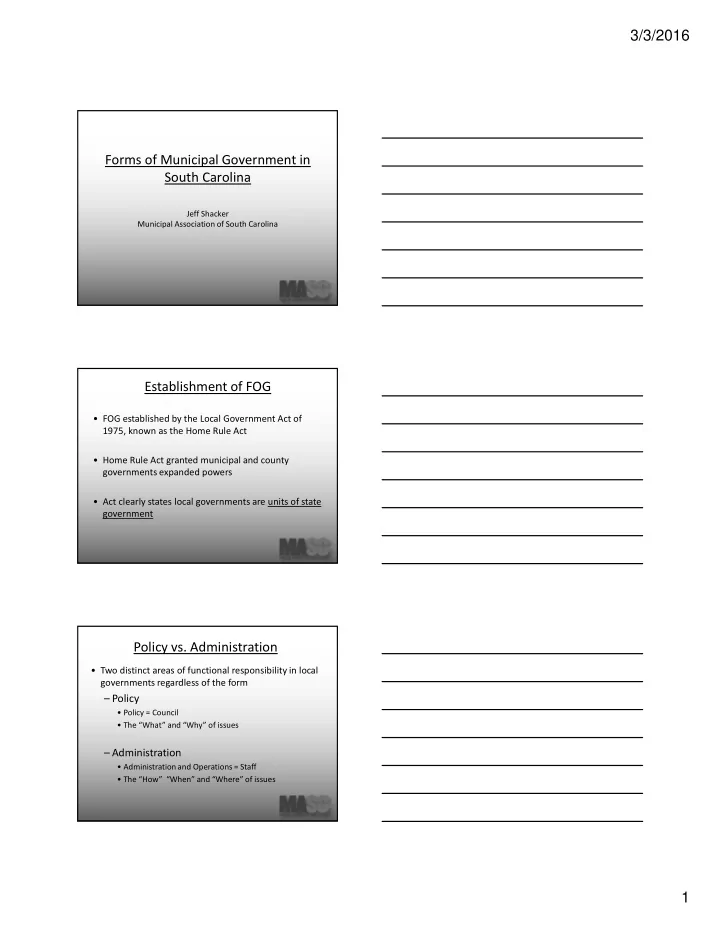
Forms of Municipal Government in South Carolina

Jeff Shacker Municipal Association of South Carolina

Establishment of FOG

  • FOG established by the Local Government Act of

1975, known as the Home Rule Act

  • Home Rule Act granted municipal and county

governments expanded powers

  • Act clearly states local governments are units of state

government

Policy vs. Administration

  • Two distinct areas of functional responsibility in local

governments regardless of the form

– Policy

  • Policy = Council
  • The “What” and “Why” of issues

– Administration

  • Administration and Operations = Staff
  • The “How” “When” and “Where” of issues
slide-2
SLIDE 2

3/3/2016 2

What Distinguishes The Forms Of Government

  • The major difference is where the executive and

administrative powers and responsibilities of the local government are vested

– The legislative function remains with the council under all forms of municipal government – Powers, roles and responsibilities exercised by the mayor, council and chief administrative officer (CAO) differ among FOG

Municipal Government In South Carolina

  • General Information

– 270 municipalities – Most are very small (207 less than 5,000 population) – Great variation in population and complexity of municipal governments

  • Three Authorized Forms Of Municipal Government

– Mayor-Council - 142 (91 under 1K, 3 over 25K) – Council - 96 (30 under 1K, 3 over 25K) – Council-Manager – 32 (1 under 1K, 10 over 25K)

Mayor-Council Form

  • General Information

– Most used form of government in South Carolina municipalities (142 of 270 municipalities) – Often called the strong mayor form because the Mayor is granted by state law the right to exercise legislative as well as executive and administrative authority

slide-3
SLIDE 3

3/3/2016 3

Mayor-Council Form

  • Council Powers

– Serves as legislative body – Determines policy for municipality – Appoints city attorney, city judge and municipal clerk – Approves annual budget

  • Mayor’s Powers

– State statute designates mayor as presiding officer – Serves as chief administrative officer (CAO) and is responsible for:

  • Preparation, administration and reporting of the

budget and financials to council

  • Oversight of city departments and all day to day
  • perations
  • Responsible for all personnel decisions except as
  • therwise provided by law and council

Mayor-Council Form Mayor-Council Form

  • Mayor’s Powers

– Votes as a member of council – Presides over meetings of council – Makes annual financial reports to public and council – Reports to council on the operations of departments – With Council approval, may hire an administrator to assist – Insures the faithful execution of laws

slide-4
SLIDE 4

3/3/2016 4

Council Form

  • General Information

– Second most used form of government in South Carolina municipalities (96 of 270 municipalities) – Sometimes called the weak mayor form which refers to the Mayor’s lack of formal executive authority – No separation of powers between the executive and the legislative functions – Often called governance by committee because of shared powers

Council Form

  • Council Powers

– Exercises all legislative and administrative functions – Establishes all departments and agencies of the municipal government – Appoints the city clerk, attorney, judge and all employees – Council may hire an administrator whose duties should be defined by ordinance of council – Responsible for adopting a balanced operating budget

Council Form

  • Mayor’s Powers

– Performs administrative duties only if authorized by council – Presides at meetings of council by tradition, not statutory authority – May exercise "informal" authority as leader of council/staff and as spokesperson for the council

slide-5
SLIDE 5

3/3/2016 5

Council Form

  • CAO Powers

– The chief administrative officer, if appointed by council, is called an administrator – Administrator's authority may vary from city to city – The administrator’s powers are limited to those specifically delegated and prescribed by council

Council-Manager Form

  • General Information

– Third most used form: 32 of 270 municipalities – The mayor and council members are forbidden by law from interfering with the operation of the departments,

  • ffices and agencies under the direction of the manager

– No direct involvement in the hiring or firing of employees under the manager or directly dealing with or giving

  • rders to those employees

Council-Manager Form

  • Council Powers

– Serves as legislative body – Determines all municipal policies – Hires and fires city manager – Appoints the municipal attorney and judge

slide-6
SLIDE 6

3/3/2016 6

Council-Manager Form

  • Mayor’s Powers

– No powers beyond that of being a member of council – Presides at meetings of council by tradition, not statutory authority – May exercise "informal" authority as leader of council and spokesperson for the council

Council-Manager Form

  • City Manager’s Powers

– The city manager serves at the pleasure of council – State statute defines the powers of the city manager – The city manager serves as the chief executive officer and head of the administrative branch – Empowered to appoint, remove and fix the salary of all employees – Prepares, submits to council and then upon approval, administers a balanced budget – Performs any other duties prescribed by law or required by council – Appoints municipal clerk

Council/Manager Form

  • City Manager’s Powers continued
  • Prepares an annual financial report to council and

advises council of the financial condition of the municipality

  • Advises council on the appointment to boards,

recommends the creation, change or abolition of departments and designates a temporary manager in his or her absence

  • Implements policies through administrative control of

all departments, offices and agencies

slide-7
SLIDE 7

3/3/2016 7

Change in Form of Municipal Government

Ordinance Method – The Municipal council calls for referendum by ordinance Petition Method – Requires the signatures of at least fifteen percent of the municipality’s qualified electors

  • A majority of referendum voters must vote for a change

Another referendum to change the form of government may only be held four years after a vote

Resources

S.C. Code of Laws Title 5 Chapters 5,9,11,13 Municipal Association

  • f SC

www.masc.sc Keyword: forms of government