3/21/2016 Carolyn Smith S. C. Archives & History Records & - - PDF document

3 21 2016
SMART_READER_LITE
LIVE PREVIEW

3/21/2016 Carolyn Smith S. C. Archives & History Records & - - PDF document

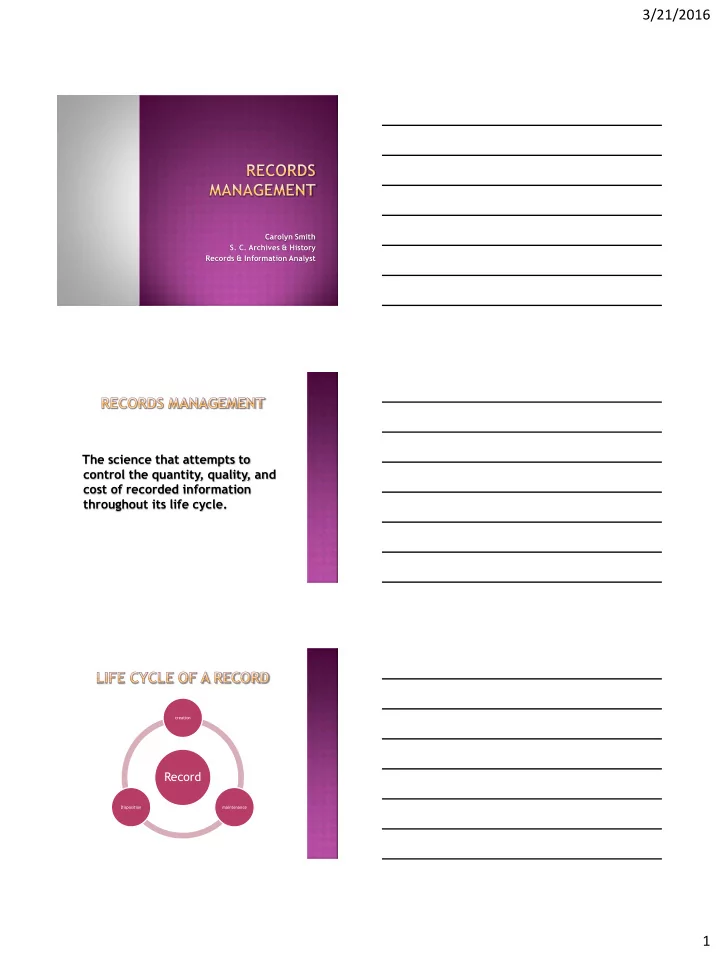
3/21/2016 Carolyn Smith S. C. Archives & History Records & Information Analyst The science that attempts to control the quantity, quality, and cost of recorded information throughout its life cycle. creation Record Disposition


slide-1
SLIDE 1

3/21/2016 1

Carolyn Smith

  • S. C. Archives & History

Records & Information Analyst

The science that attempts to control the quantity, quality, and cost of recorded information throughout its life cycle. Record

creation maintenance Disposition

slide-2
SLIDE 2

3/21/2016 2

Provides control over records from

creation to destruction

Ensures records are retained until

mandatory retention periods are met

Complies with the South Carolina Public

Records Act

Cost-effective

Ensures records are available Efficient Cost-effective.

Costly Wastes space and

time

Difficult to locate

vital files when needed.

Legal Liability

slide-3
SLIDE 3

3/21/2016 3

Pictures show us how Not to maintain our records as well as the best way to keep them….

slide-4
SLIDE 4

3/21/2016 4

THE MINIMUM STANDARDS FOR FACILITIES WHICH HOUSE SOUTH CAROLINA PUBLIC RECORDS

Construction Environment Security/Protection

The Public c Records ds Act

slide-5
SLIDE 5

3/21/2016 5

Enacted into law in 1973. Governs the relationship between the

Archives and local governments. SECTION 30-1-80. Records Management Program.

A records management program directed to the application of efficient and economical management methods and relating to the creation, utilization, maintenance, retention, preservation, and disposal of public records must be established and administered by the Archives. Section 30-1-90

(A) Archives will assist with inventorying and scheduling your records (B) Retention schedules must be approved by the Executive Officer , the Governing Board and Archives Director (C) Archives may establish General Schedules for records common to all agencies or subdivisions (D) Archives may review all public records, even those designated as closed, confidential or restricted (E) No records may be disposed of, destroyed or erased without an approved retention schedule. All records destruction must be carried out in accordance with the procedures developed by the Archives

slide-6
SLIDE 6

3/21/2016 6

Section 30-1-100 Additional powers and

duties of Archives.

(E) - When any public records have been destroyed or otherwise disposed of in accordance with the procedures authorized in section 30-1-90 and 30-1-110, any liability that the custodian of the records might incur as a result of the official action shall cease

 To establish retention schedules for public

records.

 To provide records management training

Recorded information regardless of medium or format created by your

  • ffice in the course of its business.
slide-7
SLIDE 7

3/21/2016 7

Paper: loose sheets/bound volumes Electronic Media Maps Photographs Audio or Video Tapes Microfilm

Materials that you did not create or that contain no information.

Blank forms Technical journals Federal and State Publications Junk mail Magazines

  • Names the record
  • Describes the purpose and content
  • States the amount of time

to retain the information

  • Indicates the final disposition

Timetable allowing for the regular and legal

disposal of records of non-permanent value.

slide-8
SLIDE 8

3/21/2016 8

 Provides uniform guidelines for the retention of

records.

 Ensures records are available for answering

administrative, legal, fiscal and historical needs.

 Complies with Federal & State laws,

regulations and policies.

 Promotes cost-effective management.  Provides legal authorization for the

destruction of public records.

General Specific

Contain records common to all

Municipalities.

Established and approved as

Regulations.

Can be used immediately.

slide-9
SLIDE 9

3/21/2016 9

12-605.6. Bids

  • A. Description: A record of each bid submitted by vendors selling goods and/or

services to the municipality. Information includes request for quotation, bid spread sheet, and bid award letter.

  • B. Retention: 3 years, then destroy.

12-605.7. Requisitions

  • A. Description: Request forms from the various municipal offices and departments

which describe goods or services to be ordered by the municipality. Information includes number, department, delivery location, date, date required, item number, quantity, description, known suppliers, and authorizing signature.

  • B. Retention: 3 years, then destroy.

12-605.8. Purchase Orders

  • A. Description: Purchase orders for goods and services paid for by the

municipality, or for goods and services yet to be delivered to the municipality. Information includes quantity, commodity, service unit, price, total price, number, page number, name of company or business, address, date, item number, delivery location, total items, and signature of purchasing agent.

  • B. Retention: 3 years, then destroy.
slide-10
SLIDE 10

3/21/2016 10

Records not included in the General Retention Schedules. Before destroying unique records, an approved specific retention schedule must be established.

Are prepared and approved specifically for your office. The local government name and the department appears on the specific schedule. A 5-digit schedule number is assigned by the Archives.

Created by the Archives after we

receive inventory worksheets (ARM-1 form).

Schedules are reviewed and approved

by the Department Head and the Governing Body chairman.

Schedules may be implemented after

approval of the SC Archives Director.

slide-11
SLIDE 11

3/21/2016 11

Complete a Record Series

Inventory Form (ARM-1)

Submit the completed form to the

Archives

slide-12
SLIDE 12

3/21/2016 12

  • Schedule Number:

A five-digit number assigned by the Archives For Example: 13813

  • Series Title:

Bankruptcy Notices

 Description: A short statement describing the

use and informational content of the record series.

Notification from the U.S. Bankruptcy Court of bankruptcy cases regarding properties/businesses in the City of Fountain Inn. Information includes name of debtor, name of bankruptcy judge, notice

  • f entry and attorney name(s).

 Retention: The minimum length of time records

must be retained by the office. Example: 10 years, then destroy.

slide-13
SLIDE 13

3/21/2016 13

Periodically cut off files as well as

segregate inactive and obsolete records.

Dispose of inactive records when

the minimum retention has been met, unless needed for audit or legal reasons.

slide-14
SLIDE 14

3/21/2016 14

Paper Records - May be destroyed after the required retention period has been met. Microfilmed Records – After microfilming permanent records, the paper records may be eligible for destruction. Digital Images – After converting paper records to electronic media, the paper records may be destroyed provided you agree to the Archives guidelines for Records stored as Digital Images. (see Technical Leaflet # 13)

Complete an ARM-11- “Report on Records Destroyed” Form - if you are destroying paper records that have met the required retention period.

OR

Complete an ARM-13 – “Authorization for the Disposal

  • f Original Paper Records Stored as Digital Images”

Form - if you are digitizing records and wish to destroy the paper before the required retention period has been met. Submit completed form(s) to the Archives Retain a copy of the form in your office permanently.

slide-15
SLIDE 15

3/21/2016 15

Public Records Stored as Digital Images – Policy Statement

To ensure accessibility, reduce the risk of premature disposition, and preserve records of permanent (archival) value, the following policy is established for the disposition of public records stored as digital images:

slide-16
SLIDE 16

3/21/2016 16

When reporting records destruction, please be sure to keep a copy of all completed destruction forms for your files. Destruction forms may be mailed, faxed or emailed to:

S.C. Department of Archives & History 8301 Parklane Rd. Columbia, SC 29223-4905 Or Fax to: 803-896-6138 Or Email to: csmith@scdah.sc.gov

E-mail is a method of transmission Like US mail, Email is a form of

correspondence

Must be classified and retained according to

informational content

Develop an internal policy for the consistent

handling of email

E-mail systems are not recordkeeping systems. Messages should only be stored in an email system temporarily. Retaining important e-mail records in the e-mail system disconnects it from other related information and makes it susceptible to loss. Important email records should be relocated immediately to a separate electronic filing system, or printed to paper and filed with an existing paper filing system.

slide-17
SLIDE 17

3/21/2016 17

Retention of information contained in an email could range from records that must be retained permanently to personal emails that should be deleted immediately.

Email may contain information that is considered as part of a record series such as Case Files, Project Files, Personnel Files, etc. These record series already have an existing general retention schedule.

Email containing information considered to be part of a record series that has an approved retention schedule. Retain email until the information has been filed within an associated paper file

  • r an electronic filing system, then delete.

Personal or Non-Record Emails – Retain until no longer needed for reference, then delete.

slide-18
SLIDE 18

3/21/2016 18

12-607.2 – Personnel Files (Active and Inactive)

  • A. Description: Forms and materials relating to

municipal employees. Files include applications, salary information, attendance and leave records, workman’s compensation reports, performance evaluations, and complete employment history.

  • B. Retention: 5 years after termination of

employment, then destroy.

Develop an internal Email Policy to show consistency in the management of email.

Determine which office must retain the “official record”.

Include procedures for organizing, storing/filing, maintaining, accessing, and disposing of records received via email.

Clearly define how users must manage email accounts and include steps for the regular removal of personal and transitory messages from e-mail accounts.

(Electronic Records Management Guidelines – E-Mail Management )

For help with Records Management questions or concerns, please contact:

Carolyn Smith (803) 896-6125 E-Mail: csmith@scdah.sc.gov

Technical Leaflets may be accessed on the Archives Website at: http://rm.sc.gov/leaflets/pages/default.aspx