27/04/2015 Oral presentation IMPLEMENTATION OF GUIDELINES IN - - PDF document

27 04 2015
SMART_READER_LITE
LIVE PREVIEW

27/04/2015 Oral presentation IMPLEMENTATION OF GUIDELINES IN - - PDF document

27/04/2015 Oral presentation IMPLEMENTATION OF GUIDELINES IN DUTCH QUALITY CIRCLES Why and how is it organized? Bas Spelberg, General practitioner, Scientist at the Dutch College of General Practitioners Qualityconsultant Network


slide-1
SLIDE 1

27/04/2015 1

Oral presentation IMPLEMENTATION OF GUIDELINES IN DUTCH QUALITY CIRCLES Why and how is it organized?

Bas Spelberg, General practitioner, Scientist at the Dutch College of General Practitioners Qualityconsultant Network Coordinator

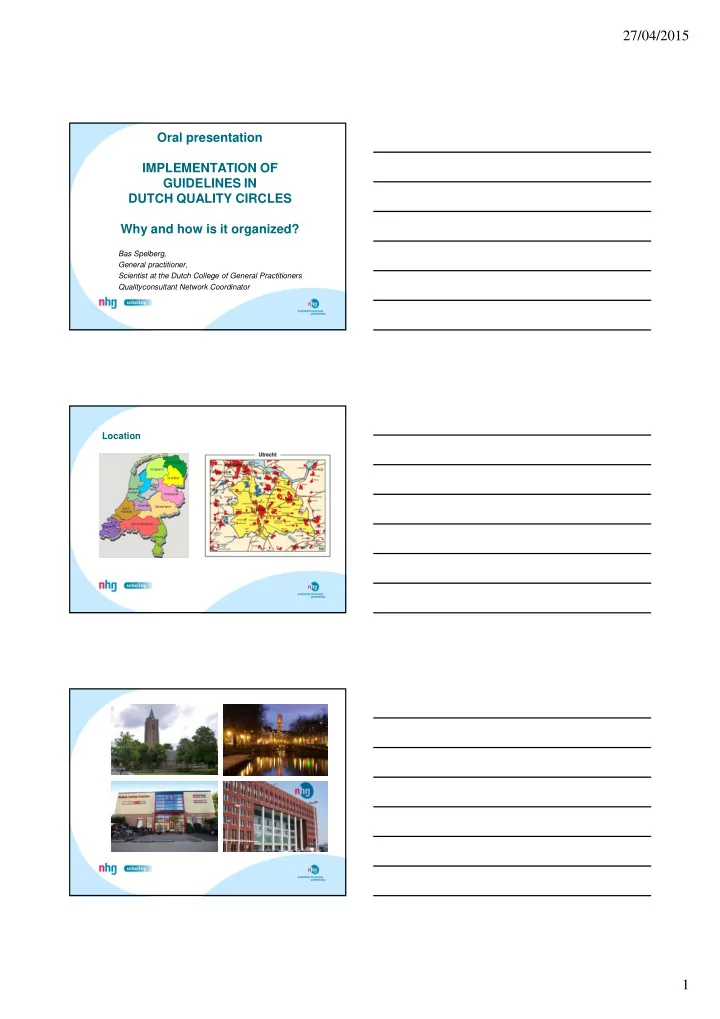
Location

slide-2
SLIDE 2

27/04/2015 2

The GP in the Netherlands

  • 8,879 GPs / 4970 practices
  • Central position/gatekeeper
  • Listed patients: 2300 patients
  • 2 GP organizations

– National Association of GPs (LHV; trade union) – Dutch College of GPs (NHG = scientific organisation)

slide-3
SLIDE 3

27/04/2015 3

slide-4
SLIDE 4

27/04/2015 4

Dutch College of GPs (NHG)

  • Scientific society of GPs
  • Mission: to improve and to support

evidence-based general practice.

  • Funding: member fees, insurance

companies, project funding

  • 12.000 members (90% of practicing GPs

and trainees)

Dutch College of GPs (NHG)

  • 140 employees
  • Main activities

– Evidence-based guidelines (104; 19 in English) – CME Materials, e-learning – Educational programs, practice tools – Programmes for practice accreditation – Scientific journal ‘GP & Science’ – Prevention programmes and guides – Tools for patient education / shared decision making

Registration Rules Dutch General practitioner

  • 6 years of medical study
  • 3 years of specialisation

And after that…..

  • Every 5 years re-registration
slide-5
SLIDE 5

27/04/2015 5

Rules on re-registration

  • Started in 1996
  • 16 hours/week work in a GP practice
  • 50 hours/year duty in out of office hours
  • 40 hours/year accreditated postgraduate

education

  • Since 2009: at least 2 hours/year in quality

circle Different types of postgraduate education

  • Central
  • Regional
  • Local

Examples of Central postgraduate education

  • NHG congres:

– More than 2000 participants – One central theme – Oral presentation and workshops

  • NHG Science Day

– 300 participants – Presentations on research in the GP practice

slide-6
SLIDE 6

27/04/2015 6

Examples of Regional Postgraduate Education

  • Agenda made by the regional GP’s
  • Sometimes in cooperation with

the regional healthcare

  • rganisations
  • Programs independant

Local post graduate education: quality circle

  • Evidence based effective
  • Independent: by and for GP’s
  • Making the interdoctor variation

transparant

  • Registration of conclusions
  • Quality consultant is compulsory

Lourens Kooy 2005:

  • 17 % qual. circles
  • 43 % regional
  • 27 % country
  • 8 % farm.industry
  • 5 % individual

Bas Spelberg 2013

  • 20 % qual. circles
  • 32 % regional
  • 32 % country
  • 6 % farm. industry
  • 10 % individual

Why Quality circles?

slide-7
SLIDE 7

27/04/2015 7

Effect of a Practice-Based Strategy on Test Ordering Performance of Primary Care Physicians. A Randomized Trial Wim Verstappen, Dutch GP, in Jama 2004 – 2 groups 13 quality circles – Each group had interventions on 3 subjects:

  • Group 1: cardiovasculair; upper abdominal complaints;

lower abdominal complaints

  • Group 2: astma/copd; vague complaints; articular

complaints

– Group 1 was the referal group for group 2 and v.v.

Theory Wim Verstappen

  • The number of diagnostic tests ordered by

GP’s is growing although many of these tests are seen as unnecessary.

  • Possible explanations:

– test ordering routines – more defensive attitude – lack of knowledge – patients more actively ask for tests

Intervention Wim Verstappen

  • Multifaceted strategy:

– personal feedback – guideline dissemination – quality meetings in small groups of GP’s

  • Social interactions were used as an important

motivator for change

  • Aim: to achieve sustained improvements in test
  • rdering working in line with the national,

evidence-based guidelines.

slide-8
SLIDE 8

27/04/2015 8

Conclusion Wim Verstappen

  • Strategy using guidelines, feedback, and social

interaction give modest improvements in test

  • rdering

Effectiveness of pharmacovigilance training of GP’s

  • Practice based GP’s had significantly better documented

report than the lecture trained GP’s

  • The effect persisted en did not diminish over time

Gerritsen R. e.a. in Drug safety sep. 2011

Effects of educational interventions on primary dementia care: a systematic review

  • Educational interventions for Primary Care Providers that

require active participation improve detection of dementia

  • Educational interventions alone do not

Perry, M. In Int. Journal of Geriatric Psychiatry; jan 2011

slide-9
SLIDE 9

27/04/2015 9

Also: prevention burnout?

Denemarken 379 (83%) GP’s

  • 25% burnout
  • No member Quality circle: more

risk of burnout

Brondt A. Continuing medical education and burnout among Danish GPs. Br J Gen Pract 2008

  • Central theme in Quality Circles:

Making the interdoctor variation transparant – Where are the differences? – Why are there differences? – How should we do it? – How can we change our everyday habits? Diffirent types of quality circles

  • Educational programs on quality guidelines
  • Farmaco therapeutical meeting: meeting between

local GP’s and farmacists about coherent prescriptioning

  • Intervision: intercollegial exchange of experiences

and problems on communication, collaboration and professionalism

  • Groupewise training on skills or special subjects
slide-10
SLIDE 10

27/04/2015 10

Rules for the Quality Circle

  • At least 3 GP’ s
  • One of them = Quality Consultant (QC)
  • At least 2 x 1 hour/year (mostly average 6-10 hours/year)
  • Start with a year planning
  • Report after each meeting
  • Signed attendance list of each meeting
  • Controlled and advised by a Regional Accreditation

Contributor (RAC)

  • Control System in central computer

Rules for the Quality Consultant

  • Start: 2 days of training on

– Rules of accreditation & task of the QC – Which subjects do I choose? – What is the best form of education? – Group dynamics – Ways of Implementation

  • Every 5 years re-registration as a QC

– Enough experience as a QC (8 hours/year) – Enough education on QC subjects (4 hours/year)

slide-11
SLIDE 11

27/04/2015 11