
SLIDE 1
|
2020 Bulkers Ltd. Pareto Securities Oil & Offshore Conference - - PowerPoint PPT Presentation
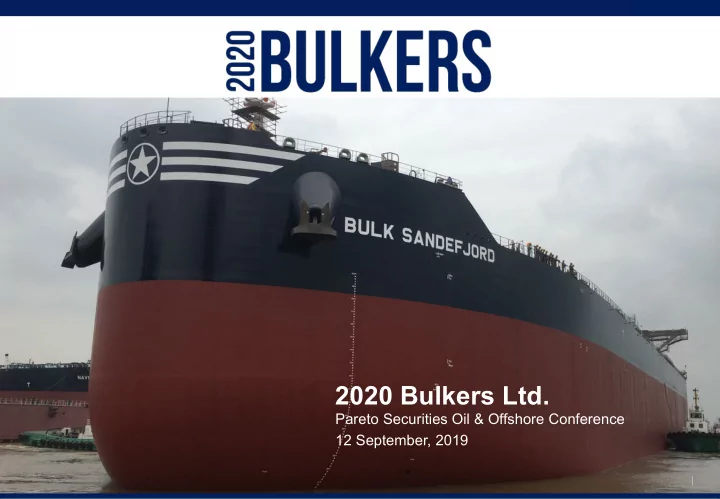
2020 Bulkers Ltd. Pareto Securities Oil & Offshore Conference 12 September, 2019 | Disclaimer This presentation (the " Presentation ") has been prepared by 2020 Bulkers Ltd. (the " Company ") and is made 12 September,
|
|
2
This presentation (the "Presentation") has been prepared by 2020 Bulkers Ltd. (the "Company") and is made 12 September, 2019 solely for information purposes. The Presentation does not constitute any recommendation to buy, sell or otherwise transact with any securities issued by the Company. No representation, warranty or undertaking, express or implied, is made by the Company and no reliance should be placed on the fairness, accuracy, completeness or correctness of the information or the opinions contained herein. The Company shall have no responsibility or liability whatsoever (for negligence or otherwise) for any loss arising from the use by any person or entity of the information set forth in the Presentation. All information set forth in the Presentation may change materially and without
Presentation should be considered in the context of the circumstances prevailing at the date hereof and has not been and will not be updated to reflect material developments which may occur after such date unless specifically stated in such update(s). Matters discussed in the Presentation include "forward looking statements". "Forward looking statements" are statements that are not historical facts and are usually identified by words such as "believes", "expects", "anticipates", "intends", "estimates", "will", "may", "continues", "should" etc. These "forward looking statements" reflect the Company's beliefs, intentions and current expectations concerning, among other things, the Company's results, financial condition, liquidity position, prospects, growth and strategies. "Forward looking statements" include statements regarding: objectives, goals, strategies, outlook and growth prospects, future plans, events or performance and potential for future growth, liquidity, capital resources and capital expenditures, economic outlook and industry trends, developments in the Company's market, the impact of regulatory initiatives and the strength of the Company's competitors. "Forward looking statements" involve risks and uncertainties because they relate to events and depend on circumstances that may or may not occur in the future. The "forward looking statements" included herein are based upon various assumptions, many of which, in turn, are based upon further assumptions. This includes, without limitation, the Company's review of historical operating trends, data contained in the Company's records and data available from third parties. Although the Company believes that these assumptions were reasonable when the relevant statements were made, they are inherently subject to significant known and unknown risks, uncertainties, contingencies and other factors which are difficult or impossible to predict and which are beyond the Company's control. "Forward looking statements" are not guarantees of future performance and such risks, uncertainties, contingencies and other important factors which are inherent thereto could cause the actual results of operation, financial condition and liquidity position of the Company or the industry in which it operates to differ materially from those results which, expressed or implied, are contained herein. No representation to the effect that at any of the "forward looking statements" or forecasts will come to pass or that any forecasted result will be achieved are made. The Presentation and the information contained herein does not constitute or form a part of and should not be construed as an offer for sale or subscription or of solicitation or invitation of any offer to subscribe for or purchase any securities issued by the Company.
|
36 184 13 197 50 100 150 200 250 2002 Purchase price EBITDA 2002- 2018 Residual value Total cash flow USDm
Significant value destruction in shipping stocks historically… …however the underlying business was good
Source: Company, Bloomberg, Clarkson Research Services Limited (SIN)
3
5.5x Money multiple
~35% IRR buying a Capesize in 2002 holding until 2018
2020 Bulkers with strong focus on capital discipline, low cash breakeven and dividends. Strong alignment with shareholders
100 200 300 400 500 600 700 800 Rebased share price
| 4
|
5
Name Built/Delivery Charter terms Charterer Bulk Sandefjord August, 2019 3 years index-linked timecharter with share of scrubber profit Koch Supply & Trading Bulk Santiago September, 2019 12-15 months timecharter @ usd 19,525 per day Koch Supply & Trading Bulk Seoul October, 2019 12-16 months timecharter @ usd 22,250 per day Koch Supply & Trading Bulk Shanghai November, 2019 Bulk Shenzen January, 2020 Bulk Sydney January, 2020 3 years index-linked timecharter with share of scrubber profit Koch Supply & Trading Bulk Sao Paulo April, 2020 Bulk Santos May, 2020
(1) Baltic Exchange Capesize reference vessel (2) Based on current 2020 Swaps for HFO vs LSFO Singapore (3) Gross TCE rate based on Baltic 5TC index on 11 Aug, 2019
7,25 ship years on the water in 2020 High Performing assets delivering into a strong market Larger cargo intake vs. standard Capesize1) 15% Lower fuel consumption than standard Capesize1) 20% Fuel saving vs. non-scrubber fitted Newcastlemax2) 37%
in today’s spot market, ex scrubber economics + +
|
6
Normalized cash break-even per vessel, per day Capesize historical rates(3) vs 2020 cash breakeven
Opex USD/d 4 750 G&A " 1 000 Debt amortization " 4 566 Interest expense(1) " 3 822 2020 Bulkers Cash Breakeven (CBE) @ 100% utilization " 14 138
“ (744)
" 2 840
" 3 122 = Standard Capesize rate2) required for index linked Newcastlemax to earn CBE 8 920
(1) Does not include interest on revolving credit facility. Assumes 3M Libor of 2.15%. (2) Baltic Exchange Capesize reference vessel (3) 1 year TC for Baltic Exchange reference Capesize 180,000 DWT without scrubbers. Monthly data. Source: Company, Clarkson Research Services Limited (SIN)
Since 1990, Capesize rates have been above 2020 Bulkers’ cash breakeven indexed to a Baltic Type Capesize ~95% of the time(3)
10 20 30 40 50 60 70 80 Capesize dayrate (USD'000/day) 1 year Capesize TC rate 2020 BE non-scrubber Capesize equivalent 140 145 150 155 160 165
|
7
FREE CASH FLOW TO EQUITY PER SHARE STANDARD CAPESIZE RATE
NOK
20 30 40 50 60 70 80 10 000 15 000 20 000 25 000 30 000 35 000 40 000 45 000 50 000 2020 2021
|
Brazilian iron ore shipments Australian iron ore shipments
Source: Arrow Shipbroking Group
8
10 12 14 16 18 20 jan feb mar apr mai jun jul aug sep
nov des
Million tonnes, 3-week moving average
2018 2019 10 12 14 16 18 20 jan jan feb mar mar apr mai mai jun jul jul aug sep okt
Million tonnes, 3-week moving average
2018 2019
|
Chinese steel production remains strong… While Chinese mills have been destocking iron ore inventories1)
9
10 20 30 40 50 60 70 80 90 100 Jan-05 Jan-07 Jan-09 Jan-11 Jan-13 Jan-15 Jan-17 Jan-19 Tons per month (million) China steel production 0,1 0,2 0,3 0,4 0,5 0,6 0,7 0,8
Iron ore inventories at mills million tons (1) Inventory shown as average per mill based on survey sample of 64 mills, representing ~30% of Chinese steel output Source: MySteel, Bloomberg, J.P. Morgan, Reuters, Company, Clarkson Research Services Limited (SIN)
|
Source: Arrow Shipbrokering group Calculations: Company
10
Capesize scrubber retrofitting timeline Increased reports of delays for scrubber retrofits
Capesize scrubber installations by end 2020
50 100 150 200 250 300 jan.19 feb.19 mar.19 apr.19 mai.19 jun.19 jul.19 aug.19 sep.19
nov.19 des.19 jan.20 feb.20 mar.20 apr.20 mai.20 jun.20 jul.20 209 446 35 142 60 90 180 270 360 450 To be fitted Under discussion Potential* Already fitted Total
Impact on non scrubber fitted Capesize vessels Decrease in optimal speed
Portion of fleet without scrubber YE 2020 80 % Avg time at sea 65 % Reduction in effective supply
Impact on scrubber fitted Capesize vessels Increase in optimal speed 3,60 % Portion of fleet with scrubber YE 2020 20 % Avg time at sea 65 % Increase in effective supply 0,5 % Net reduction in effective Capesize supply
Higher fuel prices will reduce speeds for ships without scrubbers
|
455 551 484 315 370 283 249 248 229 206 161 81 51 55 100 200 300 400 500 600 Number of shipyards No of yards taking orders
Dry bulk orderbook as % of fleet Dry bulk Newbuild contracts(1) Number of active shipyards(2)
(1) For vessels larger than 20,000 dwt (2) With at least one order larger than 1,000 GT on order, includes merchant and ship-shaped offshore vessels Source: Clarkson Research Services Limited
11
20 40 60 80 100 120 2005 2006 2007 2008 2009 2010 2011 2012 2013 2014 2015 2016 2017 2018 2019 USDbn Bulk carriers 0% 10% 20% 30% 40% 50% 60% 70% 80% Orderbook as % of fleet Dry Bulk
|
1) Mark to market - assuming 8 Newcastlemax trading spot at Index linked charter reflecting Baltic 5TC Index + 35% with 60% share of scrubber economics based on HFO vs LSFO spread of USD 200 per ton.
12
market lows in April 2019
implemented
|
13