Recent case law has investigated and sought to deal there exists no - - PowerPoint PPT Presentation

recent case law has investigated and sought to deal there
SMART_READER_LITE
LIVE PREVIEW

Recent case law has investigated and sought to deal there exists no - - PowerPoint PPT Presentation

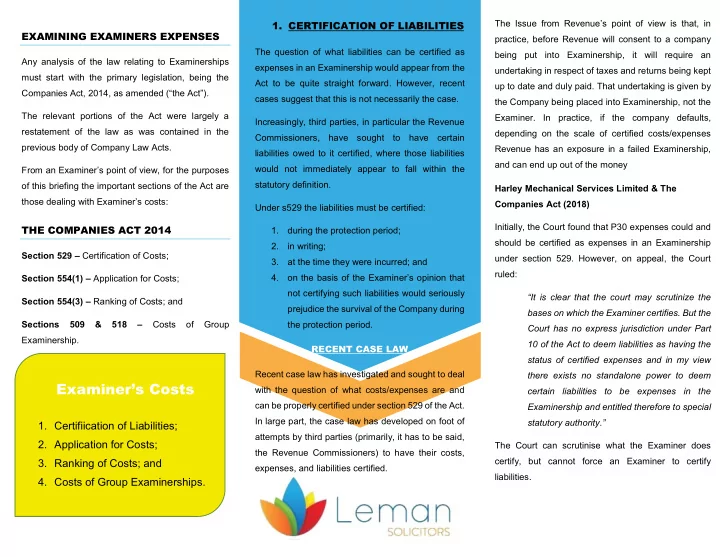
1. CERTIFICATION OF LIABILITIES The Issue from Revenues point of view is that, in EXAMINING EXAMINERS EXPENSES practice, before Revenue will consent to a company The question of what liabilities can be certified as being put into


slide-1
SLIDE 1

EXAMINING EXAMINERS EXPENSES

Any analysis of the law relating to Examinerships must start with the primary legislation, being the Companies Act, 2014, as amended (“the Act”). The relevant portions of the Act were largely a restatement of the law as was contained in the previous body of Company Law Acts. From an Examiner’s point of view, for the purposes

  • f this briefing the important sections of the Act are

those dealing with Examiner’s costs:

THE COMPANIES ACT 2014

Section 529 – Certification of Costs; Section 554(1) – Application for Costs; Section 554(3) – Ranking of Costs; and Sections 509 & 518 – Costs

  • f

Group Examinership.

Examiner’s Costs

  • 1. Certifiication of Liabilities;
  • 2. Application for Costs;
  • 3. Ranking of Costs; and
  • 4. Costs of Group Examinerships.
  • 1. CERTIFICATION OF LIABILITIES

The question of what liabilities can be certified as expenses in an Examinership would appear from the Act to be quite straight forward. However, recent cases suggest that this is not necessarily the case. Increasingly, third parties, in particular the Revenue Commissioners, have sought to have certain liabilities owed to it certified, where those liabilities would not immediately appear to fall within the statutory definition. Under s529 the liabilities must be certified:

  • 1. during the protection period;
  • 2. in writing;
  • 3. at the time they were incurred; and
  • 4. on the basis of the Examiner’s opinion that

not certifying such liabilities would seriously prejudice the survival of the Company during the protection period. RECENT CASE LAW Recent case law has investigated and sought to deal with the question of what costs/expenses are and can be properly certified under section 529 of the Act. In large part, the case law has developed on foot of attempts by third parties (primarily, it has to be said, the Revenue Commissioners) to have their costs, expenses, and liabilities certified. The Issue from Revenue’s point of view is that, in practice, before Revenue will consent to a company being put into Examinership, it will require an undertaking in respect of taxes and returns being kept up to date and duly paid. That undertaking is given by the Company being placed into Examinership, not the

  • Examiner. In practice, if the company defaults,

depending on the scale of certified costs/expenses Revenue has an exposure in a failed Examinership, and can end up out of the money Harley Mechanical Services Limited & The Companies Act (2018) Initially, the Court found that P30 expenses could and should be certified as expenses in an Examinership under section 529. However, on appeal, the Court ruled: “It is clear that the court may scrutinize the bases on which the Examiner certifies. But the Court has no express jurisdiction under Part 10 of the Act to deem liabilities as having the status of certified expenses and in my view there exists no standalone power to deem certain liabilities to be expenses in the Examinership and entitled therefore to special statutory authority.” The Court can scrutinise what the Examiner does certify, but cannot force an Examiner to certify liabilities.

slide-2
SLIDE 2
  • 2. APPLICATION FOR COSTS

An Examiner must apply for Court approval of their costs whether an Examinership is successful and the company exits the Examinership process with an agreed Scheme of Arrangement, or whether the Examinership fails and the company goes immediately into Liquidation. In practice an Examiner will frequently try to deal with the issue of their costs with the other interested parties in a failed Examinership in the hope of making an application on consent in respect of their

  • costs. It will still be for the Court to assess and

determine whether the Examiner’s costs are appropriate, but the Court will likely draw strong inference from an application being on consent. Section 554(1) The court may from time to time make such orders as it thinks proper for payment of the remuneration and costs of, and reasonable expenses properly incurred by, an Examiner. Section 554(2) Unless the court

  • therwise
  • rders,

the remuneration, costs and expenses of an Examiner shall be paid and the Examiner shall be entitled to be indemnified in respect thereof out of the revenue

  • f the business of the company to which he or she

has been appointed, or the proceeds of realisation

  • f the assets (including investments).

An application for costs under section 554 is an application on notice to other parties. Typically, at the hearing of the application by the Examiner to bring the Examinership to an end, interested parties will make themselves known to the Court and seek to be put on notice of the Examiner’s section 554 application. The application is brought by notice of motion, grounded on an affidavit by the Examiner in which the Examiner will exhibit their final report, and set

  • ut a breakdown of the precise costs they are

seeking under section 554. Pierce Farrell (official liquidator) v. Plastronix investments limited – 16 march, 2018 "Since the delivery of the judgment in re Sharmane ltd., it has been clear that the court, in determining the remuneration

  • f

persons appointed as Examiners, administrators or official liquidators, will not determine the reasonable remuneration by reference only to the total charge-out costs computed from the hours spent and relevant hourly rates, but will also have regard to:

  • 1. The nature of the work carried out;
  • 2. the complexity of the work; and
  • 3. the importance or value of the work ‘to the

client’.” A number of cases decided by the Courts have focussed on the question of what amount to reasonable costs for the purposes of Section 529. The principles decided in Examinership cases are

  • ften cited with approval by the Courts in cases

relating to costs of Receivers and Liquidators and vice versa. If you would like to receive a detailed report on or access to any of the cases mentioned here, please email bconroy@leman.ie. Swift Structures Ltd & Euro Plant Hire Ltd v Companies Acts (2017) Though this particular case involved a liquidation, it is relevant in the context of Examinerships, where a 3rd party funder will often fund the Examinership, and will want or expect an arrangement with the Examiner in relation to both the Examiner’s costs (which they will effectively be paying) and safeguarding of their investment “It was argued that as the court's jurisdiction to make a payment out of assets cannot be exercised, and as the Revenue Commissioners had a contractual arrangement with the liquidator in relation to the funding of this liquidation, the court has no role under section 228. Instead, it was suggested, the liquidator if aggrieved could have recourse to judicial review or could sue the Revenue Commissioners for damages for breach of contract. In my view this contention is incorrect.”

slide-3
SLIDE 3

REASONABLE COSTS The caselaw makes clear that if the Examiner (or Liquidator or Receiver) cannot clearly show how their costs/expenses have been incurred and that they are reasonable, then the Court will not be inclined to agree to those costs. Re KH Kitty Hall Holdings Limited and Companies Act 2014 – (2017) In this case it was submitted that “the only prejudice relied upon on behalf of the Bank in relation to the appointment of an Examiner as such was the potential costs of the Examinership”. The Court held “this probably arises only if the Examinership fails as it is quite typical for new investors to make provision to discharge costs of Examinership separate to funds being invested and available for a scheme of

  • arrangement. This is a potential prejudice. In

accordance with s. 554(2), unless the Court

  • therwise orders, the Examiner is entitled to be

indemnified in respect of remuneration, costs and expenses and pursuant to S. 554(3) they must be paid in full prior to any other claim, secured or

  • unsecured. This, however, is a potential prejudice

for most secured creditors on the appointment of an Examiner” The Court further held that “part of the purpose of the Examinership legislation is to prevent the single, large and secured creditor being necessarily enabled to arrange events in a way designed solely to suit its

  • wn interest”.
  • 3. PRIORITY & RANKING

Courtney – The Law Of Companies “all expenses, so certified by an Examiner, have priority over all other claims against a company including sums secured by a floating mortgage or charge (but not an encumbrance

  • f a fixed nature) and even a liquidator’s fees,

costs and expenses”

THE TRADITIONAL VIEW An Examiner’s costs and expenses rank in priority to every other person or party in all circumstances THE LEMAN VIEW The traditional view may be wrong.This line of reasoning has been considered in detail by Leman Solicitors, in consultation with Senior Counsel and a number of practicing Examiners, and we believe there is, at the very least, merit in the argument. We further believe that it is only a matter of time before this issue will have to be decided by the Court, and in the interim would advise practitioners to be aware of the possibility when dealing with Examinerships, and particularly when certifying liabilities under section 529. THE NEW ARGUMENT (1) A fixed charge splits the Examiner’s section 554 cost and expenses and the liabilities certified under section 529 to be treated as expenses in the Examinership; BUT (2) If there is no fixed charge, then the section 529 certified liabilities rank equally with the Examiner’s costs and expenses; and (3) If, at the end of the Examinership, there isn’t sufficient funds to pay both the Examiner’s costs and expenses, and the liabilities certified to be treated as expenses under section 529, then they are split pro rata between the two.

  • 4. COSTS OF GROUP EXAMINERSHIPS

One final issue which must be considered in the context of Examinerships is where an Examiner is appointed over more than one company at the same time.

slide-4
SLIDE 4

WHY A GROUP?

This happens quite frequently, where a primary application is made under section 509 of the Act in respect of one company, but at the same time and under the same application, it is sought to have another company also placed into Examinership under section 517 of the Act. The issue here is how to split and divide the Examiner’s time between the various companies in

  • Examinership. This becomes particularly relevant

where one (or more) of those companies has no assets or funds to pay the Examiner’s fees.

THE SHARMANE CASE

This is the seminal case in respect of most aspects

  • f Examinership, and particularly the costs of
  • Examinership. It is a judgment of Finlay Geoghegan
  • J. and it is cited with approval in nearly all decisions

relating to Examinership costs (and also liquidation and receivership costs) since. One of the key issues in the case was the question

  • f joint and several liability for the Examiner’s

costs/expenses. This is an issue which is live for a number of Examiners, and at least raises the question as to whether applications should be made under section 517 at all, or should each company be the subject of its own separate section 509 application.

“the remuneration

  • f an Examiner is

to be paid out of the revenue of the business of the company to which he has been appointed or the proceeds of realisation of the assets of that company”.

HELD

Finlay Geoghegan J went on to hold that the plain meaning of the words mean that it was not possible to pay the costs of an Examiner on a joint and several basis as between a group of companies in Examinership.

“it is only the remuneration, costs and expenses

  • f an Examiner incurred when acting as Examiner

to the relevant company which he is entitled to have discharged out of the revenue or assets of that company, it does not appear to me that there is any basis for construing the normal rule in s. 29(2) as permitting an Examiner appointed to company A and a related company B to look to the assets or business of either company alone to discharge his aggregate remuneration, costs and expenses incurred while acting as Examiner of both companies A and B. This is the effect of the

  • rder for joint and several liability sought by the

Examiner.” Finlay Geoghegan J.