
SLIDE 1
|
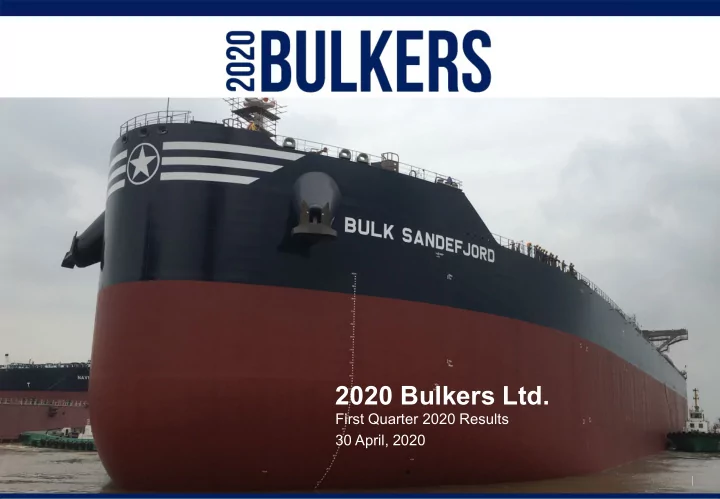
2020 Bulkers Ltd.
First Quarter 2020 Results 30 April, 2020
2020 Bulkers Ltd. First Quarter 2020 Results 30 April, 2020 | - - PowerPoint PPT Presentation
2020 Bulkers Ltd. First Quarter 2020 Results 30 April, 2020 | Disclaimer This presentation (the " Presentation ") has been prepared by 2020 Bulkers Ltd. (the " Company ") and is made 30 April, 2020 solely for information
|
First Quarter 2020 Results 30 April, 2020
|
2
This presentation (the "Presentation") has been prepared by 2020 Bulkers Ltd. (the "Company") and is made 30 April, 2020 solely for information purposes. The Presentation does not constitute any recommendation to buy, sell or otherwise transact with any securities issued by the Company. No representation, warranty or undertaking, express or implied, is made by the Company and no reliance should be placed on the fairness, accuracy, completeness or correctness of the information or the opinions contained herein. The Company shall have no responsibility or liability whatsoever (for negligence or otherwise) for any loss arising from the use by any person or entity of the information set forth in the Presentation. All information set forth in the Presentation may change materially and without
Presentation should be considered in the context of the circumstances prevailing at the date hereof and has not been and will not be updated to reflect material developments which may occur after such date unless specifically stated in such update(s). Matters discussed in the Presentation include "forward looking statements". "Forward looking statements" are statements that are not historical facts and are usually identified by words such as "believes", "expects", "anticipates", "intends", "estimates", "will", "may", "continues", "should" etc. These "forward looking statements" reflect the Company's beliefs, intentions and current expectations concerning, among other things, the Company's results, financial condition, liquidity position, prospects, growth and strategies. "Forward looking statements" include statements regarding: objectives, goals, strategies, outlook and growth prospects, future plans, events or performance and potential for future growth, liquidity, capital resources and capital expenditures, economic outlook and industry trends, developments in the Company's market, the impact of regulatory initiatives and the strength of the Company's competitors. "Forward looking statements" involve risks and uncertainties because they relate to events and depend on circumstances that may or may not occur in the future. The "forward looking statements" included herein are based upon various assumptions, many of which, in turn, are based upon further assumptions. This includes, without limitation, the Company's review of historical operating trends, data contained in the Company's records and data available from third parties. Although the Company believes that these assumptions were reasonable when the relevant statements were made, they are inherently subject to significant known and unknown risks, uncertainties, contingencies and other factors which are difficult or impossible to predict and which are beyond the Company's control. "Forward looking statements" are not guarantees of future performance and such risks, uncertainties, contingencies and other important factors which are inherent thereto could cause the actual results of operation, financial condition and liquidity position of the Company or the industry in which it operates to differ materially from those results which, expressed or implied, are contained herein. No representation to the effect that at any of the "forward looking statements" or forecasts will come to pass or that any forecasted result will be achieved are made. The Presentation and the information contained herein does not constitute or form a part of and should not be construed as an offer for sale or subscription or of solicitation or invitation of any offer to subscribe for or purchase any securities issued by the Company.
|
3
Key events during the first quarter of 2020:
Industries and ST Shipping/Glencore upon departing the yard
and US$22,673 per day, gross respectively, for the remainder of 2020.
achieved average time charter equivalent earnings of US$9,200 per day, gross, including average daily scrubber benefits of US$3,000 per day. Vessels trading on fixed charter earned on average US$21,300, gross. The Baltic 5TC Capesize Index averaged US$4,569 per day during the quarter Subsequent events:
interest rate of 3% for the fully drawn amount under the term loan facility.
Baltic 5TC Capesize index average of US$7,753 per day
|
Income Statement Comments
ship per day
charter contracts on January 10 and 23, 2020, respectively.
agreements securing an all-in interest rate of 3% for the fully drawn amount under the term loan facility.
4
USD million, except per share data Q1 2020 Operating Revenues 7.8 Vessel operating expenses (2.4) Voyage expenses (0.2) G&A (0.8) Depreciation (1.9) Total operating expenses (5.3) Operating Profit 2.5 Interest expense, net of cap. interest (2.1) Foreign exchange loss (0.1) Total financial expense (2.2) Tax expense
0.3 Earnings per share (USD/share) 0,01
|
Balance Sheet Summary Comments
US$197.1 million, reflecting the draw down on the term loan facility financing the delivery instalments for Bulk Shenzhen and Bulk Sydney.
per share
Santos are covered by cash at hand and committed bank financing of US$30 million per vessel
5
USD million March 31, 2020 Total assets 338.2 Equity 137.1 Cash and cash equivalents 15.1 Interest bearing debt 197.1
|
6
Ship name Delivery Charterer Rate Charter expiry Bulk Sandefjord Aug 19 Koch Index linked + scrubber benefit Aug 22 Bulk Santiago Sep 19 Koch 19 525 until Dec 20, index linked + scrubber benefit thereafter Nov 21 - Jan 22 Bulk Seoul Oct 19 Koch 22 250 until Dec 20, index linked + scrubber benefit thereafter Dec 21 - Feb 22 Bulk Shanghai Nov 19 Glencore 22 673 Dec 20 Bulk Shenzhen Jan 20 Glencore 21 919 Dec 20 Bulk Sydney Jan 20 Koch Index linked + scrubber benefit Jan 23 Bulk Sao Paulo Jun 20 Bulk Santos Jun 20
index every month since delivery of the first vessel
coverage, as well as the fleet’s superior cargo intake, lower fuel consumption and scrubber savings, compared to a standard Capesize vessel1)
fixed charter coverage and spot market exposure
4 000 6 000 8 000 10 000 12 000 14 000
10 000 15 000 20 000 25 000 30 000 35 000 40 000 45 000
Outperformance USD per day USD per day 2020 Fleet and Capesize 5 TC
2020 Bulkers Outperformance Fleet average Baltic 5 TC
2020 Bulkers outperforming the Baltic 5TC Capesize index Balanced charter composition
1) Baltic Capesize index type vessel
|
7
2020 estimated at US$13,436 per day
fixed at average TCE of US$21,591, gross
covers approximately 80% of operating cash breakeven for the rest of 2020 for all 8 vessels
ships to achieve operating cash breakeven is estimated at USD 5,700 per day for the balance
Newcastlemax for the balance of 2020 is estimated at USD 17,000 per day1)
Newcastlemax for Q3 and Q4 is estimated at USD 18,500 per day1)
1) Based on FFA curve and forwad fuel prices as of 29 March, 38% Newcastlemac premium and assumed as well as 75% of scrubber benefits
2020 balance 2021 2022 Available ship days 1 884 2920 2920 Days on fixed timecharter 984 Open/index linked days 900 2920 2920 G&A (USD mill) 1,4 2,2 2,2 OPEX (USD mill) 9,3 14,6 15,2 Debt Ammortization (USD mill) 9,0 14,8 14,8 Interest 5,6 9,2 8,7 Operating Cash breakeven (USD mill) 25 41 41 Fixed Charter coverage (USD mill) 20 Costs to be covered by open/index ships (USD mill) 5 41 41 Operating Cash breakeven (USD/ship/day) 13 436 13 983 13 991 Operating Cash breakeven for open/index ships (USD/ship/day) 5 700 13 983 13 991 Sensitivities - cash flow per share (USD) Standard capesize rates +/- USD 1000 per day 0,05 0,17 0,17 HFO/LSFO spread +/- USD 50/ton 0,06 0,18 0,18
|
8
dividends prior to the delivery of the final newbuilding in June 2020
through dividend payments
|
9
|
China with significant stimulus
3,5 trillion of investment projects to combat the impact of the coronavirus on the economy
2008-2009 following the Financial Crisis and more than 2x that amount if measured as a %
Coal burn compared to 2019
powerplants has recovered following the Covid- 19 shutdowns
Traffic congestion compared to 2019
has been back at normal levels since early March
Source: Arrow Shipbroking Group, Commodore Research
10
12.5 % 26.2 % 0% 5% 10% 15% 20% 25% 30% 2008-09 stimulus as %
2020 stimuls as % of the GDP 60% 65% 70% 75% 80% 85% 90% 95% 100% 0% 20% 40% 60% 80% 100% 120% 05.02.2020 05.03.2020 05.04.2020
|
Chinese Iron Ore imports has held up well While Iron Ore inventories have continued to draw Steel inventories above normal – to be digested by stimulus? Main issue for the Capesize market is low Brazil exports YTD
Source: Arrow Shipbroking Group
11
60 70 80 90 100 Jan Feb Mar Apr May Jun Jul Aug Sep Oct Nov Dec
China iron ore imports, million tonnes, based on AIS data
2018 2019 2020 100 110 120 130 140 150 160 170
06.jan.17 06.mar.17 06.mai.17 06.jul.17 06.sep.17 06.nov.17 06.jan.18 06.mar.18 06.mai.18 06.jul.18 06.sep.18 06.nov.18 06.jan.19 06.mar.19 06.mai.19 06.jul.19 06.sep.19 06.nov.19 06.jan.20 06.mar.20
China Iron ore port inventories, million tonnes
5 15 25 35 feb.15 mai.15 aug.15 nov.15 feb.16 mai.16 aug.16 nov.16 feb.17 mai.17 aug.17 nov.17 feb.18 mai.18 aug.18 nov.18 feb.19 mai.19 aug.19 nov.19 feb.20
Chinese steel product inventories, million tonnes
Mills' inventories Traders' inventories
2 4 6 8 10 jan jan feb mar mar apr mai mai jun jul jul aug sep okt okt nov des des
Brazil iron ore shipments, million tonnes, 3wma
2018 2019 2020
|
Strong correlation between Vale production and Capesize rates Comments
Sources: Vale, Arrow Shipbroking Group
12
that run rate production in Q2-Q4 2020 will be almost 50% above the Q1 2020 production volumes
Vale’s production, Brazilian exports and observed Capesize rates
Volumes estimated based on lastest Vale guidance
5 000 10 000 15 000 20 000 25 000 30 000 35 000 60 65 70 75 80 85 90 95 100 105 Vale production Capesize rate
|
China Iron and Steel Association (CISA) expectations
2019, implying expected iron ore imports of 1 109 to 1 159 million tons
2020, implying run rate imports could increase 7% - 14% for Q2 to Q4 2020 versus Q1 2020
250 Capesize vessels depending on cargo origin
consists of approximately 1 700 vessels Potential incremental capesize required Q2-Q4 vs Q1 2020
Source: Steelorbis.com
13
50 100 150 200 250 300 40 50 60 70 80 90
# of incremental capesize vessels YoY increase in Chinese iron ore imports (million tons)
# of incremental vessels if imported from Australia # of incremental vessels if 1/3 Brazil 2/3 Australia # of incremental vessels if imported from Brazil
|
20 40 60 80 100 120 2005 2006 2007 2008 2009 2010 2011 2012 2013 2014 2015 2016 2017 2018 2019 2020 DWT m Capesize Bulker Contracting 0% 10% 20% 30% 40% 50% 60% 70% 80% Orderbook as % of fleet Bulkcarrier Orderbook % Fleet
Dry bulk orderbook as % of fleet Capesize bulk newbuild contracts(1) Capesize scrapping(2)
(1) For vessels larger than 20,000 dwt (2) Drybulk vessels larger than 100,000 dwt, Source: Clarkson Research Services Limited, Arrow Shipbroking Group, Tradewinds
14
5 10 15 20 25 2017 2018 2019 2020 annualized
Million DWT
|
15