
SLIDE 1
|
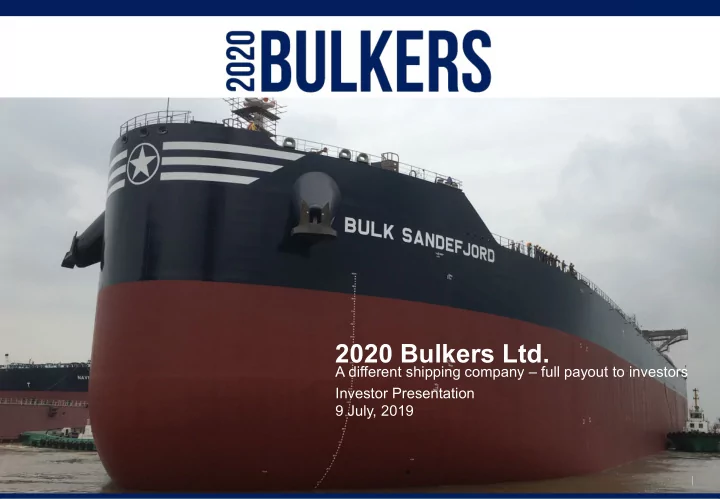
2020 Bulkers Ltd.
A different shipping company – full payout to investors Investor Presentation 9 July, 2019
2020 Bulkers Ltd. A different shipping company full payout to - - PowerPoint PPT Presentation
2020 Bulkers Ltd. A different shipping company full payout to investors Investor Presentation 9 July, 2019 | Disclaimer This presentation (the " Presentation ") has been prepared by 2020 Bulkers Ltd. (the " Company ")
|
A different shipping company – full payout to investors Investor Presentation 9 July, 2019
|
2
This presentation (the "Presentation") has been prepared by 2020 Bulkers Ltd. (the "Company") and is made 9 July, 2019 solely for information purposes. The Presentation does not constitute any recommendation to buy, sell or otherwise transact with any securities issued by the Company. No representation, warranty or undertaking, express or implied, is made by the Company and no reliance should be placed on the fairness, accuracy, completeness or correctness of the information or the opinions contained herein. The Company shall have no responsibility or liability whatsoever (for negligence or otherwise) for any loss arising from the use by any person or entity of the information set forth in the Presentation. All information set forth in the Presentation may change materially and without
Presentation should be considered in the context of the circumstances prevailing at the date hereof and has not been and will not be updated to reflect material developments which may occur after such date unless specifically stated in such update(s). Matters discussed in the Presentation include "forward looking statements". "Forward looking statements" are statements that are not historical facts and are usually identified by words such as "believes", "expects", "anticipates", "intends", "estimates", "will", "may", "continues", "should" etc. These "forward looking statements" reflect the Company's beliefs, intentions and current expectations concerning, among other things, the Company's results, financial condition, liquidity position, prospects, growth and strategies. "Forward looking statements" include statements regarding: objectives, goals, strategies, outlook and growth prospects, future plans, events or performance and potential for future growth, liquidity, capital resources and capital expenditures, economic outlook and industry trends, developments in the Company's market, the impact of regulatory initiatives and the strength of the Company's competitors. "Forward looking statements" involve risks and uncertainties because they relate to events and depend on circumstances that may or may not occur in the future. The "forward looking statements" included herein are based upon various assumptions, many of which, in turn, are based upon further assumptions. This includes, without limitation, the Company's review of historical operating trends, data contained in the Company's records and data available from third parties. Although the Company believes that these assumptions were reasonable when the relevant statements were made, they are inherently subject to significant known and unknown risks, uncertainties, contingencies and other factors which are difficult or impossible to predict and which are beyond the Company's control. "Forward looking statements" are not guarantees of future performance and such risks, uncertainties, contingencies and other important factors which are inherent thereto could cause the actual results of operation, financial condition and liquidity position of the Company or the industry in which it operates to differ materially from those results which, expressed or implied, are contained herein. No representation to the effect that at any of the "forward looking statements" or forecasts will come to pass or that any forecasted result will be achieved are made. The Presentation and the information contained herein does not constitute or form a part of and should not be construed as an offer for sale or subscription or of solicitation or invitation of any offer to subscribe for or purchase any securities issued by the Company.
| 3
Attractive bank financing Moderate leverage The right assets - 8 Scrubber fitted Newcastlemax with proven premium vs Capesize Free cash flow to be paid as dividends once fleet is delivered Stop investing as asset values and risk increases
Invest at attractive entry point
Low cost corporate structure Full alignment of interest as founders & management are largest shareholders
|
100 200 300 400 500 600 700 800 2002 2003 2004 2005 2006 2007 2008 2009 2010 2011 2012 2013 2014 2015 2016 2017 2018 2019 36 184 13 197 50 100 150 200 250 2002 Purchase price EBITDA 2002- 2018 Residual value Total cash flow USDm
Significant value destruction in shipping stocks historically… …however the underlying business was good
Source: Company, Bloomberg, Clarkson Research Services Limited (SIN)
4
5.5x Money multiple
~35% IRR buying a Capesize in 2002 holding until 2018
2020 Bulkers with strong focus on capital discipline, low cash breakeven and dividends. Strong alignment with shareholders
|
5
Short time to cash flow
Bulk Sandefjord Bulk Santiago Bulk Seoul Bulk Shanghai Bulk Shenzen Bulk Sydney Bulk Sao Paulo Bulk Santos August 2019 October 2019 December 2019 January 2020 February 2020 March 2020 April 2020 May 2020 ~1 year TC @ USD 19,525/day to Koch
and 50/50 sharing of scrubber benefit to Koch
several offers to contract vessels at index linked, voyage based charters or fixed contracts to strong counterparties
(1) Compared to Baltic 5TC reference type vessel at 13 knots ballast, 12 knots laden (2) Footnote: Calculated based on West Australian round voyage, basis 2020 Forward fuel prices, sailing 12 knots laden, 13 knots ballast
~1 year TC @ USD 22,250/day to Koch
NAV per share on various resale prices The rights assets Larger cargo intake vs. standard Capesize 15% Lower fuel consumption than standard Capesize1) 20% Fuel saving vs. non-scrubber fitted Newcastlemax2) 37% Proven premium vs. Capesize based on concluded fixtures + +
50 100 150 200 250 300 350 400 450 500 USD 54 mill - implied at last equity offering USD 9.00 USD 64 mill - 15 year average USD 70 mill - April 2014 USD 170 mill - July 2008 peak
Newcastlemax resale values (USDm)
|
6
Normalized cash break-even per vessel, per day(1) Capesize historical rates(3) vs 2020 CBE
Opex USD/d 4 750 G&A " 1 000 Debt amortization " 4 566 Interest expense " 4 192 2020 Bulkers Cash Breakeven (CBE) @ 100% utilization " 14 508
" (2 354)
" (2 876) = Standard Capesize rate2) required for 2020 Bulkers to earn CBE 9 278
(1) Does not include interest on revolving credit facility (2) Baltic reference Capesize 180,000 DWT without scrubbers (3) Baltic reference Capesize 180,000 DWT without scrubbers. Monthly data. Source: Company, Clarkson Research Services Limited (SIN)
Since 1990, Capesize rates have been above 2020 Bulkers’ cash breakeven indexed to a Baltic Type Capesize ~95% of the time(3)
10 20 30 40 50 60 70 80 Capesize dayrate (USD'000/day) 1 year Capesize TC rate 2020 BE non-scrubber Capesize equivalent 140 145 150 155 160 165
|
7
10% FCFE when a standard Capesize earns USD 15,200/ day1 Dividend potential vs Standard Capesize rates 2
1) Baltic reference Capesize 180,000 DWT without scrubbers adjusted for 31% premium and 50% share of scrubber economics 2) Mark to market - assumeing 8 Newcastlemax trading spot at Index linked charter reflecting Baltic 5TC + 31% + 50% share of scrubber economics based on HFO vs LSFO spread of USD 200 per ton 3) Baltic 5TC index - 4 July 2019
0% 10% 20% 30% 40% 50% 60% 70% 10 000 15 000 20 000 25 000 30 000 35 000 40 000
Current spot rates3) 20 year average rates
Standard Capesize rates Free cash flow to equity
20 40 60 80 100 120 140 160 180 Capesize dayrate (USD'000/day) 1 year Capesize TC rate 2020 BE non-scrubber Capesize equivalent 2020, 10% dividend yield dayrate (Newcastlemax equivalent)
|
8
Management Board of Directors
Executive committee
Pareto’s US Operations
Magnus Halvorsen | Chief Executive Officer
Vidar Hasund | Chief Financial Officer
Olav Eikrem | Chief Technical Officer
Drilling Ltd. (2011-2018), Archer Limited (2007-2018), Golden Ocean Group Ltd (2004-2018), Frontline Ltd. (2003- 2018), Avance Gas Holding Ltd (2013-2018), Ship Finance International Ltd (2003-2018), Golar LNG Ltd (2003- 2015), Golar LNG Partners LP (2007-2015), Seadrill Ltd (2005-2018), and Seadrill Partners LLC (2012-2018)
Alexandra Kate Blankenship | Director
Jeremy Kramer | Director
and Commercial Director (Sept 2004 – Apr 2008) at Frontline Management AS, Board Member at Frontline, Frontline 2012, Flex LNG, Frontline Shipping, Frontline Management (Bermuda), Seateam Ship Management
Singapore
Jens Martin Jensen | Director
Ltd., Ship Finance International Ltd., North Atlantic Drilling Ltd., Sevan Drilling Ltd., Northern Drilling Ltd., FLEX LNG Ltd., Seadrill Ltd., Knightsbridge Shipping Ltd., Golden Ocean Group Ltd., Golar LNG Ltd., Seadrill Partners LLC
(1993-2007)
Georgina Sousa | Director & Company Secretary
Experienced management and board incentivized to distribute free cash flow to shareholders
* Strike price for all outstanding options is USD 10 per share
|
9
The right assets at attractive entry point Cash breakeven when a standard Capesize earns USD 9,250 per day Solid Balance sheet <55% Loan to Value Significant dividend yield capacity:
Will pay monthly dividend payments once full fleet is delivered, targeting payout from Q1 2020 Sponsors and Management with focus on capital discipline and shareholder alignment Favorable supply demand balance:
delivered
|
10
|
455 551 484 315 370 283 249 248 229 206 161 81 51 55 100 200 300 400 500 600 Number of shipyards No of yards taking orders
Dry bulk orderbook as % of fleet Dry bulk Newbuild contracts(1) Number of active shipyards(2)
(1) For vessels larger than 20,000 dwt (2) With at least one order larger than 1,000 GT on order, includes merchant and ship-shaped offshore vessels Source: Clarkson Research Services Limited
11
20 40 60 80 100 120 2005 2006 2007 2008 2009 2010 2011 2012 2013 2014 2015 2016 2017 2018 2019 USDbn Bulk carriers 0% 10% 20% 30% 40% 50% 60% 70% 80% Orderbook as % of fleet Dry Bulk
|
Upcoming drydockings for 15+ year old Capesize vessels Commentary
to be conducted on vessels every 5th and 2.5 year, respectively
drydock costs related to Ballast Water Treatment installations, accelerated Scrapping may be expected in 2019/2020
+ USD 2.0m: Ballast water treatment system + USD 3.5m: General docking and steel renewal cost + USD 225k: 45 days off-hire with full opex = USD 5.75m: Total capex
vessel(1)
(1) 196k DWT is the average size of the 15+ year old vessels with upcoming SPS or IPS. USD 11.4m assuming USD 460 per vessel LDT and LDT of 12.5% of DWT Source: Company, Clarkson Research Services Limited (SIN)
12
2,0 % 1,6 % 2,7 % 2,5 % 4,8 % 4,1 % 0,0 % 1,0 % 2,0 % 3,0 % 4,0 % 5,0 % 6,0 % 2019 2019 Percentage of Capesize fleet (%) SPS IPS
2020 2019
24 Capesize sold for scrap YTD 2019, compared to 12 Capesize scrapped in 2018
|
5,9 % 2,6 % 2,6 % 0,7 % 0,7 % 3,3 % 1,9 % 0,0 % 1,0 % 2,0 % 3,0 % 4,0 % 5,0 % 6,0 % 7,0 % Deliveries Scrapping Net fleet growth IMO 2020 impact Effective supply growth Percentage of total fleet (%)
2019E – Capesize, Newcastlemax and VLOC 2020E – Capesize, Newcastlemax and VLOC
13
(1) Clarksons Platou Shipbroking Source: Company
Commentary
Capesize or larger vessels sold for scrap (186k DWT average) in 2019 year to date
scrubbers (1.0% of fleet)
tanks (1.0% of fleet). The majority of this impact will occur in 2H 2019 Commentary
scrubber retrofits in 2019, resulting in a neutral effect year-over-year
in 2020
to 1 knot lower optimal speed for 75% of the fleet without scrubbers, assuming 70% time at sea
5,9 % 3,8 % 3,8 % 3,8 % 0,5 % 2,1 % 1,0 % 4,3 % 0,0 % 1,0 % 2,0 % 3,0 % 4,0 % 5,0 % 6,0 % 7,0 % Deliveries Scrapping Net fleet growth IMO 2020 impact Eco-speed impact Effective supply growth Percentage of total fleet (%)
Part of the trading fleet expected to be out of service at times due to fitting of scrubber, ballast water treatment systems as well as tank cleaning
|
0,00 0,20 0,40 0,60 0,80 1,00 1,20 1,40 1990 1992 1994 1996 1998 2000 2002 2004 2006 2008 2010 2012 2014 2016 2018 Billion tonnes World Seaborne Total Coal Trade 0,00 0,20 0,40 0,60 0,80 1,00 1,20 1,40 1,60 1990 1992 1994 1996 1998 2000 2002 2004 2006 2008 2010 2012 2014 2016 2018 Billion tonnes World Seaborne Iron Ore Trade
14
World seaborne iron ore trade (28.2% of dry bulk trade in 2018) World seaborne coal trade (23.8% of dry bulk trade in 2018)
Source: Clarkson Research Services Limited (SIN)
The iron ore trade has been expanding 25 out of last 29 years, with 5.0% CAGR The coal trade has been expanding 28 out of last 29 years, with 4.7% CAGR
|
Supply estimates
4% 2% 2% 6% 6% 7% 7% 7% 7% 14% 15% 13% 6% 5% 3% 2% 4% 3% 1% 1% 6% 3% 9% 8% 6% 7% 14% 6% 1% 14% 10% 9% 9% 5%
2% 6% 4%
40 000 60 000 80 000 100 000 120 000 140 000 160 000
0% 2% 4% 6% 8% 10% 12% 14% 16% 01 02 03 04 05 06 07 08 09 10 11 12 13 14 15 16 17 18 19e 20e USD/day YoY growth (%) Capesize rates Net fleet growth Demand growth
15
For the first time since the early 2000s demand is likely to outpace supply for multiple years
Source: Company, Clarkson Research Services Limited (SIN), Clarksons Platou Shipbroking
Rates up 4,8x Rates up 2,5x
Iron ore trade has been growing with 5% CAGR
29 years 5%
|
10 20 30 40 50 60 70 80 90 Jan-05 Jan-07 Jan-09 Jan-11 Jan-13 Jan-15 Jan-17 Jan-19 Tons per month (million) China steel production 200 250 300 350 400 450 500 550 600 Jan-16 Jul-16 Jan-17 Jul-17 Jan-18 Jul-18 Jan-19 Tons ('000) Iron ore inventories at mills
0% 20% 40% 60% Iron ore production (y/y change %) Chinese domestic iron ore production (y/y change %)
0% 5% 10% 15% 20% 25% 30% 35% 40% 45% Iron ore imports (y/y change %) Chinese iron ore imports - Y/Y change (%)
(1) Inventory shown as average per mill based on survey sample of 64 mills, representing ~30% of Chinese steel output Source: MySteel, Bloomberg, J.P. Morgan, Reuters, Company, Clarkson Research Services Limited (SIN)
16
No meaningful change in net exports suggest production has gone to domestic consumption
China has been through a material destocking cycle. Demand for imported iron ore expected to increase.
|
17
Brazilian production volumes set to recover, surpassing production volumes prior to Brucutu accident
Capacity halted since 1st Jan 2019 Status Corrego do Feijao Shut permanently 8,5 Various mines in S&SE systems Halted indefinetely 40 Brucutu Expected to restart 30 Timbopeda Temporarily closed 12,8 Alegria Temporarily closed 10 Sum 101,3 Expected restarts and new capacity Status Brucutu, Timpobeda and Alegria Restart expected 2019/20 52,8 Samarco Restart expected 2020 30 S11D ramp up 20 Minas Rio ramp up 15 Sum 117,8
|
18
|
19
equivalent earnings compared to a standard Capesize while performing the same trade
equivalent earnings per year, compared to a standard Capesize
Newcastlemax can perform all key Iron Ore trades
Simplified Voyage economics Newcastlemax vs Capesize Additional cargo loaded (actual) MT 25 000 Freight rate for C5 (W Australia – China) $ 8,35 Addition revenue per voyage (net of commission) $ 200 000 Additional fuel, broker’s fees $
Additional cash flow per voyage $ 175 500 Voyage per year X 10 Additional cash flow per year (adj for 95% utilization) $ 1 667 250 Discount rate % 15 % Present value of additional cash flow $ 10 435 870 Sensitivity Present value Discount rate 10 % USD 14 mill 15 % USD 10 mill 20 % USD 8 mill
Note: Illustrative economics showing present value of additional revenue compared to Capesize earnings calculated over 20 years. Additional DWT capacity vs a Capesize is 28,000 DWT, however calculation assumes 25,000 in actual additional cargo loaded. Calculation assumes 1 ton per day higher fuel consumption for Newcastlemax vs Capesize Source: Company, Clarksons Platou SeaNet
Greater cargo intake yields higher earnings
|
20
labor cost
approximately USD 34 mill more than a Capesize
compared to a Capesize
Evident by Newcastlemax taking market share vs Capesize
Source: Company, Clarksons Platou
Current newbuild prices undervalue the cash flow of a Newcastlemax relative to a standard Capesize
6% 39% 64% 75% 74% 100% 0% 20% 40% 60% 80% 100% 120% 10 years ago 5 years ago 2019 2020 2021 2022
Newcastlemax deliveries as a % of Total Newcastlemax + Capesize deliveries
10 20 30 40 50 60 70 1 2 3 4 5 6 7 8 9 10 11 12 13 14 15 16 17 18 19 20 21 Broker quote Capesize Broker quote Newcastlemax PV Nmax vs Cape @ 15%
|
IMO 2020 Sulphur regulations Simplified analysis of scrubber investment Scrubber investment sensitivity
21
Discount rate % LSFO-HFO spread USD/t
emissions for shipping vessels to be reduced from 3.5% to 0.5%
Install scrubbers − Enables ship to keep running on HFO − Current Capex of around USD 2,5 million for a Newcastlemax vessel − Short payback time − More complicated for retrofits and may need to take ship out of service Run ships on MGO or other compliant Low Sulphur Fuel − Easiest way to comply, as well as the only way to comply without significant Capex to owner − MGO for 2020 is significantly more expensive than HFO − May require increased engine maintenance Burn LNG as fuel − Significant Capex (adds around 20% to newbuilding cost) − Long-term attractive solution as LNG has broken parity with oil and LNG also addresses CO2 emissions
Source: Company
Fuel spread USD/tonne 3,8 200 350 500 10 % 3,4 6,0 8,6 15 % 3,0 5,3 7,6 20 % 2,7 4,7 6,8 Illustrative scrubber savings, W Australia - China RV Tons HFO consumed 852 LSFO-HFO spread (2020) 200 RV days 36 Share of fuel savings 50 % Daily Savings 2 354 Discount rate 10 % PV (5 years) 3,3
|
22
Illustrative TCE Comparison Baltic type Capesize vs 2020 Bulkers Newcastlemax with scrubber trading on voyage charter
Source: Company
Assumptions: Input as of May 9th. 2020 FFA market of USD 8,35 per ton for C5 (West Australia – China round voyage). 2020 forward fuel prices (Singapore)
r
Baltic C5 2020 C5 Delta Comment Key variables USD/ton (FFA for 2020 WA-China) 8,35 8,10
Cargo Intake (tonnes) 175 000 205 000 Assumed actual intake Consumption laden - 12 knots 43,0 37,2 Consumption balast 13 knots 43,0 33,7 HFO Price (2020 fwd price) NA 340 LSFO Price (2020 fwd price) 540 540 TCE calculation Net Freight 1 388 188 1 577 378 14 % Higher cargo Intake, 3% lower USD/ton rate HFO cost
LSFO cost
Total Fuel Cost
Port costs
Misc Costs
P&L 499 098 978 119 TCE net 14 587 27 018 85 %
|
Sources and uses Comments Uses:
supervision (USD 47m per vessel) Sources:
working capital purposes
23
Uses of funds until delivery of first vessel USDm 8 x Newbuildings, including building supervision 376 Working capital, stores, spares, bunkers, G&A 6 Total uses of funds 382 Sources of funds USDm Equity raised to date 142 Bank financing 240 Total sources of funds 382
2020 Bulkers’ newbuild program is fully financed
|