Guidelines for Case Study Presentation - 2017 Attached is some - - PDF document

guidelines for case study presentation 2017 attached is
SMART_READER_LITE
LIVE PREVIEW

Guidelines for Case Study Presentation - 2017 Attached is some - - PDF document

Guidelines for Case Study Presentation - 2017 Attached is some financial information about a grain and beef farm in Jackson County, Kansas. The farm financial information on the attachment are the KFMA results for the 13 farms in the KFMA program


slide-1
SLIDE 1

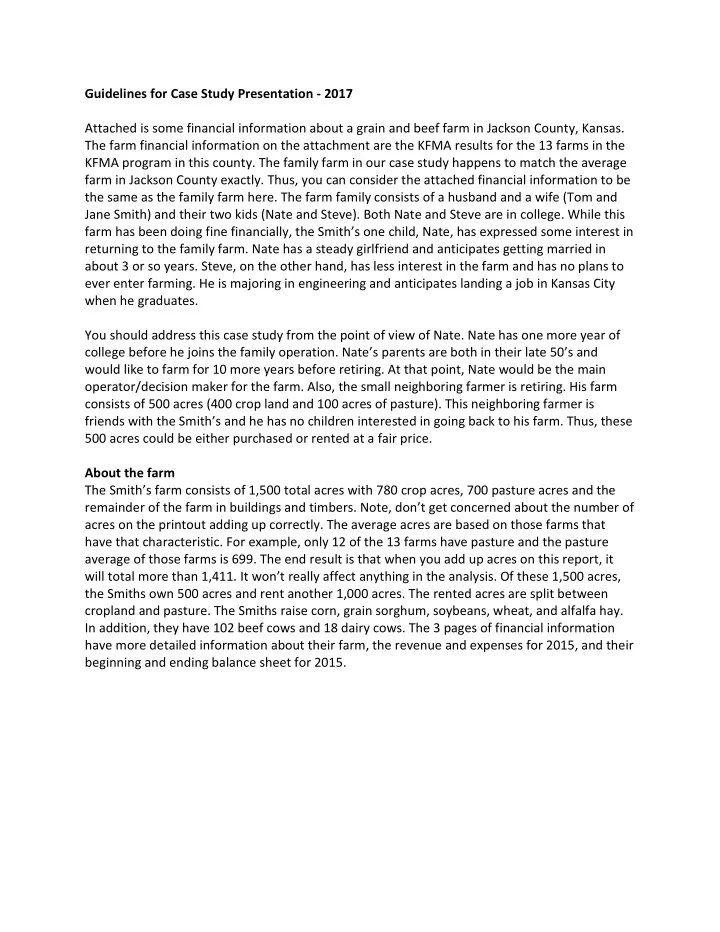
Guidelines for Case Study Presentation - 2017 Attached is some financial information about a grain and beef farm in Jackson County, Kansas. The farm financial information on the attachment are the KFMA results for the 13 farms in the KFMA program in this county. The family farm in our case study happens to match the average farm in Jackson County exactly. Thus, you can consider the attached financial information to be the same as the family farm here. The farm family consists of a husband and a wife (Tom and Jane Smith) and their two kids (Nate and Steve). Both Nate and Steve are in college. While this farm has been doing fine financially, the Smith’s one child, Nate, has expressed some interest in returning to the family farm. Nate has a steady girlfriend and anticipates getting married in about 3 or so years. Steve, on the other hand, has less interest in the farm and has no plans to ever enter farming. He is majoring in engineering and anticipates landing a job in Kansas City when he graduates. You should address this case study from the point of view of Nate. Nate has one more year of college before he joins the family operation. Nate’s parents are both in their late 50’s and would like to farm for 10 more years before retiring. At that point, Nate would be the main

  • perator/decision maker for the farm. Also, the small neighboring farmer is retiring. His farm

consists of 500 acres (400 crop land and 100 acres of pasture). This neighboring farmer is friends with the Smith’s and he has no children interested in going back to his farm. Thus, these 500 acres could be either purchased or rented at a fair price. About the farm The Smith’s farm consists of 1,500 total acres with 780 crop acres, 700 pasture acres and the remainder of the farm in buildings and timbers. Note, don’t get concerned about the number of acres on the printout adding up correctly. The average acres are based on those farms that have that characteristic. For example, only 12 of the 13 farms have pasture and the pasture average of those farms is 699. The end result is that when you add up acres on this report, it will total more than 1,411. It won’t really affect anything in the analysis. Of these 1,500 acres, the Smiths own 500 acres and rent another 1,000 acres. The rented acres are split between cropland and pasture. The Smiths raise corn, grain sorghum, soybeans, wheat, and alfalfa hay. In addition, they have 102 beef cows and 18 dairy cows. The 3 pages of financial information have more detailed information about their farm, the revenue and expenses for 2015, and their beginning and ending balance sheet for 2015.

slide-2
SLIDE 2

Assignment Your school’s assignment for the case study is as follows: Develop a business plan that is addressed to ONE of the 3 parties. Again, Nate is putting this business plan together.  The parents, Tom and Jane Smith  The lender of the local bank who would help with the financing of the farm  The brother, Steve, who will not be going back to the farm. 1) Develop a 4-minute PowerPoint presentation that is essentially a business plan for Nate returning to the family farm. Your presentation should focus on aspects that are important to who you are addressing (i.e., either Nate’s parents, the lender, or his brother). There should be some financial analysis and the level of financial analysis should be adjusted depending upon who is being addressed. For example, the lender focus would probably be on making sure the farm provides enough income for 2 families

  • ver the short-term and whether buying or renting the other farm makes sense. A focus
  • n the parents would probably address transition issues and making sure Nate becomes

the farm owner over time. A focus on the brother Steve would probably address how Steve is going to get his fair share, etc. 2) The PowerPoint presentation will be the only part being graded. There are no other materials to turn in. The presentation should be geared toward anyone with a strong interest in the farm (i.e., other family members, lenders, input suppliers, etc.) 3) The material in the packet is not the only source of information for building your case

  • study. The USDA has additional information about crop production, yield histories, cost
  • f production, etc. for the state of Kansas. In addition, Kansas State University, through

AgManager.info has plenty of information and tools that could be used for a case study. Google is always your friend as well, particularly when it comes to researching many of these decisions. 4) The attached rubric provides details about how the presentations will be scored. This year, every team will start with one point (the rubric only goes to 49 points). In addition, no team will score lower than 25 points.

slide-3
SLIDE 3

Jackson (13 Farms) Income and Expense Analysis Beef 1 109,695 Dairy and Milk 2 113,250 Sheep 3 Swine 4 Poultry and Eggs 5 Other Livestock/Hedging 6 386 Custom Feeding 7 Feed Purchased 8

  • 72,157

Livestock Value Produced 9 $151,174 Corn 10 77,099 Grain Sorghum 11 Soybeans 12 54,634 Sunflowers 13 Wheat 14 5,032 Hay and Forage 15

  • 351

Other Crop 16 6,427 Government Payments 17 1,687 Crop Insurance Proceeds 18 10,630 Machine Work 19 6,337 Other Income/Hedging 20 18,917 Value of Farm Production 21 $331,583 Hired Labor 22 27,964 Machinery Repairs 23 37,739 Irrigation Repairs 24 Building Repairs 25 4,746 Seed/Other Crop Expense 26 34,210 Crop Insurance 27 6,688 Fertilizer-Lime 28 54,685 Machine Hire 29 17,580 Organization Fees, Publications 30 4,421 Vet-Med-Drugs 31 9,472 Misc Crop Expense 32 830 Misc Livestock Expense 33 2,235 Dairy Expense 34 9,792 Gas-Fuel-Oil 35 16,539 Irrigation Energy 36 79 Real Estate Taxes 37 5,547 Personal Property Taxes 38 1,065 General Farm Insurance 39 8,058 Utilities 40 7,361 Cash Farm Rent 41 30,822 Herbicide-Insecticide 42 16,595 Conservation 43 1,415 Auto Expense 44 346 Total Operating Expense 45 $298,186 Interest Paid 46 23,154 Depreciation-Machinery 47 37,070 Depreciation-Buildings 48 5,636 Total Farm Expense 49 $364,046 Net Farm Income 50 ($32,463) Unpaid Family Labor 51 5,492 Unpaid Operator Labor 52 67,052 Current Asset Charge 53 13,328 Non-Current Asset Charge 54 74,010 Return to Labor & Management 55

  • 125,294

Return to Capital 56

  • 81,854

Ratios Total Expense Ratio 57 1.0979 Adjusted Total Expense Ratio 58 1.3167 Economic Total Expense Ratio 59 1.5801 Operating Profit Margin Ratio 60

  • 0.2469

Asset Turnover Ratio 61 0.1594 % Return on Assets 62

  • 0.0394

% Return on Equity 63

  • 0.0660

Average Current Ratio 64 2.5489 Average Debt to Asset Ratio 65 0.2353

2015 Data - Kansas County Averages Kansas Farm Management Association Annual ProfitLink Summary

slide-4
SLIDE 4

Jackson (13 Farms) Non-Irrigated Acres Cnt Yield Acres Rented Owned Avg Acres Acres Yield Yield Acres Avg Acres Owned Rented Acres Yield Cnt Corn 98 143.22 168 122.87 125 234 12 Grain Sorghum 99 Soybeans 100 34.97 182 36.20 176 262 11 Sunflowers 101 Wheat 102 31.63 86 94 6 Other Crops 103 Alfalfa Hay 104 31 6 Other Hay & Forage 105 169 60 212 11 DC Grain Sorghum 106 DC Soybeans 107 DC Sunflowers 108 Irrigated Acres Cnt Yield Acres Rented Owned Avg Acres Acres Yield Yield Acres Avg Acres Owned Rented Acres Yield Cnt Corn 109 Grain Sorghum 110 Soybeans 111 Sunflowers 112 Wheat 113 Other Crops 114 Alfalfa Hay 115 Other Hay & Forage 116 DC Grain Sorghum 117 DC Soybeans 118 DC Sunflowers 119 Acres Total Cnt Acres Rented Owned Cnt Acres Cnt Cnt Acres Cnt Owned Rented Acres Cnt Total Total Acres 87 13 993 11 494 13 1411 Non-Irrigated Crop Acres 88 12 537 10 292 12 780 Irrigated Crop Acres 89 Total Crop Acres 90 12 537 10 292 12 780 Pasture Acres 91 12 539 10 192 12 699 Farmstead-Timber Acres 92 10 60 10 60 Crop Value, Costs, Acres Total Per Crop Acre Per Harv Acre Per Harv Acre Per Crop Acre Total Acres 93 760.70 780.33 Crop Mach Invest 94 299.43 291.89 227,773 Crop Mach Cost 95 119.82 116.81 91,147 Gross Crop Value 96 311.64 303.80 237,067 Crop Prod Costs 97 308.90 301.13 234,980 Assets/Loans January 1 December 31 December 31 January 1 Current Assets 66 328,176 433,414 Non-Current Accts Receivable 67 47,674 27,176 Breeding Livestock 68 196,705 181,433 Machinery and Equipment 69 301,692 288,577 Buildings 70 48,040 49,720 Owned Land 71 1,130,999 1,126,184 Total Assets 72 2,053,286 2,106,504 Current Liabilities 73 162,071 136,725 Non-Current Liabilities 74 335,752 344,176 Net Worth 75 1,555,463 1,625,602 Labor Number of Operators 76 0.94 Number of Workers 77 1.42 Total Work Days 78 321 Value Farm Production/Worker 79 233,636 Net Farm Income/Worker 80

  • 22,874

Per Operator Basis Total Assets 81 2,216,283 Value of Farm Production/Operator 82 353,327 Net Farm Income/Operator 83

  • 34,592

Other Factors % Crop Acres Irrigated 84 % Tillable Land 85 51.05 % Crop Machine Cost/Total Expense (%) 86 25.04 % Avg Livestock Inventories and Sales Beef Cows 120 102 Dairy Cows 121 18 Ewes 122 Litters Farrowed 123 Beef Feeders 124 80 Swine Feeders 125 Turkeys 126

2015 Data - Kansas County Averages Kansas Farm Management Association Annual ProfitLink Summary

slide-5
SLIDE 5

Jackson 13 Farms 761 780 Harv Acre Crop Acre Crop Total Livestock Total Total Costs* Non-Cash Costs Exp Inv Change Accrued Expense Cash Expense 27,964 27,964 Hired Labor 16,424 11,540 14.79 15.17 67,052 67,052 Operator Labor 23,262 43,789 56.12 57.56 5,492 5,492 Family Labor 1,318 4,174 5.35 5.49 Total Labor $100,509 $41,005 $59,504 $76.25 $78.22 24,032 24,032 Gen Mach Repair 5,285 18,487 23.69 24.30 3,493 3,493 Crop Mach Repair 3,493 4.48 4.59 Irrigation Equip Repair 17,580 2,093 15,487 Machine Hire 1,341 16,239 20.81 21.35 16,539

  • 397

16,935 Gas-Fuel-Oil 5,074 11,228 14.39 14.76 346 346 Farm Auto Expense 346 0.44 0.45 22,520 22,520 Depr - Motor Vehicle 4,586 17,312 22.19 22.76 14,550 14,550 Depr - Machinery 2,885 11,378 14.58 14.96 Total Machinery $99,059 $19,171 $78,483 $100.58 $103.17 34,210

  • 1,992

462 35,740 Seed-Crop Expense 34,210 43.84 44.97 6,688 6,688 Crop Insurance 6,688 8.57 8.79 54,685

  • 2,554

57,239 Fertilizer-Lime 5,885 48,800 62.54 64.15 79 79 Irrigation Fuel 79 0.10 0.10 830 830 Crop Stor-Marketing 830 1.06 1.09 16,595

  • 1,084

17,679 Herbicide-Insecticide 284 16,312 20.90 21.44 152 101 51 Crop Supplies 152 0.20 0.20 Total Crop Expenses $113,239 $6,169 $107,070 $137.21 $140.75 9,792

  • 3

9,795 Dairy Expense 9,792 72,157

  • 51

100 72,108 Feed Purchased 72,157 9,472 9,472 Vet-Medicine-Drugs 9,472 2,235 2,235 Lvstk Marketing-Breeding 2,235 10,061

  • 48

10,110 Livestock Supplies 10,061 Total Lvstk Expenses $103,717 $103,717 4,746 4,746 Building Repair 1,142 3,604 4.62 4.74 1,415 1,415 Conservation 1,415 1.81 1.86 5,636 5,636 Depr - Buildings 2,752 2,884 3.70 3.79 Total Improvement $11,797 $3,894 $7,904 $10.13 $10.39 23,154 23,154 Interest Paid 5,819 17,133 21.96 22.52 30,822 30,822 Cash Farm Rent 12,753 18,069 23.16 23.75 13,328 13,328 Net Curr Asset Chg 3,314 10,014 12.83 13.16 21,445 21,445 Net Int Asset Chg 10,636 10,583 13.56 13.91 52,566 52,566 Net LT Asset Chg 16,317 36,249 46.45 47.65 Total Asset Charges $141,314 $48,840 $92,048 $117.96 $121.00 4,421

  • 4

4,425 Fee-Publ-Travel 1,144 3,277 4.20 4.31 5,547 5,547 Real Estate Tax 1,071 4,477 5.74 5.89 1,065 1,065 Property Taxes 253 812 1.04 1.07 8,058 8,058 Gen Farm Insurance 2,540 5,462 7.00 7.18 3,956 3,956 Farm Utilities 2,906 1,050 1.35 1.38 3,405 3,405 Utilities 2,683 722 0.92 0.95 Total Other Expenses $26,451 $10,596 $15,799 $20.25 $20.77 $596,087 $233,391 $360,807 $462.38 $474.31 $202,589 ($6,024) $2,647 $396,874 Total 2015 Data - Kansas County Averages Kansas Farm Management Association Annual ProfitLink Summary

* Total costs may include costs allocated to custom work and/or other enterprises

slide-6
SLIDE 6

2017 Case Study Evaluation Sheet School: ______________________________________________________________________ Title: ___________________________________________________________________________ Reviewer: ________________________________________________________________________ Note: Please do NOT shake hands with any of the judges. We want to allow you adequate time for set-up and prevent the spread of germs.

Topic/ Rating

Unacceptable (0 to 2) Marginal (C: 2 to 4) Acceptable (B: 4 to 6) Exceptional (A: 6 to 7)

Points Com m ents Possible Point Score for each Category 1 3 5 7 Structure of Presentation Not possible to understand presentation due to absence of structure. Difficult to follow presentation due to erratic topical shifts and jumps. Most information is presented in logical

  • rder which is easy to

follow. Presented in a logical, interesting and novel sequence, which is easily followed. PowerPoint Slides Missing or impossible to

  • read. Misspellings and
  • ther mistakes

Unattractive, hard to follow, either too busy

  • r not enough info

Ok appearance. Slightly too busy or lacking in info Attractive and easy to

  • follow. Contains the

right amount of info Knowledge of Subject Material No grasp of information. Reading entirely from notes. Uncomfortable with

  • information. Heavy

reliance on notes. At ease with content and able to elaborate and explain to some

  • degree. Minimal use of

notes. Demonstration of full knowledge of the subject with explanations and elaboration. Methods and Analysis Methods and results were

  • unclear. Hard to

understand the findings

  • f the model and

implications for the problem being examined. Methods were somewhat unclear. Results were not strongly supported by the methods used. Methods were ok but not the best choice for the problem. Results were weakly supported from the model and methods. Methods used were

  • appropriate. Very clear

and logical approach to how the conclusions and results were reached Delivery & Speaking Skills Significant mumbling and incorrect pronunciation of

  • terms. Voice level too low
  • r too high. Monotonous,

no eye contact, rate of speech too fast/ slow Occasional mispronunciation of

  • terms. Little eye

contact, uneven rate,

  • nly little expression

Voice is clear and at a proper level. Most words pronounced

  • correctly. Some eye

contact, steady rate, excessively rehearsed Clear voice and correct, precise pronunciation of

  • terms. Good eye

contact, steady rate, enthusiasm, confidence Candidate Appearance Sweats, Shorts, flip-flops, hair uncombed Jeans with either t-shirt

  • r polo. Also FFA jacket

with non-dress shirt Business casual: Dockers or other dress slacks, polo shirt, blouse, dress shoes Professional: FFA jacket (or suit or sport coat), shirt, tie, dress slacks, skirt, dress, dress shoes Presentation Length Too long or too short. + /– 2 minutes + /– 1.5 minutes + /– 1 minutes + /– 30 seconds

Point Average (= total points/7)

Please list any other comments on the back of this sheet.