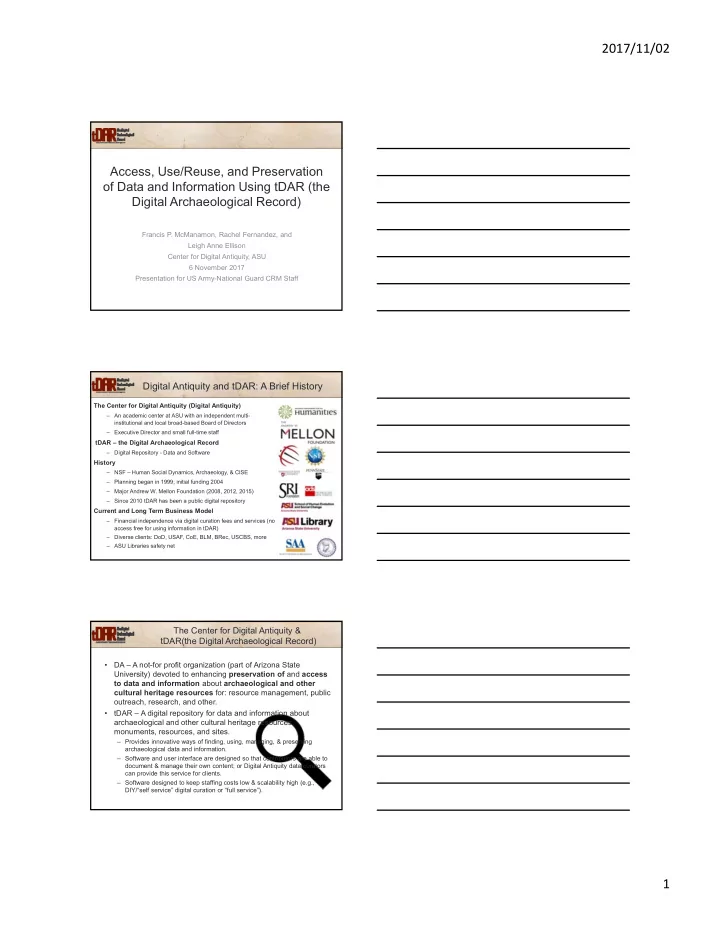
2017/11/02 Access, Use/Reuse, and Preservation of Data and - - PDF document

2017 11 02
SMART_READER_LITE
LIVE PREVIEW

2017/11/02 Access, Use/Reuse, and Preservation of Data and - - PDF document

2017/11/02 Access, Use/Reuse, and Preservation of Data and Information Using tDAR (the Digital Archaeological Record) Francis P. McManamon, Rachel Fernandez, and Leigh Anne Ellison Center for Digital Antiquity, ASU 6 November 2017


slide-1
SLIDE 1

2017/11/02 1

Access, Use/Reuse, and Preservation

  • f Data and Information Using tDAR (the

Digital Archaeological Record)

Francis P. McManamon, Rachel Fernandez, and Leigh Anne Ellison Center for Digital Antiquity, ASU 6 November 2017 Presentation for US Army-National Guard CRM Staff

Digital Antiquity and tDAR: A Brief History

The Center for Digital Antiquity (Digital Antiquity)

– An academic center at ASU with an independent multi- institutional and local broad-based Board of Directors – Executive Director and small full-time staff

tDAR – the Digital Archaeological Record

– Digital Repository - Data and Software

History

– NSF – Human Social Dynamics, Archaeology, & CISE – Planning began in 1999; initial funding 2004 – Major Andrew W. Mellon Foundation (2008, 2012, 2015) – Since 2010 tDAR has been a public digital repository

Current and Long Term Business Model

– Financial independence via digital curation fees and services (no access free for using information in tDAR) – Diverse clients: DoD, USAF, CoE, BLM, BRec, USCBS, more – ASU Libraries safety net

The Center for Digital Antiquity & tDAR(the Digital Archaeological Record)

  • DA – A not-for profit organization (part of Arizona State

University) devoted to enhancing preservation of and access to data and information about archaeological and other cultural heritage resources for: resource management, public

  • utreach, research, and other.
  • tDAR – A digital repository for data and information about

archaeological and other cultural heritage resources, monuments, resources, and sites.

– Provides innovative ways of finding, using, managing, & preserving archaeological data and information. – Software and user interface are designed so that contributors are able to document & manage their own content; or Digital Antiquity data curators can provide this service for clients. – Software designed to keep staffing costs low & scalability high (e.g., DIY/“self service” digital curation or “full service”).

slide-2
SLIDE 2

2017/11/02 2

tDAR for Data Curation: Preservation and Uses To be reliable, findable, accessible, usable, and reusable, data must be curated.

Expert Digital Preservation Services

Digital Antiquity data curators and managers:

  • Recommend data management approaches, methods, and techniques
  • Check files on upload and regularly when in repository
  • Draft and/or check metadata for uploaded files
  • Store rich descriptive metadata with files
  • Maintain files in open & common formats
  • Maintain a robust backup schedule with off-site storage
  • Employ multiple, redundant security measures
  • Migrate files to new standards as these develop

“Preservation is more than putting data on a CD stored in a climate-controlled stable environment or in the cloud.” “Discovery, data access, and use require more than a website.”

To Ignore Digital Curation is to Risk Losing Important Data

  • files that won’t open

‐ software that cannot “read” old files

slide-3
SLIDE 3

2017/11/02 3

Examples of Digital Antiquity Clients, Partners, & Users

  • DoD: USAF, USACE, Army, Navy, Marine Corps
  • Other Federal: BLM, BRec, NPS
  • State: AZ State Parks, Delaware DoT, Texas DoT, SC State

Archaeologist, NC State Archaeologist

  • NGOs and Private Firms: USCBS, Society for American

Archaeology, Society for Historical Archaeology, American Cultural Resource Association, SRI Inc, Brockington Inc, Hartgen Inc, SWCA, Northland Research, ACS Inc, Logan Simpson Design

  • Grants from: Andrew W. Mellon Foundation, NEH, NSF, Center for

Library and Information Resources (CLIR)

Case Study: DoD Legacy Data Maryland & Virginia Curation Facilities

Summary of the project available at:

http://www.digitalantiquity.org/wp‐ uploads/2011/07/Evaluating‐a‐Cooperative‐ Approach‐to‐the‐Management‐of‐Digital‐ Archaeologial‐Records.pdf

Case Study: DoD Legacy Data Maryland Archaeological Conservation Lab

slide-4
SLIDE 4

2017/11/02 4

Workflow Planning: Outcomes

Final report can be found at: https://core.tdar.org/collection/239 45/maryland‐archaeological‐ conservation‐laboratory

Full-Service Digital Curation Workflow

  • 1. Organization of digital

and paper files: Create a list Identify key metadata Determine needed actions

  • 2. DA & Client consultation:
  • Consider administrative and
  • ther terms to use for metadata

categories.

  • Decide about scanning of paper

records.

  • Create metadata style guide.
  • Consider redaction &

confidentiality needs.

  • 3. DA receives files:
  • Send digital files.
  • Send paper copies, DA

digitizes; Or, scan locally, then send.

  • 4. Files checked by

DA Curators and tDAR software.

  • 5. DA Curators Procedures:
  • Files processed and uploaded.
  • Files marked “confidential,” as

needed.

  • Metadata records drafted for files.
  • Redactions, if needed, made.
  • Access permissions added.
  • 6. Review by client

staff.

  • 7. Corrections made

& final review

  • 8. Review of project:
  • “Draft” resources are changed to

“Active” and available in tDAR.

  • Client staff ensure that future

investigations include documents and data to be archived in tDAR.

  • Report on project provided by DA.

Recommended approach in future: tDAR as the digital repository for physical collection‐ related digital files. Three procedural options for moving the associated digital files to tDAR.

Case Study: DoD Legacy Data: Maryland & Virginia Curation Facilities

slide-5
SLIDE 5

2017/11/02 5

Using tDAR to Meet DoD Cultural Heritage Needs

https://www.digitalantiquity.org/wp‐uploads/2011/07/Evaluating‐a‐Cooperative‐Approach‐to‐the‐Management‐of‐Digital‐Archaeologial‐Records.pdf

Case Study: USAF Base Archives in tDAR

Resources in tDAR Avon Park Air Force Range, FL 43 Shaw Air Force Base, SC 81 Dyess Air Force Base, TX 17 Base Archives in the Works Base Digital Archives Completed Total Known CR Digital Resources Currently in tDAR Travis, CA 24 14 Vandenberg, CA 1,031 45 Joint Base San Antonio, TX Greater than 3,500 1,205 Kaena Point, HI 23 (not comprehensive) 3 Bellows Air Force Station, HI 180 147 Hickam Air Force Base, HI N/A 53 Koke’e Air Force Station, HI N/A 1

USAF tDAR Collection

slide-6
SLIDE 6

2017/11/02 6

USAF tDAR Archive – Providing Access

Managing Access

  • Metadata records with information about files in tDAR and their content are public.
  • Access to the files themselves is available, but controlled at different levels through

a variety of means.

Controlling Access and Administration

slide-7
SLIDE 7

2017/11/02 7

Digital Data Curation Take-away

“Managing digital data isn’t a job that can be left to chance … Managing data is a full-time responsibility, and one that is so complex that it can’t be done effectively in an ad hoc manner.”

Digital Antiquity and tDAR: Q & A

For more details: www.tdar.org www.digitalantiquity.org

  • FPMcManamon@asu.edu
  • Leigh Anne Ellison:

laellison@digitalantiquity.org

  • Rachel.Fernandez.1@asu.edu

End of US Army Reserve Presentation End of 6 November presentation slides. Slides below include additional information for reference.

slide-8
SLIDE 8

2017/11/02 8

The Center for Digital Antiquity - Mission

A not-for profit organization (part of Arizona State University) … devoted to enhancing preservation of and access to data and information about archaeological and other kinds of cultural heritage resources for multiple purposes:

  • Develop and apply economical and effective means of

managing cultural heritage data for discovery, access, use/reuse, and preservation.

  • Manage, preserve, protect cultural heritage resources.
  • Provide for education, outreach, public interpretation,

and historic and scientific research.and

tDAR – the Digital Archaeological Record

  • A domain digital repository for data and information about

archaeological and other cultural heritage resources, monuments, resources, and sites.

  • Provides innovative ways of finding, using, managing, & preserving

archaeological data and information.

  • tDAR contents are searchable using geographical location, key

words, or text.

  • Software and user interface are designed so that contributors are

able to document & manage their own content; or Digital Antiquity data curators can provide this service for clients.

  • Software designed to keep staffing costs low & scalability high (e.g.,

DIY/“self service” digital curation or “full service”).

slide-9
SLIDE 9

2017/11/02 9

# of Coding Sheets # of Documents # of Documents with Files # of Data Sets # of Ontologies # of Projects # of Images # of GeoSpatial Objects # of Sensory Data Objects 2009 52 25 33 25 2010 100 609 596 57 26 90 27 2011 249 360,635 2,418 303 36 257 6,107 139 2012 434 363,782 5,791 447 47 455 7,631 140 2013 504 363,657 6,634 560 48 513 17,001 78 139 2014 613 364,335 7,431 613 48 740 17,452 78 158 2015 984 368,342 8,967 954 53 822 18,629 83 158 2016 (Dec 1) 1,387 383,207 9,870 1,134 56 916 20,008 450 158 1 10 100 1,000 10,000 100,000 1,000,000

TDAR RESOURCE TYPE BY YEAR (ACTIVE)

tDAR Content – Stats & Standards Project Planning

Worked together to identify materials for preservation, organize and ingest the materials Approached a digital repository Curator identified problem preserving & providing access to digital materials

The Digital Curation Process

Organization of documents, images, etc. and create list DA & USAF CRM consultation

  • Consider administrative and other terms

to use

  • Create metadata style guide
  • Consider redaction & confidentiality needs

DA receives files

  • Send digital files;
  • Send paper copies, DA digitizes; OR,
  • Digitize locally, then send

Files checked by DA Curators and tDAR software Files processed, then uploaded & curated

  • Redaction & Permissions added

Review by USAF CRM staff Corrections made & final review ‘Draft’ resources changed to ‘Active’

slide-10
SLIDE 10

2017/11/02 10

Workflow Planning: Challenges

What to Keep?

Multiple versions & copies Extraneous Materials (Images

  • f bicycles)

Outdated Formats

Migrate to newer/archival file formats Unable to open some files

Organization & Description

Poorly organized Limited descriptive information (metadata)

tDAR for USAF

Efficiency and Organization Security and Expertise Public Outreach

slide-11
SLIDE 11

2017/11/02 11 tDAR for USAF

  • tDAR has tools to neatly organize digital cultural

materials

  • Rich, searchable metadata
  • Standard archaeological and CRM file types

Efficiency and Organization Security and Expertise Public Outreach

tDAR for USAF

Efficiency and Organization

  • Your files and information are secure
  • Digital Antiquity staff are experts in digital preservation
  • Our staff members include trained archaeologists capable of

creating metadata and performing redactions and other services Security and Expertise Public Outreach

tDAR for USAF

Efficiency and Organization Security and Expertise

  • Discoverability and variety of uses
  • A range of audiences and users

Public Outreach