
SLIDE 1
2017-10-12 1
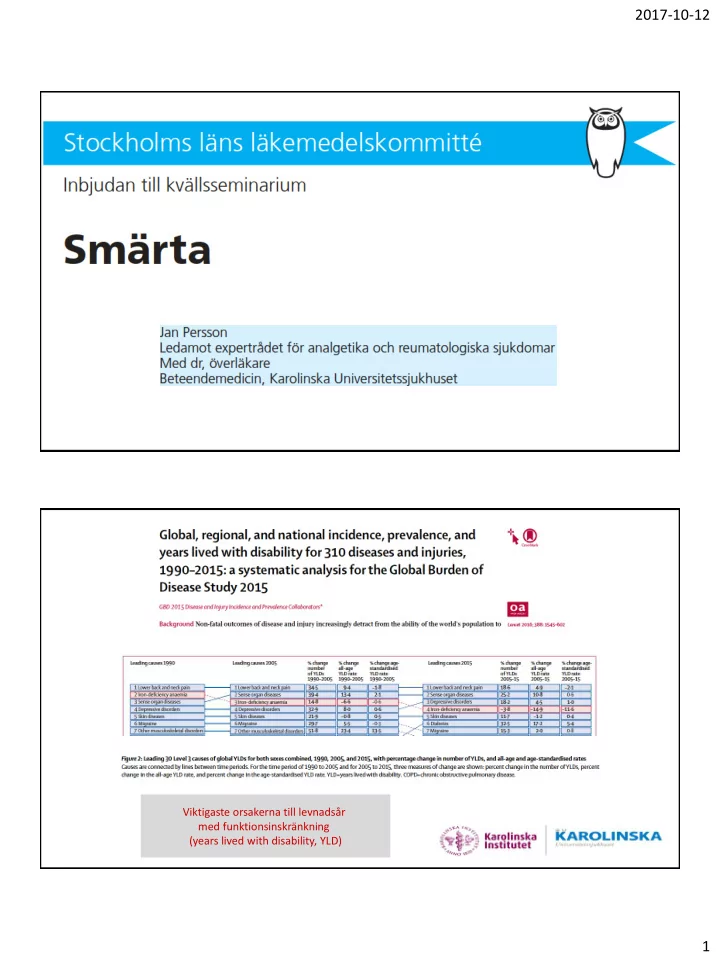
Viktigaste orsakerna till levnadsår med funktionsinskränkning (years lived with disability, YLD)
2017-10-12 Viktigaste orsakerna till levnadsr med - - PDF document
2017-10-12 Viktigaste orsakerna till levnadsr med funktionsinskrnkning (years lived with disability, YLD) 1 2017-10-12 Prestige hos olika sjukdomar Kartlggningen visar p brister och omotiverade skillnader i vrd och behandling av
2017-10-12 1
Viktigaste orsakerna till levnadsår med funktionsinskränkning (years lived with disability, YLD)
2017-10-12 2
Kartläggningen visar på brister och omotiverade skillnader i vård och behandling av patientgruppen. Nationell samordning i form av ett nationellt programråd kan ge nationella rekommendationer för
patienter med långvarig smärta, vilket ökar möjligheterna till en mer jämlik och effektiv vård och att bästa tillgängliga kunskap används för bästa möjliga patientnytta.
2017-10-12 3
Constant Remifentanil infusion
Same stimulus intensity, same opioid analgesia, three different pain experiences
6
Subjektiva smärtskattningar återspeglas i hjärnaktiviteten i smärtrelaterade regioner
2017-10-12 4
7
Hur mycket påverkar smärtan….
Smärtavdelningen Karolinska Huddinge, baserat på samtliga patienter under 2008 Monica Pedersen, Rikard Wicksell
Vad är övrigt??
8
Patienter med långvarig ländryggssmärta Förklaring till interindividuella variansen i smärtintensitet
depression, katastroftänkande rörelserädsla, försäk frågor mm
(Prefrontala cortex)
2017-10-12 5
The heart Science center
Prefrontala cortex samordnar ett väl sammanhållet, genomtänkt, medvetet planerat, rationellt och socialt acceptabelt beteende som utförs dels på basen av tidigare upplevelser och regelverk och dels med hänsyn till den aktuella situationen och den uppmärksamhet med vilken vi förmår analysera den aktuella situationen . (Från cns.sahlgrenska.gu.se)
Hur uppstår vår smärtupplevelse? hur samverkar neurofysiologi och psykologi?
hjärnor (kritisk realism)
en konstruktion av hjärnan
neurofysiologiskt
teori Smärta är en av hjärnan aktivt konstruerad upplevelse, som bestäms av förväntningar och deras modifiering genom erfarenhet (Wiech)
2017-10-12 6
12
Smärtterminologim ed ny term för sensitisering
2017-10-12 7
13
Medelvärde för alla patienter med RA Medelvärde för fibromyalgipatienter Fibromyalgihet graden av polysymptomatisk stress
Symptom intensity scale
Mäter polysymptomatisk stress: Trötthet, cognitiva problem, sömnstörning, smärta mm. Således ingen polymodal fördelning!
Sensitisering av smärtsinnet
2017-10-12 8
15
Graderad träning för patienter med ledsmärtor
The Stroop colour word test (SCWT) has proven to be a valuable tool to assess neuronal plasticity that is coupled to improvement in performance in clinical populations. Effects of a 15-week physical exercise intervention on cognitive performance, task-related cortical activation and distraction-induced analgesia in patients with fibromyalgia and healthy controls:
2017-10-12 9
Specifika fobier
Irrationell rädsla inför exponering för specifika
irrationell. Specifika delar av hjärnan bla. PFC aktiveras av fobin, möjligen finns ett neuroanatomiskt strukturellt nätverk, som är inblandat
17
Långvariga smärttillstånd
Hjärnan kan utveckla irrationella, avseende långsiktiga värden dysfunktionella beteendemönster, som individen med sitt medvetna tänkande inte har inblick i
Gemensamma drag
beteendemönster utanför medveten kontroll
medveten insikt utan genom exponering
Beteendeterapi mot smärta?
Läkemedelskommittens expertråd ANALGETIKA OCH REUMATOLOGISKA SJUKDOMAR
Nociceptiv smärta Kloka listan 2017 Sammanfattning
SMÄRTA INFLAMMATION NSAID, paracetamol (COX-hämmare) OPIOIDANALGETIKA Morfin, buprenorfin (Opioider) 2017
2017-10-12 10
Nociceptiv smärta Kloka listan 1217 Sammanfattning
SMÄRTA INFLAMMATION Sälgbark, Salicylika (COX-hämmare) OPIOIDANALGETIKA Opium (Opioider)
1217
Läkemedelskommittens expertråd ANALGETIKA OCH REUMATOLOGISKA SJUKDOMAR
20
Kloka listan 2017
2017-10-12 11
21
Kloka listan 2017
22
Kloka listan 2017
2017-10-12 12
23 24
Neither regular nor as-needed paracetamol improved recovery time or pain intensity, disability, function, global change in symptoms, sleep, or quality of life at any stage during a 3-month follow up. In previous studies, paracetamol was usually compared with non-steroidal anti-infl ammatory drugs. Investigators of a Cochrane Review concluded these medicines to be equally effective Statistically significant effects were found in favor of NSAIDs compared with placebo, but at the cost of statistically significant more side effects. There is moderate evidence that NSAIDs are not more effective than paracetamol for acute low back pain, but paracetamol had fewer side effects.
2017-10-12 13
25
Om vare sig paracetamol eller COX hämmare fungerar vid akut ryggsmärta, vad skall vi då göra?
Rörelseträning! Vid intensiva akuta smärtor afferent stimulering, ex vis periostakupunktur, sterilt vatten ic
2017-10-12 14
Läkartidningen.se
2017-10-12 15
severe chronic non-cancer pain is still medically accepted “good practice”.
patient and his social situation well.
before starting a trial of opioid therapy, that long-term opioid treatment requires considerable effort by both patient and doctor.
prescription opioid use” and the more serious, chronic neuro biological disease “addiction”, should these complications arise.
A Double le-blin blind Mult ltip iple le Intrav avenous Test t for Evalu luat atio ion of Opio ioid id Sensit itiv ivity ty in in the Cli linic ic
Jan Persson1,2 , Monica Pedersen1,2
1Pain Clinic, Department of Anesthesia, Karolinska University Hospital, Huddinge, 2CLINTEC, Karolinska Institutet, Stockholm, SwedenAim of investigation
Exploring a method for quasi-objective evaluation of
well as patient motivation.
Methods
Different opioids are given i.v. in two doses. The size of the dose is based on the clinical dose used to treat the
Morphine equivalents. Midazolam is used as an active
ml i.v. infusion during 20 minutes when the patient requires pain relief. The patients rate their pain using a visual analogue scale (VAS 0-10) before and twenty minutes after the infusion. After the test has been completed it is decoded. In the evaluation several factors are considered. The pain intensity difference (PID) for each dose of a certain opioid is calculated giving an opportunity for comparison of the effect of different opioids and doses. Since each opioid is administered in two doses a dose response analysis can be performed. An opioid responsive pattern (fig 1) would be characterized by a large PID and a consistent dose-response pattern (fig 3), compared to a non- responsive one (fig 2). The result of the test and the recommendations based upon it, are discussed with the patient. Results We have been using the test in our clinical work over many years and a wealth of clinical experience has been collected. The results indicate that the method is an aid in the choice of appropriate opioid therapy. It has often helped us to wean the patients from
depriving them of pain relief.
Fig 1: Test results from a patient classified as having anDiscussion
Opioid treatment may offer pain relief with increased activity and functioning, higher quality of life and negligible side effects, in selected patients. Clinical utility is mainly contingent on opioid sensitivity and responsiveness. Variations in opioid sensitivity is a contentious issue. Although most patients with a poor response to opioids would be expected to discontinue their opioid use, some do not. The reasons are non-analgesic opioid effects such as anxiolysis, sedation and addiction. Several caveats have to be addressed concerning the validity of the test. The tenet that all
general “opioid responsiveness” perhaps cannot be defined. Even if such an entity can be useful the validity of the test in identifying it has not been rigorously proven. Carry-over effects from previous doses can furthermore confound interpretation. Notwithstanding these objections, we have found that analyzing the test results in terms of a general “opioid-response” pattern, usually results in a relatively clear-cut result. In particular, the negative predictive value appears to be of great clinical importance (fig 4).
Conclusion We have found the double blind multiple-opioid intravenous test to be a valuable clinical tool, mainly in that it provides a base for the dialogue between clinician and patient . It is easy to perform and can be administered by nurses. The test has not yet been validated as a scientific instrument. References: Kindler LL et al J Pain. 2011 Mar;12(3):340-51
Fig 3: General dose-response curve for opioid response Fig 4: Predictive values for test outcomesDrug, dose (mg) VASbefore VASafter
Buprenorphine 0.3 8 8 Buprenorphine 0.6 8 8 Cetobemidone 5 8 7 Cetobemidone 10 8 8 Fentanyl 0.05 7 5 Fentanyl 0.1 9 8 Methadone 5 7 7 Methadone 10 8 8 Midazolam 2 8 8 Midazolam 2 5 4
Drug, dose (mg) VASbefore VASafter
Buprenorphine 0.3 5 Buprenorphine 0.6 4 Cetobemidone 5 4 1 Cetobemidone 10 4 1 Fentanyl 0.05 5 Fentanyl 0.1 5 Methadone 5 6 5 Methadone 10 5 Midazolam 2 5 4 Midazolam 2 4 4
Can we test for opioid sensitivity?
2017-10-12 16
A Double-bli blind nd Multip tiple e Intr travenous nous Test for Evaluatio tion n of Opioid Sensiti sitivi vity ty in the Clinic
Jan Persson1,2 , Monica Pedersen1,2
1Pain Clinic, Department of Anesthesia, Karolinska University Hospital, Huddinge, 2CLINTEC, Karolinska Institutet, Stockholm, SwedenReferences: Kindler LL et al J Pain. 2011 Mar;12(3):340-51
A Double-bli blind nd Multip tiple e Intr travenous nous Test for Evaluatio tion n of Opioid Sensiti sitivi vity ty in the Clinic
Jan Persson1,2 , Monica Pedersen1,2
1Pain Clinic, Department of Anesthesia, Karolinska University Hospital, Huddinge, 2CLINTEC, Karolinska Institutet, Stockholm, SwedenReferences: Kindler LL et al J Pain. 2011 Mar;12(3):340-51
2017-10-12 17
OPIOID SENSITIVITY OPIOID TEST
SENSITIVITY SPECIFICITY POS PREDICTIVE VALUE NEG PREDICTIVE VALUE
34 Opioidtest Jan Persson
2017-10-12 18
35 Opioidtest Jan Persson
No analgesia on any dose or opioid
36 Opioidtest Jan Persson
2017-10-12 19
37 Opioidtest Jan Persson
Analgesic effect PID Opioid dose
38 Opioidtest Jan Persson
Analgesic effect PID Opioid dose
Thus a completely random PID distribution with no pharmacological dose/response pattern Effect size like Midazolam
Case report Opioid test 2
2017-10-12 20
Codeine 60 mg added to a regimen of paracetamol 1,000 mg and ibuprofen 400 mg does not improve analgesia after third molar surgery.
40
2017-10-12 21
Jan Persson 2011
COX hämmare selektiva effekter
42
COX1/COX2 balansen hos olika COX hämmare
Warner 2004
2017-10-12 22
Distribution of current use of individual NSAIDs among cases and controls and pooled associations between current use of individual NSAIDs and risk of hospital admission for heart failure, with past use of any NSAID as reference. Estimates obtained by pooling individual data from all available databases. Pooled odds ratios and 95% confidence intervals estimated by fitting a conditional logistic regression model after correcting for available covariates
Kardiovaskulära, GI och renala biverkningar med Celecoxib, Naproxen
artrosbehandling
2017-10-12 23 Analgetiska effekten av olika COX hämmare och doser
Forest plot of data for tricyclic antidepressants included in the meta-analysis
“State of the art” evidens för antineuropatiska analgetika
2017-10-12 24
Forest plot of -noradrenaline reuptake inhibitors included in the meta-analysis Forest plot of data for pregabalin included in the meta-analysis
2017-10-12 25
Forest plot of data for gabapentin including extended release and Enacarbil included in the meta-analysis
2017-10-12 26