References: Procedural Sedation and Analgesia in the Emergency - - PDF document

references procedural sedation and analgesia in the
SMART_READER_LITE
LIVE PREVIEW

References: Procedural Sedation and Analgesia in the Emergency - - PDF document

References: Procedural Sedation and Analgesia in the Emergency Setting 1. 2014 Nursing Mandatory Sedation Update. University of Florida. Sharon Edmunds, 2014. 2. Adams D, Dervay KR. Pharmacology of procedural sedation. AACN Advanced Critical Care .


slide-1
SLIDE 1

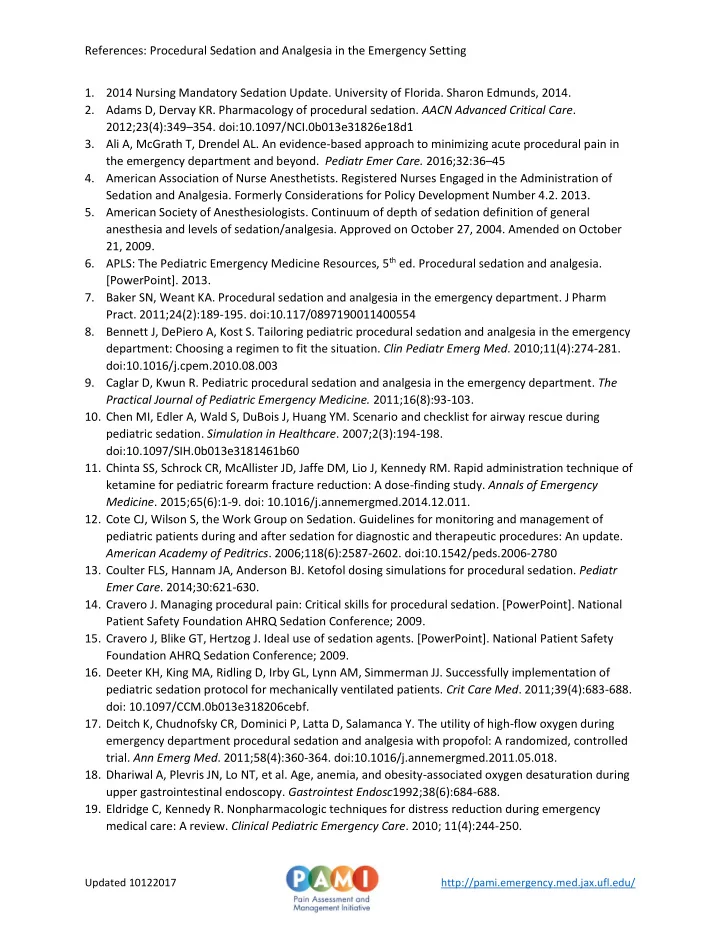
References: Procedural Sedation and Analgesia in the Emergency Setting

Updated 10122017 http://pami.emergency.med.jax.ufl.edu/

  • 1. 2014 Nursing Mandatory Sedation Update. University of Florida. Sharon Edmunds, 2014.
  • 2. Adams D, Dervay KR. Pharmacology of procedural sedation. AACN Advanced Critical Care.

2012;23(4):349–354. doi:10.1097/NCI.0b013e31826e18d1

  • 3. Ali A, McGrath T, Drendel AL. An evidence-based approach to minimizing acute procedural pain in

the emergency department and beyond. Pediatr Emer Care. 2016;32:36–45

  • 4. American Association of Nurse Anesthetists. Registered Nurses Engaged in the Administration of

Sedation and Analgesia. Formerly Considerations for Policy Development Number 4.2. 2013.

  • 5. American Society of Anesthesiologists. Continuum of depth of sedation definition of general

anesthesia and levels of sedation/analgesia. Approved on October 27, 2004. Amended on October 21, 2009.

  • 6. APLS: The Pediatric Emergency Medicine Resources, 5th ed. Procedural sedation and analgesia.

[PowerPoint]. 2013.

  • 7. Baker SN, Weant KA. Procedural sedation and analgesia in the emergency department. J Pharm
  • Pract. 2011;24(2):189-195. doi:10.117/0897190011400554
  • 8. Bennett J, DePiero A, Kost S. Tailoring pediatric procedural sedation and analgesia in the emergency

department: Choosing a regimen to fit the situation. Clin Pediatr Emerg Med. 2010;11(4):274-281. doi:10.1016/j.cpem.2010.08.003

  • 9. Caglar D, Kwun R. Pediatric procedural sedation and analgesia in the emergency department. The

Practical Journal of Pediatric Emergency Medicine. 2011;16(8):93-103.

  • 10. Chen MI, Edler A, Wald S, DuBois J, Huang YM. Scenario and checklist for airway rescue during

pediatric sedation. Simulation in Healthcare. 2007;2(3):194-198. doi:10.1097/SIH.0b013e3181461b60

  • 11. Chinta SS, Schrock CR, McAllister JD, Jaffe DM, Lio J, Kennedy RM. Rapid administration technique of

ketamine for pediatric forearm fracture reduction: A dose-finding study. Annals of Emergency

  • Medicine. 2015;65(6):1-9. doi: 10.1016/j.annemergmed.2014.12.011.
  • 12. Cote CJ, Wilson S, the Work Group on Sedation. Guidelines for monitoring and management of

pediatric patients during and after sedation for diagnostic and therapeutic procedures: An update. American Academy of Peditrics. 2006;118(6):2587-2602. doi:10.1542/peds.2006-2780

  • 13. Coulter FLS, Hannam JA, Anderson BJ. Ketofol dosing simulations for procedural sedation. Pediatr

Emer Care. 2014;30:621-630.

  • 14. Cravero J. Managing procedural pain: Critical skills for procedural sedation. [PowerPoint]. National

Patient Safety Foundation AHRQ Sedation Conference; 2009.

  • 15. Cravero J, Blike GT, Hertzog J. Ideal use of sedation agents. [PowerPoint]. National Patient Safety

Foundation AHRQ Sedation Conference; 2009.

  • 16. Deeter KH, King MA, Ridling D, Irby GL, Lynn AM, Simmerman JJ. Successfully implementation of

pediatric sedation protocol for mechanically ventilated patients. Crit Care Med. 2011;39(4):683-688. doi: 10.1097/CCM.0b013e318206cebf.

  • 17. Deitch K, Chudnofsky CR, Dominici P, Latta D, Salamanca Y. The utility of high-flow oxygen during

emergency department procedural sedation and analgesia with propofol: A randomized, controlled

  • trial. Ann Emerg Med. 2011;58(4):360-364. doi:10.1016/j.annemergmed.2011.05.018.
  • 18. Dhariwal A, Plevris JN, Lo NT, et al. Age, anemia, and obesity-associated oxygen desaturation during

upper gastrointestinal endoscopy. Gastrointest Endosc1992;38(6):684-688.

  • 19. Eldridge C, Kennedy R. Nonpharmacologic techniques for distress reduction during emergency

medical care: A review. Clinical Pediatric Emergency Care. 2010; 11(4):244-250.

slide-2
SLIDE 2

References: Procedural Sedation and Analgesia in the Emergency Setting

Updated 10122017 http://pami.emergency.med.jax.ufl.edu/

  • 20. Florida Malpractice. 766.103 Florida Medical Consent Law.

http://floridamalpractice.com/stat766.103.htm. Accessed January 9, 2015.

  • 21. Fein JA, Zempsky WT, Cravero JP. Relief of pain and anxiety in pediatric patients in emergency

medical systems. American Academy Pediatrics. 2012;130(5):e1391-e1405. doi:10.1542/peds.2012- 2536

  • 22. Fu ES, Downs JB, Schweiger JW, Miguel RV, Smith RA. Supplemental oxygen impairs detection of

hypoventilation by pulse oximetry. Chest. 2004;126(5):1552-8.

  • 23. Godwin SA, Burton JH, Gerardo CJ, Hatten BW, Mace SE, Silvers SM, Fesmire FM. Clinical policy:

Procedural sedation and analgesia in the emergency department. Ann Emerg Med. 2014 Feb;63(2):247-314.

  • 24. Godwin A, Whisenant B. Procedural Sedation. In Adams JG, Nadal ES, DeBlieux PM, Barton ED,

Collings J, ed. Emergency Medicine. 1st ed. Philadelphia, PA: Elsevier Inc; 2008:111-119.

  • 25. Green SM, Krauss B. Procedural sedation terminology: Moving beyond “conscious sedation.” Ann

Emerg Med. 2002;39:433-435. doi:10.1067/mem.2002.122770

  • 26. Gross JB, Bailey PL, Connis RT, Cote CJ, Davis FG, Epstein BS, Gilbertson L, Nickinovich DG, Zerwas

JM, Zuccaro G. Practice guidelines for sedation and analgesia by non-anesthesiologists.

  • Anesthesiology. 2002;96:1004-1017.
  • 27. Grunwell JR, McMcarcken C, Fortenberry J, Stockwell J, Kamat P. Risk factors leading to failed

procedural sedation in children outside the operating room. Pediatr Emer Care. 2014;30:381-387.

  • 28. Habre W, Peták F. Perioperative use of oxygen: Variabilities across age. Br J Anaesth. 2014;113 Suppl

2:ii26-36. doi: 10.1093/bja/aeu380.

  • 29. Havidich JE, Cravero JP. The current status of procedural sedation for pediatric patients in out-of-
  • perating room locations. Curr Opin Anesthesiol. 2012;25:453–460.

doi:10.1097/ACO.0b013e32835562d8

  • 30. Hendry PL. Management update on pain, agitation, and sedation in the emergency care of children.

[PowerPoint]. June 2015

  • 31. Hogan K et al. The safety of the single-physician procedural sedation in the emergency department.

Emerg Med J 2006; 23 (12): 922-3

  • 32. Hom J. Pediatric sedation. Medscape website. http://emedicine.medscape.com/article/804045-
  • verview. Updated on June 2015. Accessed on December 2014.
  • 33. Illinois Emergency Medical Services for Children (EMSC), Pediatric Moderate Sedation, February

2008

  • 34. Information Packet: Sedation Guideline. American Association of Critical Care Nurses website.

www.aacn.org/WD/Practice/Docs/Sedation.doc Published March 2002. Accessed December 2014.

  • 35. Isaacman D. Procedural sedation in children. Clinical Pediatric Emergency Medicine. 2010;11(4)231-

232.

  • 36. Jacob R, Ilamurugu K, Amar N. Pediatric procedural sedation: A review and an update. Indian Journal
  • f Anaesthesia. 2007;51(3):169-175.
  • 37. JCAHO website http://sedationcertification.com/resources/position-statements/jcaho/ Accessed

March 2015.

  • 38. Kaplan RF. Sedation and analgesia in pediatric patients for procedures outside the operative room.

The Joint Commission. 286-286.

  • 39. Kost S, Roy A. Sedation and analgesia in the pediatric emergency department: A review of sedative
  • pharmacology. Clinical Pediatric Emergency Medicine. 2010;11(4):233-243
slide-3
SLIDE 3

References: Procedural Sedation and Analgesia in the Emergency Setting

Updated 10122017 http://pami.emergency.med.jax.ufl.edu/

  • 40. Kweon TD. Sedation under JCI standards. Korean J Anesthesiol. 2011;61(3):190–194. doi:

10.4097/kjae.2011.61.3.190

  • 41. Lee GY, Yamanda, J, Kyololo O, Shorkey A, Stevens B. Pediatric clinical practice guidelines for acute

procedural pain: A systematic review. Pediatrics. 2014;133(3):1-18. doi:10.1542/peds.2013-2744

  • 42. Lopez S, Swadron S. Could ketofol be the perfect drug combo? January 9, 2013.

http://www.epmonthly.com/departments/clinical-skills/emrap/could-ketofol-be-the-perfect-drug- combo/. Accessed February 20, 2013.

  • 43. Mace SE, Brown LA, Francis L, Godwin SA, Hahn SA, Howard PK, et al. Clinical policy: Critical issues in

the sedation of pediatric patients in the emergency department. Ann Emerg Med. 2008;51:378-399. doi:10.1016/j.annemergmed.2007.11.001

  • 44. Mayo Clinic. Moderate sedation at mayo clinic health system. [PowerPoint].
  • 45. Nagler J, Krauss B. Monitoring the procedural sedation patient: Optimal constructs for patient
  • safety. Clinical Pediatric Emergency Medicine. 2010;11(4);251-264.

doi:http://dx.doi.org/10.1016/j.cpem.2010.09.007

  • 46. Naughton NN. Sedation analgesia: JCAHO requirements and how to fulfill them. [PowerPoint].

University of Michigan Health System, Department of Anesthesiology.

  • 47. National Institutes of Health (NIH). Patient education: Conscious (moderate) sedation for adults.

2007.

  • 48. National Institutes of Health (NIH) website; conscious sedation for surgical procedures.

http://www.nlm.nih.gov/medlineplus/ency/article/007409.htm. Accessed February 2015

  • 49. Newman DH, Azer MM, Pitetti RD, Singh S. When Is a Patient Safe for Discharge After Procedural

Sedation? The Timing of Adverse Effect Events in 1,367 Pediatric Procedural Sedations. Ann Emerg

  • Med. 2003;42(5):627-635. doi:10.1016/S0196-0644(03)00446-3.
  • 50. O’Connor RE, Sama A, Burton JH, Callaham ML, House HR, Jaquis WP, et al. Procedural sedation and

analgesia in the emergency department: Recommendations for physician credentialing, privileging and practice. Approved by the ACEP Board of Directors in June 2011.

  • 51. Obesity Ups Risks in Pediatric Procedural Sedation. Monthly Prescribing Reference (MPR) website.

http://www.empr.com/medical-news/obesity-ups-risks-in-pediatric-procedural- sedation/article/420375/ Published June 21, 2015. Accessed June 2015.

  • 52. Pacheco GS, Ferayorni A. Pediatric procedural sedation and analgesia. Emerg Med Clinc N Am.

2013;31(3):831-852. http://dx.doi.org/10.1016/j.emc.2013.04.003.

  • 53. Patil SP, Schneider H, Marx JJ, et al. Neuromechanical control of upper airway patency during sleep.

J Appl Physiol 2007;102(2):547-556.

  • 54. Phelps JR, Russell A, Lupa MC, McNaull P, Pittenger S, Ricketts K, et al. - High dose dexmedetomidine

for noninvasive pediatric procedural sedation and discharge readiness. Pediatr Anesth. 2014;1-6. doi:10.1111/pan.12569

  • 55. Procedural sedation. AHC Media website. http://www.ahcmedia.com/articles/78897-procedural-

sedation Published October 21, 2012. Accessed February 2015.

  • 56. Procedural Sedation. Medscape website http://emedicine.medscape.com/article/109695-
  • verview#showall Published December 2015. Accessed January 2015.
  • 57. Pillai Riddell RR, Racine NM, Turcotte K, Uman LS, Horton RE, Din Osmun L, et al. Non-

pharmacological management of infant and young child procedural pain (review). The Cochrane

  • collaboration. Published by John Wiley & Sons, Ltd. 2012;5:1-215.
slide-4
SLIDE 4

References: Procedural Sedation and Analgesia in the Emergency Setting

Updated 10122017 http://pami.emergency.med.jax.ufl.edu/

  • 58. Pinto RF, Bhimani M, Milne WK, Nicholson K. Procedural sedation and analgesia in rural and regional

emergency departments. Can J Rural Med.2013;18(4):130-136.

  • 59. Procedure for Intravenous Conscious Sedation. Comprehensive Accreditation Manual for Hospitals:

The Official Handbook. Oakbrook Terrace, IL: The Joint Commission on Accreditation of Healthcare Organizations, 1999: TX-73-9.

  • 60. Proudfoot J, Krug S. Pediatric procedural sedation and analgesia (PSA): Keep it simple and safe.

Pediatric Emergency Medicine Report. 2002;7(2):13-24.

  • 61. Ramaiah R, Grabinsky A, Bhananker. Sedation and analgesia for the pediatric trauma patients. Int J

Crit Illn Inj Sci. 2012;2(3):156–162. doi:10.4103/2229-5151.100897

  • 62. Scherrer PD. Safe and sound: Pediatric procedural sedation and analgesia. Minn Med. 2011;94(3):43-
  • 47. PMID:21485927
  • 63. Scherrer PD, Mallory MD, Cravero JP, Lowrie L, Hertzog JH, Berkenbosch JW. The impact of obesity
  • n pediatric procedural sedation related outcomes: results from the Pediatric Sedation Research
  • Consortium. Pediatr Anesth. 2015;25:689–697. doi:10.1111/pan.12627
  • 64. Shavit I, Hershman E. Management of children undergoing painful procedures in the emergency

department by non-anesthesiologist. IAMJ.2004;6:350-355.

  • 65. Temple Health. A practical guide to informed consent.

http://www.templehealth.org/ICTOOLKIT/html/ictoolkitpage5.html. Accessed January 9, 2015.

  • 66. The Society for Pediatric Sedation: Sedation Provider Course. Dartmouth-Hitchcock Medical Center,

University of Wisconsin School of Medicine and Public Health. June 2009.

  • 67. Urman RD, Vadiveli N. Pocket Pain Medicine. Philadelphia, PA: Lippincott Williams & Wilkins; 2011.
  • 68. Valani R, Shah KH. Essential Emergency Procedural Sedation and Pain Management. Philadelphia,

PA: Lippincott Williams & Wilkins, a Wolters Kluwer business; 2012.

  • 69. Weingart SC, Bhagwan SD. Current guidelines for procedural sedation in the emergency department.
  • EMPractice. 2010;2(3):1-12. http://www.ebmedicine.net/introduction
  • 70. Welliver M, Bednarzyk M. Sedation considerations for the nonintubated obese patient in critical
  • care. Crit Care Nurs Clin North Am 2009;21(3):341-352, vi.
  • 71. Yan JW, McLeod SL, Iansavitchene A. Ketamine-propofol versus propofol alone for procedural

sedation in the emergency department: A systematic review and meta-analysis. Acad Emerg Med. 2015;22(9):1003-13. doi: 10.1111/acem.12737.

  • 72. Young TP, Lim JJ, Kim TY, Thorp AW, Brown L. Pediatric procedural sedation with propofol using a

higher initial bolus dose. Pediatr Emer Care. 2014;30:689–693.

  • 73. Zempsky WT. Pharmacologic approaches for reducing venous access pain in children. Pediatrics

2008;122:S140–S153. doi:10.1542/peds.2008-1055g