Outline References References References References Principles - - PowerPoint PPT Presentation

outline
SMART_READER_LITE
LIVE PREVIEW

Outline References References References References Principles - - PowerPoint PPT Presentation

References Outline References References References References Principles of Complex Systems Course 300, Fall, 2008 Prof. Peter Dodds References Department of Mathematics & Statistics University of Vermont Licensed under the Creative


slide-1
SLIDE 1

References References Frame 1/20

References

Principles of Complex Systems Course 300, Fall, 2008

  • Prof. Peter Dodds

Department of Mathematics & Statistics University of Vermont

Licensed under the Creative Commons Attribution-NonCommercial-ShareAlike 3.0 License. References References Frame 2/20

Outline

References

References References Frame 3/20

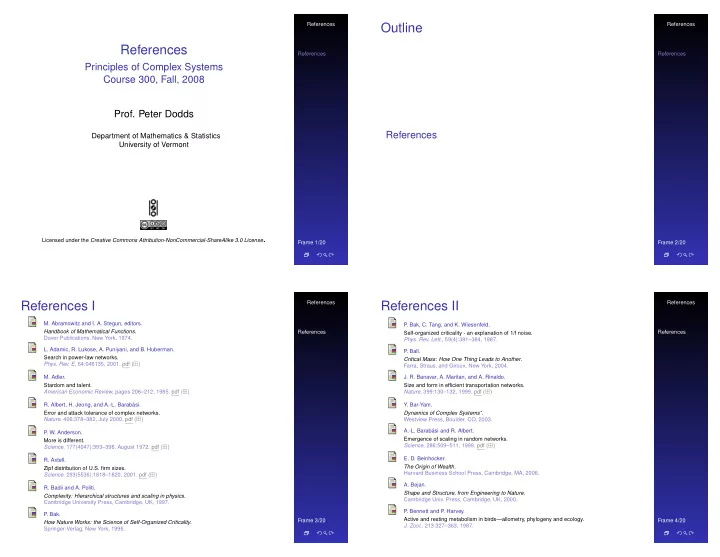
References I

  • M. Abramowitz and I. A. Stegun, editors.

Handbook of Mathematical Functions. Dover Publications, New York, 1974.

  • L. Adamic, R. Lukose, A. Puniyani, and B. Huberman.

Search in power-law networks.

  • Phys. Rev. E, 64:046135, 2001. pdf (⊞)
  • M. Adler.

Stardom and talent. American Economic Review, pages 208–212, 1985. pdf (⊞)

  • R. Albert, H. Jeong, and A.-L. Barabási.

Error and attack tolerance of complex networks. Nature, 406:378–382, July 2000. pdf (⊞) P . W. Anderson. More is different. Science, 177(4047):393–396, August 1972. pdf (⊞)

  • R. Axtell.

Zipf distribution of U.S. firm sizes. Science, 293(5536):1818–1820, 2001. pdf (⊞)

  • R. Badii and A. Politi.

Complexity: Hierarchical structures and scaling in physics. Cambridge University Press, Cambridge, UK, 1997. P . Bak. How Nature Works: the Science of Self-Organized Criticality. Springer-Verlag, New York, 1996. References References Frame 4/20

References II

P . Bak, C. Tang, and K. Wiesenfeld. Self-organized criticality - an explanation of 1/f noise.

  • Phys. Rev. Lett., 59(4):381–384, 1987.

P . Ball. Critical Mass: How One Thing Leads to Another. Farra, Straus, and Giroux, New York, 2004.

  • J. R. Banavar, A. Maritan, and A. Rinaldo.

Size and form in efficient transportation networks. Nature, 399:130–132, 1999. pdf (⊞)

  • Y. Bar-Yam.

Dynamics of Complex Systems”. Westview Press, Boulder, CO, 2003. A.-L. Barabási and R. Albert. Emergence of scaling in random networks. Science, 286:509–511, 1999. pdf (⊞)

  • E. D. Beinhocker.

The Origin of Wealth. Harvard Business School Press, Cambridge, MA, 2006.

  • A. Bejan.

Shape and Structure, from Engineering to Nature. Cambridge Univ. Press, Cambridge, UK, 2000. P . Bennett and P . Harvey. Active and resting metabolism in birds—allometry, phylogeny and ecology.

  • J. Zool., 213:327–363, 1987.
slide-2
SLIDE 2

References References Frame 5/20

References III

  • B. J. L. Berry.

Déjà vu, Mr. Krugman. Urban Geography, 20:1–2, 1999. pdf (⊞)

  • L. M. A. Bettencourt, J. Lobo, D. Helbing, Kühnhert, and G. B. West.

Growth, innovation, scaling, and the pace of life in cities.

  • Proc. Natl. Acad. Sci., 104(17):7301–7306, 2007. pdf (⊞)
  • S. Bikhchandani, D. Hirshleifer, and I. Welch.

A theory of fads, fashion, custom, and cultural change as informational cascades.

  • J. Polit. Econ., 100:992–1026, 1992.
  • S. Bikhchandani, D. Hirshleifer, and I. Welch.

Learning from the behavior of others: Conformity, fads, and informational cascades.

  • J. Econ. Perspect., 12(3):151–170, 1998. pdf (⊞)

P . M. Blau and J. E. Schwartz. Crosscutting Social Circles. Academic Press, Orlando, FL, 1984.

  • K. L. Blaxter, editor.

Energy Metabolism; Proceedings of the 3rd symposium held at Troon, Scotland, May 1964. Academic Press, New York, 1965.

  • J. J. Blum.

On the geometry of four-dimensions and the relationship between metabolism and body mass.

  • J. Theor. Biol., 64:599–601, 1977.
  • N. Boccara.

Modeling Complex Systems. Springer-Verlag, New York, 2004. References References Frame 6/20

References IV

  • S. Bornholdt and H. G. Schuster, editors.

Handbook of Graphs and Networks. Wiley-VCH, Berlin, 2003.

  • R. L. Breiger.

The duality of persons and groups. Social Forces, 53(2):181–190, 1974.

  • S. Brody.

Bioenergetics and Growth. Reinhold, New York, 1945. reprint, .

  • J. Carlson and J. Doyle.

Highly optimized tolerance: A mechanism for power laws in design systems.

  • Phys. Rev. Lett., 60(2):1412–1427, 1999. pdf (⊞)
  • J. Carlson and J. Doyle.

Highly optimized tolerance: Robustness and design in complex systems.

  • Phys. Rev. Lett., 84(11):2529–2532, 2000. pdf (⊞)
  • E. Castronova.

Synthetic Worlds: The Business and Culture of Online Games. University of Chicago Press, Chicago, IL, 2005.

  • I. D. Chase, C. Tovey, D. Spangler-Martin, and M. Manfredonia.

Individual differences versus social dynamics in the formation of animal dominance hierarchies.

  • Proc. Natl. Acad. Sci., 99(8):5744–5749, 2002. pdf (⊞)

References References Frame 7/20

References V

  • R. B. Cialdini.

Influence: Science and Practice. Allyn and Bacon, Boston, MA, 4th edition, 2000.

  • A. Clauset, C. Moore, and M. E. J. Newman.

Structural inference of hierarchies in networks, 2006. pdf (⊞)

  • A. Clauset, M. Young, and K. S. Gleditsch.

On the Frequency of Severe Terrorist Events. Journal of Conflict Resolution, 51(1):58–87, 2007. pdf (⊞)

  • J. S. Coleman.

Foundations of Social Theory. Belknap Press, Cambridge, MA, 1994.

  • M. H. DeGroot.

Probability and Statistics. Addison-Wesley, Reading, Massachusetts, 1975. P . S. Dodds and D. H. Rothman. Scaling, universality, and geomorphology.

  • Annu. Rev. Earth Planet. Sci., 28:571–610, 2000. pdf (⊞)

P . S. Dodds, D. H. Rothman, and J. S. Weitz. Re-examination of the “3/4-law” of metabolism. Journal of Theoretical Biology, 209(1):9–27, March 2001. . pdf (⊞) P . S. Dodds and D. J. Watts. Universal behavior in a generalized model of contagion.

  • Phys. Rev. Lett., 92:218701, 2004. pdf (⊞)

References References Frame 8/20

References VI

P . S. Dodds and D. J. Watts. A generalized model of social and biological contagion.

  • J. Theor. Biol., 232:587–604, 2005. pdf (⊞)
  • S. Douady and Y. Couder.

Phyllotaxis as a dynamical self organizing process Part I: The spiral modes resulting from time-periodic iterations.

  • J. Theor. Biol., 178:255–274, 1996. pdf (⊞)
  • S. Douady and Y. Couder.

Phyllotaxis as a dynamical self organizing process Part II: The spontaneous formation of a periodicity and the coexistence of spiral and whorled patterns.

  • J. Theor. Biol., 178:275–294, 1996. pdf (⊞)
  • S. Douady and Y. Couder.

Phyllotaxis as a dynamical self organizing process Part III: The simulation of the transient regimes

  • f ontogeny.
  • J. Theor. Biol., 178:295–312, 1996. pdf (⊞)
  • R. M. D’Souza, C. Borgs, J. T. Chayes, N. Berger, and R. D. Kleinberg.

Emergence of tempered preferential attachment from optimization.

  • Proc. Natl. Acad. Sci., 104:6112–6117, 2007. pdf (⊞)
  • W. Feller.

An Introduction to Probability Theory and Its Applications, volume I. John Wiley & Sons, New York, third edition, 1968.

  • R. Ferrer i Cancho and R. Solé.

The small world of human language.

  • Proc. R. Soc. Lond. B, 26:2261–2265, 2001. pdf (⊞)
slide-3
SLIDE 3

References References Frame 9/20

References VII

  • R. Ferrer i Cancho and R. V. Solé.

Zipf’s law and random texts. Advances in Complex Systems, 5(1):1–6, 2002.

  • R. Foote.

Mathematics and complex systems. Science, 318:410–412, 2007. pdf (⊞)

  • M. T. Gastner and M. E. J. Newman.

Shape and efficiency in spatial distribution networks.

  • J. Stat. Mech.: Theor. & Exp., 1:01015–, 2006. pdf (⊞)
  • R. Gibrat.

Les inégalités économiques. Librairie du Recueil Sirey, Paris, France, 1931.

  • M. Gladwell.

The Tipping Point. Little, Brown and Company, New York, 2000. K.-I. Goh, G. Salvi, B. Kahng, and D. Kim. Skeleton and fractal scaling in complex networks.

  • Phys. Rev. Lett., 96:Article # 018701, 2006. pdf (⊞)
  • M. C. González, C. A. Hidalgo, and A.-L. Barabási.

Understanding individual human mobility patterns. Nature, 453:779–782, 2008. pdf (⊞)

  • I. Gradshteyn and I. Ryzhik.

Table of Integrals, Series, and Products. Academic Press, San Diego, fifth edition, 1994. References References Frame 10/20

References VIII

  • M. Granovetter.

Threshold models of collective behavior.

  • Am. J. Sociol., 83(6):1420–1443, 1978. pdf (⊞)
  • M. Granovetter and R. Soong.

Threshold models of diversity: Chinese restaurants, residential segregation, and the spiral of silence. Sociological Methodology, 18:69–104, 1988. pdf (⊞)

  • M. S. Granovetter and R. Soong.

Threshold models of interpersonal effects in consumer demand. Journal of Economic Behavior & Organization, 7:83–99, 1986. Formulates threshold as function of price, and introduces exogenous supply curve. pdf (⊞)

  • J. T. Hack.

Studies of longitudinal stream profiles in Virginia and Maryland. United States Geological Survey Professional Paper, 294-B:45–97, 1957.

  • A. Hemmingsen.

The relation of standard (basal) energy metabolism to total fresh weight of living organisms.

  • Rep. Steno Mem. Hosp., 4:1–58, 1950.
  • A. Hemmingsen.

Energy metabolism as related to body size and respiratory surfaces, and its evolution.

  • Rep. Steno Mem. Hosp., 9:1–110, 1960.
  • A. A. Heusner.

Size and power in mammals. Journal of Experimental Biology, 160:25–54, 1991. References References Frame 11/20

References IX

  • C. A. Hidalgo, B. Klinger, A.-L. Barabási, and R. Hausman.

The product space conditions the development of nations. Science, 317:482–487, 2007. pdf (⊞)

  • R. A. Hill, R. A. Bentley, and R. I. M. Dunbar.

Network scaling reveals consistent fractal pattern in hierarchical mammalian societies. Biology Letters, 2008. pdf (⊞)

  • T. P

. Hill. The first-digit phenomenon. American Scientist, 86:358–, 1998.

  • B. A. Huberman and L. A. Adamic.

Evolutionary dynamics of the World Wide Web. Technical report, Xerox Palo Alto Research Center, 1999.

  • B. A. Huberman and L. A. Adamic.

The nature of markets in the World Wide Web. Quarterly Journal of Economic Commerce, 1:5–12, 2000.

  • H. J. Jensen.

Self-Organized Criticality: Emergent Complex Behavior in Physical and Biological Systems. Cambridge Lecture Notes in Physics. Cambridge University Press, Cambridge, UK, 1998.

  • N. F

. Johnson, M. Spagat, J. A. Restrepo, O. Becerra, J. C. Bohorquez, N. Suarez, E. M. Restrepo, and R. Zarama. Universal patterns underlying ongoing wars and terrorism, 2006. pdf (⊞)

  • E. Katz and P

. F . Lazarsfeld. Personal Influence. The Free Press, New York, 1955. References References Frame 12/20

References X

  • S. Kauffman.

The Origins of Order. Oxford, 1993.

  • M. Kearns, S. Suri, and N. Montfort.

An experimental study of the coloring problem on human subject networks. Science, 313:824–827, 2006. pdf (⊞)

  • W. O. Kermack and A. G. McKendrick.

A contribution to the mathematical theory of epidemics.

  • Proc. R. Soc. Lond. A, 115:700–721, 1927. pdf (⊞)
  • W. O. Kermack and A. G. McKendrick.

A contribution to the mathematical theory of epidemics. III. Further studies of the problem of endemicity.

  • Proc. R. Soc. Lond. A, 141(843):94–122, 1927. pdf (⊞)
  • W. O. Kermack and A. G. McKendrick.

Contributions to the mathematical theory of epidemics. II. The problem of endemicity.

  • Proc. R. Soc. Lond. A, 138(834):55–83, 1927. pdf (⊞)
  • M. Kleiber.

Body size and metabolism. Hilgardia, 6:315–353, 1932.

  • J. Kleinberg.

Navigation in a small world. Nature, 406:845, 2000. pdf (⊞)

slide-4
SLIDE 4

References References Frame 13/20

References XI

  • J. M. Kleinberg.

Authoritative sources in a hyperlinked environment.

  • Proc. 9th ACM-SIAM Symposium on Discrete Algorithms, 1998. pdf (⊞)
  • G. Kossinets and D. J. Watts.

Empirical analysis of evolving social networks. Science, 311:88–90, 2006. pdf (⊞)

  • M. Kretzschmar and M. Morris.

Measures of concurrency in networks and the spread of infectious disease.

  • Math. Biosci., 133:165–95, 1996.

P . Krugman. The self-organizing economy. Blackwell Publishers, Cambridge, Massachusetts, 1995.

  • T. Kuran.

Now out of never: The element of surprise in the east european revolution of 1989. World Politics, 44:7–48, 1991.

  • T. Kuran.

Private Truths, Public Lies: The Social Consequences of Preference Falsification. Harvard University Press, Cambridge, MA, Reprint edition, 1997. P . Laureti, L. Moret, and Y.-C. Zhang. Aggregating partial, local evaluations to achieve global ranking. Physica A, 345(3–4):705–712, January 2004. pdf (⊞)

  • L. B. Leopold.

A View of the River. Harvard University Press, Cambridge, MA, 1994. References References Frame 14/20

References XII

  • A. J. Lotka.

The frequency distribution of scientific productivity. Journal of the Washington Academy of Science, 16:317–323, 1926.

  • O. Malcai, O. Biham, and S. Solomon.

Power-law distributions and lévy-stable intermittent fluctuations in stochastic systems of many autocatalytic elements.

  • Phys. Rev. E, 60(2):1299–1303, Aug 1999. pdf (⊞)
  • B. B. Mandelbrot.

An informational theory of the statistical structure of languages. In W. Jackson, editor, Communication Theory, pages 486–502. Butterworth, Woburn, MA, 1953.

  • T. McMahon.

Size and shape in biology. Science, 179:1201–1204, 1973. pdf (⊞)

  • T. A. McMahon and J. T. Bonner.

On Size and Life. Scientific American Library, New York, 1983.

  • G. A. Miller.

Some effects of intermittent silence. American Journal of Psychology, 70:311–314, 1957. pdf (⊞)

  • J. H. Miller and S. E. Page.

Complex Adaptive Systems: An introduction to computational models of social life. Princeton University Press, Princeton, NJ, 2007. References References Frame 15/20

References XIII

  • M. Mitzenmacher.

A brief history of generative models for power law and lognormal distributions. Internet Mathematics, 1:226–251, 2003. pdf (⊞)

  • D. R. Montgomery and W. E. Dietrich.

Channel initiation and the problem of landscape scale. Science, 255:826–30, 1992. pdf (⊞)

  • E. W. Montroll and M. W. Shlesinger.

On 1/f noise aned other distributions with long tails.

  • Proc. Natl. Acad. Sci., 79:3380–3383, 1982.
  • E. W. Montroll and M. W. Shlesinger.

Maximum entropy formalism, fractals, scaling phenomena, and 1/f noise: a tale of tails.

  • J. Stat. Phys., 32:209–230, 1983.
  • S. Newcomb.

Note on the frequency of use of the different digits in natural numbers. American Journal of Mathematics, 4:39–40, 1881. pdf (⊞)

  • M. Newman.

Assortative mixing in networks.

  • Phys. Rev. Lett., 89:208701, 2002.
  • M. E. J. Newman.

The structure and function of complex networks. SIAM Review, 45(2):167–256, 2003. pdf (⊞)

  • M. E. J. Newman, M. Girvan, and J. D. Farmer.

Optimal design, robustness, and risk aversion.

  • Phys. Rev. Lett., 89:028301, 2002.

References References Frame 16/20

References XIV

  • M. A. Nowak.

Five rules for the evolution of cooperation. Science, 314:1560–1563, 2006. pdf (⊞)

  • W. H. Press, S. A. Teukolsky, W. T. Vetterling, and B. P

. Flannery. Numerical Recipes in C. Cambridge University Press, second edition, 1992.

  • D. J. d. S. Price.

Networks of scientific papers. Science, 149:510–515, 1965. pdf (⊞)

  • D. J. d. S. Price.

A general theory of bibliometric and other cumulative advantage processes.

  • J. Amer. Soc. Inform. Sci., 27:292–306, 1976.
  • F. Radicchi, J. J. Ramasco, A. Barrat, and S. Fortunato.

Complex networks renormalization: Flows and fixed points.

  • Phys. Rev. Lett., 101:Article # 148701, 2008. pdf (⊞)

P . J. Rentfrow, S. D. Gosling, and J. Potter. A theory of the emergence, persistence, and expression of geographic variation in psychological characteristics. Perspectives on Psychological Science, 3:339–369, 2008. pdf (⊞)

  • C. J. Rhodes and R. M. Anderson.

Power laws governing epidemics in isolated populations. Nature, 381:600–602, 1996. pdf (⊞)

slide-5
SLIDE 5

References References Frame 17/20

References XV

  • S. Rosen.

The economics of superstars.

  • Am. Econ. Rev., 71:845–858, 1981. pdf (⊞)
  • M. Rubner.

Ueber den einfluss der körpergrösse auf stoffund kraftwechsel.

  • Z. Biol., 19:535–562, 1883.
  • M. J. Salganik, P

. S. Dodds, and D. J. Watts. An experimental study of inequality and unpredictability in an artificial cultural market. Science, 311:854–856, 2006. pdf (⊞) Sarrus and Rameaux. Rapport sur une mémoire adressé à l’Académie de Médecine.

  • Bull. Acad. R. Méd. (Paris), 3:1094–1100, 1838–39.
  • A. E. Scheidegger.

The algebra of stream-order numbers. United States Geological Survey Professional Paper, 525-B:B187–B189, 1967.

  • T. Schelling.

Dynamic models of segregation.

  • J. Math. Sociol., 1:143–186, 1971.
  • T. C. Schelling.

Hockey helmets, concealed weapons, and daylight saving: A study of binary choices with externalities.

  • J. Conflict Resolut., 17:381–428, 1973.
  • T. C. Schelling.

Micromotives and Macrobehavior. Norton, New York, 1978. References References Frame 18/20

References XVI

  • S. S. Shen-Orr, R. Milo, S. Mangan, and U. Alon.

Network motifs in the transcriptional regulation network of Escherichia coli. Nature Genetics, pages 64–68, 2002. pdf (⊞)

  • G. Simmel.

The number of members as determining the sociological form of the group. I. American Journal of Sociology, 8:1–46, 1902.

  • H. A. Simon.

On a class of skew distribution functions. Biometrika, 42:425–440, 1955. pdf (⊞)

  • C. Song, S. Havlin, and H. A. Makse.

Nature, 433:392–395, 2005. pdf (⊞)

  • C. Song, S. Havlin, and H. A. Makse.

Origins of fractality in the growth of complex networks. Nature Physics, 2:275–281, 2006. pdf (⊞)

  • D. Sornette.

Critical Phenomena in Natural Sciences. Springer-Verlag, Berlin, 2nd edition, 2003.

  • W. R. Stahl.

Scaling of respiratory variables in mammals. Journal of Applied Physiology, 22:453–460, 1967.

  • C. R. Sunstein.

Infotopia: How many minds produce knowledge. Oxford University Press, New York, 2006. References References Frame 19/20

References XVII

  • N. N. Taleb.

The Black Swan. Random House, New York, 2007. P . Turchin. Historical Dynamics: Why States Rise and Fall. Princeton University Press, Princeton, NJ, 2003.

  • D. L. Turcotte, J. D. Pelletier, and W. I. Newman.

Networks with side branching in biology. Journal of Theoretical Biology, 193:577–592, 1998. P . B. Umbanhowar, F . Melo, and H. L. Swinney. Localized excitations in a vertically vibrated granular layer. Nature, 382:793–6, 29 August 1996. pdf (⊞)

  • S. Wasserman and K. Faust.

Social Network Analysis: Methods and Applications. Cambridge University Press, Cambridge, UK, 1994.

  • D. J. Watts.

A simple model of global cascades on random networks.

  • Proc. Natl. Acad. Sci., 99(9):5766–5771, 2002. pdf (⊞)
  • D. J. Watts, P

. S. Dodds, and M. E. J. Newman. Identity and search in social networks. Science, 296:1302–1305, 2002. pdf (⊞)

  • D. J. Watts and S. J. Strogatz.

Collective dynamics of ‘small-world’ networks. Nature, 393:440–442, 1998. pdf (⊞) References References Frame 20/20

References XVIII

  • G. B. West, J. H. Brown, and B. J. Enquist.

A general model for the origin of allometric scaling laws in biology. Science, 276:122–126, 1997. pdf (⊞)

  • U. Wilensky.

Netlogo segregation model. http://ccl.northwestern.edu/netlogo/models/Segregation. Center for Connected Learning and Computer-Based Modeling, Northwestern University, Evanston, IL., 1998.

  • G. U. Yule.

A mathematical theory of evolution, based on the conclusions of Dr J. C. Willis, F.R.S.

  • Phil. Trans. B, 213:21–, 1924.
  • K. Zhang and T. J. Sejnowski.

A universal scaling law between gray matter and white matter of cerebral cortex. Proceedings of the National Academy of Sciences, 97:5621–5626, May 2000. pdf (⊞)

  • G. K. Zipf.

Human Behaviour and the Principle of Least-Effort. Addison-Wesley, Cambridge, MA, 1949.