
2015/02/15 1
CACTUS PEAR BY CACTUS PEAR BY CACTUS PEAR BY CACTUS PEAR BY-
- PRODUCTS: SHOW AND
PRODUCTS: SHOW AND PRODUCTS: SHOW AND PRODUCTS: SHOW AND ELABORATION OF FOOD CONSERVES ELABORATION OF FOOD CONSERVES ELABORATION OF FOOD CONSERVES ELABORATION OF FOOD CONSERVES
Vigueras, A. L. & L. Portillo BIOTECHNOLOGY,DEPARTMENT OF BOTANY AND ZOOLOGY UNIVERSITY OF GUADALAJARA-MEXICO
CONABIO, la Red Nopal del Sistema Nacional de Recursos, Filogenéticos de SAGARPA y el Consejo Mexicano del Nopal y Tuna, A.C.,
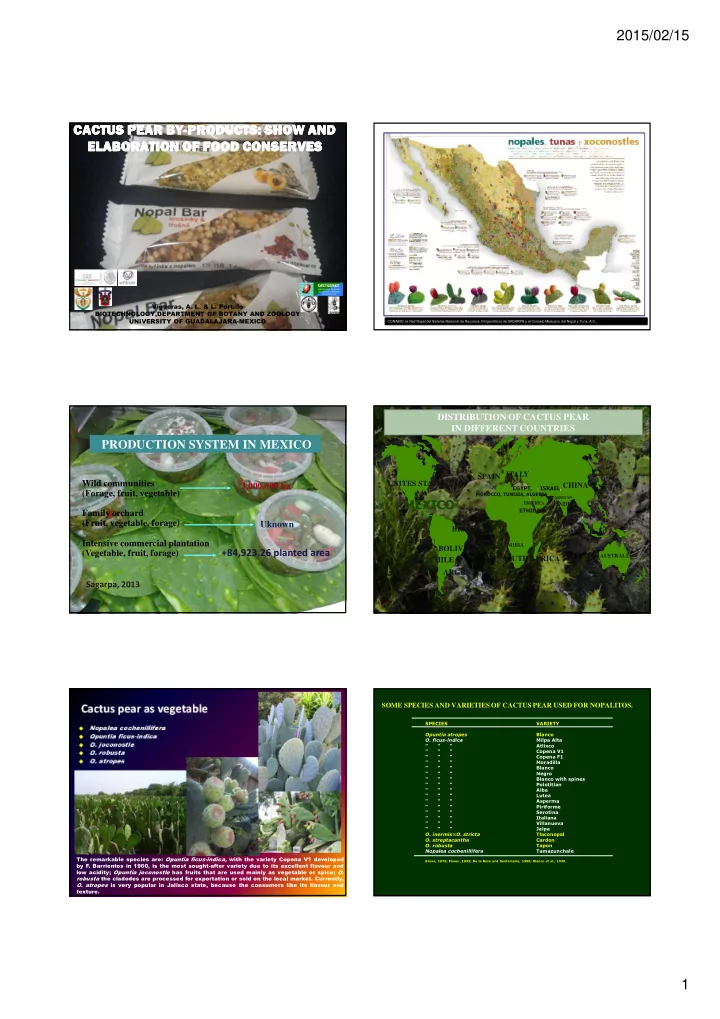
PRODUCTION SYSTEM IN MEXICO
Wild communities (Forage, fruit, vegetable) Family orchard (Fruit, vegetable, forage) Intensive commercial plantation (Vegetable, fruit, forage) 3,000.000 ha Uknown
+84,923.26 planted area
Sagarpa, 2013 DISTRIBUTION OF CACTUS PEAR IN DIFFERENT COUNTRIES
UNITES STATES
MÉXICO
CHILE BRAZIL PERU ARGENTINA SOUTH AFRICA BOLIVIA SPAIN
MOROCCO, TUNISIA, ALGERIA
EGYPT, ISRAEL, ETHIOPIA
ITALY CHINA
INDIA
NAMIBIA AUSTRALIA
ERITREA
PAKISTAN
Cactus pear as vegetable
- Nopalea cochenillifera
- Opuntia ficus-indica
- O. joconostle
- O. robusta
- O. atropes
The remarkable species are: Opuntia ficus-indica, with the variety Copena V1 developed by F . Barrientos in 1960, is the most sought-after variety due to its excellent flavour and low acidity; Opuntia joconostle has fruits that are used mainly as vegetable or spice; O. robusta the cladodes are processed for exportation or sold on the local market. Currently,
- O. atropes is very popular in Jalisco state, because the consumers like its flavour and
texture.
SOME SPECIES AND VARIETIES OF CACTUS PEAR USED FOR NOPALITOS.
SPECIES VARIETY Opuntia atropes Blanco
- O. ficus-indica
Milpa Alta " " " Atlixco " " " Copena V1 " " " Copena F1 " " " Moradilla " " " Blanco " " “ Negro " " " Blanco with spines " " " Polotitlan " " " Alba " " “ Lutea " " " Asperma " " " Piriforme " " " Serotina " " " Italiana " " " Villanueva " " " Jalpa
- O. inermis=O. stricta
Tlaconopal
- O. streptacantha
Cardon
- O. robusta
Tapon Nopalea cochenillifera Tamazunchale
Bravo, 1978; Flores ,1995; De la Rosa and Santamaria, 1998; Blanco et al., 1999.