
SLIDE 1
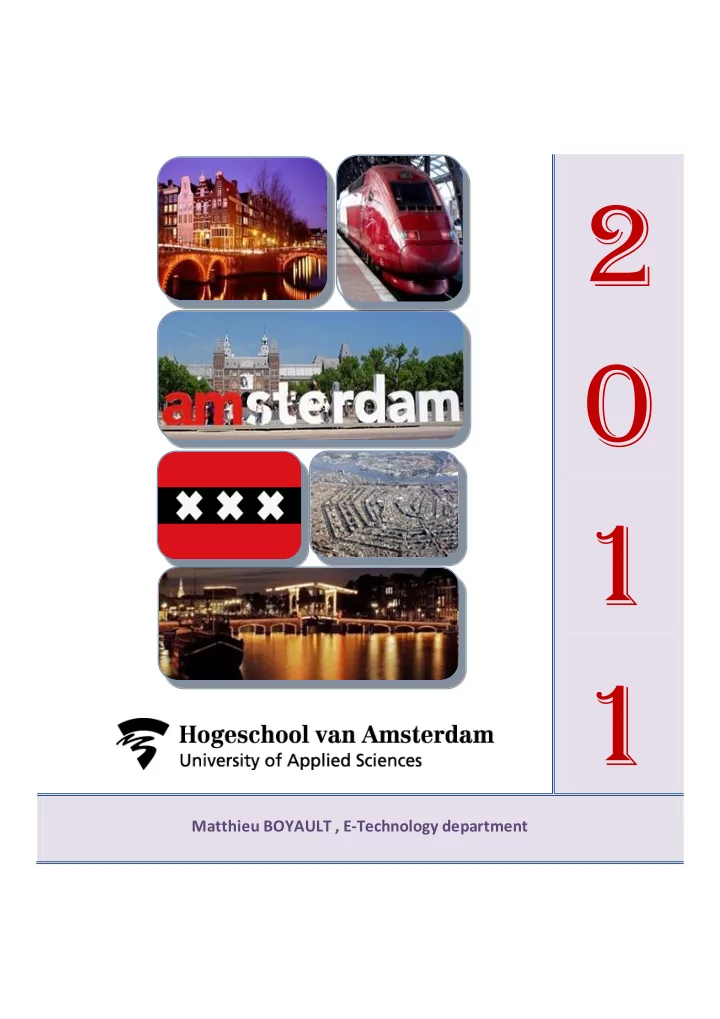
2 0 1 1 Matthieu BOYAULT , E-Technology department Presentation - - PDF document
2 0 1 1 Matthieu BOYAULT , E-Technology department Presentation 2011 Table of contents Table of
Matthieu BOYAULT – boyault@et.esiea.fr
Table of contents..............................................................................................................................................
Introduction .....................................................................................................................................................
les Pays bas & les hollandais..............................................................................................................................
Symboles......................................................................................................................................................
Héros ...........................................................................................................................................................
Rituels ..........................................................................................................................................................
Valeurs.........................................................................................................................................................
Etudier à Amsterdam ........................................................................................................................................
Structure..........................................................................................................................................................
Hogeschool Van Amsterdam .............................................................................................................................
Ressources .......................................................................................................................................................
Website ...........................................................................................................................................................
Book ................................................................................................................................................................
Matthieu BOYAULT – boyault@et.esiea.fr
Vincent van GOGH « Peintre et dessinateur néerlandais. Ses œuvres pleine de naturalisme, inspirées par l'impressionnisme et le néo-impressionnisme, annonce le fauvisme et l'expressionnisme. Van Gogh grandit au sein d'une famille de l'ancienne bourgeoisie. Il tente d'abord de faire carrière comme marchand d'art chez Goupil & Cie. Cependant, refusant de voir l'art comme une marchandise, il est licencié. Il quitte les Pays-Bas pour la Belgique, puis s'établit en France. Il est influencé par ses amis peintres, notamment Anthon van Rappard, Émile Bernard et Paul
Johan CRUIJFF « Joueur de football néerlandais considéré comme l'un des meilleurs joueurs de l'histoire du football, surnommé le "Hollandais volant" mais aussi « Till l'espiègle»
d'Or. Attaquant ou milieu offensif, ce joueur d'exception a marqué les années 70
Matthieu BOYAULT – boyault@et.esiea.fr
par son talent et son charisme au sein d'équipes prestigieuses : l'Ajax Amsterdam et le FC Barcelone. Devenu par la suite entraîneur, il s'est principalement illustré en 1992 en remportant la Coupe d'Europe des clubs champions avec l'une des plus marquantes équipes du FC Barcelone surnommée la Dream Team.» Antoni van LEEUWENHOEK « Commerçant et savant néerlandais , surtout connu pour ses améliorations du microscope et comme l'un des précurseurs de ce que l'on appellera plus tard la biologie cellulaire et la
fait de nombreuses découvertes (protozoaires, spermatozoïdes). »
Ils adorent leurs VELOS. C’est le premier moyen de locomotion utilisé par les enfants, étudiants, parents, grand parents. Ils ont bien sur un énorme commerce qui va avec. Ils utilisent des cadenas de scooter pour leur vélo. Ils roulent même s’il pleut, neige, vente. Ils roulent à vélo comme des Parisiens en voiture, à part ici il y a presque jamais d’accident. Ils mangent bien et bizarre en même temps. Ils ne prennent pas et ils n’ont pas une pause pour le déjeuner. Ils aiment beaucoup leurs sandwiches qui préparent le matin avant de partir au travail. De ce fait, ils mangent et boivent même pendant le cours, y compris le professeur. Le soir, ils ont des bons plats. Souvent, à base de
Un non-rituel qui va surement vous choquer. Mais malgré que fumer le cannabis soit légal, ils ne sont pas accros. En général, c’est plus un rituel convivial comme la chicha en Iran. La vente de drogue dure est illégale (cocaïne, champignons, extasie) à cause de touristes suicidaires.
Les Hollandais aiment être ET sont ponctuelle (influence allemande). Ils sont honnêtes et très directe (voir un peu trop selon les situations). Ils aiment aussi être égaux mais ça n’empêche qu’ils sont individualistes.
Matthieu BOYAULT – boyault@et.esiea.fr
Les Pays-Bas comptent 603 000 étudiants, dont 383 000 (64%) dans les établissements professionnels (hogescholen) et 220 000 (36 %) dans les universités, pour une population globale de 16,71 millions d’habitants, soit environ 3,4% de la population Enseignement supérieur et la Recherche (Wet op het Hoger Onderwijs, WHW) Enseignement supérieur professionnel (Hoger Beroepsonderwijs, HBO) Enseignement universitaire (Wetenschappelijk Onderwijs, WO)
Matthieu BOYAULT – boyault@et.esiea.fr
Disciplines : les hogescholen couvrent 7 grands secteurs : agronomie arts (arts appliquées, théâtre, musique, danse, arts plastiques...) ; économie et gestion (économie et économie appliquée, commerce, gestion, hôtellerie) ; soins de santé et paramédical (formations d’infirmiers, d’ergothérapeutes, de diététiciens, formations de cadres dans le domaine de la santé etc.) ; pédagogie (formations des instituteurs et des maîtres) ; social (formations des animateurs, assistants sociaux et socioculturels, formations des éducateurs spécialisés etc.) ; ingénierie et technologie (formations technologiques, formation des laborantins, formations nautiques)Les grands établissements regroupent généralement plusieurs de ces secteurs. Les filières les plus suivies sont l’économie, l’enseignement technologique et l’enseignement. Diplômes délivrés : les titres obtenus, après 4 à 6 années d’études, sont celui d’ingénieur (ing.) pour l’enseignement technologique et l’enseignement agronomique, et de baccalaureus (bc.) pour les autres formations supérieures
désormais également habilitées à délivrer des diplômes de Master. Les titulaires d’un diplôme de HBO sont totalement qualifiés pour exercer leur profession sans études supplémentaires ni inscription auprès d’une association professionnelle. Conditions d’accès : il est nécessaire d’être titulaire soit du diplôme de fin d’études secondaires générales (niveau d’une classe de première en France), le HAVO (Hoger Algemeen Voortgezet Onderwijs), qui s’obtient en 5 ans après la fin de l’enseignement primaire, soit du baccalauréat général (VWO), ou encore de sortir de l’enseignement secondaire professionnel (Middelbaar Beroepsonderwijs, MBO).
Matthieu BOYAULT – boyault@et.esiea.fr
Cette école est plus focalisée sur l’éducation pratique que théorique. D’où la différence avec UvA (Université d’Amsterdam) qui ressemble très fortement à l’éducation du système européen. Toutefois, après cette formation je pense qu’ils ont un niveau équivalent à une License car même si c’est fort pratique, ils abordent des matières comme l’intelligence artificielle, nanotechnologies. Selon moi avec leur diplôme, ils peuvent travailler soit un Super technicien soit assistant ingénieur voir ingénieur mais pas de même niveau que notre réel formation d’ingénieur. Malgré que le campus soit énormissisme environ 15 bâtiments de fois plus grand que ESIEA Paris éparpillés dans tout Amsterdam. Il est très facile de s’adapter car ça fonctionne plus comme le système américain avec des facultés plus ou moins indépendantes. Les classes ne sont pas surchargées et bien équipées. Il n’y a pas d’amphi à part pour les conférences. Le système éducatif est tourné vers l’apprentissage par l’expérience et par l’auto apprentissage. De ce fait, les étudiants ont souvent et beaucoup de projets dans différentes matières. Ils font des mini groupes de 2 à 4 voire 6 pour des gros projets. Ils sont respectueux, travaillent quand il faut, en général les cours sont calmes et il est facile de suivre le cours. Concernant la formation, ils ont plus de choix et la flexibilité au cours de l’année est assez remarquable. Ils fonctionnent comme au Canada. Ils doivent s’inscrire pour un module, ou une mineure ou une majeure. Ils assistent à presque tous les cours (ça dépend de la matière et du professeur). Et ils doivent se réinscrire pour les examens des matières étudiées. S’ils échouent, ils ont droit à un rattrapage au prochain partiel. Ils viennent même à l’école pendant la semaine de révision avant les partiels. Les cours sont presque toujours accompagnés d’un gros livre (louable à la médiathèque ou achetable), ils fournissent pas mal de support électronique. Ils ont rarement d’archive des années précédentes. Le niveau des examens est variable mais en travaillant juste les supports du cours et en lisant régulièrement le livre, il est possible de valider ses modules. En moyenne les semaines ne sont pas très chargées. Ils n’ont pas cours le jeudi et samedi mais l’école est ouverte. D’ailleurs, ils viennent souvent pour travailler leurs projets. Une chose importante concernant votre échange, si vous arrivez à convaincre ESIEA de vos choix de programme (Mme Fuertes, Mme Loubet et Mme Kateb) alors HvA vous aidera à finaliser vos objectifs. Les coordinatrices à HvA sont Mme Kitty van der wissel et Melle Emmu Ahmed concernant la procédure d’admission et de logement. Concernant toutes questions à propos du programme, il faut s’adresser à Mme Jacquelines Hiemstra étant donné qu’elle a un emploi du temps très chargé, ça peut être utile de mettre en copie Mr Cess Keyer. Si tu veux plus d’informations à propos d’un sujet en particulier, n’hésite pas à m’envoyer un mail. Personnellement, j’aime beaucoup la vie, les gens et les études à Amsterdam. D’autant plus l’échange international c’est plus que l’on s’y imagine.
Matthieu BOYAULT – boyault@et.esiea.fr
http://www.ambafrance-nl.org http://miew-in-netherlands.blogspot.com/p/welcome.html http://www.international.hva.nl http://www.hva.nl http://www.uva.nl
“The Undutchable” http://en.wikipedia.org/wiki/The_UnDutchables
Hogeschool van Amsterdam - School of Technology
Information package for international students location Leeuwenburg Version 1.0
Hogeschool van Amsterdam International student guide 2011-2012_V1.0 School of Technology
2
Information package for international students Location Leeuwenburg
Table of Contents
Introduction ................................................................................................................................... 3 1. Studying in the Netherlands ................................................................................................. 4 1.1 Higher Education in the Netherlands ............................................................................ 4 1.2 Hogeschool van Amsterdam......................................................................................... 4 1.3 Learning to learn ........................................................................................................... 4 1.4 Quality assurance ......................................................................................................... 5 1.5 ECTS (European Credit Transfer System) ................................................................... 5 1.6 Study scores ................................................................................................................. 5 1.7 The Academic Calendar 2011-2012: ............................................................................ 6 1.8 Holidays ........................................................................................................................ 6 2. Hogeschool van Amsterdam – building de Leeuwenburg .................................................... 7 2.1 Study programmes Leeuwenburg ................................................................................ 7 2.2 Exchange Programmes ................................................................................................ 7 2.3 Course Information for international students............................................................... 7 2.4 International Office School of Technology .................................................................... 7 2.5 Mentor students ............................................................................................................ 8 2.6 Student counsellors ...................................................................................................... 8 2.7 Facilities at the Leeuwenburg ....................................................................................... 9 2.8 Travelling to Location Leeuwenburg ............................................................................. 9 3. General Information ............................................................................................................ 10 3.1 International Student Network .................................................................................... 10 3.2 Finances ..................................................................................................................... 10 3.3 Language .................................................................................................................... 10 3.4 Accommodation .......................................................................................................... 10 3.5 Insurance and passport .............................................................................................. 11 3.6 Public transport ........................................................................................................... 12 3.7 Sports at the HvA ........................................................................................................ 12 3.8 Key data ...................................................................................................................... 13
Hogeschool van Amsterdam International student guide 2011-2012_V1.0 School of Technology
3
Welcome to Amsterdam! Amsterdam is a great city with international flair. The city is known for its ancient canals, tolerant atmosphere and multi-cultural society. Night-life is great, pubs are numerous and the central position of the Netherlands makes it easy for both foreigners and Dutch people to travel to other European countries. But most importantly, education in the Netherlands is known for its high quality. Therefore, a choice for Amsterdam is a wise one! In this booklet you will find information for exchange students of the study programmes in the location Leeuwenburg at the Hogeschool van Amsterdam. For an introduction of Amsterdam and the Netherlands, please look at www.coolcapitals.com If you have any questions regarding your stay at our institution, please contact the International
Netherlands, do not hesitate to contact the International Office. Kind regards, Kitty van der Wissel Emmu Ahmed International Office 020 595 1390 / 1316
Hogeschool van Amsterdam International student guide 2011-2012_V1.0 School of Technology
4
1.1 Higher Education in the Netherlands
There are two types of higher education institutions in the Netherlands; Academic Universities and Universities of Applied Sciences. The Universities of Applied Sciences (Hogescholen) prepare students for specific professions and tend to be more practically-oriented than academic universities, where the focus is on theory and the generating of knowledge through
school graduates. In an international context, the programmes of a Hogeschool are comparable to those of the ‘new universities’’ in Britain and the Hochschulen in Germany. There are about 60 Hogescholen in the Netherlands and they vary from large institutions,
courses in a single specific field. Together they offer over 200 courses.
1.2 Hogeschool van Amsterdam
The Hogeschool van Amsterdam is the largest institution of its kind in the greater Amsterdam
seven Schools. The 70 study programmes cover the fields of technology, maritime sciences, business and administration, information management, health care, education, fashion management & design and social welfare. All students of the Hogeschool van Amsterdam have work placement period of six to ten months, giving the students on-the-job experience in the field of their studies. In addition to the four-year initial study programmes, the Hogeschool van Amsterdam also
programmes. The Hogeschool van Amsterdam maintains excellent relations with other educational institutions in the region, including a number of joint ventures. Of particular significance is the strategic partnership between the University of Amsterdam and the Hogeschool van
(University and Hogeschool van Amsterdam). The UHA will bring together, where appropriate, related courses of the partner-institutes and will optimize student facilities like study counseling, libraries and housing. UHA will also develop courses for new fields of knowledge where watersheds between science and profession are irrelevant.
1.3 Learning to learn
Our students should be prepared to meet the challenges of a changing work environment. This is the idea behind our new student-centred didactical model, in which the students assume responsibility for their own learning process. This learning process mirrors the key requirement that students will face in actual professional practice: the ability to keep on learning by using their cognitive, social and affective skills. Learning to learn is realized in various ways as, for instance, project-oriented education, problem-based learning and by the use of new interactive media. Major/Minor System All HvA programmes have a major/minor structure. The major is the heart of the programme and comprises 210 study credits. In addition, students choose a minor, which represents 30 study credits. It is a coherent free-choice programme, lasting six months, in the third or fourth year of the overall programme.
Hogeschool van Amsterdam International student guide 2011-2012_V1.0 School of Technology
5
1.4 Quality assurance
Our students are regularly asked to rate the quality of the educational organization and the study programmes by means of quantitative and qualitative research. These student satisfaction ratings are an important management tool for quality control.
1.5 ECTS (European Credit Transfer System)
ECTS, the European Credit Transfer System, was developed by the Commission of the European Communities in order to provide common procedures to guarantee academic recognition of studies abroad. It provides a way of measuring and comparing learning achievements, and transferring them from one institution to another. The ECTS is based on the principle of mutual trust and confidence between the participating higher education institutions. The rules of ECTS, concerning Information, Agreement, and the Use of Credit Points are set out to reinforce this mutual trust and confidence. Each depart-ment describes the courses it offers not only in terms of content but also in number of credits. The ECTS credits ECTS credits are a value allocated to course units to describe the student workload required to complete them. They reflect the quantity of work each course requires in relation to the total quantity of work required to complete a full year of academic study at the institution, Including lectures, practical work, seminars, private work – in the library or at home - and examinations or
In ECTS, 60 credits represent the workload of a year of study; normally 30 credits are given for a semester. It is important that no special courses are set up for ECTS purposes, but that all ECTS courses are mainstream courses of the participating institutions, as followed by home students under normal regulations. Our regular study programmes usually take four years and make use of a variety of examination methods. There is an intermediate examination (known as the propedeuse) at the end of the first year, and there are final examinations at the end of the programme. Our qualifications are equivalent to bachelor level degrees. All students who are involved in a four-year study program are regularly informed of their study progress by means of the ‘’Volg+ overzichten’’; regular transcripts of records. They have a number of interviews with their study mentor each year to discuss their progress and further study plans.International exchange students receive a certificate upon successful completion of
1.6 Study scores
At the Hogeschool van Amsterdam we use two types of qualification systems for test results; the first qualifies a test as sufficient or insufficient. The second system qualifies a test in grades. Score ECTS-grade description: Dutch grades US grades Meaning: 9 – 10 A Excellent 8 B/C Very good 7 C/D Satisfactory 6 E Fulfils the minimum requirements 5 FX Some work needed to fulfil the minimum requirements 1 – 4 F Insufficient: a lot of work needed to fulfil the minimum requirements
Hogeschool van Amsterdam International student guide 2011-2012_V1.0 School of Technology
6
1.7 The Academic Calendar 2011-2012:
At the Hogeschool van Amsterdam, the academic year is divided into four terms of ten weeks; each term ends with an examination period. From: To: 1st term 29 August 2011 4 November 2011 2nd term 7 November 2011 20 January 2012 3rd term 23 January 2012 30 March 2012 4th term 2 April 2012 29 June 2012
1.8 Holidays
From: To: Autumn break 17 October 2011 21 October 2011 Christmas break 24 December 2011 2 January 2012 Spring break 27 February 2012 2 March 2012 Good Friday 6 April 2012 Easter Monday 9 April 2012 May break 30 April 2012 (Queen’s Day) 4 May 2012 Ascension Day Break 17 May 2012 18 May 2012 Whit Monday 28 May 2012 Summer break 2 July 2012 17 August 2012
Hogeschool van Amsterdam International student guide 2011-2012_V1.0 School of Technology
7
2.1 Study programmes Leeuwenburg
The location Leeuwenburg houses the following courses: School of Technology
2.2 Exchange Programmes
Exchange programmes are offered in both the autumn semester (terms 1+2) and the spring semester (terms 3+4). The application forms can be found on the website: http://www.international.hva.nl/exchange-programmes/ Application Deadlines: For Autumn Semester: 15 May For Spring Semester: 15 November
2.3 Course Information for international students
Courses Students will receive their timetables from the departmental coordinator, see section 2.4. Survival Dutch The Dutch Language Course ‘’ Survival Dutch’’ for exchange students starts Mid-September. Further details about the program will be given during the introduction. This course will earn you 2 ECTS credits and is offered in the Leeuwenburg.
2.4 International Office School of Technology
The International Office acts as an intermediary between the sending university and the hosting departments. Please come to the International Office to ask for an HvA-identity card, an HvA-facilitycard, a login name and a password. Also ask for the booklet International Student Guide. This booklet provides you with detailed information about studying, leisure and living in Amsterdam.
Hogeschool van Amsterdam International student guide 2011-2012_V1.0 School of Technology
8 Additionally, Mentor Students (current HvA students) are available to help international students with questions/problems concerning their stay and with the access to different facilities like the library, canteen and computers, see section 2.5. International Office : Weesperzijde 190 1097 DZ Amsterdam Email : schooloftechnology-international@hva.nl
Office: B4.42 Email : k.g.a.van.der.wissel@hva.nl
mobile: +31.6.20634770
Office: B4.42 Email : e.ahmed@hva.nl
Consultation hour for international students is on every Thursday from 13.30 p.m. till 14.30 p.m. An appointment can be made at the Information Desk Student Affairs on the first floor. Departmental Coordinators: Study Programme Name Email Office Telephone Architecture André de Ruiter a.m.de.ruiter@hva.nl B3.28 +31.6.20662263 Aviation Studies Bob Hogervorst j.h.hogervorst@hva.nl A 2.18 +31.20.595 1418 E-Technology Jacqueline Hiemstra j.hiemstra@hva.nl A 4.08 +31.20.595 2129
2.5 Mentor students
All students will be appointed a mentor-student, a fellow student who will take care of you and introduce you to the Dutch way of living. He/she will pick you up from the airport – or at another point of Amsterdam – upon arrival and accompany you to your accommodation, show you the HvA and present you to the persons with whom you will be involved during your stay.
2.6 Student counsellors
Studying abroad presents challenges which can be both exciting and difficult. Besides problems related to a different education system international students can be faced with problems due to cultural differences; they think it is difficult to adapt, they are not sure how to interact with
Some students have a clear picture of their concerns, others simply feel things are not as well as they hoped for. Student counsellors are trained professionals providing students with an opportunity to discuss their problems in a strict private and confidential way by listening attentively and finding solutions to assess the student’s problems. Appointments can be made at the Student Service Centre on the 1st floor.
Hogeschool van Amsterdam International student guide 2011-2012_V1.0 School of Technology
9
2.7 Facilities at the Leeuwenburg
Foreign (exchange) students will have access to all facilities at the location Leeuwenburg with the HvA student card. To obtain a student card you have to register at the International Office
and a copy of your passport. A few services offered at the Leeuwenburg are listed below. Service Location Opening hours Reception Desk For lost and found objects Entrance Opening hours of the reception desk AND the building Mon-Thu 7:30-22:45 Fri 7:30-19:00 Sat 9:00-17:00 During holidays: Mon-Fri 7:30-18:00 Bookshop Study Store Ground Floor (at the reception desk to the left) Mon-Thu 10:00-18:00 Fri 10:00-16:00 During exam periods opening hours may vary. Closed during holidays Cafeteria Breakfast, lunch and dinner Ground floor (c wing) Mon-Thu 9:00-19:00 Fri 9:00-14:00 Closed during holidays Student Service Centre For all questions related to registration and student counselling. B1.02 Monday- Friday: 9:00 13:00 and 13:30-16:00 Monday evening: 17:00-19.00 Friday evening: 17:00-19:00 Multimedia Library (Mediatheek) Including study room and Computer room 1st floor (c wing) Monday-Thursday: 8:30 - 21:00 Friday: 8:30 - 17:00 Saturday and Thursday:12:00 - 16:30 Service Desk all questions related to facility cards, renting lockers, information about phonenumbers, key cards for bikeshed, lost and found . 1st floor (c wing) Mon-Thu 8:30-22:00 Fri 8:30-17:00 Sat 9:30-14:00 Copyshop D 1.06 Mon-Fri 8:30-16:30 MiCaffe Warm drinks and small snacks 1st floor (c wing) Mon-Fri 8:00-15:30 Sat 10:30-14:00 During holidays: daily 10:00-14:00 Front Office School of Technology 1st floor (c wing) Mon-Fri 8:00-17:00 During exam periods: Mon+ Wed 8:00-20:00 Closed during holidays
2.8 Travelling to Location Leeuwenburg
It is very easy to reach the location Leeuwenburg. The building is right behind the Amstel
technology/location.htm From many places in Amsterdam you can take trams, metros and buses to the Amstel Station. Tram: 12 Metros: 51, 53,54 Buses: 15, 37, 69, 136, 157, 169. Amstel Station is also a train station.
Hogeschool van Amsterdam International student guide 2011-2012_V1.0 School of Technology
10
3.1 International Student Network
The International Student network organises an introduction period for all international students studying at the University van Amsterdam and the Hogeschool van Amsterdam. The introduction period for 2011-2012 will take place on 24, 25, and 26 August. Please look at www.isn-amsterdam.nl for the programme.
3.2 Finances
It is important for you to check at your home institution if you can receive financial support like a
Beneath you will find an estimate of the costs of living in Amsterdam: Costs in Euros, per month: Housing 380 Euros Food 220 Euros Other costs 60 Euros Personal 60 to 140 Euros Total 720 to 800 Euros The list below will give you an impression of some prices in the Netherlands. Museum ticket 5 Euros Beer 2 Euros Movie 8 Euros Public Transport 2 Euros per ride within the city centre. Train 10 Euros for a return ticket to Utrecht, 30 minutes.
3.3 Language
The Dutch language is very difficult to learn. Although many Dutch people speak English very well, it would be of great help to know the basics of our language before your arrival. Your stay will be more interesting when you know some Dutch. Most lessons at the institutes are taught in Dutch. Foreign students who would like to participate in a complete study programme or would like to follow some Dutch courses should have a good knowledge (passive as well as active) of the Dutch language. There is a possibility to follow an Erasmus language course in Dutch. You should apply for this course through your own institution. The exchange programmes are taught in English. http://www.international.hva.nl/exchange-programmes/
3.4 Accommodation
Finding an apartment in Amsterdam is quite a difficult job. Like all big cities housing shortage is a common problem. Most students therefore apply for a room through the guest-university. Each year the HvA reserves a number of rooms in flats at different locations in and around Amsterdam in order to house foreign students. Rooms are fully furnished –bed, mattress, blankest, pillow, duvet and covers, desk with chair and lamp, cupboard bookcase. Toilet, shower, kitchen are shared with other students.
Hogeschool van Amsterdam International student guide 2011-2012_V1.0 School of Technology
11 Prices are reasonable and vary from 300 to 400 Euros per month including costs like electricity and gas. Student Housing is responsible for placing foreign (exchange) students in the rooms. Please ask for an application form at the International Office Leeuwenburg. You can apply for a room 3 months in advance.
3.5 Insurance and passport
If you decide to come to the Netherlands check carefully – long before you leave your country – if you need a visa, a residence permit or a work permit. In short some general outlines are given below. Insurances Everybody staying in the Netherlands is legally bound to be insured for medical expenses meeting up Dutch standards. Make sure your insurance covers dental costs, glasses as well, because they often do not belong to a standard insurance policy. Students from the European Union, Norway, Marocco, Turkey, Tunesia and former Yugoslavia who in their own country are covered by the National Health Insurance programme will be insured by the National Health Insurance programme of the Netherlands as well if they apply for a (E)111 form available at the Social Security Department in their town of residence before leaving their home-country. If you are not coming from one of the above mentioned countries take a private insurance policy in your own country covering all medical costs during the whole of your stay in the Netherlands. Liability Not compulsory but strongly recommended is to take out a liability insurance! Liability insurance will cover you against costs as a result from injuries to someone or damages to another person’s property. If you do already have Liability insurance in your own country make sure it covers the expenses abroad as well. Medical Services Student Doctors University of Amsterdam Oude Turfmarkt 151 1012 GC Amsterdam
Valid passport All foreign students need a valid passport or a National Identity card if you are coming from one
Visa If your stay will not exceed 3 months and you are coming from a member state of the European Union, Andorra, Argentina, Canada, Chile, Cyprus, Czech Republic, Hungary, Iceland, Israel, Japan, Liechtenstein, Malta, Monaco, Poland, New Zealand, Norway, San Marino, Slovenia, South Korea, Slovakia, Switzerland, The United States, Uruguay, or Vatican City you do not need a visa, a valid passport will do. If your country is not mentioned here above you must apply for a visa before you leave your
takes at least 12 weeks before a visa is issued. There are two kinds of visa; if you stay less than three months, you need a visa for a short stay (Visum Kort Verblijf (VKV). If you intend to stay longer than three months you will need a Preliminary Permit for Temporary Residence (Machtiging tot voorlopig Verblijf (MVV).
Hogeschool van Amsterdam International student guide 2011-2012_V1.0 School of Technology
12 Note a visa for a short stay cannot be extended. Check at the Dutch Embassy which documents you have to present in order to obtain a visa. Residence Permit A residence permit is needed for all students staying longer than three months in the
Address: Johan Huizingalaan 757 1066 VH Amsterdam . tel. 020-5596106 It is in the West-area of Amsterdam See the Public Transport Guide or the map of Amsterdam which tram or bus you have to take. Opening a Bank account This is nearly impossible if you only stay here for one or two semesters. Work Permit Students from the European Union, Norway and Iceland do not need a work permit for internships within the Dutch organizations. Students from other countries on the contrary do need in all cases a work permit to fulfil an internship, even if you are not paid. In this case your employer needs to apply for your working permit. For more detailed information ask for the brochure ‘’Internships in the Netherlands’’. To be sure always check carefully with the Dutch Embassy in your country.
3.6 Public transport
OV-Chipcard To travel by Metro, train, tram or bus within the larger Amsterdam area, you need an OV- chipkaart (=Public Transport Chip Card) More information can be found on: http://www.ov- chipkaart.nl/?taal=en Please ask also for the brochure ‘’Public transport Amsterdam Tourist Guide’’ at the Tourist Information Office opposite Central Station. In this brochure you will find an explanation of the zone-system and offers to travel economically when you use public transport frequently. Outside the Amsterdam area, a specific train ticket from the Dutch Railways (the nederlandse Spoorwegen (NS) or a specific chip card is necessary. See: www.ns.nl
3.7 Sports at the HvA
The Hva has an agreement with the University of Amsterdam for using their sport facilities at the de Boelelaan-USC (Universitair Sport Centrum). You will need an HvA student card to get access to the facilities. Please contact the International Office Leeuwenburg for that. Indoor soccer, tennis, badminton, fitness training, hockey and aerobics are a few sports which you can practise at the De Boelelaan. Prices vary from 20 Euros for a two-month aerobics class to 80 Euros for tennis in the winter season. For more information, please contact: USC Boelelaan De Boelelaan 46 1082 LR Amsterdam
Email: usc@uva.nl (www.uva.nl/uva/algvoorz/usc)
Hogeschool van Amsterdam International student guide 2011-2012_V1.0 School of Technology
13
3.8 Key data
Hogeschool van Amsterdam, Central Office Full legal name of the Institution Hogeschool van Amsterdam Institution Identification code NL Amsterd05 Address Spui 21 Post code and city 1012 WX Amsterdam Country The Netherlands URL http://www.hva.nl President of the Board
Institutional Coordinator Mrs Kitty van der Wissel BA Address Weesperzijde 190 1097 DZ Amsterdam Office B4.42 Tel +31.20.5951390 Fax +31.20.5952470 Email k.g.a.van.der.Wissel@hva.nl Website for exchange students http://www.international.hva.nl/exchange- programmes/school-of-technology/