2/4/14 Debate: Haploidentical (haplo) versus Umbilical Cord Blood - - PDF document

2 4 14
SMART_READER_LITE
LIVE PREVIEW

2/4/14 Debate: Haploidentical (haplo) versus Umbilical Cord Blood - - PDF document

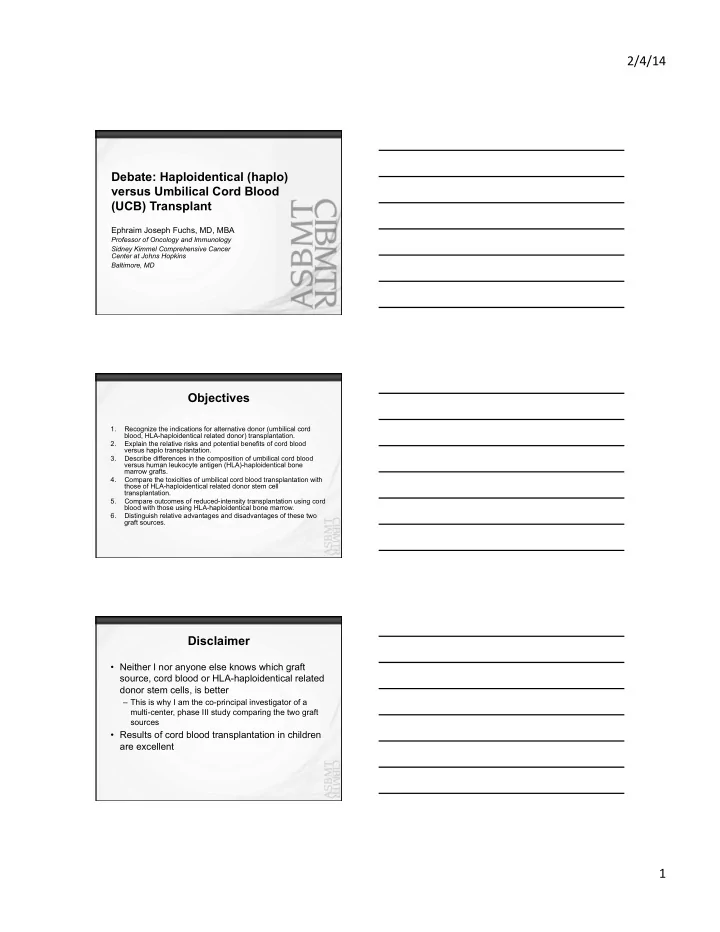
2/4/14 Debate: Haploidentical (haplo) versus Umbilical Cord Blood (UCB) Transplant Ephraim Joseph Fuchs, MD, MBA Professor of Oncology and Immunology Sidney Kimmel Comprehensive Cancer Center at Johns Hopkins Baltimore, MD Objectives


slide-1
SLIDE 1

2/4/14 ¡ 1 ¡

Debate: Haploidentical (haplo) versus Umbilical Cord Blood (UCB) Transplant

Ephraim Joseph Fuchs, MD, MBA

Professor of Oncology and Immunology Sidney Kimmel Comprehensive Cancer Center at Johns Hopkins Baltimore, MD

Objectives

1. Recognize the indications for alternative donor (umbilical cord blood, HLA-haploidentical related donor) transplantation. 2. Explain the relative risks and potential benefits of cord blood versus haplo transplantation. 3. Describe differences in the composition of umbilical cord blood versus human leukocyte antigen (HLA)-haploidentical bone marrow grafts. 4. Compare the toxicities of umbilical cord blood transplantation with those of HLA-haploidentical related donor stem cell transplantation. 5. Compare outcomes of reduced-intensity transplantation using cord blood with those using HLA-haploidentical bone marrow. 6. Distinguish relative advantages and disadvantages of these two graft sources.

Disclaimer

  • Neither I nor anyone else knows which graft

source, cord blood or HLA-haploidentical related donor stem cells, is better

– This is why I am the co-principal investigator of a multi-center, phase III study comparing the two graft sources

  • Results of cord blood transplantation in children

are excellent

slide-2
SLIDE 2

2/4/14 ¡ 2 ¡

“Whoever saves a life, it is considered as if she saved an entire world”

  • -Mishnah Sanhedrin 4:9;

Babylonian Talmud Tractate Sanhedrin 37a

Why haplo is better than cord

  • The results of HLA-haploidentical transplants have

improved dramatically and now approach those of HLA-matched transplants

– Improved prophylaxis of GVHD and graft rejection

  • UCB has inherent limitations as a graft source

– Cost – Stem cell and total cell dose→poor engraftment – T cell dose and näiveté→poor immune reconstitution – Non-recurring cell source→no donor lymphocyte infusions

  • Haplo opens up new possibilities

– Combined bone marrow and solid organ transplantation

HLA-haploidentical BMT circa 1990

C Anasetti et al., Hum Immunol 29:79, 1990

Abla%ve ¡condi%oning ¡ T ¡cell-­‑replete ¡bone ¡marrow ¡ CsA ¡+ ¡MTX ¡prophylaxis ¡

slide-3
SLIDE 3

2/4/14 ¡ 3 ¡

Severe GVHD with only 1 Ag mismatch

C Anasetti et al., Hum Immunol 29:79, 1990

Nothing wrong with the graft in haploBMT

Alloreactivity is the only problem

The ¡gold ¡standard ¡ HLA-­‑iden%cal ¡sibling ¡ HLA-­‑haploiden%cal ¡sibling ¡

ATG-based prophylaxis

e.g. D-P Lu et al. Blood 107:3065-3073, 2006

  • 158 matched sibs, 135 haplos
  • Conditioning: Bu/Cy/Ara-C/MeCCNU
  • Graft: G-BM + G-PB
  • GVHD prophy: ATG/CsA/MTX/MMF
slide-4
SLIDE 4

2/4/14 ¡ 4 ¡

ATG-based haplos in Rome

P ¡Di ¡Bartolomeo, ¡W ¡Arcese ¡et ¡al. ¡ ¡Blood ¡121: ¡849, ¡2013 ¡

N=80; ¡MAC, ¡64; ¡RIC, ¡16 ¡ G-­‑CSF-­‑primed ¡bone ¡marrow ¡ GVHD ¡prophylaxis: ¡ATG ¡Fresenius, ¡CsA, ¡MTX, ¡MMF, ¡basiliximab ¡

Cyclophosphamide-induced tolerance

Prolifera1ng ¡ ALLOREACTIVE ¡ cells ¡are ¡killed ¡ Non-­‑prolifera1ng ¡ non-­‑alloreac1ve ¡ cells ¡are ¡spared ¡

an)-­‑CMV ¡ an)-­‑HSV ¡ an)-­‑CMV ¡ an)-­‑HSV ¡

PT/Cy solves the problem of haploGVHD

Acute ¡GVHD ¡II-­‑IV ¡ Acute ¡GVHD ¡III-­‑IV ¡ Chronic ¡GVHD ¡ Severe ¡chronic ¡GVHD ¡

MUD ¡ MSD ¡ Haplo ¡ Haplo ¡ MUD ¡ MSD/ ¡ Haplo ¡ MUD ¡ MSD/ ¡ A ¡Bashey ¡et ¡al. ¡ ¡J ¡Clin ¡Oncol ¡31:1310, ¡2013 ¡ Only ¡recipients ¡of ¡haplo ¡graAs ¡got ¡PT/Cy ¡

slide-5
SLIDE 5

2/4/14 ¡ 5 ¡

Months ¡aDer ¡transplanta%on ¡

Survival ¡(%) ¡ Disease-­‑free ¡survival ¡(%) ¡

MUD ¡(n=101) ¡ MSD ¡(n=117) ¡ Haplo ¡(n=53) ¡ MUD ¡ MSD ¡ Haplo ¡ A ¡Bashey ¡et ¡al. ¡ ¡J ¡Clin ¡Oncol ¡31:1310, ¡2013 ¡

Similar survival after matched or haplo Question 1: In 2014, which GVHD prophylaxis regimen would be considered inadequate for T cell-replete, HLA-haploidentical BMT?

  • A. Cyclophosphamide, tacrolimus, mycophenolate

mofetil (MMF)

  • B. ATG, cyclosporine (CsA), methotrexate, MMF
  • C. CsA plus methotrexate (MTX)
  • D. ATG, CsA, MTX, MMF, and basiliximab

Haplo versus double cord after reduced intensity conditioning

slide-6
SLIDE 6

2/4/14 ¡ 6 ¡

Cumula)ve ¡incidence ¡(%) ¡ Days ¡aGer ¡transplanta)on ¡ Days ¡aGer ¡transplanta)on ¡

Neutrophil recovery: haplo>double cord

Median: ¡22 ¡days ¡ Median: ¡15 ¡days ¡ Double ¡cord: ¡HL ¡Wallet ¡et ¡al. ¡ ¡Haematologica, ¡2013 ¡in ¡press ¡ Haplo: ¡ ¡ ¡ ¡ ¡ ¡ ¡ ¡ ¡ ¡ ¡ ¡L ¡Luznik ¡et ¡al. ¡ ¡Biol ¡Blood ¡Marrow ¡Transpl. ¡14:641, ¡2008 ¡

Double ¡unrelated ¡cord ¡ HLA-­‑haploiden%cal ¡BM ¡

46 ¡MAC ¡ 90 ¡RIC ¡ 68 ¡RIC ¡

Cumula)ve ¡incidence ¡(%) ¡ Days ¡aGer ¡transplanta)on ¡ Days ¡aGer ¡transplanta)on ¡

Double ¡unrelated ¡cord ¡ HLA-­‑haploiden%cal ¡BM ¡

Platelet recovery: haplo>>double cord

Median: ¡54 ¡days ¡ Median: ¡24 ¡days ¡ Double ¡cord: ¡HL ¡Wallet ¡et ¡al. ¡ ¡Haematologica, ¡2013 ¡in ¡press ¡ Haplo: ¡ ¡ ¡ ¡ ¡ ¡ ¡ ¡ ¡ ¡ ¡ ¡L ¡Luznik ¡et ¡al. ¡ ¡Biol ¡Blood ¡Marrow ¡Transpl. ¡14:641, ¡2008 ¡

US Phase II trials of haplo or double cord Cord ¡(0604) ¡ Haplo ¡(0603) ¡

* ¡ * ¡ *May ¡subs)tute ¡other ¡ ¡ ¡calcineurin ¡inhibitor ¡

C ¡Brunstein ¡et ¡al. ¡ ¡Blood ¡118: ¡282, ¡2011 ¡

slide-7
SLIDE 7

2/4/14 ¡ 7 ¡

Acute and chronic GVHD

Cord ¡(0604) ¡ Haplo ¡(0603) ¡

Acute ¡GVHD ¡ Chronic ¡GVHD ¡

C ¡Brunstein ¡et ¡al. ¡ ¡Blood ¡118:282, ¡2011 ¡

Poor immune reconstitution early after UCBT

C ¡Jacobson ¡et ¡al. ¡Biol ¡Blood ¡Marrow ¡Transplant ¡18: ¡565, ¡2012 ¡

N.B.: ¡Only ¡cord ¡blood ¡recipients ¡got ¡ATG ¡

slide-8
SLIDE 8

2/4/14 ¡ 8 ¡

Recovery of CD4 T cells MRD=haplo > cord

Courtesy ¡A. ¡Bacigalupo, ¡Genoa, ¡Italy ¡ Matched ¡sib ¡ Haplo ¡ Unrelated ¡donor ¡ Cord ¡blood ¡

Donor-derived immunity to CMV is back by day 60 in 12/17 patients

Cord blood: a luxury item

Country ¡ GDP ¡per ¡capita ¡ Popula%on ¡(million) ¡ Qatar ¡ $102,800 ¡ 1.9 ¡ Two ¡cord ¡blood ¡units ¡ ~$60,000 ¡ USA ¡ $49,800 ¡ 317 ¡ Germany ¡ $39,100 ¡ 81 ¡ Brazil ¡ $12,000 ¡ 201 ¡ China ¡ $9,100 ¡ 1360 ¡ Indonesia ¡ $5,000 ¡ 238 ¡ India ¡ $3,900 ¡ 1235 ¡ Pakistan ¡ $2,900 ¡ 185 ¡ Nigeria ¡ $2,700 ¡ 174 ¡

slide-9
SLIDE 9

2/4/14 ¡ 9 ¡

Why haplo is better than cord

  • The results of HLA-haploidentical transplants have

improved dramatically and now approach those of HLA-matched transplants

– Improved prophylaxis of GVHD and graft rejection

  • UCB has inherent limitations as a graft source

– Cost – Stem cell and total cell dose→poor engraftment – T cell dose and näiveté→poor immune reconstitution – Non-recurring cell source→no donor lymphocyte infusion

  • Haplo opens up new possibilities

– Combined bone marrow and solid organ transplantation Assistant: ¡ “Professor ¡Brunstein, ¡I ¡think ¡I ¡have ¡finally ¡devised ¡an ¡ex ¡vivo ¡culture ¡ technique ¡that ¡resolves ¡the ¡inherent ¡limita)ons ¡of ¡cord ¡blood ¡ ¡

  • graGs. ¡ ¡I ¡can ¡expand ¡hematopoie)c ¡stem ¡cells ¡and ¡stem ¡

progenitors ¡by ¡over ¡10-­‑fold. ¡ ¡I ¡can ¡differen)ate ¡naïve, ¡pathogen-­‑specific ¡ T ¡cells ¡into ¡memory ¡cells ¡that ¡will ¡provide ¡defense ¡against ¡infec)on ¡ early ¡aGer ¡transplanta)on. ¡ ¡With ¡these ¡methods, ¡I ¡believe ¡we ¡will ¡ improve ¡engraGment ¡and ¡reduce ¡non-­‑relapse ¡mortality ¡substan)ally.” ¡ Professor ¡Brunstein: ¡ “That ¡is ¡wonderful! ¡ ¡What ¡will ¡you ¡call ¡this ¡cellular ¡product?” ¡ Assistant: ¡ “I ¡shall ¡call ¡it ¡. ¡. ¡. ¡. ¡. ¡. ¡. ¡.” ¡

HLA-­‑haploiden1cal ¡bone ¡marrow!!! ¡

Question 2: Based upon BMT CTN trials 0603 and 0604, which appear to be true?

  • 1. There is more severe GVHD after cord blood SCT

than after haploBMT

  • 2. Relapse is worse after haplo than after cord SCT
  • 3. Neutrophil recovery is faster after haplo than after cord

blood SCT

  • 4. Event-free survival is better after haplo than cord
  • A. 1, 2, and 3
  • B. 1 and 3
  • C. 2 and 4
  • D. 4 only
  • E. All of the above