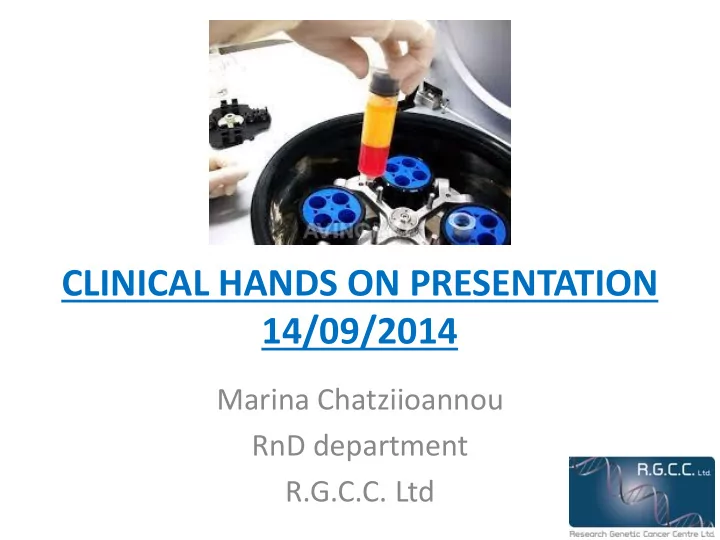
CLINICAL HANDS ON PRESENTATION 14/09/2014 Marina Chatziioannou RnD - - PowerPoint PPT Presentation
CLINICAL HANDS ON PRESENTATION 14/09/2014 Marina Chatziioannou RnD department R.G.C.C. Ltd Points of interest 1. CTCs isolation Manual or automated cell isolation Magnetic bead epitope selection 2. Clinical flow cytometry What for?
Points of interest
- 1. CTCs isolation
− Manual or automated cell isolation − Magnetic bead epitope selection
- 2. Clinical flow cytometry
− What for? − Epitope selection − Sample handling − Data analysis
CTCs isolation
Topics
- 1. Sample arrival and handling
- 2. Manually or automated cell isolation
- 3. Magnetic bead epitope selection
- 4. Culture treatment
CTCs isolation
Manually
Ficoll layering Washing Beads incubation Magnetic CTCs isolation Culture in FL25
Automated
Robosep handling Culture in FL25
Epitopes (bead selection)
Categorization
- 1. Epithelial origin
- 2. Hematological origin
- 3. Sarcomas
- 4. Non epithelial, non hematological, non
sarcoma
Epithelial origin
EpCAM i. Expressed exclusively in epithelia and epithelial-derived neoplasms.
- ii. Can be used as diagnostic marker for various
cancers.
- iii. Plays a role in tumorigenesis and metastasis
- f carcinomas, so it can also act as a
potential prognostic marker.
Hematological origin
CD45
i. Leukocyte Common Antigen (LCA). ii. Its various forms are present on all differentiated hematopoietic cells except erythrocytes and plasma cells.
- iii. It is expressed in lymphomas, B-cell chronic
lymphocytic leukemia, hairy cell leukemia, and acute nonlymphocytic leukemia.
- iv. A monoclonal antibody to CD45 is used in routine
immunohistochemistry to differentiate between histological sections from lymphomas and carcinomas.
Sarcomas
CD99 i. Ewing’s marker
- ii. Present to all sarcomas
Non epithelial, non hematological, non sarcomas
CD45 negative selection i. For types of cancer that are not included in the previous categorizations.
- ii. For example:
- Renal cancer
- SCLC
- NK lymphomas
- Neuroblastomas
- Adrenal cancer
Flow cytometry for clinical samples
Topics
- What for?
- Epitopes selected
- Sample handling
- Data analysis
What for?
- Easy, quick and reliable technique.
- Gives accurate results.
- Quick view of what to expect in the isolated
culture from the same patient.
Flow cytometry clinical epitopes
i. CD45:LCA
- ii. CD31: Endothelial cell marker
- iii. cMet: Metastatic cell marker
- iv. PanCK: Marker of cell of origin of various
tumors (depends on cytokeratis pattern)
- v. CD227: Breast, Lung cancer marker
- vi. CD63: Melanoma cancer cell marker
- vii. PSMA: Prostate cancer cell marker
Sample handling
Steps
- 1. Extracellular staining
- 2. Washing
- 3. Fixation
- 4. Washing
- 5. Permeabilization
- 6. Intracellular staining
Data analysis
- Flow cytometry data file is analyzed and
percentages of epitopes are produced.
- Results are represented as below:
References
1. Ignatiadis, M., C. Sotiriou, et al. (2012). "Minimal residual disease and circulating tumor cells in breast cancer: open questions for research." Recent Results Cancer Res 195: 3-9. 2. Gendler SJ (July 2001). "MUC1, the renaissance molecule". J. Mammary Gland Biol Neoplasia 6 (3): 339–353. doi:10.1023/A:1011379725811. PMID 11547902 3. Radford KJ, Thorne RF, Hersey P (1996). "CD63 associates with transmembrane 4 superfamily members, CD9 and CD81, and with beta 1 integrins in human melanoma". Biochem. Biophys.
- Res. Commun. 222 (1): 13–18. doi:10.1006/bbrc.1996.0690. PMID 8630057
4. Omary MB, Ku NO, Strnad P, Hanada S (July 2009). "Toward unraveling the complexity of simple epithelial keratins in human disease". J. Clin. Invest. 119 (7): 1794–805. doi:10.1172/JCI37762. PMC 2701867. PMID 19587454 5. Tang DG, Chen YQ, Newman PJ, et al. (1993). "Identification of PECAM-1 in solid tumor cells and its potential involvement in tumor cell adhesion to endothelium.". J. Biol. Chem. 268 (30): 22883–94. PMID 8226797 6. Gentile A, Trusolino L, Comoglio PM (March 2008). "The Met tyrosine kinase receptor in development and cancer". Cancer Metastasis Rev. 27 (1): 85–94. doi:10.1007/s10555-007- 9107-6. PMID 18175071