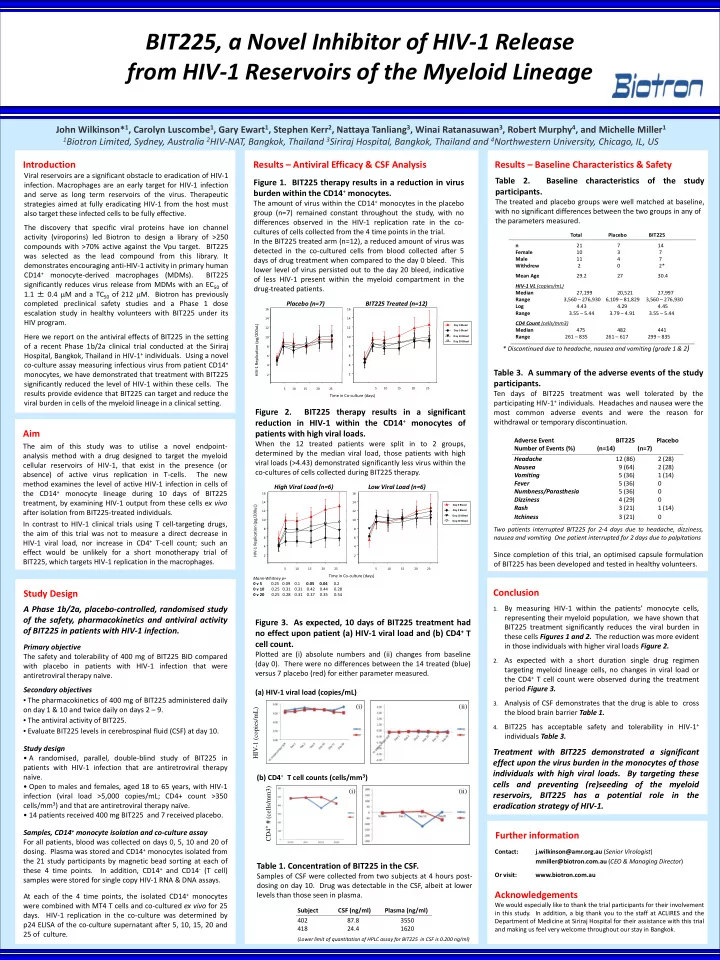

BIT225, a Novel Inhibitor of HIV-1 Release from HIV-1 Reservoirs of the Myeloid Lineage
John Wilkinson*1, Carolyn Luscombe1, Gary Ewart1, Stephen Kerr2, Nattaya Tanliang3, Winai Ratanasuwan3, Robert Murphy4, and Michelle Miller1
1Biotron Limited, Sydney, Australia 2HIV-NAT, Bangkok, Thailand 3Siriraj Hospital, Bangkok, Thailand and 4Northwestern University, Chicago, IL, US
Aim
The aim of this study was to utilise a novel endpoint- analysis method with a drug designed to target the myeloid cellular reservoirs of HIV-1, that exist in the presence (or absence) of active virus replication in T-cells. The new method examines the level of active HIV-1 infection in cells of the CD14+ monocyte lineage during 10 days of BIT225 treatment, by examining HIV-1 output from these cells ex vivo after isolation from BIT225-treated individuals. In contrast to HIV-1 clinical trials using T cell-targeting drugs, the aim of this trial was not to measure a direct decrease in HIV-1 viral load, nor increase in CD4+ T-cell count; such an effect would be unlikely for a short monotherapy trial of BIT225, which targets HIV-1 replication in the macrophages.
Study Design
A Phase 1b/2a, placebo-controlled, randomised study
- f the safety, pharmacokinetics and antiviral activity
- f BIT225 in patients with HIV-1 infection.
Primary objective The safety and tolerability of 400 mg of BIT225 BID compared with placebo in patients with HIV-1 infection that were antiretroviral therapy naïve. Secondary objectives
- The pharmacokinetics of 400 mg of BIT225 administered daily
- n day 1 & 10 and twice daily on days 2 – 9.
- The antiviral activity of BIT225.
- Evaluate BIT225 levels in cerebrospinal fluid (CSF) at day 10.
Study design
- A randomised, parallel, double-blind study of BIT225 in
patients with HIV-1 infection that are antiretroviral therapy naïve.
- Open to males and females, aged 18 to 65 years, with HIV-1
infection (viral load >5,000 copies/mL; CD4+ count >350 cells/mm3) and that are antiretroviral therapy naïve.
- 14 patients received 400 mg BIT225 and 7 received placebo.
Samples, CD14+ monocyte isolation and co-culture assay For all patients, blood was collected on days 0, 5, 10 and 20 of
- dosing. Plasma was stored and CD14+ monocytes isolated from
the 21 study participants by magnetic bead sorting at each of these 4 time points. In addition, CD14+ and CD14- (T cell) samples were stored for single copy HIV-1 RNA & DNA assays. At each of the 4 time points, the isolated CD14+ monocytes were combined with MT4 T cells and co-cultured ex vivo for 25
- days. HIV-1 replication in the co-culture was determined by
p24 ELISA of the co-culture supernatant after 5, 10, 15, 20 and 25 of culture.
Further information Results – Antiviral Efficacy & CSF Analysis Introduction
Viral reservoirs are a significant obstacle to eradication of HIV-1
- infection. Macrophages are an early target for HIV-1 infection
and serve as long term reservoirs of the virus. Therapeutic strategies aimed at fully eradicating HIV-1 from the host must also target these infected cells to be fully effective. The discovery that specific viral proteins have ion channel activity (viroporins) led Biotron to design a library of >250 compounds with >70% active against the Vpu target. BIT225 was selected as the lead compound from this library. It demonstrates encouraging anti-HIV-1 activity in primary human CD14+ monocyte-derived macrophages (MDMs). BIT225 significantly reduces virus release from MDMs with an EC50 of 1.1 ± 0.4 µM and a TC50 of 212 µM. Biotron has previously completed preclinical safety studies and a Phase 1 dose escalation study in healthy volunteers with BIT225 under its HIV program. Here we report on the antiviral effects of BIT225 in the setting
- f a recent Phase 1b/2a clinical trial conducted at the Siriraj
Hospital, Bangkok, Thailand in HIV-1+ individuals. Using a novel co-culture assay measuring infectious virus from patient CD14+ monocytes, we have demonstrated that treatment with BIT225 significantly reduced the level of HIV-1 within these cells. The results provide evidence that BIT225 can target and reduce the viral burden in cells of the myeloid lineage in a clinical setting.
Results – Baseline Characteristics & Safety Conclusion
1.
By measuring HIV-1 within the patients’ monocyte cells, representing their myeloid population, we have shown that BIT225 treatment significantly reduces the viral burden in these cells Figures 1 and 2. The reduction was more evident in those individuals with higher viral loads Figure 2.
2.
As expected with a short duration single drug regimen targeting myeloid lineage cells, no changes in viral load or the CD4+ T cell count were observed during the treatment period Figure 3.
3.
Analysis of CSF demonstrates that the drug is able to cross the blood brain barrier Table 1.
4.
BIT225 has acceptable safety and tolerability in HIV-1+ individuals Table 3.
Treatment with BIT225 demonstrated a significant effect upon the virus burden in the monocytes of those individuals with high viral loads. By targeting these cells and preventing (re)seeding of the myeloid reservoirs, BIT225 has a potential role in the eradication strategy of HIV-1.
Contact: j.wilkinson@amr.org.au (Senior Virologist) mmiller@biotron.com.au (CEO & Managing Director) Or visit: www.biotron.com.au
Acknowledgements
We would especially like to thank the trial participants for their involvement in this study. In addition, a big thank you to the staff at ACLIRES and the Department of Medicine at Siriraj Hospital for their assistance with this trial and making us feel very welcome throughout our stay in Bangkok.
Figure 3. As expected, 10 days of BIT225 treatment had no effect upon patient (a) HIV-1 viral load and (b) CD4+ T cell count.
Plotted are (i) absolute numbers and (ii) changes from baseline (day 0). There were no differences between the 14 treated (blue) versus 7 placebo (red) for either parameter measured. (a) HIV-1 viral load (copies/mL) (b) CD4+ T cell counts (cells/mm3)
Table 1. Concentration of BIT225 in the CSF.
Samples of CSF were collected from two subjects at 4 hours post- dosing on day 10. Drug was detectable in the CSF, albeit at lower levels than those seen in plasma.
Subject CSF (ng/ml) Plasma (ng/ml) 402 87.8 3550 418 24.4 1620
(Lower limit of quantitation of HPLC assay for BIT225 in CSF is 0.200 ng/ml)
HIV-1 (copies/mL) (i) (ii) CD4+ # (cells/mm3) (i) (ii)
Figure 1. BIT225 therapy results in a reduction in virus burden within the CD14+ monocytes.
The amount of virus within the CD14+ monocytes in the placebo group (n=7) remained constant throughout the study, with no differences observed in the HIV-1 replication rate in the co- cultures of cells collected from the 4 time points in the trial. In the BIT225 treated arm (n=12), a reduced amount of virus was detected in the co-cultured cells from blood collected after 5 days of drug treatment when compared to the day 0 bleed. This lower level of virus persisted out to the day 20 bleed, indicative
- f less HIV-1 present within the myeloid compartment in the
drug-treated patients.
2 4 6 8 10 12 14 16 5 10 15 20 25 2 4 6 8 10 12 14 16 5 10 15 20 25
Time in Co-culture (days)
Day 5 Bleed Day 20 Bleed Day 10 Bleed Day 0 Bleed
HIV-1 Replication (pg/200uL)
Placebo (n=7) BIT225 Treated (n=12)
Figure 2. BIT225 therapy results in a significant reduction in HIV-1 within the CD14+ monocytes of patients with high viral loads.
When the 12 treated patients were split in to 2 groups, determined by the median viral load, those patients with high viral loads (>4.43) demonstrated significantly less virus within the co-cultures of cells collected during BIT225 therapy.
2 4 6 8 10 12 14 16 5 10 15 20 25
Mann-Whitney p= 0 v 5 0.25 0.09 0.1 0.05 0.04 0.2 0 v 10 0.25 0.31 0.31 0.42 0.44 0.28 0 v 20 0.25 0.28 0.31 0.37 0.35 0.54
2 4 6 8 10 12 14 16 5 10 15 20 25
Time in Co-culture (days) HIV-1 Replication (pg/200uL)
Day 5 Bleed Day 20 Bleed Day 10 Bleed Day 0 Bleed
High Viral Load (n=6) Low Viral Load (n=6)
Table 3. A summary of the adverse events of the study participants.
Ten days of BIT225 treatment was well tolerated by the participating HIV-1+ individuals. Headaches and nausea were the most common adverse events and were the reason for withdrawal or temporary discontinuation.
Adverse Event BIT225 Placebo Number of Events (%) (n=14) (n=7) Headache 12 (86) 2 (28) Nausea 9 (64) 2 (28) Vomiting 5 (36) 1 (14) Fever 5 (36) Numbness/Parasthesia 5 (36) Dizziness 4 (29) Rash 3 (21) 1 (14) Itchiness 3 (21) Two patients interrupted BIT225 for 2-4 days due to headache, dizziness, nausea and vomiting One patient interrupted for 2 days due to palpitations
Since completion of this trial, an optimised capsule formulation
- f BIT225 has been developed and tested in healthy volunteers.
Table 2. Baseline characteristics of the study participants.
The treated and placebo groups were well matched at baseline, with no significant differences between the two groups in any of the parameters measured. Total
Placebo BIT225 n 21 7 14 Female 10 3 7 Male 11 4 7 Withdrew 2 2* Mean Age 29.2 27 30.4 HIV-1 VL (copies/mL) Median 27,199 20,521 27,997 Range 3,560 – 276,930 6,109 – 81,829 3,560 – 276,930 Log 4.43 4.29 4.45 Range 3.55 – 5.44 3.79 – 4.91 3.55 – 5.44 CD4 Count (cells/mm3) Median 475 482 441 Range 261 – 835 261 – 617 299 – 835
* Discontinued due to headache, nausea and vomiting (grade 1 & 2)