2/13/2017 Unlocking Potential: Promoting Strengths and Inspiring - - PDF document

2 13 2017
SMART_READER_LITE
LIVE PREVIEW

2/13/2017 Unlocking Potential: Promoting Strengths and Inspiring - - PDF document

2/13/2017 Unlocking Potential: Promoting Strengths and Inspiring Success February 8, 2017 The PowerPoint and handouts for todays webinar can be downloaded from www.pattan.net under the training calendar tab for todays date. 1


slide-1
SLIDE 1

2/13/2017 1

February 8, 2017 The PowerPoint and handouts for today’s webinar can be downloaded from www.pattan.net under the training calendar tab for today’s date.

Unlocking Potential: Promoting Strengths and Inspiring Success

1

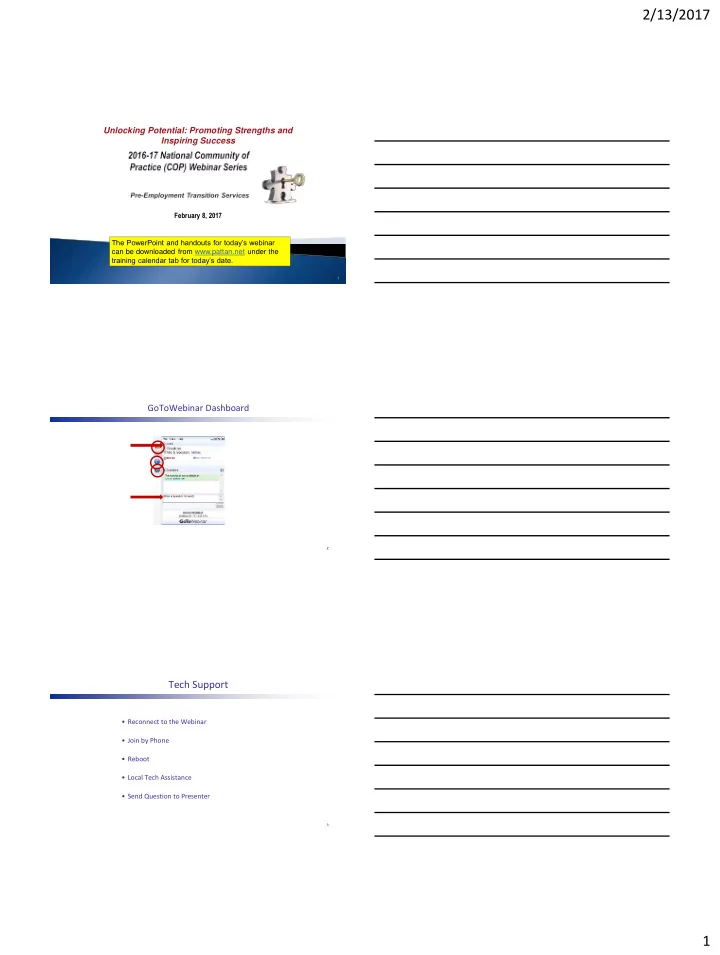
GoToWebinar Dashboard

2

Tech Support

  • Reconnect to the Webinar
  • Join by Phone
  • Reboot
  • Local Tech Assistance
  • Send Question to Presenter

3

slide-2
SLIDE 2

2/13/2017 2

The National Community of Practice on Secondary Transition

The National Community of Practice on Secondary Transition is a group of various stakeholders from states and organizations across the United States who work collaboratively to ensure appropriate transition

  • utcomes for youth and young adults with

disabilities.

4

Agenda

  • Overview of Pre-Employment Transition Services
  • Outline of Cross Technical Assistance Center

(TAC) Collaboration

  • State Examples of Pre-ETS
  • California
  • Delaware
  • District of Columbia
  • New Hampshire
  • Pennsylvania

5

Overview of Pre-Employment Transition Services (Pre-ETS)

6

slide-3
SLIDE 3

2/13/2017 3

Workforce Innovation and Opportunity Act (WIOA)

Signed into law on July 22, 2014

Replaces the Workforce Investment Act of 1998

http://www2.ed.gov/about/offices/list/osers/rsa/wioa-reauthorization.html

7

 Fiscal

  • 15% reserve requirement can only be spent on students with

disabilities, and

  • Only for the activities specified in the law

 Programmatic

  • Applies only to students with disabilities who are eligible or

potentially eligible for VR services

  • Includes certain “required” activities, additional “authorized”

activities, and “coordination” activities

 Coordination

  • Between the state VR agency(s), state education agency, and local

education agencies

Pre-employment Transition Services (Section 113) Requirements

8

  • Reserve Requirement

 A State must reserve at least 15% of their Federal Award for pre-employment transition services (Section 110(d), and Section 113(a), §361.48(a)).  15% reserve may only be spent on pre-employment transition services (five “required”, nine additional “authorized” activities, and four “coordination” activities) for students with disabilities.  The “required” activities under pre-employment transition services must be provided to students with disabilities. [Section 113(b) of the Act and §361.48(a)(2) and implementing regulations]  “Authorized” activities - may be provided if reserved funds remain after all required services have been made available and provided to all students with disabilities who need them. [Section 113(c) of the Act and §361.48(a)(3) and implementing regulations]  “Pre-employment transition coordination” - must carry out these activities and reserve

funds may be used to pay for pre-employment transition coordination activities. [Section 113(d) of the Act and §361.48(a)(3) and implementing regulation]s

Pre-employment Transition Services Requirements - Fiscal

9

slide-4
SLIDE 4

2/13/2017 4

  • Pre-employment transition services are an early start at job exploration

that:

– Must be made available statewide to all students with disabilities who need them, regardless of whether a student has applied for VR services; – May begin once a student requests or is recommended for one or more pre-employment transition services, and documentation of the disability is provided to the VR agency; – Assist students with identifying career interests to be further explored through additional VR services, including transition services; – Must be provided or arranged in collaboration with LEAs; and – Are the only activities that can be paid for with the funds reserved under section 110(d)(1).

Pre-employment Transition Services Programmatic Overview

10

WIOA does not eliminate the school’s responsibility to provide appropriate transition services. They should continue to provide the same or enhanced transition services to students. Pre-Employment Transition Services funded by VR are meant to expand or enhance services. Pre-ETS should never replace programs provided by school districts. For example: programs funded by extended school year or job coaching services provided by districts

11

“Potentially Eligible” defined in 34CFR361.48(a) means all students with disabilities who satisfy the definition in 34CFR361.5(c)(51), regardless of whether they have applied, and been determined eligible, for the VR program. Potentially Eligible

12

slide-5
SLIDE 5

2/13/2017 5

Student with A Disability

  • A student with a disability is an individual who is in a secondary, post-secondary,
  • r other recognized education program; and

– Meets certain age requirements (varies from state to state); and – Is eligible for and receiving special education or related services under IDEA; or – Is an individual with a disability for purposes of section 504 of the Act. 13

  • The five “required” activities of pre-employment transition services which can be

provided in group setting or on an individual basis, are: 1. Job exploration counseling; 2. Work-based learning experiences, which may include in-school or after school

  • pportunities, or experience outside the traditional school setting (including

internships), that is provided in an integrated environment to the maximum extent possible; 3. Counseling on opportunities for enrollment in comprehensive transition or post- secondary educational programs at institutions of higher education; 4. Workplace readiness training to develop social skills and independent living; 5. Instruction in self-advocacy, which may include peer mentoring.

Pre-employment Transition Services Required Activities

14

Job Exploration Counseling - Examples

  • Information regarding in-demand

industry sectors and occupations, as well as nontraditional employment;

  • Information about labor market

composition;

  • Administration of vocational interest

inventories; and

  • Identification of career pathways of

interest to the students.

  • Job exploration counseling provided
  • n an individual basis might be

provided in school or the community and could include discussions pertinent to the particular student about:

  • The student’s vocational interest

inventory results;

  • In-demand occupations;
  • Career pathways; and
  • Local labor market information that

applies to the student’s particular interests.

Group Individual Basis

15

slide-6
SLIDE 6

2/13/2017 6

Work-based Learning Experiences - Examples

  • Coordinating a school-based program
  • f job training and informational

interviews to research employers;

  • Work-site tours to learn about

necessary job skills;

  • Job shadowing; or
  • Mentoring opportunities in the

community.

  • Work-based learning experiences
  • n an individual basis could include

paid or unpaid:

  • Internships;
  • Apprenticeships;
  • Short-term employment;
  • Fellowships; or
  • On-the-job trainings located in the

community.

Group Individual Basis

16

Counseling for Post-Secondary Ed Programs - Examples

  • Course offerings;
  • Career options;
  • The types of academic and
  • ccupational training needed to

succeed in the workplace; and

  • Postsecondary opportunities

associated with career fields or pathways

  • Advising students and parents or

representatives on academic curricula;

  • Providing information about college

application and admissions processes;

  • Completing the Free Application for

Federal Student Aid (FAFSA); and

  • Providing resources that may be

used to support individual student success in education and training (i.e., disability support services)

Group Individual Basis

17

Workplace Readiness Training - Examples

Offered in a generalized manner in a classroom

  • r other such group settings to provide

programming to assist students with disabilities to develop social skills and independent living skills necessary to prepare for eventual

  • employment. These services could teach skills

such as:

  • Communication and interpersonal skills;
  • Financial literacy;
  • Group orientation and mobility skills (i.e., to

access workplace readiness training or to learn to travel independently);

  • Job-seeking skills; and
  • Understanding employer expectations for

punctuality and performance, as well as

  • ther “soft” skills necessary for employment
  • All of the services discussed to the

left that may be provided in a group setting, may also be tailored to an individual’s needs in a work readiness training program, provided in an educational or community-based setting through instruction, as well as opportunities to acquire and apply knowledge.

Group Individual Basis

18

slide-7
SLIDE 7

2/13/2017 7

Instruction in Self-Advocacy - Examples

Generalized classroom lessons in which students:

  • Learn about their rights and

responsibilities;

  • Learn how to request

accommodations or services and supports;

  • Communicate their thoughts,

concerns, and needs, in order to prepare them for peer mentoring

  • pportunities with individuals working

in their area(s) of interest

  • conducting informational

interviews;

  • mentoring with educational staff

such as principals, nurses, teachers,

  • r office staff; or
  • mentoring with individuals

employed by or volunteering for employers, boards, associations, or

  • rganizations in integrated

community settings; and

  • participating in youth leadership

activities offered in educational or community settings.

Group Individual Basis

19

  • If funds remain after all necessary “required” activities have been provided, VR

may provide additional “authorized” activities that:

  • Improve the transition of students with disabilities from school to postsecondary education or

an employment outcome; and

  • Support the arrangement or provision of the “required” activities.
  • “Authorized” activities (section 113(c) of the Act and §361.48(a)(3)) include, but

are not limited to (there are nine authorized activities):

– Providing instruction to VR counselors, school transition personnel, and other persons supporting students with disabilities; – Disseminating information about innovative, effective, and efficient approaches to achieve the goals of pre-employment transition services; and – Applying evidence-based findings to improve policy, procedure, practice, and the preparation

  • f personnel, in order to better achieve the goals of pre-employment transition services.

Pre-employment Transition Services Authorized Activities

20

  • Annual on-line survey of and listening sessions with families of students in

receipt of pre-employment transition services conducted to gather data and information and develop instruction, training, and professional service activities for PACER staff and vendors (other persons supporting students with disabilities)

  • Parent training workshops conducted by PACER for families of students who

are blind, visually impaired, or deaf-blind, including topics such as self- advocacy, leveraging IDEA for effective transition planning and coordination

  • f pre-employment transition services and developing independent living

skills and soft skills necessary for employment

Authorized Activities: Examples from RSA

21
slide-8
SLIDE 8

2/13/2017 8

  • Outreach to and training materials (i.e., podcasts, videos and

handouts) for families of students with disabilities, including accessible and family friendly resources, addressing topics such as building self-advocacy, working with vendors, and developing high expectations for students with disabilities in receipt of pre- employment transition services. Resources are to be provided through videos, podcasts and handouts.

Note: VR staff or PACER time to develop the materials and the costs incurred for printing the materials may be an “authorized” activity, clerical time or

  • ther “administrative costs” may not be paid with pre-ets reserve funds.

Authorized Activities: Examples from RSA

22

  • Pre-employment transition coordination activities (section 113(d)
  • f the Act and §361.48(a)(4)) are:

– Attending IEP meetings, when invited; – Working with the local workforce development boards, one-stop centers, and employers to develop work opportunities for students with disabilities; – Working with schools to coordinate and ensure the provision of pre- employment transition services; and – Attending person-centered planning meetings for students with disabilities receiving services under title XIX of the Social Security Act, when invited.

Pre-employment Transition Services Coordinated Activities

23

Work Based Learning Experiences (WBLE)

  • An assessment that includes job supports at a temporary, seasonal or

summer job for a youth that may or may not be consistent with the youth’s long term employment goal. A WBLE is intended to assess student strengths and limitations, teach students soft skills, and provide

  • pportunities to explore careers of interest.
  • It includes 20 hours of job development and up to 90 hours of job

supports to teach job tasks and assess student job skills. Student must be paid; can be done in conjunction with the stipend or Pre-ETS On The Job Training (OJT) to ensure that student is paid for experience.

24

slide-9
SLIDE 9

2/13/2017 9

Work Based Learning Experiences

Job Shadowing 1-5 day experience for a maximum of 25 hours per school year, in an

  • ccupation of interest within a community integrated setting. Provider

contacts employers of interest and arranges for student to observe employees on a jobsite to obtain an overview of the work environment, tasks, and abilities required for the field of interest. Provider is expected to supervise each student at the employer site to ensure ongoing monitoring of student progress, assess student abilities, and ensure their safety.

25

  • Collaborate with Education to Identify Students
  • Enhance Outreach Efforts and Student Access
  • Coordinate with Education to Develop Pre-ETS Services

– In school – After school – Summer

  • Contract with Providers/Vendors for Potentially Eligible
  • Partner with Employers and Others
  • Cross-Training

Pre-employment Transition Services (Programmatic) State Approaches

26

Where are States with Pre-ETS?

In General: Vocational Rehabilitation

  • Pre-ETS program planning
  • Pre-ETS fiscal forecasting (15% reserved funds)
  • Pre-ETS staff training (VR- time charging, providing Pre-ETS, data tracking)
  • Developing/updating existing policies regarding transition services to include Pre-ETS
  • Outreach efforts to increase opportunities for Pre-ETS provision

In Coordination with Departments of Education:

  • Agreements (MOU’s, Interagency, etc…)
  • Working together on WIOA section 511 requirements/referral processes
  • Joint Training

Specific State Examples of Pre-ETS Activities and Coordination (AZ, AK, NV, etc..)

27

slide-10
SLIDE 10

2/13/2017 10

Outline of Cross Technical Assistance Center (TAC) Collaboration

28

National Training and Technical Assistance Centers Pre-ETS and Transition Related Resources

29

Cross Technical Assistance Center (TAC) Collaboration

  • In October 2015 the US Department of Education, through the Rehabilitation Services

Administration (RSA), created six new Technical Assistance Centers (TACs):WINTAC, TC-TAC, Y-

TAC, AIVRS-TAC, OIB-TAC, and PEQA-TAC.

  • The previous year RSA awarded the JD-VRTAC and the Department of Education, Office of

Special Education Programs created the PROMISE TAC and the NTACT.

  • To ensure efficiency the TACs formed a collaborative to coordinate TA requests and to

reduce duplication of efforts.

  • The youth-focused TACs have formed an off shoot of the larger group and invited the US

Department of Labor’s Office of Disability Employment Policy, Youth-Focused TA Center, the National Collaborative on Workforce and Disability for Youth (NCWD/Youth) to join the youth-focused group.

30

slide-11
SLIDE 11

2/13/2017 11

Alphabet Soup- List of TA Centers

  • JD-VRTAC - Job Driven Vocational Rehabilitation Technical Assistance Center
  • NTACT - National Technical Assistance Center on Transition
  • WINTAC - Workforce Innovation Technical Assistance Center
  • Y-TAC - Vocational Rehabilitation Technical Assistance Center for Youth
  • NCWD/Youth - National Collaborative on Workforce and Disability for Youth
  • TC-TAC - Targeted Communities Technical Assistance Center
  • OIBTAC - Older Individuals who are Blind Technical Assistance Center
  • AIVRTAC - American Indian Vocational Rehabilitation Technical Assistance Center
  • PEQA-TAC - Program Evaluation and Quality Assurance Technical Assistance Center
  • PROMISE – Promoting the Readiness of Minors in Supplemental Security Income

31

Overview of the Youth Focus Training and TA Centers

32

Workforce Innovation Technical Assistance Center (WINTAC)

Purpose: The purpose of the Workforce Innovation Technical Assistance Center (WINTAC) is to provide training and technical assistance (TA) in five topic areas related to WIOA, including pre-employment transition services, that lead to effective implementation of the requirements set forth in WIOA to State Vocational Rehabilitation Agencies, and their partners. Target Audience:

  • State Vocational Rehabilitation Agencies, related agencies
  • Rehabilitation professionals, and
  • Service providers

Website: http://www.wintac.org/ States Receiving TA: California, Hawaii, Alaska, Arizona, Nevada, Montana, Iowa Blind, Tennessee, Kentucky G & Blind, Indiana, Maryland, Mississippi, Louisiana, North Carolina, Rhode Island, Minnesota, Virginia Blind, south Carolina Blind,

33

slide-12
SLIDE 12

2/13/2017 12

National Technical Assistance Center on Transition (NTACT)

Purpose: To assist State Education Agencies, Local Education Agencies, State VR agencies, and VR service providers to implement evidence-based and promising practices ensuring students with disabilities, including those with significant disabilities, graduate prepared for success in postsecondary education and employment. Target Audience:

  • State Education Agencies,
  • Local Education Agencies,
  • State VR agencies, and
  • VR service providers

Website: www.transitionta.org News and Events/Webinars: http://transitionta.org/#whatsnew States Receiving TA: North Dakota, Nevada, Alaska, Arizona, Arkansas, Delaware, New Hampshire, Maryland, Oregon, West Virginia

34

Youth Technical Assistance Center (Y-TAC)

Purpose: The purpose of the Institute for Educational Leadership’s (IEL) Vocational Rehabilitation (VR) Training and Technical Assistance (TA) Center for Youth (Y-TAC) is to provide State VR Agencies with TA and training to help more effectively serve all youth with disabilities, including students with disabilities who are not receiving comprehensive special education services, such as students with 504 plans and other “potentially eligible” young people; youth connected to other systems, such as youth in and out of foster care and court-involved, homeless, and runaway youth; and other disconnected, hard-to-serve, and at-risk youth populations. Target Audience:  State VR Agencies (SVRAs) and related rehabilitation professionals  Other youth service professionals Website: http://iel.org/vryouth-tac (under construction) States Receiving TA: Arizona, Alaska, Iowa Blind Services, Nevada, Virginia Blind Services, Kentucky Blind Services, Indiana, Minnesota

35

National Collaborative on Workforce and Disability (NCWD)

Purpose: The National Collaborative on Workforce and Disability for Youth (NCWD/Youth) assists state and local workforce development systems to better serve all youth, including youth with disabilities and other disconnected youth. Target Audience:

  • State and local workforce development systems and associated partners
  • Other youth service professionals
  • Youth and their families

Website: http://www.ncwd-youth.info/ Why contact????

  • To learn more about resources and models for quality career development and individualized

planning

  • To learn about training available to youth service providers including how to work with YWD

36

slide-13
SLIDE 13

2/13/2017 13

PROMISE TA Center

Purpose: The Promoting the Readiness of Minors in Supplemental Security Income (PROMISE) program, state agencies have partnered to develop and implement six model demonstration projects (MDPs) that provide coordinated services and supports to youth with disabilities receiving supplemental security income (SSI) benefits and to their families in order to improve education and career outcomes. Six model demonstration projects have been established serving a total of eleven states. Target Audience: The PROMISE model demonstration projects and their staff Website: http://www.promisetacenter.org/ Webinars: http://promisetacenter.org/webinar-library States Receiving TA: The PROMISE Model Demonstration Projects are located in: Arizona, Colorado, Montana, North Dakota, South Dakota, Utah, Arkansas, California, Maryland, New York, Wisconsin

37

Other Pre-ETS and Transition Coordination Resources:

The Office of Special Education and Rehabilitative Services (OSERS) is pleased to publish A Transition Guide to Postsecondary Education and Employment for Students and Youth with Disabilities. This guide is being issued by OSERS, the Rehabilitation Services Administration, and the Office of Special Education Programs to advance our efforts in ensuring that all students and youth with disabilities are equipped with the skills and knowledge to be engaged in the 21st century workforce. This transition guide addresses the following topics to facilitate a seamless transition from school to post-school activities:

  • Transition planning: opportunities and programs;
  • Transition services and requirements, as authorized by the Individuals with Disabilities Education Act

and the Rehabilitation Act;

  • Education and employment options for students and youth with disabilities after leaving secondary

school; and

38

Other Pre-ETS and Transition Coordination Resources

WORKFORCE GPS: Online Professional Network

  • https://www.workforcegps.org Home page
  • https://www.workforcegps.org/events schedule of webinars and archived events

– Registration for WIOA Wednesdays- various topics/focus areas

ION- Information and Opportunity Network (Community of Practice)

  • https://ion.workforcegps.org/home Home Page
  • https://ion.workforcegps.org/Announcements resources and events

39

slide-14
SLIDE 14

2/13/2017 14

What to Watch For…

  • TAC’s continually adding resources and webinars to their websites (check for

updates)

  • Youth Focus TAC’s have started a new Community of Practice called “Youth

Pathways to Post-Secondary Education and Employment”

  • Working on Launching a website (including webinar/event schedules and resources)
  • Feb. 2017 Launching Pre-ETS CoP

40

Contact Information

Sara Sembiante Y-TAC Liaison sembiantes@iel.org (520)981-5500- cell Christine Johnson WINTAC (Pre-ETS) cj1957@gwu.edu (513)882-3927 Catherine Fowler, PhD Project Coordinator NTACT UNC Charlotte - Cato College of Education chfowler@uncc.edu 704-687-8735

41

State Examples of Pre-ETS California

42

slide-15
SLIDE 15

2/13/2017 15

2016-17 We Can Work Grants

  • California’s Department of Rehabilitation (DOR) offered one year

contracts to school districts to offer students paid work based learning.

  • Students did an intake to become clients of DOR, the school district

provides PETS as usual and DOR reimburses us for up to 100 hours paid work based learning.

  • Still no word on whether this is continuing next year.

43

Increased Intakes for DoR While in School

  • DOR offices are looking to enroll more youth than they previously did.
  • Some offices are asking school districts in their areas to assist in

referring recent leavers (contacted in one year out follow up calls) to their local DOR office for intake. Offices may set aside intake dates based on demand.

  • Some offices are also asking districts to enroll students in DOR while in

school without the potential for a paid work based learning experience. DOR can take credit for PETS offered at the school site and students get the benefit of becoming a client of DOR.

44

Contact Information

Lela Rondeau Coordinator, Transition Services Division of Special Education Los Angeles Unified School District 213-241-8050 Lela.rondeau@lausd.net dots.lausd.net

45

slide-16
SLIDE 16

2/13/2017 16

State Examples of Pre-ETS Delaware

46

Delaware DVR and Pre-ETS

  • Collaboration with vendors

–Started in June of 2015 as an initiative to develop summer programs for transition students ages 14-21 –Objectives of the Pre-ETS summer programs

  • learn about and explore different career choices
  • discover their strengths and interests that can be applied to a career
  • Identify appropriate career pathways
  • job shadow and perform internships in different career fields
  • acquire financial literacy skills and independent living skill

47

Delaware DVR and Pre-ETS

  • Program Categories

–Training (customer service, hospitality, culinary arts and urban gardening and workplace readiness) –Career exploration and preparation –College preparation and experience –Work based learning (paid and unpaid) –Three programs were offered to incarcerated youth (workplace readiness, culinary arts)

48

slide-17
SLIDE 17

2/13/2017 17

Delaware DVR and Pre-ETS

  • Summer of 2016

– Awards were expanded to additional programs with an emphasis on including school year programming

  • New programs offered during the school year: culinary, transportation training, career

exploration, workplace readiness, media literacy and video production, work-based learning

  • University of Delaware, Center for Disabilities Studies: follow along services provided to

students after summer program is completed

– With the release of regulations, minor changes needed to be made in order to track services and gather required documentation

  • Develop a PRE case type in our case management system to track students who receive Pre-ETS

services

  • Expansion of documentation requirements for vendors

49

Delaware DVR and Pre-ETS: Univ of DE Program Examples

  • Edge

–Existing pre-college residential program –Built supports specific to students with disabilities

  • Swank Summer Employment

–Career Exploration –Work-based learning (paid)

  • Summer CLSC

–Person-centered plan –College & Career exploration –Building Self-Advocacy skills

50

Delaware DVR and Pre-ETS

  • Fall 2016

–Expansion of Pre-ETS services provided directly by DVR

  • Case management system updated to provide transition counselors an
  • pportunity to track Pre-ETS services
  • Develop a Pre-Employment Transition Unit within the agency Transition

Program

– Pre-ETS Career Counselors (in development) » Provide group and individual services to students

51

slide-18
SLIDE 18

2/13/2017 18

Contact Information

Sandra Miller Transition Coordinator Delaware Division of Vocational Rehabilitation 302-761-8278 Sandra.j.miller@state.de.us http://dvr.delawareworks.com/

52

Brian Freedman University of Delaware College of Education & Human Development 302-831-4688 brianf@udel.edu

State Examples of Pre-ETS District of Columbia

53 54

  • Work-Based Learning Experiences
  • Instruction in Self-Advocacy
  • Out-of-School Youth
  • Annual Voices of Change Conference
  • JumpStart Summer Youth Employment Program (SYEP)
  • Additional Authorized Activities
  • Coordinated Activities between RSA & LEA

Overview of Pre-Employment Transition Services (Pre-ETS)

slide-19
SLIDE 19

2/13/2017 19

Work-Based Learning Experiences

55

56

  • The Rehabilitation Services Administration (RSA) pays the wages for youth to have internship

experiences.

  • For DC Public Schools, internship efforts are facilitated by workforce development coordinators at each

comprehensive high school: – Workforce development coordinators secure internships in the community based on students’ career interests and preferences.

  • For charter schools, internship efforts are coordinated by RSA:

– RSA is utilizing their business relations unit to build and maintain business partnerships ultimately to

  • btain internships for charter school youth.

Internships for Youth

Instruction in Self- Advocacy

57

slide-20
SLIDE 20

2/13/2017 20

58

  • RSA contracts with the DC Center for Independent Living (DC-CIL) to assist with self-advocacy instruction.
  • DC-CIL has developed a transition curriculum that focuses on self-advocacy and self-determination.
  • DC-CIL, in collaboration with LEAs, push into classrooms that provide instruction to students with

intellectual disabilities and autism. – This is a semester-long course where DC-CIL provides instruction in the areas of self-advocacy and self-determination. » Part of the program includes peer-to-peer mentoring

Self-Advocacy Instruction

Pre-ETS for Out-of- School Youth

60

  • RSA hosts workshops for college students three times a year.

– During winter break, spring break, and at the end of the spring semester – The final workshop focuses on work readiness to help students get the most out of summer internships » Internships align with student’s course of study at the university or college level.

Services for College Students

slide-21
SLIDE 21

2/13/2017 21

61

  • RSA partners with Department of Employment Services (DOES) to connect out-of-school youth (who are

also vocational rehabilitation clients) with job training and paid internships. – As of January 2017, RSA has approximately 200 out-of-school youth who are vocational rehabilitation clients looking for employment.

  • RSA & DOES held a DC Youth Workforce Development fair in December.

– Youth are connected to DOES for training programs offered in career pathways such as IT, security, medical billing, etc. – The partnership examines utilizing existing job training programs in the city to provide students with a career pathway and job training.

Out-of-School Youth

Annual Voices of Change Conference

63

  • For the eighth year, DC has hosted the Voices of Change Conference: Secondary Transition for DC Youth

by DC Youth.

  • Each year, all DC high schools are invited to bring their students with disabilities to learn how to

successfully transition into employment, education, and independent living.

  • The conference is jointly funded by the following agencies: District of Columbia Department on Disability

Services; District of Columbia Developmental Disabilities Council; District of Columbia Office of the State Superintendent of Education’s Division of Elementary, Secondary, and Specialized Education; John F. Kennedy Center for the Performing Arts; and the Institute for Educational Leadership.

  • This year’s conference will be held on March 10 at the Washington Convention Center.

Voices of Change Conference

slide-22
SLIDE 22

2/13/2017 22

64

Voices of Change Conference Focus Areas

Youth Leadership Interns (Prior to and day of event) Youth Presenters (Prior to and day of event) Youth Volunteers (Day of event) Youth Participants (Day of Event)

Job Exploration Counseling

Youth Leadership Interns (Prior to and day of event) Youth Presenters (Prior to and day of event) Youth Volunteers (Day of Event)

Work-based learning experiences

Youth Leadership Interns (Day of event) Youth Presenters (Day of event) Youth Volunteers (Day of event) Youth Participants (Day of event)

Counseling on transition & postsecondary educational programs

Youth Leadership Interns (Prior to and day of event) Youth Presenters (Prior to and day of event) Youth Volunteers (Day of event) Youth Participants (Day of event)

Workplace readiness training to develop social skills and independent living

Youth Leadership Interns (Prior to and day of event) Youth Presenters (Prior to and day of event) Youth Volunteers (Day of event) Youth Participants (Day of event)

Instruction on Self-Advocacy

JumpStart Summer Youth Employment Program (SYEP)

66

  • RSA coordinates a summer employment program for youth with disabilities. The following activities are

part of the program:

– Outreach & Recruitment

  • Targeted outreach to public and charter schools

– Pre-Program Activities

  • Work with youth, families, school staff, and RSA counselors to coordinate vocational evaluations for all program

participants – Pre-Employment Boot Camp

  • Develop a training program and review curriculum to ensure the same procedures and protocols for all participants

– SYEP Placement & Retention

  • Ensure appropriate job site placements for students
  • Align and provide the most comprehensive set of on-the-job supports for participating students

– Close Out & Evaluation

  • Develop and implement an interactive closing session for participating youth
  • Conduct a program evaluation and submit a comprehensive program report

JumpStart Summer Youth Employment Program

slide-23
SLIDE 23

2/13/2017 23

Additional Authorized Activities

67

68

  • MOU established between DC Public Schools and RSA for use of Project Discovery Curriculum.

– This curriculum focuses on providing LEAs with workplace readiness training materials that will be distributed to schools.

  • The curriculum focuses on money management, teamwork, and problem solving.
  • Implementation of this course will be monitored by RSA.

Project Discovery website: http://educationassociates.com/curriculum/

Project Discovery

Coordinated Activities between RSA & LEA

slide-24
SLIDE 24

2/13/2017 24

70

  • RSA funds three DC Public Schools workforce development coordinators

– Workforce development coordinators are school-based staff who are assigned to schools and assist with transition planning and securing internships for students with disabilities.

  • RSA recently added two additional workforce development coordinators who are community based.

– These coordinators will work with local businesses to further establish partnerships for internships and work experiences for youth.

Coordinated Activities

71

Angela Spinella Office of the State Superintendent of Education Secondary Transition PD Specialist Angela.Spinella@dc.gov Willina Robson Rehabilitation Services Administration Project Manager, Transition Unit Willina.Robson2@dc.gov

Contact Information

State Examples of Pre-ETS New Hampshire

72

slide-25
SLIDE 25

2/13/2017 25

New Hampshire

  • Granite State Independent Living’s IMPACCT Academy:

– Comprehensive program that students attend during the school day. The curriculum is focused on the 5 Pre-ETS areas. – Morning session = teaching curriculum afternoon session = support toward diploma/HiSet etc... One day a week morning session = work experience. – Two 14 week sessions (fall and spring) one 5 week session in the summer.

  • Granite State Independent Living’s Workshops:

– Workshops are delivered in school and community settings by GSIL staff covering the 5 Pre-ETS areas. They are delivered in small groups.

73

New Hampshire continued…

  • Strafford Leaning Center’s Standardized Approach: curriculum that

addresses Job Exploration, Work-based Learning Experiences, and Instruction in Self-Advocacy (Areas 1, 2 & 5 of the Pre-ETS services) is adaptable and flexible (in 30 minute lesson plans) with areas 3&4 met through interactive events, fairs and workshops.

  • Strafford Leaning Center’s Differentiated Approach: Similar to the

standardized approach however it is designed to reach traditionally underserved populations for example those who are blind/visually impaired or those who are deaf or hard of hearing.

74

Contact Information

  • Dr. Dawn Breault

District Transition Coordinator Alvirne High School dbreault@sau81.org 603-886-1260 x2548

75

Kevin Stevenson Youth Transition Services Administrator 21 South Fruit Street, Suite 20 Concord, NH 03301 (603) 271- 5024 Kevin.Stevenson@doe.nh.gov

slide-26
SLIDE 26

2/13/2017 26

State Examples of Pre-ETS Pennsylvania

76

Starbucks Starbucks Inclusion Academy

Six weeks of learning curriculum on site at the York Starbucks Roasting Plant...

  • Four weeks classroom instruction
  • Two weeks internship at Starbuck facility
  • Disability Etiquette Training was done by OVR for the Starbucks executives,

trainers, and “partners” (employees) before the Inclusion Academy began.

  • Participants in the Inclusion Academy must be at least 18 years old.
  • Program has yielded 6 hires with average $14.00/per hour.
  • Operates 4 times per year, average of 6 participants per class.

77

Starbucks Inclusion Academy

Starbucks Inclusion Academy Graduation – York, PA https://www.youtube.com/watch?v=ks7aTlFWaRo http://crispusattucks.org http://www.prologistix.com/ https://news.starbucks.com/news/starbucks-inclusion- academy-york-pennsylvania

78

slide-27
SLIDE 27

2/13/2017 27

Early Reach Initiative

  • Developed an OVR Outreach Program, “Early Reach”: to find youth earlier (14 – 16

years old) and their parents to discuss:

  • OVR services and vocational planning
  • What to expect from OVR and when to expect it.

79

BBVS Summer Academy BBVS Summer Academy at PSU The Summer Academy is a three week program for Pennsylvania students who are blind or visually impaired and preparing for post-secondary education leading to competitive employment.

  • OVR’s partnership with PaTTAN (Dept. of Ed) and PSU
  • At PSU’s State College, 3 weeks in summer
  • No cost to eligible students 9th-12th grade
  • Mini college prep experience

80

Early Reach Academy at PSU - Harrisburg

81

slide-28
SLIDE 28

2/13/2017 28

Work Based Learning at Fenner Drives

  • Partnership between:
  • OVR York District Office
  • Manheim Central School District
  • Fenner Drives

OVR provides: * Reimbursement of the students wages through the Youth On the Job Training, * A job coach through the Intermediate Unit #13,

  • Steel toe shoes which are a requirement to work at Fenner Drives.
  • https://youtu.be/FFZMgyUU9Nc

82

Contact Information

Amy Engbarth, MS, CRC PA Office of Vocational Rehabilitation VR Specialist Special Programs Division Phone (412) 209-4524 Email aengbarth@pa.gov

83

2016-17 – National Secondary Transition COP Webinar Series

  • March 16, 2017 – (2:00 pm – 4:00 pm) -

Career Preparation and Work-Based Learning

  • April 26, 2017 – (2:00 pm – 4:00 pm) - Youth

Development and Youth Leadership

84

slide-29
SLIDE 29

2/13/2017 29

Contact Information www.pattan.net Michael Stoehr mstoehr@pattan.net 412-826-6864

85