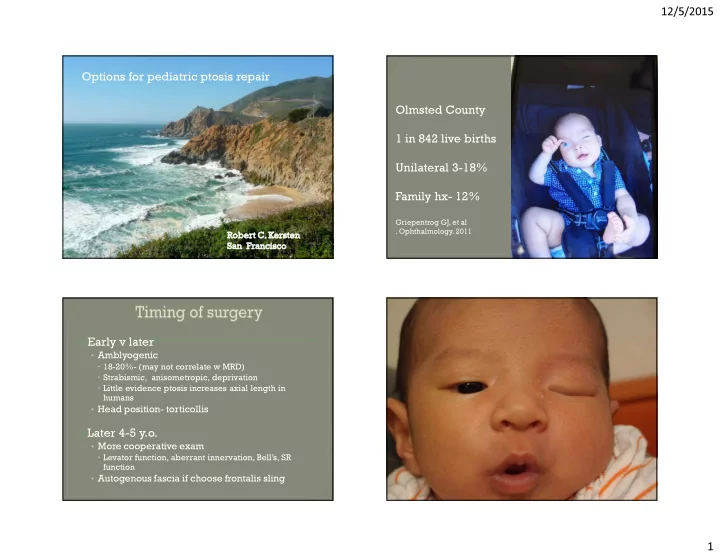
SLIDE 1 12/5/2015 1 Options for pediatric ptosis repair Olmsted County 1 in 842 live births Unilateral 3-18% Family hx- 12%
Griepentrog GJ, et al . Ophthalmology. 2011
Early v later
18-20%- (may not correlate w MRD) Strabismic, anisometropic, deprivation Little evidence ptosis increases axial length in humans
- Head position- torticollis
Later 4-5 y.o.
Levator function, aberrant innervation, Bell’s, SR function
- Autogenous fascia if choose frontalis sling
SLIDE 2 12/5/2015 2
Levator function Amblyopia Aberrant innervation levator (Marcus-Gunn, III n
palsy)
Good function: > 10 mm
- Mullerectomy, Fasanella-Servat (2 mm ptosis, excellent
function)
- Aponeurotic advancement- goal- height under anesthesia
Intermediate: 6-8 mm
- Levator advancement plus tarsectomy
Poor: < 6 mm
- Frontalis sling
- Supramaximal resection
(20-30 mm levator muscle)
:
SLIDE 3 12/5/2015 3
3 y.o.- comngenital ptosis L.U.L. Astigmatism O.D.- part time occlusion 2-3 m m function
Poor levator function: Generally “bypass” levator muscle
- Frontalis sling- effectively transmits force from frontalis
muscle to eyelid
- Open lid crease
- Suture sling directly to tarsus
- Adjust lid contour with tarsal sutures
- Fixate crease
- Adjust height with tension at brow incision
Sling materials:
- Autogenous fascia*
- Homologous fascia
- PTFE- suture or patch*
- Supramid
- Frontalis muscle
advancement(?)
- Mersilene mesh
- Proline suture
- Silicone tube
SLIDE 4
12/5/2015 4
Reflex recruitment of frontalis muscle to clear visual axis Frontalis sling allows more efficient frontalis elevation of eyelid 1:1 elevation of eyelid : brow
SLIDE 5
12/5/2015 5
SLIDE 6
12/5/2015 6
Congenital nil function ptosis Recruiting frontalis muscle s/p PTFE sling
SLIDE 7
12/5/2015 7
Congenital R. III n palsy s/p extirpation R levator unilateral fascia lata sling Levator ablation: unpredictable, undesirable levator
SLIDE 8 12/5/2015 8
Bilateral ptosis Frontalis sling- “self-adjusting” Variable recruitment of frontalis to clear
Unilateral ptosis: unilateral vs bilateral surgery
Amblyopia- no drive to recruit frontalis Results in more lagophthalmus
Not useful if aberrant innervation of levator
- Marcus-Gunn jaw wink
- Congenital III n palsy w aberrant innervation
SLIDE 9
12/5/2015 9
3 y.o- poor function ptosis, amblyopia w no frontalis recruitme Good SR function, good Bell’s
SLIDE 10
12/5/2015 10
SLIDE 11
12/5/2015 11
SLIDE 12
12/5/2015 12
SLIDE 13 12/5/2015 13
Early v later
Head position- tortocollis Later 4-5 y.o. Options
- Levator surgery
- Frontalis sling
Poor/aberrant levator function Bypass levator w sling
Supramaximal resection
- Avoid if aberrant innervation
- Exposure greater concern post-op
Avoid if poor Bell’s “Double –elevator palsy”
SLIDE 14
12/5/2015 14
SLIDE 15
12/5/2015 15
SLIDE 16
12/5/2015 16
SLIDE 17
12/5/2015 17
SLIDE 18
12/5/2015 18
SLIDE 19
12/5/2015 19
SLIDE 20
12/5/2015 20
Robert C. Kersten M.D. Kerstenr@vision.ucsf.edu O-415-353-9399 C-415-235-0227
SLIDE 21
12/5/2015 21
Robert C. Kersten M.D. Kerstenr@vision.ucsf.edu O-415-353-9399 C-415-235-0227
External DCR- still my preference
Robert C Kersten UCSF The relation of Graves Hyperthyroidism and Graves Ophthalmopathy Robert C. Kersten UCSF
SLIDE 22 12/5/2015 22
Early v later
18-20%- (may not correlate w MRD) Strabismic, anisotropic, deprivation
- Head position- torticollis
- Little evidence ptosis increases axial length in
humans
Later 4-5 y.o.
- More cooperative exam
- Autogenous fascia if choose frontalis sling