
SLIDE 1
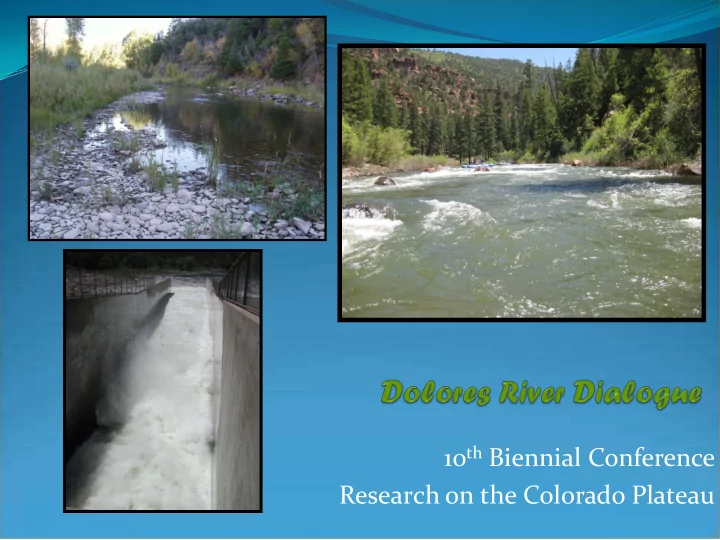
10 th Biennial Conference Research on the Colorado Plateau Agenda - - PowerPoint PPT Presentation
10 th Biennial Conference Research on the Colorado Plateau Agenda Introduction and Background Carolyn Dunmire Dolores River Action Group Formation of DRD and the Plan to Proceed Chuck Wanner Dolores River Coalition
–
Carolyn Dunmire – Dolores River Action Group
–
Chuck Wanner – Dolores River Coalition
–
Mike Preston – Manager, Dolores Water Conservancy District
–
Jim Siscoe – Manager, Montezuma Valley Irrigation Company
–
Ann Oliver – DRD Technical Committee
–
David Graf – Regional Water Resource Specialist Colorado Division of Wildlife
–
Mike Preston – Lower Dolores River Working Group
–
Chester Anderson – Dolores River Watershed Plan
–
Randy Carver – President, Montezuma Valley Irrigation Company
2 Dolores River Dialogue
Dolores River Dialogue 3
Dolores River Dialogue 4
McPhee Dam
Active Capacity
229,200 a-f
Max release 5000 cfs Acres Irrigated 61,000 Drainage 809 sq-miles Federal Project with
private water rights.
Transbasin diversion
5 Dolores River Dialogue
Mitigation for white-
water rafting
Tail-water trout fishery Minimum in-stream
flow
Spill Committee Fish pool
6 Dolores River Dialogue
7 Dolores River Dialogue
8 Dolores River Dialogue
DRD – Dolores River Dialogue DWCD – Dolores Water Conservancy District MVIC – Montezuma Valley Irrigation Company McPhee – McPhee Dam or Reservoir Bureau – Bureau of Reclamation DOW – Colorado Division of Wildlife DRIP – Dolores River Instream Flow Partnership WETPACK – Water for Everyone Tomorrow Package
9 Dolores River Dialogue
Dolores River Dialogue 10
It the intent of the Dolores Water Conservancy District and the Dolores River Coalition, in collaboration with other interests, to discuss the management of the flows of the Dolores River to determine how the river might best be managed to serve the needs of the various human and natural communities of the Basin and the region. The parties will act will by a general consensus. This collaborative effort is not intended to involuntarily diminish the quantity of water available for the current Dolores Project beneficiaries or the operational flexibility needed to meet the demands of Project beneficiaries.
11 Dolores River Dialogue
Dolores Water Conservancy District Montezuma Valley Irrigation Company Colorado Water Conservation Board The Colorado Water Trust Colorado State Engineer Bureau of Reclamation Colorado Division of Wildlife Bureau of Land Management United States Forest Service Montezuma and Dolores Counties Dolores River Coaltion The Nature Conservancy
Dolores River Dialogue 12
Milestones in the Flow of the Dolores River Dialogue Plan to Proceed Core Science Report Hydrology Report Correlation Report Matrix of Opportunities
13 Dolores River Dialogue
Dolores River Dialogue 14
Keep the politics out of the science Define the questions that help policy makers Establish permanent study sites Use GIS to fullest extent possible Draw on existing research and motive new ideas
Dolores River Dialogue 15
8 distinct Reaches were defined using distinct channel characteristics (i.e slope and gradient), as well as vegetation, etc.
Goal Flow Hypothesis Floodplain scour/ deposition. 2000+ cfs for 10+days Floodplain saturation (nutrient cycling) 800+ cfs Cottonwood seedling establishment. 2000+cfs to build bars; ~100cfs/day ramp down to favor seedling establishment
Goal Flow Hypothesis Spawning. Moderate spring flows (~100 cfs to 1000 cfs) for ~60 days to keep pre-spill water temperature low. Year class recruitment. Avoid rapid drop at end of peak (stranding); (ramp-down rates <200 cfs/d) Adult fish survival Maintain adequate base flows Reduce non-native fish populations. High annual spring flows (~100 cfs to 1000 cfs). Avoid sustained (esp. multi-year) low flows.
Goal Flow Hypothesis Combined biomass >30lbs/ac (3yr avg) Spill duration exceeding 70 days. Stocking recruitment (+1 size class evident) Maintain adequate baseflow (>78cfs minimum base flow during summer; >30 cfs winter) Maintain 10 trout/ac over 14" (3 yr avg) Spill duration exceeding 70 days.
Goal Flow Hypothesis Scour fine sediment (“flushing flows") >400cfs Frequently mobilize channelbed surface. 2000 cfs for 10-14 days. Small-spill years: 1000 cfs for 1 week to continue 'downsizing' of alluvial channel. Periodic channelbed scour/ coarse sediment flux. >3000 cfs for 1 wk Infrequent channel resetting flow. 20 yr flood frequency+ (~5000 cfs)
CDOW Management of Terrestrial and Aquatic Wildlife Resources for Recreational and Conservation Purposes Brief History of Cooperative Management on Lower Dolores
Cooperative Land Management of River Corridor (to
Dolores River Biology Team - Flow Management w/
Dolores River In-stream Flow Partnership (DRIP) w/
MOA signed in 1998 articulating goals, including
Dolores River Dialogue 21
FISHERY MANAGEMENT AND DATA
Management
Cutthroat Trout
Surveys (four sites)
Projects
Dolores River Dialogue 22
Warmwater Native Species Conservation
(warranted for ESA Protection in Lower CO River Basin)
Bluehead Suckers
Surveys (one site)
dependent longitudinal surveys
Dolores River Dialogue 23
Pre-Dam History of Land and
Water Management Affecting Aquatic Habitat
Late- Summer Dewatering since
1886
Agriculture and Grazing
Post-Dam Issues Affecting
Aquatic Habitat
Reduced Peak Flows, No-
Spill Years
Reduced Sediment Flux
below Reservoir
Dolores River Dialogue 24
Specific Inquiries
Mobility Threshold Exceeded at XS? D50 D84 800 1400 4500 800 1400 4500 XS#0 YES YES YES NO NO YES XS#1 NO NO NO NO NO NO XS#2 NO NO NO NO NO NO XS#3 YES YES YES NO NO YES XS#4 YES YES YES NO (~) YES YES XS#5 YES YES YES YES YES YES
History of ‘Collaborative Processes’ in general has been
Dangers of politicizing wildlife management
Mandate to manage wildlife resources whether or not a
‘FAD’ or a Meaningful, Long Term Management
Strategy?
Dolores River Dialogue 26
Decision Making Authority
THE DRD HAS NONE
Parochial Interests vs. Common Goal
PARTICIPANTS MUST MAKE A CHOICE
Dolores River Dialogue 27
Meaningful scientific information has been collected
COLLABORATIVE SCIENCE WORKS
All key players are at the table
THE DRD CAN BECOME A FORCE FOR PROACTIVE
DECISIONS THAT COULD AFFECT FEDERAL LISTINGS OF AQUATIC SPECIES
Dolores River Dialogue 28
Dolores River Dialogue 29
River Mile 74
Dolores River Dialogue 30
River Mile 74
Lower Dolores River Working Group Dolores River Watershed Plan Private Water Rights
Dolores River Dialogue 31
Purpose
Organized by DRD to evaluate alternatives to WSR Update 1990 BLM Dolores River Corridor Management
Plan
Process
Diverse Stakeholder Group (5o people) Meetings on Outstandingly Remarkable Values,
Management Issues, Opportunities & Concerns
Field Trips (3) Brainstorming tools and strategies in small groups by
Reach
Dolores River Dialogue 32
Topic Workshops 2010
Select Top 3 issues from previous meetings In-depth Workshops on each topic Bucket List: #1) We Prefer #2), If #1 doesn’t work #3) If 1
and 2 have been exhausted
Recommendations for Preferred Alternative(s) for EA
and Revised Corridor Management Plan to be Conducted by Dolores Public Lands Office.
Dolores River Dialogue 33
EPA Driven Non-point source pollution Watershed plan? Or communication tool?.
Dolores River Dialogue 34