
SLIDE 1
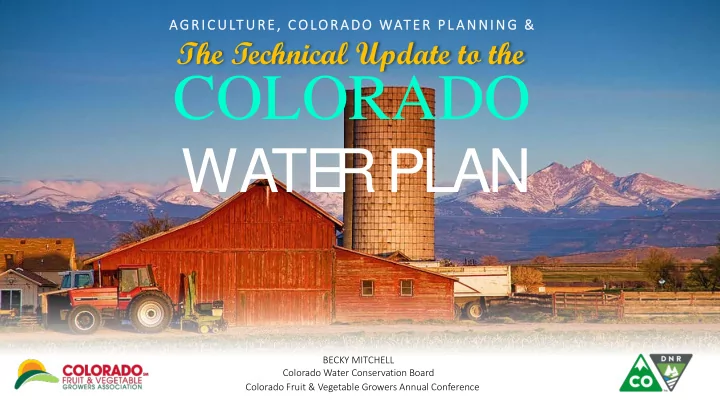
The Technical Update to the
WATE R PLAN
COLORADO
AGRIC GRICULTURE, C COLORADO W WATER PL PLANNIN ING & &
BECKY MITCHELL Colorado Water Conservation Board Colorado Fruit & Vegetable Growers Annual Conference
COLORADO WATE R PLAN BECKY MITCHELL Colorado Water Conservation - - PowerPoint PPT Presentation
AGRIC GRICULTURE, C COLORADO W WATER PL PLANNIN ING & & The Technical Update to the COLORADO WATE R PLAN BECKY MITCHELL Colorado Water Conservation Board Colorado Fruit & Vegetable Growers Annual Conference CWCB Sections of
The Technical Update to the
AGRIC GRICULTURE, C COLORADO W WATER PL PLANNIN ING & &
BECKY MITCHELL Colorado Water Conservation Board Colorado Fruit & Vegetable Growers Annual Conference
Water Supply Planning Watershed & Flood Protection Stream & Lake Protection Finance & Admin. Interstate & Federal MGMT.
Under er 50 s 50 staff
6 Sec ections
Mission:
To Conserve, Develop, Protect and Manage Colorado’s Water for Present and Future Generations.
A productive economy that supports vibrant and sustainable cities, agriculture, recreation and tourism.
Efficient
and effective water infrastructure. A strong environment with healthy watersheds, rivers, streams and wildlife.
E FFE CTS
Since 2015, significant progress has been made on over 65%
SUPPL Y AGRICUL TURE
Reduce the projected 2050 municipal and industrial gap form 560,000 acre-feet to zero by 2030. Support agricultural economic productivity and share 50,000 acre-feet using alternative transfer methods by 2030.
FUNDING
Sustainably fund the water plan by raising $100 million in revenue annually starting in 2020 ($3 billion by 2050). Achieve 400,000 acre-feet of municipal and industrial conservation
by 2050.
CONSERVA TION
Ensure 75 percent of Coloradoans live in water-saving communities by 2025.
LAND USE
Attain 400,000 acre-feet
storage to manage and share conserved water by 2050.
STORAGE
Improve the level of public awareness by 2020 and engage Coloradoans
challenges by 2030.
EDUCA TION
Cover 80 percent of all prioritized watersheds and rivers with a Management plan by 2030.
WA TERSHED
Respond to and prepare for natural disasters, climate change and energy needs while protecting interstate matters.
ADDITIONAL
MAKING
PROGRE SS
W A TER PLAN
SCE NARIOS
NOTE:
Number of long-term SNOTEL stations that reported low peak snowpack.
is almost half of it’s maximum capacity.
In the percent of the state in severe drought from Oct 1 –Sept 30.
Without any precipitation reported at Gateway from October 3 – November 17. cracked the top 10 list for the largest state wildfires on record. The Spring Creek Fire, 416 and MM 117 fires burned more than 200,000 acres.
Number of 2”
reports made. That’s over twice as many as the average
All-time highest minimum temperature ever recorded at Trinidad Perry Stokes Airport on June 28.
COLORADO W A TER YEAR 2018
Highest wind gust in 30 years reported at La Junta on April 17.
“As of the date of this memorandum, the Colorado Drought Mitigation and Response Plan is in effect for Montezuma, La Plata, Archuleta, Conejos, Costilla, Las Animas, Baca, Prowers, Bent, Otero, Huerfano, Alamosa, Rio Grande, Mineral, Hinsdale, San Juan, Dolores, San Miguel, Ouray, Montrose, Saguache, Custer, Pueblo, Crowley, Kiowa, Cheyenne, Lincoln, El Paso, Elbert, Gunnison, Mesa, Delta, Garfield, Rio Blanco counties.”
Drought Activation Memo May 2, 2018
DROUGHT
ACTIVATION
9 COMPACTS
+
DROUGHT CONTINGENCY
*This would be the water available at a full allocation of that 16.5MAF
CRITICAL ELEV A TIONS FOR
Max Capacity* 1,219’ Current Level** 1,081’ Shortage Condition 1,075’ Minimum Power Pool 1,050’ Dead Pool 895’
*Lake Mead last approached full levels in 1986 **Level as of January 4, 2019
COMPANION AGREEMENT Operational Provisions Drought Response Operations Agreement Demand Management (DM) Storage Agreement
DOCUME ME NT NTS AND A AGRE E ME NTS TS
Lower Basin DCP*
Upper Basin DCP Lower Basin DCP Agreement
Agreements
Agreements
NV
Agreements
CA
Agreements Agreements FEDERAL LEGISLATION COLORADO RIVER BASIN DROUGHT CONTINGENCY PLAN (DCP)
AZ
*Activates Section IV of Minute 323 (Binational Water Scarcity Plan)
THIS I IS NOT OT A DM P PRO ROGRAM.
Creates free storage if a DM Program is created.
Colorado River Compact
(1922 - Perpetuity)
Upper Colorado River Basin Compact
(1948 - Perpetuity)
Interim Guidelines
(2007 - 2026)
Drought Contingency Plans for the Lower & Upper Basins
(2019? - 2026)
Upper Basin Demand Management Program (?)
must provide to comply with 75 MAF over 10 year rolling average
if drought worsens
UB compact compliance
Lee Ferry below 75 MAF over ten year rolling average
Rights ts to to C Colorado River er W Water er a and Compact C t Compliance e (under er v variable e water er s supplies es)
CONNE CTE D
COMPACTS, AGREEMENTS AND ANY POSSIBLE FUTURE PROGRAMS ARE
VOLUNTARY , TEMPORARY &
COMPE NSATE D
TARGE TE D BASIN PLANNING
Case e Studi udies es
Tool
Data, D Driver ers a s and nd I Impacts
W A TER PLAN ANAL YSIS
4,000,000 6,000,000 8,000,000 10,000,000 12,000,000
Population
Statewide Population - Baseline and Projections
SWSI 2010 High Population SWSI 2010 Medium Population SWSI 2010 Low Population
SWSI BASELINE SWSI UPDATE 2050 PROJECTIONS
*SWSI 2010 projection is shown adjusted for 2015 to compare to SWSI Update Baseline.
Comparison to SWSI 2010 Projections
Geographic Comparisons by Water Plan Scenario
0.0 0.1 0.2 0.3 0.4 0.5 0.6 0.7 0.8 0.9 1.0 1.1 1.2 1.3 1.4 Business as Usual Weak Economy Cooperative Growth Adaptive Innovation Hot Growth
Urban Center to Mtn. Resort Counties Comparison: Normalized to Business as Usual
Mtn Resort Counties Urban Center Counties All Other Counties
Per SDO 2017 Forecast Sets an objective that agricultural economic productivity will keep pace with the growing state, national and global needs, even if some acres go out of production. The state will work closely with the agricultural community , in the same collaborative manner that has produced agricultural transfer pilot projects. To s
sha hare e at l least 50,000 a 000 acre-feet o
agr gricultural water u using g voluntary alter ernative t e transfer er m method b by 203 030.
TH E CO LO RA D O
WATE R PLAN
ALTERNA TIVE TRANSFER
supply other uses, without permanently transferring the water rights from the farm
impacts, net benefits, fits need of parties
Water Plan Grant Category
FY 17/18 FY 18/19 FY 19/20
WSRF Supplemental Funding
$10M $2M $2.5M
CO Watershed Restoration Program
$5M $2M $4M
Agricultural Transfer Methods (ATM) Grants
$1M* $1M
Agricultural Projects Water Plan Grants
$1M $1M $1M
Conservation & Land Use Planning Water Plan Grants
$1M $1M $1M
Environment/Recreation Water Plan Grants
$1M $1.5M $1.5M
Innovation/Outreach Water Plan Grants
$5M $0.5M $0.5M
Storage & Supply Gap Water Plan Grants
$1M $3M $3M
Water Plan Updating Efforts
$1M $5.5M
TOTAL $25M $11M $20M WATER PLAN GRANT
= $56 M OVE R
*ATM grants were not calculated into the original $25M package in FY 17/18.
Education, Innovation & Outreach
Agriculture Water Collaborative
Applicant: Colorado Cattlemen’s Association Project Cost: $152,400 Water Plan Grant Funding: $76,200 Project: Engage and inform ag water right holders and non-ag water interests about ag water issues, including direct and indirect benefits of irrigated agriculture and how agriculture and other water interests can benefit from mutual collaboration. Measurable Result: 10 workshops, 7 conferences/ tradeshows, 3 webinars, 2 videos, 5 ag water tours, 6 publications, 1 screen tool
Education, Innovation & Outreach
Agriculture Water Collaborative
PROJECT GOALS MEASURABLE RESULTS APPLICANT COSTS
indirect benefits of irrigated agriculture and how agriculture and other water interests can benefit from mutual collaboration.
PROJE CT E XAMPLE :
WATER PLAN GRANTS AWARDED
ACROSS COLORADO
SUPPORT
CONTINUED SUPPORT FOR
Webinar is April 23, 2019. Sign-up Today at www.colorado.gov!
AGRICULTURAL
ME THODOLOGY
THOUGHTS, S, C COMMENT ENTS S OR