10.00 overview Basiliko am Project EAS and waste management - - - PowerPoint PPT Presentation

10 00
SMART_READER_LITE
LIVE PREVIEW

10.00 overview Basiliko am Project EAS and waste management - - - PowerPoint PPT Presentation

Time Monday June 24 Tuesday June 25 Wednesday June 26 Time (Monday) (Tuesday Wednesday) 9.15 10.00 Plenary Skip Kingston: The Isotopic Periodic Table Guides Plenary Jeffrey Skousen: Use of Reclaimed Lands for Income Plenary


slide-1
SLIDE 1

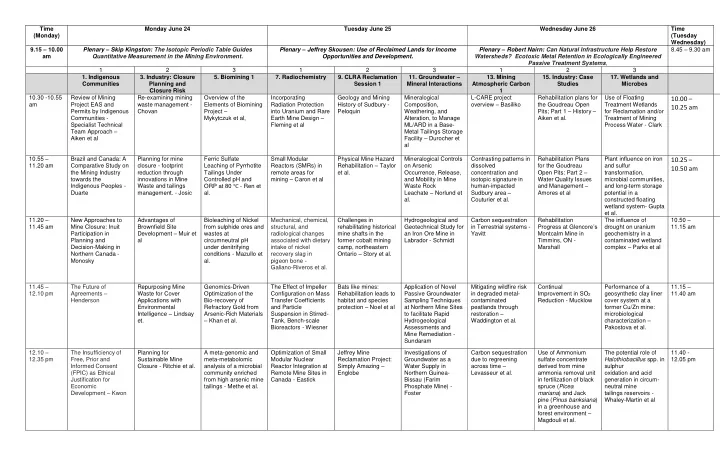
Time (Monday) Monday June 24 Tuesday June 25 Wednesday June 26 Time (Tuesday Wednesday) 9.15 – 10.00 am Plenary – Skip Kingston: The Isotopic Periodic Table Guides Quantitative Measurement in the Mining Environment. Plenary – Jeffrey Skousen: Use of Reclaimed Lands for Income Opportunities and Development. Plenary – Robert Nairn: Can Natural Infrastructure Help Restore Watersheds? Ecotoxic Metal Retention in Ecologically Engineered Passive Treatment Systems, 8.45 – 9.30 am 1 2 3 1 2 3 1 2 3

  • 1. Indigenous

Communities

  • 3. Industry: Closure

Planning and Closure Risk

  • 5. Biomining 1
  • 7. Radiochemistry
  • 9. CLRA Reclamation

Session 1

  • 11. Groundwater –

Mineral Interactions

  • 13. Mining

Atmospheric Carbon 1

  • 15. Industry: Case

Studies

  • 17. Wetlands and

Microbes 10.30 -10.55 am Review of Mining Project EAS and Permits by Indigenous Communities - Specialist Technical Team Approach – Aiken et al Re-examining mining waste management - Chovan Overview of the Elements of Biomining Project – Mykytczuk et al, Incorporating Radiation Protection into Uranium and Rare Earth Mine Design – Fleming et al Geology and Mining History of Sudbury - Peloquin Mineralogical Composition, Weathering, and Alteration, to Manage ML/ARD in a Base- Metal Tailings Storage Facility – Durocher et al L-CARE project

  • verview – Basiliko

Rehabilitation plans for the Goudreau Open Pits; Part 1 – History – Aiken et al. Use of Floating Treatment Wetlands for Reclamation and/or Treatment of Mining Process Water - Clark

10.00 – 10.25 am

10.55 – 11.20 am Brazil and Canada: A Comparative Study on the Mining Industry towards the Indigenous Peoples - Duarte Planning for mine closure - footprint reduction through innovations in Mine Waste and tailings

  • management. - Josic

Ferric Sulfate Leaching of Pyrrhotite Tailings Under Controlled pH and ORP at 80 ℃ - Ren et al. Small Modular Reactors (SMRs) in remote areas for mining – Caron et al Physical Mine Hazard Rehabilitation – Taylor et al. Mineralogical Controls

  • n Arsenic

Occurrence, Release, and Mobility in Mine Waste Rock Leachate – Norlund et al. Contrasting patterns in dissolved concentration and isotopic signature in human-impacted Sudbury area – Couturier et al. Rehabilitation Plans for the Goudreau Open Pits: Part 2 – Water Quality Issues and Management – Amores et al Plant influence on iron and sulfur transformation, microbial communities, and long-term storage potential in a constructed floating wetland system- Gupta et al.

10.25 – 10.50 am

11.20 – 11.45 am New Approaches to Mine Closure: Inuit Participation in Planning and Decision-Making in Northern Canada - Monosky Advantages of Brownfield Site Development – Muir et al Bioleaching of Nickel from sulphide ores and wastes at circumneutral pH under denitrifying conditions - Mazullo et al. Mechanical, chemical, structural, and radiological changes associated with dietary intake of nickel recovery slag in pigeon bone - Galiano-Riveros et al. Challenges in rehabilitating historical mine shafts in the former cobalt mining camp, northeastern Ontario – Story et al. Hydrogeological and Geotechnical Study for an Iron Ore Mine in Labrador - Schmidt Carbon sequestration in Terrestrial systems - Yavitt Rehabilitation Progress at Glencore’s Montcalm Mine in Timmins, ON - Marshall The influence of drought on uranium geochemistry in a contaminated wetland complex – Parks et al 10.50 – 11.15 am 11.45 – 12.10 pm The Future of Agreements – Henderson Repurposing Mine Waste for Cover Applications with Environmental Intelligence – Lindsay et. Genomics-Driven Optimization of the Bio-recovery of Refractory Gold from Arsenic-Rich Materials – Khan et al. The Effect of Impeller Configuration on Mass Transfer Coefficients and Particle Suspension in Stirred- Tank, Bench-scale Bioreactors - Wiesner Bats like mines: Rehabilitation leads to habitat and species protection – Noel et al Application of Novel Passive Groundwater Sampling Techniques at Northern Mine Sites to facilitate Rapid Hydrogeological Assessments and Mine Remediation - Sundaram Mitigating wildfire risk in degraded metal- contaminated peatlands through restoration – Waddington et al. Continual Improvement in SO2 Reduction - Mucklow Performance of a geosynthetic clay liner cover system at a former Cu/Zn mine: microbiological characterization – Pakostova et al. 11.15 – 11.40 am 12.10 – 12.35 pm The Insufficiency of Free, Prior and Informed Consent (FPIC) as Ethical Justification for Economic Development – Kwon Planning for Sustainable Mine Closure - Ritchie et al. A meta-genomic and meta-metabolomic analysis of a microbial community enriched from high arsenic mine tailings - Methe et al. Optimization of Small Modular Nuclear Reactor Integration at Remote Mine Sites in Canada - Eastick Jeffrey Mine Reclamation Project: Simply Amazing – Englobe Investigations of Groundwater as a Water Supply in Northern Guinea- Bissau (Farim Phosphate Mine) - Foster Carbon sequestration due to regreening across time – Levasseur et al. Use of Ammonium sulfate concentrate derived from mine ammonia removal unit in fertilization of black spruce (Picea mariana) and Jack pine (Pinus banksiana) in a greenhouse and forest environment – Magdouli et al. The potential role of Halothiobacillus spp. in sulphur

  • xidation and acid

generation in circum- neutral mine tailings reservoirs - Whaley-Martin et al 11.40 - 12.05 pm

slide-2
SLIDE 2
  • 2. Northern Issues
  • 4. Numerical

Modelling & Remote Sensing

  • 6. Biomining 2
  • 8. Analytical Methods
  • 10. CLRA

Reclamation Session 2

  • 12. Mine and

Environment Innovative Research Partnerships

  • 14. Mining

Atmospheric Carbon 2

  • 16. Industry:

Geochemical Processes

  • 18. Sudbury & Elliot

Lake 1.45 – 2.10 pm Sustainable Mining - A new business imperative - Pedlar- Hobbs A case study on water quality model development for a mining project in the Great Lakes Basin – Hamilton et al Microbially-mediated reductive processes for sulfur and selenium – Baldwin et al. Development and Application of an Adsorption Model for Nickel in Sudbury Area Soils – Evans et al. Abandoned Mines Act

  • Stewart

Water balance modelling of a revegetated cover with elevated water table

  • n the Manitou

abandoned mine site in Northern Québec – Botula et al Long-term impacts of metal smelting and acid deposition on carbon stocks in Sudbury lakes over the last 200 years – Meyer-Jacobs et al. CO2 sequestration within mine wastes via weathering and mineralization- Power Effects of catchment reclamation and terrestrial characteristics on biological recovery across heavily smelter- damaged lakes of Sudbury, Ontario – Dawson et al 1.30 – 1.55 pm 2.10 – 2.35 pm Towards sustainable development of the Ring of Fire chromite resources - Paktunc A sensitivity analysis

  • n effluent quality

within numerical models of a waste rock pile – Raymond et al Investigation of the Biodegradation of Diethylenetriamine and its Metal Chelates, an Effluent By-product in Nickel Mineral Processing – Furnel et al. Legally Defensible Quantitative Chromium Species Assessment using EPA Method 6800 and New Resources - Henderson et al. Improving Soil Health with Biotic Soil Technology – Thiesen A new drought index for oxygen barriers performance assessment under climate change - Bresson et al What’s up DOC? Drivers of lake dissolved organic matter - Erik Emilson et al. Acid Mine Drainage Takes Its Time to Burn Out – a case for Interceding with Spot Treatments? – Coleman et al. Soil liming increases enzymatic activities in soils impacted by mining activities in the City of Greater Sudbury, Ontario (Canada) - Narendrula-Kotha et al. 1.55 – 2.20 pm 2.35 - 3.00 pm Effects of waterborne chromate (Cr 6+ ) on mRNA expression patterns in Lake Trout (Salvelinus namaycush) - Sherry An exploration of GIS data collection techniques, architectures, and practical applications – Fischer et al. Microbial Nickel Capture Proteins for Mining Applications – Diep et al. History of Several Chromium Contamination Cases in the US and Examples of Interchanging Chromium Species in Dietary Supplements - Pamuku et al. An evaluation of silica- Bacillus microencapsulation for reducing acid mine drainage from sulfur waste rock – Mitchell et al (Tom Peters Student Award Winner 2018) Valorization of peat as

  • rganic cover or

amendment for gold mine tailings reclamation - Rakotonimaro et al Metal interactions with carbon biogeochemical

  • processes. – Bellenger

et al. Developing a Zero- Waste Project - Blackwell et al Tools to assess and restore multiple ecosystem functions and services – Santala et al. 2.20 – 2.45 pm 3.00 – 3.25 pm Lake Sediment and Water Geochemistry

  • ver the McFaulds 1

Lake (“Ring of Fire”) region - Dyer Assessing changes in aboveground biomass

  • n a recovering

industrial landscape using vegetation indices applied to LANDSAT images – Levasseur et al. One-step efficient genome editing in Acidithiobacillus ferrooxidans via CRISPR/Cas9 – Chen et al. Remote Monitoring at Northern Reclamation Mine Sites: Remote Sensing and Telemetry Approach Study - Ingham Tailings reclamation and revegetation using municipal dewatered biosolids – Watson et al. Assessment of drainage water quality from REE-bearing mine wastes – Edahbi et al. Carbon sequestration following regreening of a barren landscape: A chronosequence study – Preston et al. When is Water Treatment Not Forever? Exploring the Actual Availability

  • f Sulphide and

Carbonate Mineral Contents in Acid Generating Rock – Skruch et al Biogeochemical Influence on the Mobility of Uranium in the Marsh Soil of the Lower Williams Lake – Mizutani et al 2.45 – 3.10 pm 3.25 – 3.50 pm Chromium, arsenic, and other elements of concern in fish from remote boreal lakes and rivers: drivers of variation and implications for subsistence consumption – Lescord et al. Techno economic assessments of pyrrhotite processing technology options – Saville et al. Remote Monitoring at Northern Reclamation Mine Sites: Tailings Water Treatment Study - Leslie Evaluation of Dry Covers Emplaced at the Kam Kotia Mine, Timmins, ON – Schmall et al. Geochemical and mineralogical characterization of an inactive tailings storage facility: the case study of Joutel mine – Elghali et al Restoration strategies as carbon offsets. Beckett et al. In-Situ Application of Batch Treatment for Water Management at Closed Mine Sites – Barabash et al. More than 20 years later, the status of longterm Stewardship and Management of Denison’s Decommissioned Uranium Mines and Mills in Elliot Lake, Ontario - Cecchetto 3.10 – 3.35 pm 4.15 – 5.15 pm Plenary Plenary – Willian Shotyk: Metals versus Minerals in the Mining Environment: Misconceptions and Misunderstandings Plenary - Mark Tibbert: The development soil organic matter in biodiverse forests restored in ancient landscapes 4.00 – 5.00 pm

Session 19. Selenium Treatment Monday 1.45 – 3.00 pm

slide-3
SLIDE 3

1.45 – 2.10 Treatment of Selenite and Selenate by reduction with Fe(0) and by precipitation with Na2S – Calugaru et al 2.10 – 2.35 Using Ion exchange column for selenium removal in mine effluents – Zolfaghari et al 2.35 – 3.00 Fe-impregnated wood-based biochar for selenium removal in aqueous solutions – Satyro et al.