
SLIDE 1
2018 Fall Seminar for Lake Associations: COTTAGE COUNTRY – What’s Coming & How to Prepare for it
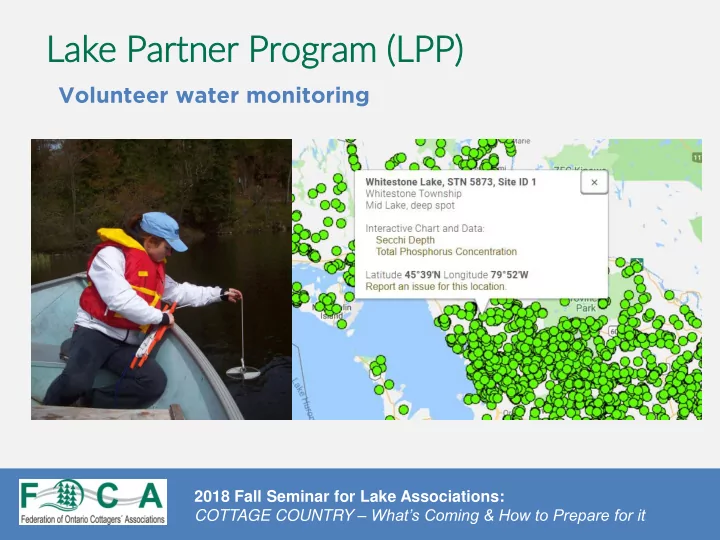
Lake Partner Program (L (LPP)
Volunteer water monitoring
Lake Partner Program (L (LPP) Volunteer water monitoring 2018 Fall - - PowerPoint PPT Presentation
Lake Partner Program (L (LPP) Volunteer water monitoring 2018 Fall Seminar for Lake Associations: COTTAGE COUNTRY Whats Coming & How to Prepare for it Intro by: Marlin Horst, President FOCA Board of Directors (Baptiste Lake
2018 Fall Seminar for Lake Associations: COTTAGE COUNTRY – What’s Coming & How to Prepare for it
Volunteer water monitoring
2018 Fall Seminar for Lake Associations: COTTAGE COUNTRY – What’s Coming & How to Prepare for it
FOCA Board of Directors (Baptiste Lake Association)
2018 Fall Seminar for Lake Associations: COTTAGE COUNTRY – What’s Coming & How to Prepare for it
Ministry of the Environment, Conservation & Parks, Dorset Environmental Science Centre
Write to the Minister!
2018 Fall Seminar for Lake Associations: COTTAGE COUNTRY – What’s Coming & How to Prepare for it
As one of FOCA’s 50,000 waterfront families, and on behalf of my own lake, __________, …writing in support of the Lake Partner Program, a partnership between FOCA, the Ministry of the Environment, and DESC. The significant value of this program:
each year by hundreds of citizens
across Ontario …urge you to continue supporting this program
send to:
Minister of the Environment, Conservation & Parks rod.phillips@ pc.ola.org Please c.c. FOCA: president@ foca.on.ca and your MPP!
2018 Fall Seminar for Lake Associations: COTTAGE COUNTRY – What’s Coming & How to Prepare for it
Emily Shapiera FOCA Assistant Lake Stewardship Coordinator Dorset Environmental Science Centre
6
Assistant Lake Stewardship Coordinator Federation of Ontario Cottagers’ Associations Dorset Environmental Science Centre
7
water quality and water clarity in 550 lakes at over 800 sites
DESC chemistry lab for analyses
annually online
water quality across Ontario
Largest volunteer-based water quality monitoring program of its kind in Canada
Total Phosphorus (TP) Water clarity
controlling the growth
Lakes
Secchi Disk
Calcium
(since 2008)
that is required by all living organisms
Chloride
(since 2015)
increases in chloride concentrations across the province due to road salt
8
9
Total phosphorus controls the growth of algae in most Ontario lakes
10
11
significantly over the last ~ten years for LPP lakes
12
Ontario inland lakes
deposition (acid rain) and biomass loss through timber harvesting
experiments have shown that when Ca levels fall below 1.5-2 mg/L, aquatic organisms may be negatively affected
Ca since 2008
1975 1980 1985 1990 1995 2000
Calcium Concentration (mg·L-1)
1.0 1.5 2.0 2.5 3.0 3.5
Year
13
Ontario have Ca levels that can support calcium-rich aquatic
concentrations that may hinder the reproduction and survival of some Ca-rich organisms (< 2.0 mg/L)
14
water clarity (Secchi) across Ontario. Trends correspond with geological factors that would influence water clarity.
15
significant change in Secchi from 2000-2014
decline in water clarity over time (lakes becoming less clear)
increases in dissolved organic carbon (DOC) – lakes are becoming more tea-stained in appearance
10 20 30 40 50 60 70 No change Strong decline Weak decline Weak increase Strong increase
Lakes (%) Long-term trend in Secchi transparency
Download “Secchi Trends Across the Province” at www.foca.on.ca/lake-partner- program-sampling-assistance/
16
increasing due to road salt
health
chloride in Ontario lakes; dataset will help watch for trends
17
tea-stained, dark colour that is prevalent in many lakes in Ontario
in the Lake Partner Program
is difficult to analyze due to its short shelf life, and our current lab load
18
Thanks to any volunteers in the audience who took the time to fill this out!
19
Survey result Outcome
87% would highly recommend the program; mostly “retirement” age demographic Enhance youth engagement and volunteer recognition 87% use the LPP data. The LPP data are being used as intended – to monitor long-term trends etc. Low interest in in-person training (e.g., workshops), mobile app and social media usage. Volunteers are OK with the instructional materials available to them; work with FOCA to explore other options (Webinars, FAQ’s, “Ask the Expert”, Videos). Volunteers need help understanding and interpreting their data. Improved and more varied resources to help them interpret their data. Modernize data reporting where possible. Minimal understanding of how the MOECC uses the data. Use newsletters and annual reports to communicate news to volunteers.
“Being an LPP volunteer is important because I am helping to gather data that will be used to monitor the effect of environmental change on
the water samples and provides valuable information to the Ministry. Our lakes are a beautiful natural resource that need to be protected.” “If we don't have data about what is happening in our lakes how do we know what is needed and whether any of the efforts that we undertake are having any effect.”
“Being a LPP volunteer means that you have a reason to regularly spend some quiet time on your lake and at the same time do something meaningful for your lake.”
“They're not making lakes anymore.....”
a desire to understand how the LPP data are used
Card released in 2016
volunteer-monitored lakes across Ontario
www.desc.ca
21
22
One of our youngest volunteers at 10 years old! Kids investigating benthic invertebrates at the Haliburton- Muskoka-Kawartha Children’s Water Festival!
23
…for your dedication, your passion, and your sense of humour!
24
https://foca.on.ca/lake-partner-program-sampling-assistance/ Find links to your local LPP results, and FOCA’s video about water sampling tips, here: