1 Well, plenty of registers But where should X, Y and SUM go? - - PDF document

1
SMART_READER_LITE
LIVE PREVIEW

1 Well, plenty of registers But where should X, Y and SUM go? - - PDF document

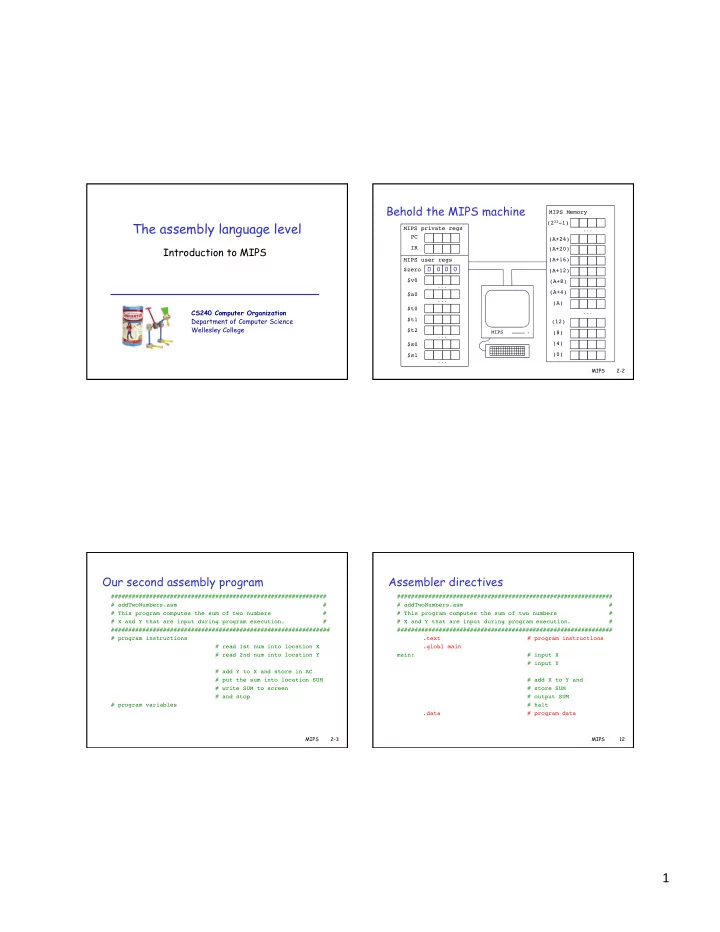
Behold the MIPS machine MIPS Memory The assembly language level (2 32 -1) . . . MIPS private regs PC (A+24) Introduction to MIPS IR (A+20) MIPS user regs (A+16) 0 0 0 0 $zero (A+12) $v0 (A+8)


slide-1
SLIDE 1

1 ¡

CS240 Computer Organization Department of Computer Science Wellesley College

The assembly language level

Introduction to MIPS

Behold the MIPS machine

. . . (232-1) (A+8) (A+4) (A) (12) (8) (4) (0) MIPS Memory

MIPS

.

2-2

. . . PC IR $zero MIPS private regs 0 0 0 0 MIPS user regs $v0 $s0 $a0 $t0 $t1 $t2 . . . . . . . . . $s1 . . .

MIPS

(A+24) (A+20) (A+16) (A+12)

Our second assembly program

############################################################## # addTwoNumbers.asm

  • #

# This program computes the sum of two numbers

  • #

# X and Y that are input during program execution.

  • #

############################################################### # program instructions

  • # read 1st num into location X
  • # read 2nd num into location Y
  • # add Y to X and store in AC
  • # put the sum into location SUM
  • # write SUM to screen
  • # and stop

# program variables

  • 2-3

MIPS

Assembler directives

############################################################## # addTwoNumbers.asm

  • #

# This program computes the sum of two numbers

  • #

# X and Y that are input during program execution.

  • #

##############################################################

  • .text
  • # program instructions
  • .globl main
  • main:
  • # input X
  • # input Y
  • # add X to Y and
  • # store SUM
  • # output SUM
  • # halt
  • .data
  • # program data

12 MIPS

slide-2
SLIDE 2

2 ¡

But where should X, Y and SUM go?

############################################################## # addTwoNumbers.asm

  • #

# This program computes the sum of two numbers

  • #

# X and Y that are input during program execution.

  • #

##############################################################

  • .text
  • # program instructions
  • .globl main
  • main:
  • # input X
  • # input Y
  • # add X to Y and
  • # store SUM
  • # output SUM
  • # halt
  • .data
  • # program data

2-5 MIPS

Well, plenty of registers …

. . . (232-1) (A+8) (A+4) (A) (12) (8) (4) (0) MIPS Memory

MIPS

.

2-6

. . . PC IR $zero MIPS private regs 0 0 0 0 MIPS user regs $v0 $s0 $a0 $t0 $t1 $t2 . . . . . . . . . $s1 . . . … so assign X to $t0, Y to $t1, and SUM to $t2 X Y SUM

MIPS

(A+24) (A+20) (A+16) (A+12)

How do we input values to X and Y?

############################################################## # addTwoNumbers.asm

  • #

# This program computes the sum of two numbers

  • #

# X and Y that are input during program execution.

  • #

##############################################################

  • .text
  • # program instructions
  • .globl main
  • main:
  • # input X
  • # input Y
  • # add X to Y and
  • # store SUM
  • # output SUM
  • # halt
  • .data
  • # program data

2-7 MIPS

First reserve room for prompt

############################################################## # addTwoNumbers.asm

  • #

# This program computes the sum of two numbers

  • #

# X and Y that are input during program execution.

  • #

##############################################################

  • .text
  • # program instructions
  • .globl main
  • main:
  • # input X
  • # input Y
  • # add X to Y and
  • # store SUM
  • # output SUM
  • # halt
  • .data
  • # program data

str: .asciiz “Enter number: “

2-8 MIPS

Another assembler directive

slide-3
SLIDE 3

3 ¡

str:
 .asciiz “Enter number: “

. . . (232-1) (A+8) (A+4) (A) (12) (8) (4) (0) MIPS Memory

MIPS

.

2-9

. . . PC IR $zero MIPS private regs 0 0 0 0 MIPS user regs $v0 $s0 $a0 $t0 $t1 $t2 . . . . . . . . . $s1 . . . X Y SUM

MIPS

e t n E u n r r e b m : str (A+24) (A+20) (A+16) (A+12)

Reading in an integer

############################################################## # addTwoNumbers.asm

  • #

# We’re going need some more room up here real soon. # ##############################################################

  • .text
  • # program instructions
  • .globl main
  • main:
  • li

$v0, 4

  • # sys call code print_str
  • la

$a0, str

  • # addr of string to print
  • syscall
  • # print the prompt
  • # input x; input Y
  • # add X to Y and
  • # store SUM
  • # output SUM
  • # halt
  • .data
  • # program data

str: .asciiz “Enter number: “

2-10 MIPS

Pseudoinstructions Okay OS do your thing

li $v0, 4
 la $a0, str


  • . . .

(232-1) (A+8) (A+4) (A) (12) (8) (4) (0) MIPS Memory

MIPS

.

2-11

. . . PC IR $zero MIPS private regs 0 0 0 0 MIPS user regs $v0 $s0 $a0 $t0 $t1 $t2 . . . . . . . . . $s1 . . . X Y SUM

MIPS

e t n E u n r r e b m : str 0 0 0 4 0 0 0 A (A+24) (A+20) (A+16) (A+12)

syscall

. . . (232-1) (A+8) (A+4) (A) (12) (8) (4) (0) MIPS Memory

MIPS

.

2-12

. . . PC IR $zero MIPS private regs 0 0 0 0 MIPS user regs $v0 $s0 $a0 $t0 $t1 $t2 . . . . . . . . . $s1 . . . X Y SUM

MIPS

e t n E u n r r e b m : str 0 0 0 4 0 0 0 A

Enter number:

(A+24) (A+20) (A+16) (A+12)

slide-4
SLIDE 4

4 ¡

Reading in X

  • .text
  • # program instructions
  • .globl main
  • main:
  • li

$v0, 4

  • # sys call code print_str
  • la

$a0, str

  • # addr of string to print
  • syscall
  • # print the prompt
  • li

$v0, 5

  • # sys code read integer
  • syscall
  • move

$t0, $v0

  • # $t0 is the variable X
  • # input Y
  • # add X to Y and
  • # store SUM
  • # output SUM
  • # halt
  • .data
  • # program data

str: .asciiz “Enter number: “

2-13 MIPS

li $v0, 5
 syscall

. . . (232-1) (A+8) (A+4) (A) (12) (8) (4) (0) MIPS Memory

MIPS

.

2-14

. . . PC IR $zero MIPS private regs 0 0 0 0 MIPS user regs $v0 $s0 $a0 $t0 $t1 $t2 . . . . . . . . . $s1 . . . X Y SUM

MIPS

e t n E u n r r e b m : str 0 0 0 5 0 0 0 A

Enter number:

(A+24) (A+20) (A+16) (A+12)

The user enters 3

. . . (232-1) (A+8) (A+4) (A) (12) (8) (4) (0) MIPS Memory

MIPS

.

2-15

. . . PC IR $zero MIPS private regs 0 0 0 0 MIPS user regs $v0 $s0 $a0 $t0 $t1 $t2 . . . . . . . . . $s1 . . . X Y SUM

MIPS

e t n E u n r r e b m : str 0 0 0 3 0 0 0 A

Enter number: 3

… and it miraculously appears in register $v0 (A+24) (A+20) (A+16) (A+12)

move $t0, $v0

. . . (232-1) (A+8) (A+4) (A) (12) (8) (4) (0) MIPS Memory

MIPS

.

2-16

. . . PC IR $zero MIPS private regs 0 0 0 0 MIPS user regs $v0 $s0 $a0 $t0 $t1 $t2 . . . . . . . . . $s1 . . . X Y SUM

MIPS

e t n E u n r r e b m : str 0 0 0 3 0 0 0 A

Enter number: 3

0 0 0 3 Copy the contents

  • f $v0 to $t0

(A+24) (A+20) (A+16) (A+12)

slide-5
SLIDE 5

5 ¡

Second verse, same as the first*

  • .text
  • # program instructions
  • .globl main
  • main:
  • li

$v0, 4

  • # sys call code print_str
  • la

$a0, str

  • # addr of string to print
  • syscall
  • # print the prompt
  • li

$v0, 5

  • # sys code read integer
  • syscall
  • move

$t0, $v0

  • # $t0 is the variable X
  • li

$v0, 5

  • # sys code read integer
  • syscall
  • move

$t1, $v0

  • # $t1 is the variable Y
  • # add X to Y & store SUM
  • # output SUM
  • # halt
  • .data
  • # program data

str: .asciiz “Enter number: “

2-17 MIPS *We should print another prompt here, but PowerPoint space is tight.

Adding is easy

  • .text
  • # program instructions
  • .globl main
  • main:
  • li

$v0, 4

  • # sys call code print_str
  • la

$a0, str

  • # addr of string to print
  • syscall
  • # print the prompt
  • li

$v0, 5

  • # sys code read integer
  • syscall
  • move

$t0, $v0

  • # $t0 is the variable X
  • li

$v0, 5

  • # sys code read integer
  • syscall
  • move

$t1, $v0

  • # $t1 is the variable Y
  • add

$t2, $t0, $t1 # SUM <- X + Y

  • # output SUM
  • # halt
  • .data
  • # program data

str: .asciiz “Enter number: “

2-18 MIPS

add $t2, $t0, $t1

. . . (232-1) (A+8) (A+4) (A) (12) (8) (4) (0) MIPS Memory

MIPS

.

2-19

. . . PC IR $zero MIPS private regs 0 0 0 0 MIPS user regs $v0 $s0 $a0 $t0 $t1 $t2 . . . . . . . . . $s1 . . . X Y SUM

MIPS

e t n E u n r r e b m : str 0 0 0 5 0 0 0 A

Enter number: 3 5

0 0 0 3 0 0 0 5 0 0 0 8 (A+24) (A+20) (A+16) (A+12)

Now all we need to do is print …

main:

  • li

$v0, 4

  • # sys call code print_str
  • la

$a0, str

  • # addr of string to print
  • syscall
  • # print the prompt
  • li

$v0, 5

  • # sys code read integer
  • syscall
  • move

$t0, $v0

  • # $t0 is the variable X
  • li

$v0, 5

  • # sys code read integer
  • syscall
  • move

$t1, $v0

  • # $t1 is the variable Y
  • add

$t2, $t0, $t1 # SUM <- X + Y

  • li

$v0, 1

  • # sys code print integer
  • move

$a0, $t2

  • # integer to print
  • syscall
  • # now print it
  • # halt
  • 2-20

MIPS

slide-6
SLIDE 6

6 ¡

li $v0, 1
 move $a0, $t2
 syscall

. . . (232-1) (A+8) (A+4) (A) (12) (8) (4) (0) MIPS Memory

MIPS

.

2-21

. . . PC IR $zero MIPS private regs 0 0 0 0 MIPS user regs $v0 $s0 $a0 $t0 $t1 $t2 . . . . . . . . . $s1 . . . X Y SUM

MIPS

e t n E u n r r e b m : str 0 0 0 1 0 0 0 8

Enter number: 3 5 8

0 0 0 3 0 0 0 5 0 0 0 8 (A+24) (A+20) (A+16) (A+12)

… and halt

main:

  • li

$v0, 4

  • # sys code print_str
  • la

$a0, str

  • # addr of string to print
  • syscall
  • # print the prompt
  • li

$v0, 5

  • # sys code read integer
  • syscall
  • move

$t0, $v0

  • # $t0 is the variable X
  • li

$v0, 5

  • # sys code read integer
  • syscall
  • move

$t1, $v0

  • # $t1 is the variable Y
  • add

$t2, $t0, $t1 # SUM <- X + Y

  • li

$v0, 1

  • # sys code print integer
  • move

$a0, $t2

  • # integer to print
  • syscall
  • # now print it
  • li

$v0, 10

  • # sys code halt
  • syscall
  • # bedtime for Bonzo
  • 2-22

MIPS

Service Mode Arguments Result print_int 1 $a0 = integer print_float 2 $f12 = float print_double 3 $f12 = double print_string 4 $a0 = string read_int 5 integer in $v0 read_float 6 float in $f0 read_double 7 double in $f0 read_string 8 $a0 = buffer, $a1 = length sbrk 9 $a0 = amount address in $v0 exit 10 print_char 11 $a0 = char read_char 12 char in $v0

  • pen

13 $a0=filename(string), $a1=flags, $a2=mode file descriptor in $a0 read 14 $a0=file descriptor, $a1=buffer, $a2=length num chars read in $a0 write 15 $a0=file descriptor, $a1=buffer, $a2=length num chars written in $a0 close 16 $a0 = file descriptor exit2 17 $a0 = result

2-23 MIPS

Much ado about nothing

  • You can see why early

computer scientists were in such a rush to invent higher level languages.

  • The computational portion
  • f the previous program

could be expressed in C as SUM = X + Y;

MIPS 2-24