1 The current Financial Climate: From 2008 onwards. PROPERTIES - - PDF document

1
SMART_READER_LITE
LIVE PREVIEW

1 The current Financial Climate: From 2008 onwards. PROPERTIES - - PDF document

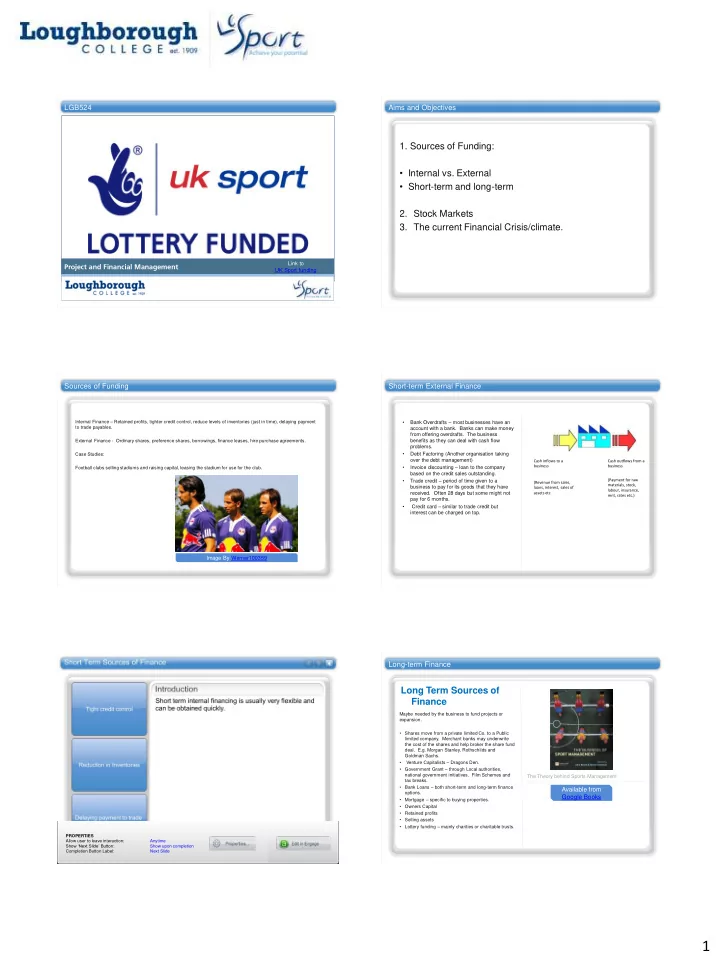
LGB524 Aims and Objectives 1. Sources of Funding: Internal vs. External Short-term and long-term 2. Stock Markets 3. The current Financial Crisis/climate. Link to Project and Financial Management UK Sport funding Sources of Funding


slide-1
SLIDE 1

1

LGB524 Project and Financial Management

Link to UK Sport funding

Aims and Objectives

  • 1. Sources of Funding:
  • Internal vs. External
  • Short-term and long-term
  • 2. Stock Markets
  • 3. The current Financial Crisis/climate.

Sources of Funding

Internal Finance – Retained profits, tighter credit control, reduce levels of inventories (just in time), delaying payment to trade payables. External Finance - Ordinary shares, preference shares, borrowings, finance leases, hire purchase agreements. Case Studies: Football clubs selling stadiums and raising capital, leasing the stadium for use for the club.

Image By Werner100359

Short-term External Finance

  • Bank Overdrafts – most businesses have an
account with a bank. Banks can make money from offering overdrafts. The business benefits as they can deal with cash flow problems.
  • Debt Factoring (Another organisation taking
  • ver the debt management)
  • Invoice discounting – loan to the company
based on the credit sales outstanding.
  • Trade credit – period of time given to a
business to pay for its goods that they have
  • received. Often 28 days but some might not
pay for 6 months.
  • Credit card – similar to trade credit but
interest can be charged on top. Cash inflows to a business Cash outflows from a business (Revenue from sales, loans, interest, sales of assets etc (Payment for raw materials, stock, labour, insurance, rent, rates etc.) PROPERTIES Allow user to leave interaction: Anytime Show ‘Next Slide’ Button: Show upon completion Completion Button Label: Next Slide

Long-term Finance

Long Term Sources of Finance

Maybe needed by the business to fund projects or expansion.
  • Shares move from a private limited Co. to a Public
limited company. Merchant banks may underwrite the cost of the shares and help broker the share fund
  • deal. E.g. Morgan Stanley, Rothschilds and
Goldman Sachs.
  • Venture Capitalists – Dragons Den.
  • Government Grant – through Local authorities,
national government initiatives. Film Schemes and tax breaks.
  • Bank Loans – both short-term and long-term finance
  • ptions.
  • Mortgage – specific to buying properties.
  • Owners Capital
  • Retained profits
  • Selling assets
  • Lottery funding – mainly charities or charitable trusts.
The Theory behind Sports Management

Available from Google Books

slide-2
SLIDE 2

2

PROPERTIES Allow user to leave interaction: Anytime Show ‘Next Slide’ Button: Show upon completion Completion Button Label: Next Slide

The current Financial Climate: From 2008 onwards…. More on the current climate:

Just another angle on the Financial Climate:

Sport Specific Financing

  • Public and Voluntary sports Organisations
  • Sponsorship
  • Grants
  • Charitable Trusts (writing funding agreements)
  • The National Lottery
  • European Funding

Sponsorship case study: http://news.bbc.co.uk/1/hi/business/8506885.stm National Lottery case study: http://www.lotterygoodcauses.org.uk/ Sports Business case study articles: http://www.sportbusiness.com/news/183989/adidas-extends-argentina-kit- partnership

Sport England: Sportsmatch Funding Sportsmatch makes awards to not-for-profit organisations that have secured sponsorship to deliver new community projects to grow or sustain participation in sport. The finance comes from the government to encourage new sponsorship to deliver community projects. Priority funding goes to projects that are matched by commercial sector funding. Awards of between £1,000 and £100,000 can be awarded. There are strict criteria that has to be adhered to throughout the application process.

Link to Sport England funding

Stock Markets

What is the stock market and how does it raise capital for the organisations involved? A stock market is a public trading area. Company stocks and shares are sold and bought at an agreed price and listed on the stock exchange. Companies float on the stock market to raise additional capital for expansion. In 1998 JJB floated on the London Stock market with already 120 stores open in the UK. The company had grown a lot since Dave Whelan took over the Wigan based JJB store in 1971

Image owned by Loughborough College

slide-3
SLIDE 3

3

How Stock Markets Work Professional Sports finance

Media – TV, internet and Radio pay huge sums of money for the rights to show major sporting events. They pay the governing bodies who use the money to promote and develop the sport. Sponsorship and merchandising – Big companies pay professional teams to put their names on their shirts, around the stadium, on the programme, and on the internet. Ticket sales – Big teams and events sell tickets to spectators that raise finance. If 80,000 people watch a football match and pay a minimum of £30 per ticket this raises £2,400,000. ‘Price discrimination’ means these clubs will differentiate the prices for those who can afford a higher price. Grants – The Sports Aid Foundation provide grants to up and coming sports people to help them train and compete. This is how less publicised athletes get finance. Competitions – entrance fees can make money for the organisers or the competitions can provide some of the biggest rewards, which draw the best players/teams in the world to compete at that level.