1 Domain search Span Space High Gradient Subdivide the space - - PDF document

1
SMART_READER_LITE
LIVE PREVIEW

1 Domain search Span Space High Gradient Subdivide the space - - PDF document

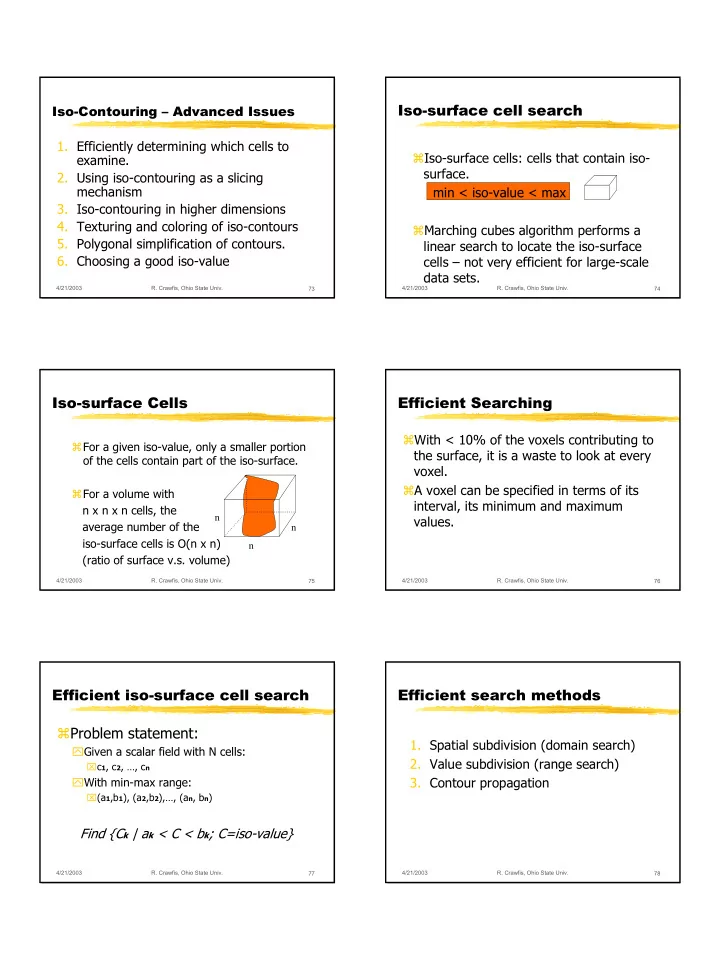
Iso-surface cell search Iso-Contouring Advanced Issues 1. Efficiently determining which cells to Iso-surface cells: cells that contain iso- examine. surface. 2. Using iso-contouring as a slicing mechanism min < iso-value < max


slide-1
SLIDE 1

1

4/21/2003

  • R. Crawfis, Ohio State Univ.

73

Iso-Contouring – Advanced Issues

  • 1. Efficiently determining which cells to

examine.

  • 2. Using iso-contouring as a slicing

mechanism

  • 3. Iso-contouring in higher dimensions
  • 4. Texturing and coloring of iso-contours
  • 5. Polygonal simplification of contours.
  • 6. Choosing a good iso-value

4/21/2003

  • R. Crawfis, Ohio State Univ.

74

Iso-surface cells: cells that contain iso- surface. min < iso-value < max Marching cubes algorithm performs a linear search to locate the iso-surface cells – not very efficient for large-scale data sets.

Iso-surface cell search

4/21/2003

  • R. Crawfis, Ohio State Univ.

75

Iso-surface Cells

For a given iso-value, only a smaller portion

  • f the cells contain part of the iso-surface.

For a volume with n x n x n cells, the average number of the iso-surface cells is O(n x n) (ratio of surface v.s. volume)

n n n

4/21/2003

  • R. Crawfis, Ohio State Univ.

76

Efficient Searching

With < 10% of the voxels contributing to the surface, it is a waste to look at every voxel. A voxel can be specified in terms of its interval, its minimum and maximum values.

4/21/2003

  • R. Crawfis, Ohio State Univ.

77

Efficient iso-surface cell search Problem statement:

Given a scalar field with N cells:

⌧c1, c2, …, cn

With min-max range:

⌧(a1,b1), (a2,b2),…, (an, bn)

Find {Ck | ak < C < bk; C=iso-value}

4/21/2003

  • R. Crawfis, Ohio State Univ.

78

Efficient search methods

  • 1. Spatial subdivision (domain search)
  • 2. Value subdivision (range search)
  • 3. Contour propagation
slide-2
SLIDE 2

2

4/21/2003

  • R. Crawfis, Ohio State Univ.

79

Domain search

  • Subdivide the space into several sub-domains, check the

min/max values for each sub-domain

  • If the min/max values (extreme values) do not contain the

iso-value, we skip the entire region

Min/max

Complexity = O( k log(n/k) )

4/21/2003

  • R. Crawfis, Ohio State Univ.

80

Span Space

Mi Minimum nimum

Threshold Threshold High Gradient Low Gradient 4/21/2003

  • R. Crawfis, Ohio State Univ.

81

Span Space - Representing

Mi Minimum nimum

  • K

K-

  • d Trees

d Trees

Split Min. axis Split Max. axis

4/21/2003

  • R. Crawfis, Ohio State Univ.

82

Basic Idea: Given an initial cell that contains iso-surface, the remainder of the iso-surface can be found by propagation

Contour Propagation

A B D C E Initial cell: A Enqueue: B, C Dequeue: B Enqueue: D … FIFO Queue A B C C C D …. Breadth-First Search

4/21/2003

  • R. Crawfis, Ohio State Univ.

83

Challenges

Need to know the initial cells!

For any given iso-value C, finding the initial cells to start the propagation is almost as hard as finding the iso-surface cells. You could do a global search, but …

4/21/2003

  • R. Crawfis, Ohio State Univ.

84

Solutions

(1) Extrema Graph (Itoh vis’95) (2) Seed Sets (Bajaj volvis’96)

Problem Statement: Given a scalar field with a cell set G, find a subset S G, such that for any given iso-value C, the set S contains initial cells to start the propagation. We need search through S, but S is usually (hopefully) much smaller than G. We will only talk about extrema graph due to time constraint

slide-3
SLIDE 3

3

4/21/2003

  • R. Crawfis, Ohio State Univ.

85

Extrema Graph (1)

Basic Idea: If we find all the local minimum and maximum points (Extrema), and connect them together by straight lines (Arcs), then any closed Iso-contour is intersected by at least one of the arcs.

4/21/2003

  • R. Crawfis, Ohio State Univ.

86

Extrema Graph (2)

4/21/2003

  • R. Crawfis, Ohio State Univ.

87

Extrema Graph (3)

E1 E2 E3 E4 E7 E5 E6 E8 a2 a3 a4 a5 a6 a7 a1 Extreme Graph: { E, A: E: extrema points A: Arcs conneccts E } An ‘arc’ consists of cells that connect extrema points (we only store min/max of the arc though)

4/21/2003

  • R. Crawfis, Ohio State Univ.

88

Extrema Graph (4)

Algorithm: Given an iso-value 1) Search the arcs of the extrema graph (to find the arcs that have min/max values that contain the iso-value 2) Walk through the cells along each of these arcs to find the seed cells 3) Start the iso-contour propagation from the seed cells 4) …. There is something more that needs to be done…

4/21/2003

  • R. Crawfis, Ohio State Univ.

89

We are not done yet …

What ?! We just mentioned that all the closed iso-contours will intersect with the arcs connecting the extrema points How about non-closed iso-contours? (or called open iso- contours)

4/21/2003

  • R. Crawfis, Ohio State Univ.

90

Extrema Graph (5)

Contours missed

These open iso-contours will intersect with ?? cells

Boundary Cells!!

slide-4
SLIDE 4

4

4/21/2003

  • R. Crawfis, Ohio State Univ.

91

Extrema Graph (6)

Algorithm (continued) Given an iso-value:

1) Search the arcs of the extrema graph (to find the arcs that have min/max values that contain the iso-value. 2) Walk through the cells along each of the arcs to find the seed cells. 3) Start the iso-contour propagation from the seed cells.

4) Search the cells along the boundary and find additional seed cells. 5) Propagate from these new seed cells for the open iso-contours.

4/21/2003

  • R. Crawfis, Ohio State Univ.

92

Extrema Graph

Efficiency - Number of cells visited:

extrema graph - N0.33 boundary - N 0.66 Iso-surface - N 0.66

based on tetrahedra - will create more surface triangles ... should extract the same number of cells/ triangulation as Marching Cubes

4/21/2003

  • R. Crawfis, Ohio State Univ.

93

Extrema Graph

Storage Costs:

Extrema graph – very small amount of memory for most datasets. For unstructured grids, I need to be able to access my neighbors. This requires a very expensive data structure, more than the span-space data structures.

4/21/2003

  • R. Crawfis, Ohio State Univ.

94

Selecting iso-values

Which iso-values should I examine to best comprehend my dataset? Some data has very specific values:

The aluminum structure in my simulation will start to fail at a pressure

  • f 5672psi.

The molecular state changes from a liquid to a gas at 100° C.

4/21/2003

  • R. Crawfis, Ohio State Univ.

95

Contour Spectrum

Basic Idea: Calculate and present to the user several properties of an iso-contour. Do this for all iso-contours. This leads to several functions in terms of the iso-value, α. Present these functions to the user as an aid in picking contour values.

These slides are from Baja, Pascucci and Schikore (IEEE Visualization 1997)

4/21/2003

  • R. Crawfis, Ohio State Univ.

96

Outline

User Interface Signature Computation Real Time Quantitative Queries Rule-based Contouring Topological Information Future Directions

slide-5
SLIDE 5

5

4/21/2003

  • R. Crawfis, Ohio State Univ.

97

Graphical User Interface Graphical User Interface for Static Data for Static Data

  • The horizontal axis

spans the scalar values α

  • Plot of a set of

signatures (length, area, gradient ...) as functions of the scalar value α.

  • Vertical axis spans normalized ranges of each signature.
  • White vertical bars mark current selected isovalues.

4/21/2003

  • R. Crawfis, Ohio State Univ.

98

Graphical User Interface for time varying data

(α,t ) --> c The color, c, is mapped to the magnitude

  • f a

signature function of time, t, and isovalue α α t c low high magnitude

  • The horizontal axis spans the scalar value

dimension α.

  • The vertical axis spans the time dimension t .

4/21/2003

  • R. Crawfis, Ohio State Univ.

99

User Interface - MRI of a human torso -

  • In real time the exact value of each signature is displayed.
  • The isocontour that bounds the region of interest is obtained by

selecting the maximum of the gradient signature.

4/21/2003

  • R. Crawfis, Ohio State Univ.

100

Signature Computation

Consider a terrain of which you want to compute the length of each isocontour and the area contained inside each isocontour

4/21/2003

  • R. Crawfis, Ohio State Univ.

101

Signature Computation

  • The length of each

contour is a C0 spline function.

  • The area inside/outside

each isocontour is a C1 spline function.

4/21/2003

  • R. Crawfis, Ohio State Univ.

102

Signature Computation

In general, the size (surface area) of each iso-contour of a scalar field of dimension d is a spline function of d-2 continuity. The size (volume) of the region inside/ outside is given by a spline function of d-1 continuity

slide-6
SLIDE 6

6

4/21/2003

  • R. Crawfis, Ohio State Univ.

103

Real Time Quantitative Queries

(agricultural yield data)

  • size and position
  • f the region

with unsatisfactory production

  • size and position

size and position

  • f the region
  • f the region

where wrong where wrong data acquisition data acquisition

  • ccurred
  • ccurred

Spectrum space is a useful space to visualize by itself.

4/21/2003

  • R. Crawfis, Ohio State Univ.

104

Rule-based Contouring

(CT scan of an engine)

  • The contour

spectrum allows the development of an adaptive ability to separate interesting isovalues from the

  • thers.

4/21/2003

  • R. Crawfis, Ohio State Univ.

105

Rule-based Contouring (foot of the Visible Human)

  • The contour

spectrum allows the development of an adaptive ability to separate interesting isovalues from the

  • thers.

4/21/2003

  • R. Crawfis, Ohio State Univ.

106

Topological information.

an isocontour with three connected components two

  • f which are about to merge}
  • number of components per

number of components per isocontour isocontour

  • which

which isocontours isocontours merge together or merge together or split while modifying the split while modifying the isovalue isovalue. .

4/21/2003

  • R. Crawfis, Ohio State Univ.

107

Other Topics

Interval Volumes 4D Iso-contouring Smooth surfaces Polygon Reduction Triangle Strip generation Time-varying iso-contours Texture map parameterization

Penny Rheingans