1 Brenda Milner 1918 There are Two Major Forms of Long Term Memory - - PDF document
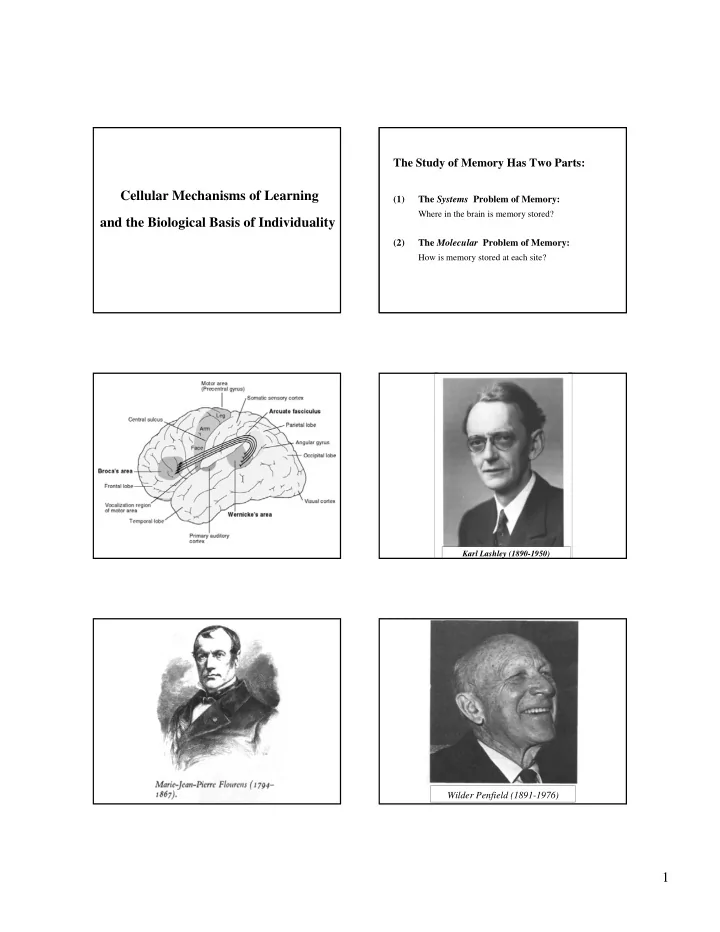
The Study of Memory Has Two Parts: Cellular Mechanisms of Learning (1) The Systems Problem of Memory: Where in the brain is memory stored? and the Biological Basis of Individuality (2) The Molecular Problem of Memory: How is memory stored at
2
Brenda Milner 1918– Explicit (Declarative) Implicit (Procedural)
There are Two Major Forms of Long Term Memory
Requires Conscious Attention Medial Temporal Lobe Hippocampus
Facts and Events People, Objects and Places
Does Not Require Conscious Attention But Often Requires Salience Signals Amygdala, Cerebellum, Reflex Pathways
Skills and Habits Nonassociative And Associative Learning
3
The Gill Withdrawal Reflex has a Simple Stereotypical Internal Representation. Long Term Sensitization Leads to Altered Gene Expression and the Growth of New Synaptic Connections. (5HT) (5HT)
Long-Term Memory Requires a CREB1-Mediated Transcriptional Cascade
Sensitization Produces Both Pre- and Postsynaptic Structural Changes in the Intact Animal (HRP)
Sensitized
4
Explicit (Declarative) Implicit (Procedural)
There are Two Major Forms of Long Term Memory
Requires Conscious Attention Medial Temporal Lobe Hippocampus
Facts and Events People, Objects and Places
Does Not Require Conscious Attention Amygdala, Cerebellum, Reflex Pathways
Skills and Habits Nonassociative and Associative Learning
Hippocampus of Humans Encodes Space
Route from Hyde Park to Primrose Hill
Hyde Park Primrose Hill
Hippocampus of Mice Also Encodes Space
5
Multi Sensory Information About Spatial Memory is Only Brought Together in the CA1 Region of the Hippocampus
The Hippocampal Pyramidal Cells Encode a Cognitive Map of Space :Is Attention Importand for Formation of the Map or for its Perpetuation
Is Attention Important to Form the Spatial Map or to Stabilize and Perpetuate it? Four Degrees of Attention
Day 1 3 Hours 10 min
No Task (Basal Attention) Spatial Task (Maximum Attention)
Selective Attention is not Required for the Formation of the Map but is Essential for its Maintenance
Long Term Place Cell Stability Requires Selective Attention;Short Term Stability Does Not.
LTP is a Candidate Synaptic Mechanism for Spatial Memory LTP has both an Early and a Late Phase
EPSP Slope (% of control)
6
Dopamine as a Candidate Mediator of Attention
1 h 24 h Similarity Score % Freezing (5 min) 1 h 24 h
Both the Long-Term Memory for Spatial Context and the Long-Term Stability of the Place Cell Map Require PKA
WT R(AB)
Long Term Stability of the Place Cell Map Long Term Memory of Spatial Context
Both Explicit and Implicit Memory Storage Use Modulatory Transmitters as a Salience Signal and a CREB-Mediated Transcriptional Switch for Converting Short-Term to Long- Term Memory
Aplysia
(bottom up modulation)
Hippocampus
(top down modulation)
Where- Posterior Parietal Cortex What- Prefrontal Cortex
How is synapse specificity achieved? How is it maintained for the long term?
In Addition to Transcription the Growth of New Synapses Requires 2 Local Marking Signals
Two Marking Signals
- 1. PKA for Growth
- 2. Local Protein Synthesis
for Stabilization
7
The Cytoplasmic Polyadenylation Element Binding Protein Is a Regulator
- f Local Protein Synthesis that Can Activate Dormant Transcripts
Properties of a “Prion” Protein (CPEB)
1) At least two distinct conformational states 2) Conformational states are interconvertible 3) One of the conformational states is dominant and can self-perpetuate epigenetically
A B CPEB as a Candidate for the Self-Perpetuating Switch of Local Protein Synthesis
AA
Growth and proteins
AA
CRE
5 x 5HT 1 x 5HT Conformation A Conformation B
The “Prion-Like” Properties of Aplysia CPEB Are Different from Known Prions
- The conversion from one state to the other is
regulated by a physiological signal.
- The dominant self-perpetuating state is the
active state. Aplysia CPEB might be representative of a new class of proteins with prion like properties, which has normal physiological function.
- CPEB-3
D1/D5 receptor agonist 2 hr post injection CPEB-3 Naive animal
Dopaminergic Stimulation Induces CPEB-3 Expression in the Hippocampus
Implicit Memory: Sensitization in Aplysia Explicit Memory: Spatial Memory in the Mouse
Modulatory Transmitters Serve as Salience Signals to Stabilize Synaptic Plasticity and Behavior for Both Implicit and Explicit Memory Is the mechanism for maintenance also general?
8
Period
- 1. Development
- 2. Critical Period
- 3. Adult Learning