Care of the Patient with Posttraumatic Stress Disorder Thomas C. - - PDF document

care of the patient with posttraumatic stress disorder
SMART_READER_LITE
LIVE PREVIEW

Care of the Patient with Posttraumatic Stress Disorder Thomas C. - - PDF document

Care of the Patient with Posttraumatic Stress Disorder Thomas C. Neylan, M.D. Director, PTSD Clinical and Research Programs University of California, San Francisco San Francisco VAMC Epidemiology of PTSD National Comorbidity Study 7.8%


slide-1
SLIDE 1

Care of the Patient with Posttraumatic Stress Disorder

Thomas C. Neylan, M.D. Director, PTSD Clinical and Research Programs University of California, San Francisco San Francisco VAMC

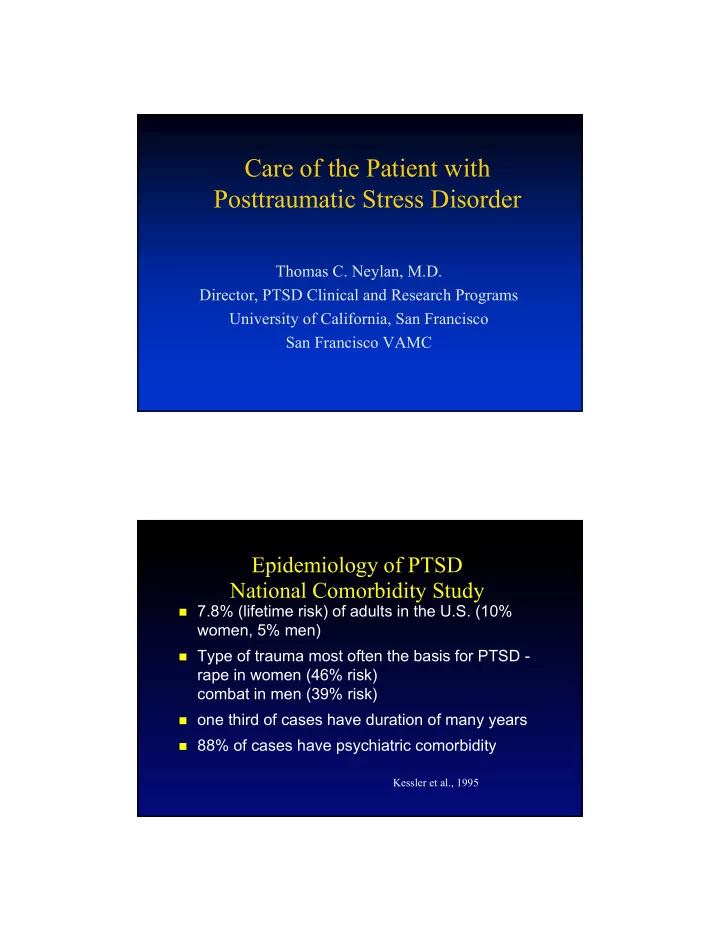
Epidemiology of PTSD National Comorbidity Study

 7.8% (lifetime risk) of adults in the U.S. (10%

women, 5% men)

 Type of trauma most often the basis for PTSD -

rape in women (46% risk) combat in men (39% risk)

 one third of cases have duration of many years  88% of cases have psychiatric comorbidity

Kessler et al., 1995

slide-2
SLIDE 2

Mental Health and recent wars in Iraq and Afghanistan Up to 17% screen + for PTSD, depression, GAD 23% to 40% sought professional help Stigma, care barriers Redeployment

PTSD

DSM- 5 Criteria

Exposure to actual or threatened death, serious injury, or sexual violence in one (or more) of the following ways:

 Direct experience  Witnessing in person as it occurs to others  Learning of accidental or violent death in a someone close  Experiencing repeated or extreme exposure to aversive

details of trauma (e.g. first responders collecting human remains; police officers exposed to details of child abuse).

slide-3
SLIDE 3

PTSD

DSM- 5 Criteria (cont.)

 Re-experiencing the traumatic event  Persistent avoidance of stimuli associated with event  Negative alterations in cognitions and mood (e.g.

disillusionment, guilt, shame, emotional numbing, estrangement, inability to experience positive emotions)

 Symptoms of increased arousal  At least 1 month’s duration (otherwise can diagnose Acute

Stress Disorder)

 Significant distress or impairment in social, occupational,

  • r other functioning

American Psychiatric Association. DSM-5.

Kessler R et al. J Clin Psychiatry. 2000;61(Suppl 5):4-14. Kessler R et al. Arch Gen Psychiatry. 1995;52:1048-1060.

Prevalence of Trauma and Probability of PTSD

P ro b a b ility o f P T S D

10 20 30 40 50 60 70

W itn e s s A c c id e nt Thre a t w / W e a p

  • n

P hy s ic a l A tta c k M

  • le

s ta tio n C

  • m

b a t R a p e

%

P re va le n c e

  • f T

ra u m a

10 20 30 40 % M a le F em a le

Witness Accident Threat w/ Weapon Physical Attack Molestation Combat Rape

1 2 1 2

slide-4
SLIDE 4

Twelve-Month Prevalence of DSM-IV Major Psychiatric Disorders

Mood Disorders Major depressive episode 6.7 Dysthymia 1.5 Manic episode 2.6 Anxiety Disorders Social Phobia 6.8 Simple Phobia 8.7 PTSD 3.5 Agoraphobia without panic 0.8 GAD 3.1 Panic disorder 2.7 Substance Use Disorders Alcohol abuse/dependence 4.4 Drug abuse/dependence 1.8

Adapted from Kessler RC, et al. Arch Gen Psychiatry. 2005;62:617-627.

%

10 20 30 40 50 60 70 80

Number of Individuals

McFarlane, Atchison, Yehuda. Ann N Y Acad Sci. 1997(June);821:437-441

Responses to Trauma Are Heterogeneous

Primary Psychiatric Disorder 6 Months Following Trauma

slide-5
SLIDE 5

Shalev & Yehuda, 1999

3m W 9m Years

94% 47% 42% 30%

?

Longitudinal Course of PTSD Symptoms

PTSD

Risk Factors for PTSD

 Severity of trauma (ie, threat, duration, injury, loss)  Prior traumatization  Gender  Prior mood and/or anxiety disorders  Family history of mood or anxiety disorders  Education

slide-6
SLIDE 6

PTSD Symptoms Low IQ HR > 90 Thought Would Die Duration/severity

  • f exposure

+ + + + + Personal History

  • f Anxiety Disorder

Female + Disorder (type) Family History of Anxiety Disorder +

  • Trauma

Functional Neuroanatomy of Traumatic Stress

Amygdala Hippocampus Locus Coeruleus Pituitary

Hypothalamus

Orbitofrontal Cortex Cerebral Cortex Adrenal

CRF ACTH NE

Extinction to fear through amygdala inhibition Long-term storage of traumatic memories Conditioned fear

Cortisol

Output to cardiovascular system

Prefrontal Cortex Parietal Cortex

Stress

Attention and vigilance-fear behavior Dose response effect on metabolism

Glutamate

slide-7
SLIDE 7

AUTOIMMUNE DISORDERS WITH PTSD

O'Donovan..Neylan. Biol Psychiatry. 2015 Feb 15;77(4):365-74

  • VA OEF/OIF Roster
  • Includes OEF/OIF veterans who have separated & accessed

VA care (Seal et al., 2007)

  • TREATMENT‐SEEKING POPULATION
  • N=670,338 (October 2005 – March 2012)
  • Aged < 55 years
  • No AI diagnosis before MH diagnosis (n=2,939)
  • M age = 31.3±8.7
  • N = 80,361 women

Men 88% Women 12%

No Mental Health Other Mental Health PTSD No Mental Health Other Mental Health PTSD No Mental Health Other Mental Health PTSD No Mental Health Other Mental Health PTSD No Mental Health Other Mental Health PTSD No Mental Health Other Mental Health PTSD

ANY AI DISORDER

INCREASED PREVALENCE OF AUTOIMMUNE DISORDERS WITH PTSD

THYROIDITIS INFLAMMATORY BOWEL DISORDERS RHEUMATOID ARTHRITIS MULTIPLE SCLEROSIS LUPUS

slide-8
SLIDE 8

Sleep and Metabolic Risk Factors in PTSD

Lisa Talbot et al. Psychosomatic Medicine 2015 May;77(4):383-91

50 100 150 200

Triglycerides

50 100 150 200

Cholesterol

5 10 15 20 25 30

VLDL cholesterol

20 40 60 80 100 120

LDL cholesterol

40 42 44 46 48 50

HDL cholesterol

2 4 6 8 10

Cholesterol: HDL ratio

Multivariate analysis of covariance (controlled for body fat percentage) p < .01 p < .001 p < .01 p < .01 p < .05 ns

49 50 51 52 53 54 55

Percentage

Truncal Fat

ns

Sleep and Lipids

100 200 300 400 500 100 200 300 400 500 600

Triglycerides Diary-Measured Total Sleep Time (minutes) Control PTSD

0.00 2.00 4.00 6.00 8.00 10.00 100 200 300 400 500 600

Cholesterol:HDL ratio Diary-Measured Total Sleep Time (minutes) Control PTSD

50 100 150 200 250 300 100 200 300 400 500 600

Cholesterol Diary-Measured Total Sleep Time (minutes) Control PTSD

10 20 30 40 50 60 70 100 200 300 400 500 600

VLDL Cholesterol Diary-Measured Total Sleep Time (minutes) Control PTSD

r = -.258, p = .015 r = -.400, p = < .001 r = -.360, p = .011 r = -.237, p = .026

Talbot et al., 2015

slide-9
SLIDE 9

Evidence for insulin resistance in PTSD

Madhu Rao et al., Psychoneuroendocrinology. 2014 Jul 23;49C:171-181.

Does Treatment for PTSD Affect Other Outcomes?

  • Brain Structure (e.g. hippocampal volume)
  • Metabolism
  • Inflammation
  • Long-term risk for dementia
slide-10
SLIDE 10

PTSD Treatment Options

Psychotherapy Pharmacotherapy Complementary Alternative Interventions

–Yoga –Exercise –Meditation

Multimodal treatment

PTSD

Impact of Treatment on Recovery

Kessler RC et al. Arch Gen Psychiatry. 1995;52:1057. 64 36

Treated Untreated Median Months to Recovery (N = 459)

slide-11
SLIDE 11

Psychological Treatments for Chronic PTSD

First-Line Psychotherapies

Prolonged Exposure therapy

Cognitive processing therapy Additional treatments

Stress Inoculation Training

Eye Movement Desensitization and Reprocessing (EMDR)

Interpersonal Psychotherapy (IPT)

Mindfulness-based stress reduction

PTSD involves Fear Conditioning

  • Pairing of neutral stimuli (contextual cues) and

traumatic stimulus (combat) leads to fear responses to neutral cues

  • After combat, neutral cues leads to fear response
  • PTSD maintained by avoidance behavior
slide-12
SLIDE 12

Exposure Therapy and Extinction of Fear Conditioning

  • Animal model: Repeated exposure to neutral cue

(light) without shock decreases fear conditioning

  • Involves active learning and is mediated by the

neurotransmitter glutamate

  • Extinction is the basis for exposure therapy in PTSD
  • Patients learn to confront their feared memories and situations under

safe circumstances with the goal of extinguishing fear

Cognitive Processing Therapy

  • 12 structured sessions with assignments
  • Targets 5 core schemas: safety, trust,

power/control, esteem, intimacy

  • Goal is to identify and modify “stuck

points” or problem areas in thinking about the event, process trauma

slide-13
SLIDE 13

VA and DoD 2017 guidelines have a set of recommendations for the management of PTSD: First-line: manualized trauma-focused psychotherapy If these are not available, other pharmacologic and nonpharmacologic interventions are recommended for PTSD.

DoD/VA Guidelines for Treatment of PTSD

  • Teaching patients about PTSD, a.k.a. “psychoeducation”
  • i.e., causes, symptoms, effects on functioning in various domains
  • Teaching patients basic skills for managing common symptoms
  • ”grounding” techniques, anger management, assertiveness...review series info

Format:

  • Cohort-based group treatment: The 101-102-103 series
  • 3 12-week once-weekly groups which veterans complete as a cohort
  • Drop-in groups:
  • focused on skills development, patients can attend as desired
  • Brief individual therapy “stabilization”
  • ~6-12 week interventions, often for veterans unwilling or unable to participate in

group treatment

  • Dialectical Behavioral Therapy Program
  • comprehensive program for patients with pronounced features of

borderline personality disorder, especially pronounced self-harm behaviors (e.g. cutting, suicidal behaviors)

Phase-Based Treatment: Stabilization

slide-14
SLIDE 14

Phase-Based Treatment: “Adjunctive” Therapies

Medication Clinic Family Therapy Mindfulness/Meditation Groups Strength and Wellness ??

FDA-Approved Medications

SSRIs

 Sertraline  Paroxetine

slide-15
SLIDE 15

Medications Studied for PTSD

  • Antidepressants

– SSRIs (Sertraline and Paroxetine FDA approved) – SNRIs (Venlafaxine, Duloxetine) – SARIs (Nefazodone and Trazodone) – NaSSA (Mirtazapine) – TCAs & MAOIs

  • Adrenergic inhibiting agents
  • Anxiolytics
  • Anticonvulsants
  • Atypical antipsychotics

α-1 Antagonists

  • Agent

– Prazosin (multiple RCTs, large VA Coop study was

negative

  • Molecular Target

– α-1 post-synaptic adrenergic receptor (antagonist)

  • Clinical Significance

– α-1 receptors widely distributed in brain, including

amygdala and hippocampus

– α-1 receptors modulate sleep and startle responses – Adverse reactions: syncope, dizziness, drowsiness,

decreased energy, headache

slide-16
SLIDE 16

Antianxiety Agents: Benzodiazepines

Acute stress disorder: alprazolam * or clonazepam *

Did not prevent development of PTSD

Gelpin, et al. J Clin Psych 1996; 57:390–394. Chronic PTSD: alprazolam vs placebo

Improves anxiety, no effect for core symptoms of PTSD

Braun P, et al. J Clin Psychiatry. 1990;51:236-8. May interfere with exposure-based desensitization Adverse reactions include: drowsiness, light-headed, dependency

Shalev AY, Bonne E. In: Shalev AY et al, eds. International Handbook of Human Response to Trauma. New York, NY: Klumer/Plenum Publishers; 1999.

Anti-Psychotic Agents

Not routinely used Indications (Not FDA approved):

 Reduce disorganizing hyperarousal, paranoid

ideation, and aggressive impulsivity

 Co-morbid psychotic disorder  Adjunctive for chronic treatment resistant PTSD  Open trials for aripirazole*, olanzapine*, quetiapine*,  Risperidone positive RCTs, however, large multisite

VA trial was negative

slide-17
SLIDE 17
  • Sleep. 2014 Feb 1;37(2):327-41

CRF Receptor Antagonist for PTSD

Dunlop et al. Biol

  • Psychiatry. 2017 Dec

15;82(12):866-874

slide-18
SLIDE 18

Increased Hippocampal Volume With Paxil in PTSD

1180 1200 1220 1240 1260 1280 1300 1320 1340 1360 Left Hippocampus Right Hippocampus Hippocampal Volume (mm-3) Baseline Post-treatment * * *p<.05 Effects of 9-12 months of treatment with 10-40 mg paroxetine. Vermetten et al. Biol Psychiatry. 2003.

Exercise and Neurogenesis?

Slide adapted from D. Shin

Growth factor signaling genes upregulated by exercise

VGF involved in energy balance & synaptic activity; increased by ECS

Growth factor signaling genes

Exercise increases VGF mRNA in the hippocampus

Sedentary Exercise

slide-19
SLIDE 19

Pilot Trial 26 WL vs 21 Integrative Exercise

  • 80
  • 60
  • 40
  • 20

Improvement in CAPS Score

WL IE CAPS Total Score

  • 4
  • 2

2 4 6 Improvement in WHOQOL Physical Domain Score

WL IE WHOQOL Physical Domain

  • 4
  • 2

2 4 6 Improvement in WHOQOL Physical Domain Score

WL IE WHOQOL Psychological Domain

slide-20
SLIDE 20

Change in Exercise Capacity- Metabolic Equivalents (METS) and PTSD Symptoms

r = -.48

  • 80
  • 60
  • 40
  • 20

Change in CAPS Score

  • 4
  • 2

2 4

Change in METS

Wait List Exercise Relationship between METS and PTSD Symptom Improvement

https: //www.istss.org/treating-trauma.aspx combining recommendations with good clinical judgment PTSD Coach

Tools and Resources

slide-21
SLIDE 21

Veterans & Service

Members

Veterans & Service

Members

VA Patients Patients Enrolled

in EBP

Apps for PTSD

MIREC

C

PTSD Coach

slide-22
SLIDE 22

Tool Examples

Collaborators

Steve Batki MD Deborah Barnes PhD Linda Chao PhD Margaret Chesney PhD Beth Cohen MD Richard Hauger MD Sabra Inslicht PhD Daniela Kaufer PhD Thomas Kilduff PhD Shira Maguen PhD Wolf Mehling MD Dieter Meyerhoff PhD Stephen Morairty PhD Valerie Nicholson PhD Aoife O’Donovan PhD Lynn Pulliam PhD Madhu Rao MD Anne Richards MD Kristin Samuelson PhD Norbert Schuff PhD Karen Seal MD Angela Waldrop PhD Mike Weiner MD Rachel Yehuda, PhD