
SLIDE 1
Wilson M. Compton, M.D., M.P.E. Deputy Director National Institute on Drug Abuse
Percentage of Past Month Marijuana Users Aged 12 or Older: Annual - - PowerPoint PPT Presentation
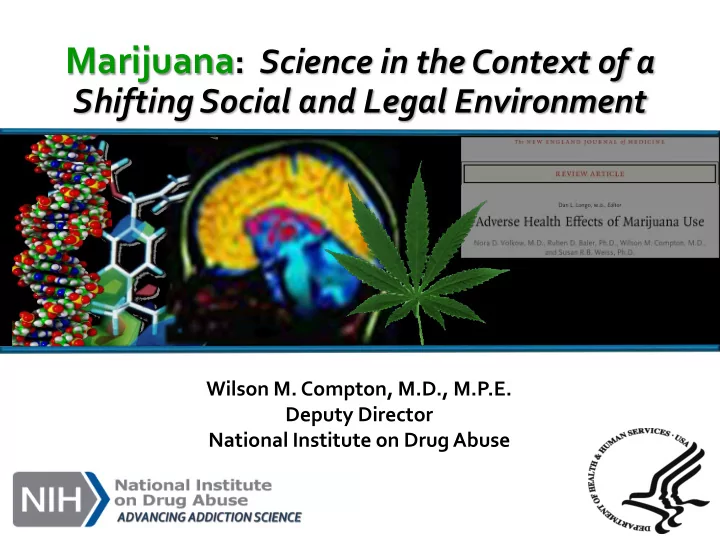
Marijuana : Science in the Context of a Shifting Social and Legal Environment Wilson M. Compton, M.D., M.P.E. Deputy Director National Institute on Drug Abuse Marijuana is the Most Commonly Used Illicit Drug In the U.S. Over 115 million
Wilson M. Compton, M.D., M.P.E. Deputy Director National Institute on Drug Abuse
2013 National Survey on Drug Use and Health, SAMHSA, 2014.
Tetrahydrocannabinol (THC) Active Ingredient in Marijuana
Age in Years
1.0 5.8 14.2 20.3 18.3 13.7 11.7 7.0 5.6 5.2 5.5 4.4 3.1 0.9
5 10 15 20 25
12-13 14-15 16-17 18-20 21-25 26-29 30-34 35-39 40-44 45-49 50-54 55-59 60-64 65+ Percent Using in Past Month Source: SAMHSA, 2013 National Survey on Drug Use and Health (September 2014).
1 to 2 Days 23% 3 to 5 Days 17% 6 to 19 Days 19%
20 or More Days 41%
Source: SAMHSA, 2013 National Survey on Drug Use and Health (September 2014).
19.8 Million Past Month Users of Marijuana in 2013
Number of Days Used Marijuana in the Past Month
10 20 30 40 50 60
91 92 93 94 95 96 97 98 99 00 01 02 03 04 05 06 07 08 09 10 11 12 13 14 15
University of Michigan, 2015 Monitoring the Future Study.
Cigarettes Marijuana Alcohol
5 10 15 20 95 96 97 98 99 00 01 02 03 04 05 06 07 08 09 10 11 12
∆-9 THC
∆-9 THC
SOURCE: University of Mississippi Marijuana Project (potency data)
%
2 4 6 8 10 12 10 20 30 40 50 60 70 80 90
Daily Use (Percent) Perceived Risk (Percent)
SOURCE: University of Michigan, 2014 Monitoring the Future Study.b
2 4 6 8 10 12 10 20 30 40 50 60 70 80 90
Daily Use (Percent) Perceived Risk (Percent)
SOURCE: University of Michigan, 2014 Monitoring the Future Study.b
Cerda M et al. Drug and Alcohol Dependence 2012; 120: 22 – 27. NESARC: National Epidemiologic Survey on Alcohol and Related Conditions
1.81 1.92 1.03 0.5 1 1.5 2 2.5
Past Year MJ Abuse/Dependence Past Year MJ Use Past Year MJ Abuse/Dependence Among Current Users Map of States that Legalized Medical Marijuana by 2004
passed laws legalizing medical MJ
Odds Ratio
20 40 60 80 100
Medical Marijuana States Non-Medical Marijuana States ** **
*Categories not mutually exclusive ** Statistically significant difference SOURCE: University of Michigan, 2013 Monitoring the Future Study
%
0.0 20.0 40.0 60.0 80.0 100.0
Smoking In Food In Drink Other
SOURCE: University of Michigan, 2014 Monitoring the Future Study
0.0 0.5 1.0
z-score
Controls (n=34) Marijuana Users (n=31)
Medina, Hanson, Schweinsburg, Cohen-Zion, Nagel, & Tapert, 2007
Verbal Memory
50 60 70 80
Marijuana Users Controls
50 60 70 80
*p<.01
~Age18 N=46
Mean CBF (ml/100g/min)
Left Insula
Medial Frontal Gyrus Brain blood flow after 28 days monitored abstinence
Tapert, 2016
Non-users used 1 Dx used 2 Dx used 3 Dx
2
Average Point Difference in IQ score (IQ at age 38 – IQ at age 13)
Source: Meier MH et al., PNAS Early Edition 2012
Followed 1,037 individuals from birth to age 38. Tested marijuana use at 18, 21, 26, 32 and 38. Tested for IQ at ages 13 and 38
Silins, et al., Lancet Psychiatry 2014;1:286-293
HS Complete Never < Monthly Monthly + Weekly + Daily 0.2 0.4 0.6 0.8 1 1.2 HS Complete
O.R.
5 10 15 20 Cannabis Depend
O.R.
2 4 6 8 10 Other Illicit Drug
O.R.
2 4 6 8 Suicide Attempt
O.R.
Marie O, Zollitz U, IZA Discussion Paper No. 8900, March 2015
61 49 47 20 24 10 9 14 21 27 21 20 16 17 4 3 2 1 4 5 9 4
10 20 30 40 50 60 70
Percent
Marijuana Dependence General Population
Source: NESARC Study; Conway KP et al., J Clin Psychiatry 2006; 67(2): 247-257.
Andréasson et al Lancet, 1987.
1 2 10 <50 >50
30 20 10 No of times marijuana taken
Cases of Sz per 1,000
4.5 1.6 1 2 3 4 5 6 7 8 9
Cannabis users by age 15 years Cannabis users by age 18 years
Arseneault et al BMJ 2002
Risk of schizophrenia-like psychosis at age 26 years
Odds ratio
MARIJUANA AND SCHIZOPHRENIA
Study of Swedish Conscripts (n=45570)
MARIJUANA AND SCHIZOPHRENIA-Like
Longitudinal prospective Dunedin study (n=1037)
Regular Marijuana Use Increases Schizophrenia Risk in those with AKT1 rs2494732 genotype
Di Forti et al., Biological Psychiatry, 2012.
AKT1 genotype does not predict History of Cannabis use (p=0.772) GXE multiplicative model: p*=0.014
Never used cannabis History of cannabis use Never used cannabis Used cannabis at week ends or less Used cannabis everyday
Odds Ratio
AKT1(T/T) AKT1(C/T) AKT1(C/C) AKT1(T/T) AKT(C/T) AKT1(C/C)
Odds Ratio
31.4 31.1 29.5 26.5* 25.2*
None ≤ Weekly Hash Daily Hash ≤ Weekly Skunk Daily Skunk
Di Forti M et al. Schizophr Bull 2013;schbul.sbt181
Hippocampus/Amygdala volumes correlated with psychosis in schizophrenics (closed) and bipolar patients (open)
Watson et al., Brain Imaging Behav. 2012.
Areas in Hippocampus and Amygdala where volumes were smaller in schizophrenics than controls
Prestia et al., Am J Geriatr Psychiatry 2015.
delta-9-tetrahydrocannabinol delta-9-tetrahydrocannabivarin delta-8-tetrahydrocannabinol cannabigerol cannabinol cannabichromene cannabidiol
& Analgesia
& Reward
Ahmad et al., Mol Imaging Biol. 2013 A Terry et al., Eur J Nucl Med Mol Imaging. 2010
after injection of 11C-MePPEP)
Source: Mackie K. Ann Rev Pharmacol Toxicol., 2006
Endocannabinoids are produced on demand. They travel back to the transmitting neuron to dampen further activity.
Van Loere et al., 2007. Hirvonen et al., Mol Psychiatry 2013
Marijuana Abusers Controls
ACC/CBL
Weiland B J et al. J. Neurosci. 2015;35:1505-1512
Zalesky et al Brain 2012.
Precuneus to splenium Fimbria of hippocampus, hippocampal commissure and Splenium
Hutchison, 2016
abstinence?
impairment?
Need large longitudinal study to disentangle multiple interacting factors and examine individual differences.
Meier, Tapert, Hutchison, 2016
NIDA, NIAAA, NCI, NICHD, NIMHD, ORWH, NIMH, NINDS, OBSSR
5 10 15 20
2001 2002 2003 2004 2005 2006 2007 2008 2009 2010 2011 2012 2013 2014 Percent Who Reported
Source: University of Michigan, 2014 Monitoring the Future study, Unpublished special tabulations (December 2014).
During the LAST TWO WEEKS, have you driven a car, truck, or motorcycle after …
… drinking alcohol … smoking marijuana Since 2009, more high school seniors reported driving after smoking marijuana than driving after drinking alcohol.
ACG OFC SCC Hipp NAcc VP Amyg
REWARD INHIBITORY CONTROL MEMORY/ LEARNING EXECUTIVE FUNCTION
PFC
MOTIVATION/ DRIVE
VTA/SN nucleus accumbens frontal cortex Drugs of abuse increase DA in the Nucleus Accumbens, which is believed to trigger the neuroadaptions that result in addiction
100 200 300 400 500 600 700 800 900 1000 1100 1 2 3 4 5 hr
AMPHETAMINE
% of Basal Release 50 100 150 200 60 120 180
Time (min)
% of Basal Release Empty Box Feeding Di Chiara et al., 1997
FOOD
150 125 100
0 20 40 60 80
MARIJUANA
% of Basal Release Tanda, et al, Scienceb 1997 Di Chiara et al., 1997
Genes/Development
Laws/Culture Neighborhood/ Community Family/Peers Biology Individual/ Genes
Substance Use Rate of Increase
Involved-Supportive Parenting
Low High
High supportive parenting decreased substance use risk in those with low serotonin transporter expressing valiants (high risk alleles)
No Genetic Risk (l-l allele) Genetic Risk (s-s or s-l allele)
Age Gender Race/ethnicity Poverty level Genotype Early aggression Social skills deficits Academic problem Misperceived drug use norms Association with deviant peers Neighborhood availability Media glamorization Parental monitoring and support
Parent skills training Social skills training Self-regulation Impulse control Tutoring Norms training Refusal skills Community policing Health literacy
Sum of six lifetime illicit use measures (methamphetamines, Ecstasy, inhalants, Vicodin, prescription drug misuse overall,
points, including 11th and 12th grades.
0.00 0.50 1.00 1.50 2.00 2.50 Grade 6 Grade 7 Grade 8 Grade 9 Grade 10 Grade 11 Grade 12
Control Intervention
Source: Spoth, Redmond, Shin, Greenberg, Feinberg, et al. (2013). PROSPER community-university partnerships delivery system outcomes through 6½ years past baseline.
Higher Risk = Lifetime initiation of alcohol, cigarette or marijuana use at baseline; Lower Risk = No initiation at baseline. Intervention effects are significantly stronger for the Higher-Risk subgroup, as compared to the Lower-Risk Subgroup.
0.00 0.50 1.00 1.50 2.00 2.50 3.00 Grade 6 Grade 7 Grade 8 Grade 9 Grade 10 Grade 11 Grade 12 Higher-Risk in Control Lower-Risk in Control Higher-Risk in Intervention Lower-Risk in Intervention
Source: Spoth, Redmond, Shin, Greenberg, Feinberg, et al. (2013). PROSPER community-university partnerships delivery system outcomes through 6½ years past baseline.
Piomellli, 2016
Devinsky O et al., Poster presented at the 2015 Annual Meeting of the American Epilepsy Society. Research funding from GW Pharmaceuticals, the company developing the tested formulation of cannabidiol (Epidiolex)
Source: Pacula, March 2016
Source: Glantz and Barry, 2016
Web interactive
Drugs + Your Body: It Isn't Pretty
Includes graphics, videos, quizzes and much more on the wide-ranging harmful effects