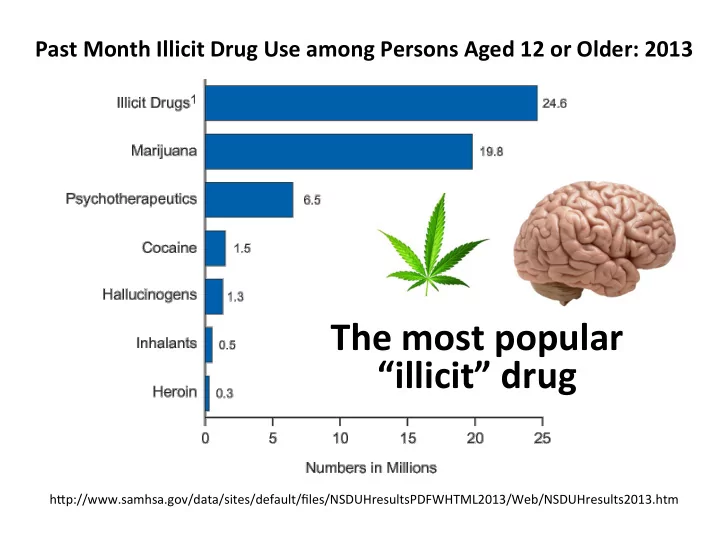
SLIDE 1 The most popular “illicit” drug
Past Month Illicit Drug Use among Persons Aged 12 or Older: 2013
h#p://www.samhsa.gov/data/sites/default/files/NSDUHresultsPDFWHTML2013/Web/NSDUHresults2013.htm
SLIDE 2
Marijuana use in the past month among youths aged 12 to 17, by state: percentages, annual averages, 2013-2014; SAMHSA NSDUH
SLIDE 3
PercepMons of great risk of harm from smoking marijuana once a month among youths aged 12 to 17, by state: percentages, annual averages, 2013-2014; SAMHSA NSDUH
SLIDE 4 A history of demonizaMon
- Harry Anslinger, first Commissioner
- f NarcoMcs, Bureau of NarcoMcs
- “Those who are habitually
accustomed to use of the drug are said to develop a delirious rage aQer its administraMon, during which they are temporarily, at least, irresponsible and liable to commit violent crimes…”
SLIDE 5 Marijuana is sMll a Schedule I substance
Controlled Substances Act (1970)
- The drug or other substance…
- 1. …has a high potenMal for abuse
- 2. …has no currently accepted medical use
- There is a lack of accepted safety for use of
the drug…under medical supervision…
SLIDE 6 Cannabis contains cannabinoids
- More than 60!
- Concentrated in resin
- Lots of differences, depending on strain, other factors…
Indicas SaMvas
SLIDE 7 Marijuana is smoked…and eaten
Method of drug administraMon maSers
Burning vaporizes cannabinoids, which reach the brain in seconds. Oral administraMon delivers less THC, CBD, CBN, etc. more slowly…
“I strained to remember where I was or even what I was wearing, touching my green corduroy jeans and staring at the exposed-brick wall. As my paranoia deepened, I became convinced that I had died and no one was telling me…” New York Times, 6/3/13
SLIDE 8 Cannabinoids act at cannabinoid receptors: CB1 and CB2
CB1 Receptors Abundant! Cerebellum Basal ganglia Hippocampus Brainstem Spinal cord Neocortex
(Herkenham et al. (1991) J. Neurosci. 11: 563)
CNS expression in areas important for motor coordinaMon, memory, pain, nausea, decision making…
SLIDE 9
Endogenous cannabinoid neurotransmiSers
If we have receptors for cannabinoids like THC, why are they there? What neurotransmi#ers act at these endogenous receptors..?
Derived from arachidonic acid, a fa#y acid found in membranes Anandamide 2-AG
SLIDE 10 Anxiety: GeneMc protecMon?
Decreased anxiety in humans and mice with FAAH C385A Breakdown by FAAH; several Forms (A, C)
FAAH geneMc variaMon enhances fronto-amygdala funcMon in mouse and human, Nature CommunicaMons, Iva Dincheva et al (2015)
A less common; Less effecMve at breakdown Anandamide
SLIDE 11
Cannabinoids reduce pain
A large body of literature indicates that cannabinoids suppress behavioral responses to acute and persistent noxious sMmulaMon…
(Walker JM, Hohmann AG, 2005)
Co-administraMon of cannabinoids and opiates allows for pain relief with a lower opiate dose!
(e.g., Wilson AR, Maher L, Morgan MM, 2008)
SLIDE 12 More therapeuMc effects
(e.g., FolMn, 1988; Williams, 1988) Why is this therapeuTc?
(e.g., studies referenced by the NaMonal Cancer InsMtute at cancer.gov; though chronic use linked to hyperemesis syndrome; Soriano-Co M, 2010)
SLIDE 13 Marijuana impairs cogniMon, memory, motor coordinaMon
- Deficits in verbal and spaMal
memory (e.g., Curran et al, 2002)
- With increasing cogniMve demand,
there is significantly reduced cogniMve performance…
- Cannabis and alcohol both impair
skills criMcal for driving (Sewell RA et al, 2009)
- DifferenMal effects on socializaMon
SLIDE 14 Early chronic marijuana exposure linked to persistent cogniMve deficits
“…results suggest that adolescents are more vulnerable than adults to neurocogniMve abnormaliMes associated with chronic heavy marijuana use…” Schweinsburg
et al (2008)
h#p://www.drugabuse.gov/publicaMons/topics-in-brief/marijuana
SLIDE 15 Risks of chronic adolescent use
- CogniMve impairment: IQ drop
- Risk of dependence: 9% of those who experiment; 1 in 6 of those who
start using in adolescence, and 25 – 50% of those who smoke daily…
- Changes in funcMonal connecMvity
- Increased risk of anxiety and depression, and schizophrenia/psychosis in
those with a preexisMng geneMc vulnerability (But from Volkow arMcle: “It is inherently difficult to establish causality in these types of studies because factors other than marijuana use may be directly associated with the risk
- f mental illness…”)
- School performance: “Early marijuana use is associated with impaired
school performance…although reports of shared environmental factors… suggest that the relaMonship may be more complex…”
Volkow et al (2014), NEJM
SLIDE 16 However…we’re sMll learning
- Cannabis use is quan2ta2vely
associated with nucleus accumbens and amygdala abnormaliMes in young adult recreaMonal users.
Gilman JM1, Kuster JK, Lee S, Lee MJ, Kim BW, Makris N, van der Kouwe A, Blood AJ, Breiter HC., J Neurosci. 2014 Apr 16;34(16):5529-38 (2014)
Nucleus accumbens, amygdala are part of moMvaMonal networks (what you seek, what you avoid…)
SLIDE 17 But wait - which is it..?
- Daily Marijuana Use Is Not Associated
with Brain Morphometric Measures in Adolescents or Adults
Barbara J. Weiland, Rachel Thayer, Brendan E. Depue, Amithrupa Sabbineni, Angela Bryan, Kent E. Hutchison, The Journal
- f Neuroscience, 28 January 2015
Same journal Different research group * Controlled for alcohol exposure…
SLIDE 18 Past Month Illicit Drug Use
Youths Aged 12 to 17: 2002-2013
Substance Abuse and Mental Health Services AdministraMon NaMonal Survey on Drug Use and Health, 2013
SLIDE 19 Alcohol Use in the Past Month among Youths Aged 12 to 17, by State; SAMHSA NSDUH
Percentages, Annual Averages Based on 2013 and 2014 NSDUHs