Global, East Europe, Middle East , p , & Africa Illicit Trade - - PowerPoint PPT Presentation

global east europe middle east p africa illicit trade
SMART_READER_LITE
LIVE PREVIEW

Global, East Europe, Middle East , p , & Africa Illicit Trade - - PowerPoint PPT Presentation

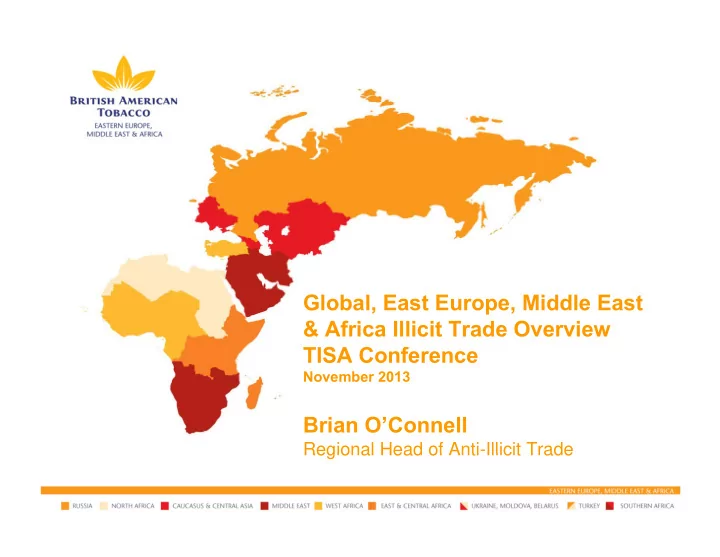
Global, East Europe, Middle East , p , & Africa Illicit Trade Overview TISA Conference November 2013 Brian OConnell Regional Head of Anti-Illicit Trade Regional Head of Anti Illicit Trade Types of Illicit Trade The Global Illicit


slide-1
SLIDE 1

Global, East Europe, Middle East , p , & Africa Illicit Trade Overview TISA Conference

November 2013

Brian O’Connell

Regional Head of Anti-Illicit Trade Regional Head of Anti Illicit Trade

slide-2
SLIDE 2

Types of Illicit Trade

slide-3
SLIDE 3

The Global Illicit Trade problem

  • Global illicit trade has grown for 5 consecutive years
  • Some 330-657 billion cigarettes consumed each year are illicit* – either

l d f i l ll d d g y smuggled, counterfeit or locally tax evaded

  • Equivalent to 6-12% of world cigarette consumption
  • Governments globally losing some $40-50 billion a year in tobacco taxes*
  • Governments globally losing some $40-50 billion a year in tobacco taxes

*Source: Various, BAT, Euromonitor, Framework Convention Alliance

slide-4
SLIDE 4

Global market share (%) of major players

41.4 41.4

40 30

% 20

10 10 12 12 15 15 13 13

10

Japan Tobacco ILLICIT Philip Morris British American Imperial

5

CNTC China p International TRADE p International Tobacco p Tobacco UK CNTC China

Source: 2011 Credit Suisse/BAT estimates

slide-5
SLIDE 5

BAT’s East Europe, Middle East & Africa Region

One trillion cigarettes sold; 220 million smokers g ;

slide-6
SLIDE 6

Illicit Trade across the Region: 2012

According to our estimates: According to our estimates:

Over a hundred and thirty billion illicit cigarettes in the region Illicit traders make over a £1 billion; governments lose £2 billion

CF 10% T E d d 10% S l d 80% CF - 10% Tax Evaded - 10% Smuggled - 80%

slide-7
SLIDE 7

Illicit trade is growing across EEMEA (billion sticks)

140 160 100 120 60 80 100 40 60 20 2012 2013 2014 2015 2012 2013 2014 2015

7 *Source: BAT

slide-8
SLIDE 8

History still means that the main volume of illicit trade is in the Middle East and Africa is in the Middle East and Africa

7.2 6 1.9 7.3 3.4 5.7

Southern Africa East & Central Africa West Africa

12.6

North Africa Middle East

20.4

Turkey Ukraine, Moldova & Belarus Russia

35.6

Russia Caucasus & Central Asia

8 *Source: BAT

% of consumption across EEMEA

slide-9
SLIDE 9

Illicit trade in the Continent of Africa: 1 in 10 cigarettes are illicit are illicit

18.8 53.3 Southern Africa East & Central Africa West Africa North Africa 19.0 53.3 North Africa 8.8

9

% of consumption (Africa only)

*Source: BAT

slide-10
SLIDE 10

The Drivers of Illicit Trade…

The opportunity it offers for all elements of the illicit supply chain to make money at very low risk and for the smoker to save money at very low risk, and for the smoker to save money

Consumer willingness to accept illegal cigarettes

Lack of Enforcement

Lack of consumer knowledge - Viewed as a “Victimless Crime”

Free Trade Zones Internet

Excise Increases

Weak controls, d ti

(and in neighboring Markets)

  • ver-production

and oversupply in neighboring countries Increasing regulation & Legislation War, unrest etc.

10

Lightweight Penalties Global Economic Crisis

slide-11
SLIDE 11

2011 2013 Trends & Developments 2011-2013 Trends & Developments

11

slide-12
SLIDE 12

The Modus Operandi of smugglers has developed

12

slide-13
SLIDE 13

Social unrest, wars, coups etc. and sanctions have been key to the growth of illicit trade in

  • Pricing and excise may be the drivers but these are the facilitators:

have been key to the growth of illicit trade in Africa and the Middle East

  • Pricing and excise may be the drivers, but these are the facilitators:

THE ARAB SPRING

25 20.7 17.8 20.3 15 8 18.4 20 14.6 9 4 14.1 15.8 15 2010 2011 % MANY OF THESE MARKETS HAVE NOW BECOME KEY HUBS AND TRANSIT ROUTES FOR ILLICIT TRADE INTO OTHER MARKETS 7.2 9.4 5 10 2011 2012

13

5

13

Middle East North Africa ME & NA 2011→2012 Middle East & North Africa DNP year on year growth (less Iran) – 47%

slide-14
SLIDE 14

Working Across Government Agencies

Critical Interagency AIT Working Group Participants

Ministry of Finance Ministry of Trade Ministry of Supply & Ministry of Foreign Ministry of Finance Ministry of Trade Ministry of Supply & Internal Trade Ministry of Foreign Affairs

Provides financial expertise

  • n scope of losses and

measures to reduce tax evasion Can also assist in Leads dialogues with trade partners on tackling illicit trade and provide authoritative info on nature Works to protect consumers from illicit tobacco that violates product regulation. Collaborates with partners

  • n reducing illicit trade and

interfaces with foreign govts donors and int orgs

  • evasion. Can also assist in

seizing illicit traders’ financial assets and monitoring transactions. authoritative info on nature and scope of problem. govts., donors, and int. orgs to obtain financial and technical assistance.

Border Guards/ Armed Forces Customs Police/Interior Tobacco Industry

Defends borders against Leads efforts to interdict Deploys resources to Provides critical intelligence g

  • smugglers. Provides critical

intelligence on arrests, seizures, trafficking routes,

  • etc. Deploys resources for

land and maritime border security efforts. smugglers, seize illicit product, and recover lost revenues. p y investigate and unravel

  • rganised smuggling

networks and patrols street markets for illicit product. g

  • n sources of product,

market dynamics, shipment routes and volumes.

14

secu ty e o ts

Some include: Health, Transportation, Education etc.

slide-15
SLIDE 15

The role of international agreements, trade blocks, customs unions etc. is continuing to grow; its impact on illicit trade must be considered and reflected

  • Promulgated new EU-wide AIT Strategic Action Plan in 2013
  • Coordinates engagement with neighbouring countries against illicit trade

China, Belarus, Ukraine, Moldova, Russia, Western Balkans and Turkey Supply Chain Enforcement Customs & Police Sanctions Penalties for SOC

Licensing equipment Sharing analytical information C M d i i Minimum penalties Minimum maximum penalties Due diligence (KYC) Track & Trace Customs Modernisation Customs Training Confiscating the proceeds from SOC

15

slide-16
SLIDE 16

What can be done?

Consideration in regulatory decision making Increased enforcement International cooperation Stronger laws & g Stronger laws & Tougher penalties

Reduce Illicit Trade

Nationally aligned responses

Illicit Trade

Pressure on the Illegal Graduate & Moderate

16

Pressure on the Illegal supply chain Excise Rises

slide-17
SLIDE 17

The WHO’s FCTC Protocol to Eliminate Illicit Trade in Tobacco Products Tobacco Products

  • In November 2012, the Protocol to Eliminate Illicit Trade in Tobacco

Products was unanimously adopted by the delegates of the Parties to the Products was unanimously adopted by the delegates of the Parties to the WHO’s Framework Convention on Tobacco Control (FCTC)

  • It is the first Protocol to the WHO FCTC.

It is the first Protocol to the WHO FCTC.

  • The Protocol is an important step in addressing the problem but there is still

a long way to go. g y g

  • It’s vital that the work to move this finalised Protocol forward, to

implementation stage, begins immediately.

17

slide-18
SLIDE 18

What does the ITP contain ?

  • A comprehensive set of Supply Chain

Illicit Trade

controls and international cooperation commitments to help fight against Illicit Trade in tobacco Trade in tobacco

  • Not all the provisions of the ITP are

mandatory

slide-19
SLIDE 19

Signatories to the ITP g

(17 out of 36)

Source: www.WHO.int

slide-20
SLIDE 20

How Do We Address the Issue?

  • Key Company Priority / Building Internal Momentum
  • Raise Awareness Internally (Research & Analysis)
  • Consistent approach to fighting Illicit Trade
  • Dedicated Resources - AIT Cross Functional Cooperation

Dedicated Resources AIT Cross Functional Cooperation

  • Supply Chain Security
  • ‘Know Your Customer’ & ‘Customer Approval’ / Standards of Business Conduct
  • Supply commensurate with legitimate demand
  • Destroy Old Production Equipment
  • Destroy Old Production Equipment
  • Track & Trace – Product Authentication Devices
  • Brand Protection
  • Gather Intelligence to Support Seizures
  • BAT Laboratory / Trademark Protection / Internet Strategy
  • Training Enforcement Agencies / Adult Smokers Campaigns
  • Work with Governments / Policymakers
  • AIT Dialogue / Social Reporting
  • MoU Programme /Cooperation Agreements
  • Industry and cross industry cooperation – Brand Protection Groups
  • Striving for appropriate regulatory & tax regimes
  • Appropriate Portfolio Strategy

Appropriate Portfolio Strategy

slide-21
SLIDE 21

Thank You Thank You

21