1 GoB Vision: to reduce the vulnerability of the poor to the - - PDF document

1
SMART_READER_LITE
LIVE PREVIEW

1 GoB Vision: to reduce the vulnerability of the poor to the - - PDF document

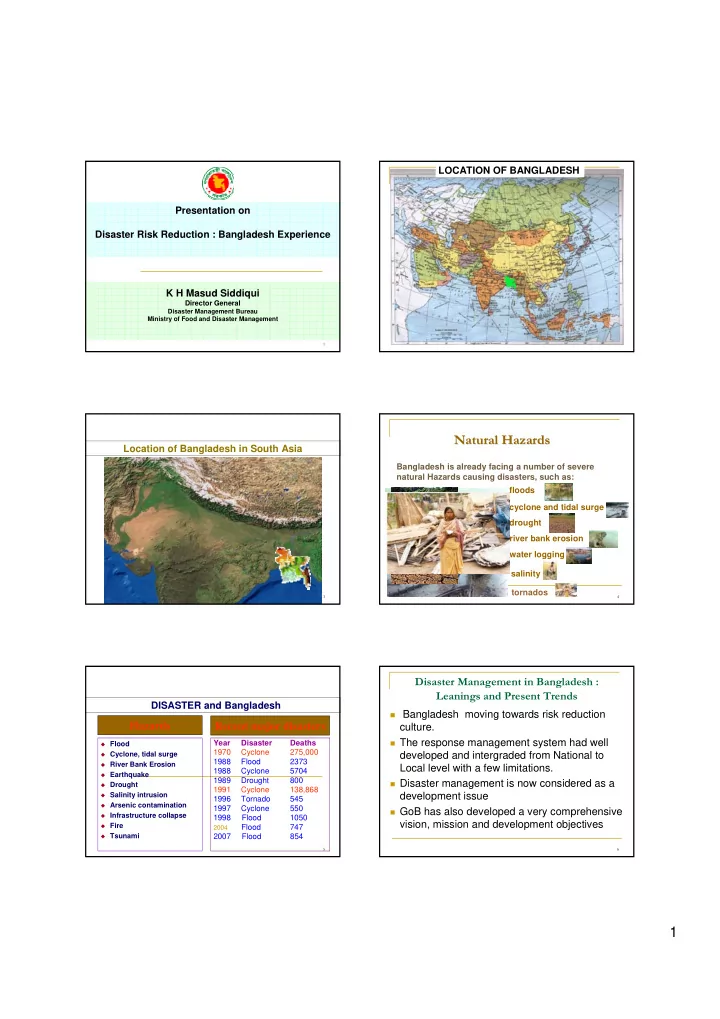
LOCATION OF BANGLADESH Presentation on Disaster Risk Reduction : Bangladesh Experience K H Masud Siddiqui Director General Disaster Management Bureau Ministry of Food and Disaster Management 1 Natural Hazards Natural Hazards Location of


slide-1
SLIDE 1

1

1

K H Masud Siddiqui

Director General

Disaster Management Bureau Ministry of Food and Disaster Management

Presentation on Disaster Risk Reduction : Bangladesh Experience LOCATION OF BANGLADESH

3

Location of Bangladesh in South Asia

4

Natural Hazards Natural Hazards

river bank erosion Bangladesh is already facing a number of severe natural Hazards causing disasters, such as: floods cyclone and tidal surge drought salinity water logging tornados

5

DISASTER and Bangladesh

Flood Cyclone, tidal surge River Bank Erosion Earthquake Drought Salinity intrusion Arsenic contamination Infrastructure collapse Fire Tsunami

Year Disaster Deaths 1970 Cyclone 275,000 1988 Flood 2373 1988 Cyclone 5704 1989 Drought 800 1991 Cyclone 138,868 1996 Tornado 545 1997 Cyclone 550 1998 Flood 1050

2004

Flood 747 2007 Flood 854

Recent major disasters Hazards

6

Disaster Management in Bangladesh : Leanings and Present Trends

Bangladesh moving towards risk reduction

culture.

The response management system had well

developed and intergraded from National to Local level with a few limitations.

Disaster management is now considered as a

development issue

GoB has also developed a very comprehensive

vision, mission and development objectives

slide-2
SLIDE 2

2

7

GoB Vision:

to reduce the vulnerability of the poor to the effects of

natural, environmental and human induced hazards to a manageable and acceptable humanitarian level

MoFDM Mission:

to bring a paradigm shift in disaster management from

conventional response and relief to a more comprehensive risk reduction culture

Overall Objective:

to strengthen the capacity of the Bangladesh Disaster

Management System to reduce unacceptable risk and improve response and recovery management at all levels

8 9 National Disaster Management Council Inter Ministerial Disaster Management Coordination Committee (IMDMCC) National Disaster Management Advisory Council (NDMAC) Ministry of Food and Disaster Management Directorate of Relief and Rehabilitation Disaster Management Bureau District Disaster Management Committee Upazila Disaster Management Committee City Corporation Disaster Management Committee Municipal Disaster Management Committee Union Disaster Management Committee

Institutional Arrangement for Disaster Management in Bangladesh

Directorate of Food 10

Disaster Management Framework for Action

INTERNATIONAL DRIVERS

Millennium Development Goals Agenda 21 United Nations Framework Convention on Climate

Change

Hyogo Framework of Action (2005-2015) International Strategy for Disaster Reduction

(ISDR)-Global Platform

  • SAARC Comprehensive Regional Framework of

Action

11

NATIONAL DRIVERS

GoB Vision on Disaster Management Poverty Reduction Strategy Paper Standing Order on Disaster Management National Plan for Disaster Management National Water Management Plan National Adaptation Plan of Action

12

National Risk Reduction Framework

Ministry of Food and Disaster Management Ministry of Food and Disaster Management National Plan for Disaster Management ( 2007 National Plan for Disaster Management ( 2007-

  • 2015

2015) PPPDU PPPDU DMB, DRR and DMB, DRR and DGoF DGoF Strategic Plans Strategic Plans DMB, DRR and DMB, DRR and DGoF DGoF Operational Plans Operational Plans Strategic Partnerships Strategic Partnerships Implementing Partnerships Implementing Partnerships Scientific and Technical Partnerships Scientific and Technical Partnerships

slide-3
SLIDE 3

3

13

Risk Reduction Initiatives in Bangladesh

Community Risk Reduction Planning Community Risk Reduction Planning starts from 2004. This program has developed a Risk Assessment Guideline and subsequently will train the DRROs, PIOs, Other Govt. Officials and NGOs on Risk Assessment and Risk Reduction Planning Procedures. The major activities are:

  • Community Risk Assessment
  • Community Risk Reduction Planning
  • Scale up community best practices of risk reduction

14

Disaster Risk Reduction Program

Launched since 2003 to support poor and vulnerable people to build resilience to natural hazards (specially flood). Highly supportive to the needs of the people. To date, 61764 vulnerable people (56074 male and 5690 female) of 72 Upazilas are supported with a total of 450 million taka in 2004-2005. In this financial year, 650 million taka is supported to 287 Upazilas. . Major achievements in relation to risk reduction are following:

  • Decreasing income vulnerabilities
  • Build hazard resilient small entrepreneurship
  • Increase economic empowerment

15

Seasonal Unemployment Reduction Program

DRR has developed a seasonal unemployment reduction program in 2005-2006 fiscal year to reduce the vulnerabilities

  • f poor and marginal people to reduce their food

vulnerabilities during seasonal unemployment. Working Areas Jamalpur, Sherpur, Faridpur, Madaripur, Rajbari, Gopalganj, Rangpur, Nilphamari Lalmonirhat, Gaibandha and Kurigram districts. Budget : 500 million taka. Objectives : To address the risk of

  • Food insecurity
  • Market Inaccessibility
  • Unemployment

16

Early warning issued by the meteorological department (Cyclone, Rainfall, Temperature etc,) F l l

  • d

Through District office DRROs and PIOs activate the DMCs and facilitate warning disseminations Flood Forecasting and Warning Center (FFWC)

EARLY WARNING AND EVACUATION

17

Information Flow during Emergency Response

Union Disaster Management Committee Upazila Disaster Management Committee District Disaster Management Committee (DRRO)

EOC

PM office monitoring cell` 18

Overall Response Management

FIELD Ministry of Food and Disaster Management Prime Minister Office

District, Upazilla and Union/ Pourashava/ City Corporation

slide-4
SLIDE 4

4

19

Resource Mobilization System

FIELD

DC Offices

MoFDM

DRR UNO Offices and Union Parishad

20

Response mechanism

Warning Evacuation Emergency Support Rehabilitation Recovery

21

Emergency Cash Relief Emergency Shelter as Relief Distribution of Cloths and Tents as Relief Distribution of Housing Materials as Relief Emergency Coordination at Union/ Upazila/ District level Emergency Medical Care Communication Restoration Security of the Evacuated and Sheltered People Provide Social Counseling to the Victim or Affected Ensure Recreation and other social activities (specially for children) Emergency Food Relief

Emergency Response Program

22

Early Warning Dissemination Systems

Bangladesh Meteorological Department collects and disseminate weather and rainfall data. BMD issues warning signals on cyclone Cyclone Preparedness Program (MoFDM) propagates emergency HF/VHF radio bulletins from BMD through a community volunteer network Flood Forecasting and Warning Center (MoWR) sends daily email, fax and couriered water level prediction bulletins to national and district agencies, and more frequently during emergencies Center for Environmental and Geographic Information Services (MoWR) publishes an annual report of river bank erosion predictions at active sites on the main rivers

23

Disaster Management Information Centre

Goal: to implement effective information sharing among disaster management agencies and communities to support sustainable risk reduction and emergency response capacity:

for all hazards in all sectors in normal times and emergencies throughout the nation and regionally

24

Disaster Management Information Centre

Goal: to implement effective information sharing among disaster management agencies and communities to support sustainable risk reduction and emergency response capacity:

for all hazards in all sectors in normal times and emergencies throughout the nation and regionally

slide-5
SLIDE 5

5

25

Early Warning Information Sharing

The DMIC will integrate early warning information sources and users in regional, national and local level institutions. The DMIC encourages and, if requested, will assist the primary source agencies to disseminate warning information directly to communities. The Global Disaster Alert and Coordination System (GDACS) will have linkages with Bangladesh agencies through DMIC by default and directly by arrangement.

26

Slide 11 of 17

Long-term District Upazilla Union

27

Cyclone Preparedness Programme (CPP)

A joint programme between Ministry of Food and Disaster

Management and Bangladesh Red Crescent Society.

Covers 11 districts in the coastal areas. Have 27,600 trained male and 5,520 female volunteers. 2,023 Cyclone Shelters along the coastal belt of Bangladesh. CPP provides scheduled daily weather reports via extensive high

frequency (HF) radio (stations operated by volunteers) throughout the coastal areas

CPP volunteers contributed to the amazing success in reducing

cyclone death tolls.

Integrating Tsunami risks with Cyclones and storm surges as a part

  • f all-hazards risk reduction framework.

28

Capacity Building Initiatives

  • Inclusion of DM chapter in the class V-

XII curriculum

  • Adopted 2 hour mandatory training

module by all public sector training institutes

  • Training and Briefing Programmes for

the Disaster Management Committees at community level (DMC)

  • Specialized DM courses offered by

different academic institutions

29

Establishing Institutional Accountability

30

Comprehensive Disaster Management Program

CDMP is a vehicle to achieve MoFDM-led reform from reactive emergency response to proactive risk reduction. This Program is also a vehicle for the implementation of Hyugo Framework of Action

Key Strategic Focus Areas of CDMP: 1. Professionalising the disaster management system 2. Mainstreaming risk management programming 3. Strengthening community institutional mechanisms 4. Expanding risk reduction programming across a broader range of hazards 5. Strengthening emergency response systems 6. Maintaining and strengthening the national food security system

slide-6
SLIDE 6

6

31

Limitation of Disaster Management Initiatives

Legal Framework of Standing Order is

delayed

Taking time for endorsement of Disaster

Management Act

Enadequate equipment for rescue and

search

Traditional attitude of GoB officials towards

relief based disaster management

Slow motion in developing regional strategy

for disaster management

32

What Can We Do More?

Community Risk Assessment (CRA) Risk Priorities Funding the RR Options Monitoring, Evaluation and Impact

Assessment

Documentation of Lessons Learned Documentation of Best Practices Campaigning for the Best Practices Mainstreaming Risk Reduction

33

People are initiating their own strategy to adapt to waterlogging problem through alternative agriculture

Preparing a floating garden with water Preparing a floating garden with water hyacinth hyacinth

Vegetables growing on a floating garden Vegetables growing on a floating garden Harvesting ladies finger ( Harvesting ladies finger (Abelmoschus Abelmoschus esculentus esculentus) ) from the floating garden from the floating garden 34

Duck rearing Duck rearing

Cage Aquaculture Cage Aquaculture

35

Crab Fattening (Salinity, Waterlogging and Climate Change)

People have Increased income through alternative livelihoods resistant to different hazards

Mele (reed) cultivation (Salinity and Flood)

Goat rearing and Cow rearing as an strategy for poverty reduction which will reduce their vulnerability to food and income for disasters caused by natural hazards

36

People are trying to improve health condition & personal safety to Flood, Cyclone and Waterlogging

People are trying to improve access to safe water resistant to different hazards (flood, cyclone and salinity are major)

slide-7
SLIDE 7

7

37

Initiatives to improve housing safety Cyclone and Storm resistance housing

38

Integrated farming Integrated farming

(rice, fish and vegetables) (rice, fish and vegetables) through household approach through household approach (flood, cyclone and water logging) (flood, cyclone and water logging)

39