1 O.T. Referral O.T. Referral Subtle dyspraxia Subtle dyspraxia - - PDF document

1
SMART_READER_LITE
LIVE PREVIEW

1 O.T. Referral O.T. Referral Subtle dyspraxia Subtle dyspraxia - - PDF document

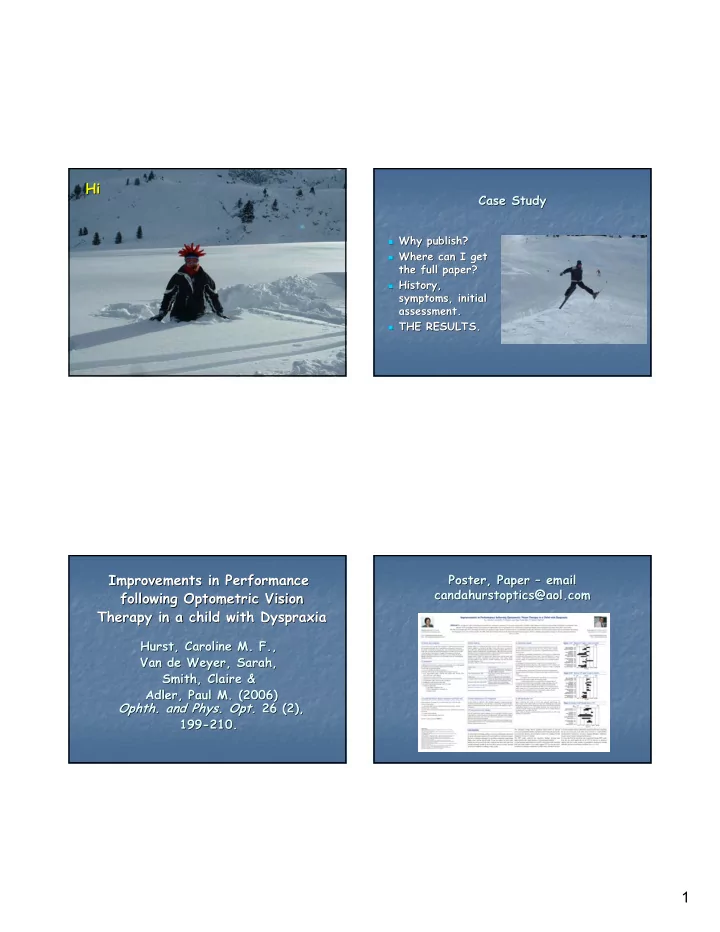
Hi Hi Case Study Case Study Why publish? Why publish? Where can I get Where can I get the full paper? the full paper? History, History, symptoms, initial symptoms, initial assessment. assessment. THE


slide-1
SLIDE 1

1

Hi Hi

Case Study Case Study

  • Why publish?

Why publish?

  • Where can I get

Where can I get the full paper? the full paper?

  • History,

History, symptoms, initial symptoms, initial assessment. assessment.

  • THE RESULTS.

THE RESULTS.

Improvements in Performance Improvements in Performance following Optometric Vision following Optometric Vision Therapy in a child with Dyspraxia Therapy in a child with Dyspraxia

Hurst, Caroline M. F., Hurst, Caroline M. F., Van de Weyer, Sarah, Van de Weyer, Sarah, Smith, Claire & Smith, Claire & Adler, Paul M. (2006) Adler, Paul M. (2006) Ophth

  • Ophth. and Phys. Opt.

. and Phys. Opt. 26 26 (2), (2), 199 199-

  • 210.

210. Poster, Paper Poster, Paper – – email email candahurstoptics@aol.com candahurstoptics@aol.com

slide-2
SLIDE 2

2

O.T. Referral O.T. Referral – – Subtle dyspraxia Subtle dyspraxia

  • Poor

Poor proprioception proprioception, ,

  • Delayed bilateral

Delayed bilateral integration, integration,

  • Poor visual

Poor visual perception. perception.

Praxis Praxis

  • Means

Means ‘ ‘action based on will action based on will’ ’. .

  • From the Greek meaning, doing, acting,

From the Greek meaning, doing, acting, deed and practice. deed and practice.

  • Primarily the planning of a motor act.

Primarily the planning of a motor act.

  • Requires knowledge of action and objects,

Requires knowledge of action and objects, plus motivation and intent on the part of plus motivation and intent on the part of the person. the person.

Apraxia Apraxia

  • An inability to perform

An inability to perform a learned action, or a learned action, or

  • An impeded ability to

An impeded ability to learn a new action, learn a new action, in the absence of in the absence of paralysis, sensory loss paralysis, sensory loss

  • r disturbance of
  • r disturbance of

muscle tone. muscle tone.

Dyspraxia Dyspraxia

  • Motor planning defects that are

Motor planning defects that are developmental rather than acquired. developmental rather than acquired.

slide-3
SLIDE 3

3

Skill Difficulties in Dyspraxia Skill Difficulties in Dyspraxia

  • A continued misjudgement of distance and

A continued misjudgement of distance and time e.g. bumping into objects / people, time e.g. bumping into objects / people, failing to catch balls etc, failing to catch balls etc,

  • An inability to co

An inability to co-

  • ordinate complex
  • rdinate complex

movements for sports e.g. running, kicking, movements for sports e.g. running, kicking, catching and throwing, catching and throwing,

  • Poor balance and postural control,

Poor balance and postural control,

  • Low self esteem and confidence.

Low self esteem and confidence.

Skill Difficulties in Dyspraxia Skill Difficulties in Dyspraxia

  • Difficulties in manipulative skills e.g. writing

Difficulties in manipulative skills e.g. writing copying, drawing, dressing and eating, copying, drawing, dressing and eating,

  • Slow reaction times, and inefficient, poorly

Slow reaction times, and inefficient, poorly timed movements lacking rhythm, timed movements lacking rhythm,

  • Poor physical fitness, and are often less

Poor physical fitness, and are often less physically active, physically active,

  • Poor fitness can prevent optimal

Poor fitness can prevent optimal performance and can compound movement performance and can compound movement difficulties. difficulties.

Sam Sam’ ’s difficulties s difficulties

  • Losing his place when reading, especially in the

Losing his place when reading, especially in the middle of the line. middle of the line.

  • His handwriting, with poor use of the line, letter

His handwriting, with poor use of the line, letter crowding, and frequent reversals. crowding, and frequent reversals.

Sam Sam’ ’s difficulties s difficulties

  • Copying from the board

Copying from the board

  • Sequencing days, months, alphabet and

Sequencing days, months, alphabet and can can’ ’t do multiplication tables. t do multiplication tables.

  • Unable to use graph paper.

Unable to use graph paper.

  • Spellings are both difficult to learn, and to

Spellings are both difficult to learn, and to use when writing. use when writing.

slide-4
SLIDE 4

4

Initial Assessment Initial Assessment

R 9, L 9, Bin R 9, L 9, Bin 7 7½ ½ cpm cpm

  • facility

facility +1.00 on +1.00 on 7 7 ∆ ∆/DS /DS +1.00 off +1.00 off 5 5 ∆ ∆/DS /DS

  • 1.00 on

1.00 on 4 4 ∆ ∆/DS /DS

  • 1.00 off

1.00 off 2 2 ∆ ∆/DS /DS AC/A AC/A R 10, L 10, Bin 10cm R 10, L 10, Bin 10cm

  • amplitude

amplitude Accommodation Accommodation Effort ++ Effort ++ effort needed effort needed 10 cm 10 cm Convergence Convergence – – near pt near pt

Initial Assessment Initial Assessment

  • / 8

/ 8Δ Δ / 6 / 6Δ Δ Near Near – – base out base out

  • / 15

/ 15Δ Δ / 12 / 12Δ Δ Near Near – – base in base in

  • / 4

/ 4Δ Δ / 2 / 2Δ Δ Distance Distance – – base out base out

  • / 6

/ 6Δ Δ / 4 / 4Δ Δ Distance Distance – – base in base in Blur/Break/Recovery Blur/Break/Recovery Fusional Reserves Fusional Reserves

Initial Assessment Initial Assessment

Not aware of where Not aware of where he is looking he is looking Brock String Brock String Poor Poor Physiological Physiological Diplopia Diplopia N5, age N5, age 6/7 6/7 Reading Reading ( (Maclure Maclure chart) chart)

Initial Assessment Initial Assessment-

  • Maples + DEM

Maples + DEM

25th 25th Horiz Horiz Perc Perc Rank Rank 25th 25th DEM DEM Vert Vert Perc Perc Rank Rank 1 1 Body Body Movement Movement 40th 40th Ratio Ratio Perc Perc Rank Rank 1 1 Head Movement Head Movement 1 1 Accuracy Accuracy 5 5 Saccades Ability Saccades Ability 1 1 Body Movement Body Movement 1 1 Head Movement Head Movement 1 1 Accuracy Accuracy 5 5 Pursuits Ability Pursuits Ability

slide-5
SLIDE 5

5

Retained Primitive Reflexes can Retained Primitive Reflexes can interfere with: interfere with:-

  • Control of gross and

Control of gross and fine motor skills fine motor skills including eye including eye movements. movements.

  • Kinaesthetic and

Kinaesthetic and proprioceptive proprioceptive senses. senses.

  • Timing, rhythm and

Timing, rhythm and the understanding of the understanding of space and time. space and time.

  • Vestibular integration.

Vestibular integration.

  • Visual perception.

Visual perception.

Primitive Reflexes Primitive Reflexes The primitive reflexes involved with The primitive reflexes involved with visual development are : visual development are :-

  • Moro

Moro

  • Tonic Labyrinthine Reflex (TLR)

Tonic Labyrinthine Reflex (TLR)

  • Spinal Galant

Spinal Galant

  • Asymmetric Tonic Neck Reflex

Asymmetric Tonic Neck Reflex (ATNR) (ATNR)

  • Symmetric Tonic Neck Reflex (STNR)

Symmetric Tonic Neck Reflex (STNR) Primitive Reflexes Primitive Reflexes

Retained primitive Retained primitive reflexes therapy reflexes therapy – – a reflex inhibition a reflex inhibition programme of physical programme of physical stereotyped stereotyped movements, practised movements, practised each day, to give the each day, to give the brain a brain a ‘ ‘second chance second chance’ ’ to register the reflex to register the reflex inhibitory movement inhibitory movement patterns that should patterns that should have been made at the have been made at the appropriate stage of appropriate stage of development. development. ( (Goddard 1996

Goddard 1996)

)

slide-6
SLIDE 6

6

Primitive Reflex Inhibition and Primitive Reflex Inhibition and Integration Programme Integration Programme – – 3 months 3 months Retained Primitive Reflexes Retained Primitive Reflexes

Post Reflex Post Reflex 13.12.02 13.12.02 Initial Initial 18.9.02 18.9.02

1 just 1 just 3 3 STNR STNR 1 1 4 4 ATNR ATNR 1 1 SG SG 4 4 TLR TLR Moro Moro

Optometric Vision Therapy Optometric Vision Therapy 8 months 8 months

Optometric Results Optometric Results

  • / 25

/ 25Δ Δ / 20 / 20Δ Δ

  • / 20

/ 20Δ Δ/ 15 / 15Δ Δ

  • / 8

/ 8Δ Δ / 6 / 6Δ Δ Near Near Base out Base out

  • / 20

/ 20Δ Δ / 15 / 15Δ Δ

  • / 15

/ 15Δ Δ / 8 / 8Δ Δ

  • / 15

/ 15Δ Δ / 12 / 12Δ Δ Near Near Base in Base in

  • / 20

/ 20Δ Δ / 15 / 15Δ Δ

  • / 15

/ 15Δ Δ / 6 / 6Δ Δ

  • / 4

/ 4Δ Δ / 2 / 2Δ Δ Distance Distance Base out Base out

  • / 12

/ 12Δ Δ / 10 / 10Δ Δ

  • / 6

/ 6Δ Δ / 4 / 4Δ Δ

  • / 6

/ 6Δ Δ / 4 / 4Δ Δ Distance Distance Base in Base in Final Final 15.8.03 15.8.03 Post Reflex Post Reflex 13.12.02 13.12.02 Initial Initial 18.9.02 18.9.02 Fusional Fusional Reserves Reserves

slide-7
SLIDE 7

7

Accommodative facility Accommodative facility

5 10 15 20 25

cpm

Initial Post reflex Final 3 month post

Right Left Bin

Optometric Results Optometric Results

Can make 9 Can make 9 jumps there jumps there and back easily and back easily

  • n the string.
  • n the string.

Beginning to Beginning to make a cross in make a cross in the string at the string at each bead. each bead. Not aware of Not aware of where he is where he is looking. looking.

Brock String Brock String Accurate Accurate Accurate Accurate Poor Poor Physiological Physiological Diplopia Diplopia N5 age N5 age 10+ 10+ N5, age 7/8 N5, age 7/8 N5, age N5, age 6/7 6/7 Reading Reading ( (Maclure Maclure chart) chart) Final Final 15.8.03 15.8.03 Post reflex Post reflex 13.12.02 13.12.02 Initial Initial 18.9.02 18.9.02

Optometric Results Optometric Results -

  • Maples

Maples

5 5 2 2 1 1

Body Body Movement Movement

5 5 1 1 1 1

Head Movement Head Movement

5 5 2 2 1 1

Accuracy Accuracy

5 5 5 5 5 5

Saccades Ability Saccades Ability

5 5 3 3 1 1

Body Body Movement Movement

5 5 3 3 1 1

Head Movement Head Movement

5 5 3 3 1 1

Accuracy Accuracy

5 5 5 5 5 5

Pursuit Ability Pursuit Ability Final Final 15.8.03 15.8.03 Post Reflex Post Reflex 13.12.02 13.12.02 Initial Initial 18.9.02 18.9.02

DEM DEM – – Percentile Rank Percentile Rank

20 40 60 80 100 Initial Post Reflex Final 3 months post Percentile Rank V H Ratio

slide-8
SLIDE 8

8

SIPT SIPT A test battery containing tests for : A test battery containing tests for :-

  • Visualisation and visual perception,

Visualisation and visual perception, without involving motor co without involving motor co-

  • ordination
  • rdination
  • Combined motor and visual perception,

Combined motor and visual perception,

  • Evaluation of praxis skills,

Evaluation of praxis skills,

  • Sensory Integration.

Sensory Integration. SIPT Results 28/3/02 Aged 7y 9m SIPT Results 28/3/02 Aged 7y 9m

SIPT Results SIPT Results 28/7/03 Aged 9y 2m 28/7/03 Aged 9y 2m

SIPT Results due to OVT SIPT Results due to OVT

slide-9
SLIDE 9

9

Life Skills Life Skills

  • Can now go down

Can now go down stairs one foot after stairs one foot after the other, and can the other, and can become dizzy. become dizzy.

  • Physical co

Physical co-

  • rdination improved
  • rdination improved

especially swimming, especially swimming, trampolining, bike trampolining, bike riding, ball skills. riding, ball skills.

Life Skills Life Skills

  • Improved reading,

Improved reading, spelling, spelling, concentration and concentration and less distracted at less distracted at school. school.

  • Socially now able to

Socially now able to make eye contact, make eye contact, and has increased and has increased confidence. confidence.

Conclusions Conclusions

Improvements in Improvements in

  • ptometric skills:
  • ptometric skills:-
  • fixation,

fixation,

  • spatial and peripheral

spatial and peripheral awareness, awareness,

  • convergence control,

convergence control,

  • fusional reserves,

fusional reserves,

  • accommodative facility,

accommodative facility,

  • culomotor control of
  • culomotor control of

pursuit and saccadic pursuit and saccadic eye movements. eye movements. ‘ ‘Sam refused to Sam refused to absail absail down down frontwards frontwards as he as he could see how high he was, whereas before could see how high he was, whereas before he never had the depth perception to he never had the depth perception to realise realise how dangerous something was. how dangerous something was.’ ’ ( (C.Smith C.Smith) )

slide-10
SLIDE 10

10

Conclusions Conclusions

  • Reading Level

Reading Level

  • Optometric results

Optometric results reinforced by reinforced by Occupational Occupational Therapy SIPT Therapy SIPT results. results.

Rawstron Rawstron J.A., Burley C.D., J.A., Burley C.D., Elder M.J. (2005) Elder M.J. (2005)

A systematic review of the applicability and A systematic review of the applicability and efficacy of eye exercises. efficacy of eye exercises. J J Pediatr Pediatr Ophthal Ophthal Strabismus. 2005

  • Strabismus. 2005

March March-

  • April; 42 (2): 82

April; 42 (2): 82-

  • 88.

88.

Rawstron Rawstron J.A., Burley C.D., J.A., Burley C.D., Elder M.J. (2005) Elder M.J. (2005)

  • Convergence insufficiency

Convergence insufficiency

  • TBI

TBI

  • Ocular motility, accommodative dysfunction,

Ocular motility, accommodative dysfunction, stereopsis stereopsis, learning difficulties, amblyopia, , learning difficulties, amblyopia, myopia, motion sickness and sports myopia, motion sickness and sports performance. performance.

Hurst C.M.F., Van de Weyer S., Hurst C.M.F., Van de Weyer S., Smith C. and Adler P.M. Smith C. and Adler P.M.

Oph Oph Phys Opt 2006 (2) 199 Phys Opt 2006 (2) 199-

  • 210

210

  • cular motility,
  • cular motility,
  • accommodative dysfunction,

accommodative dysfunction,

  • learning difficulties,

learning difficulties,

  • sports performance.

sports performance.

slide-11
SLIDE 11

11