URBAN HYDRO-SOCIOLOGY: THE MUTUAL CARE BETWEEN WATERS AND - - PowerPoint PPT Presentation

urban hydro sociology the mutual care between waters and
SMART_READER_LITE
LIVE PREVIEW

URBAN HYDRO-SOCIOLOGY: THE MUTUAL CARE BETWEEN WATERS AND - - PowerPoint PPT Presentation

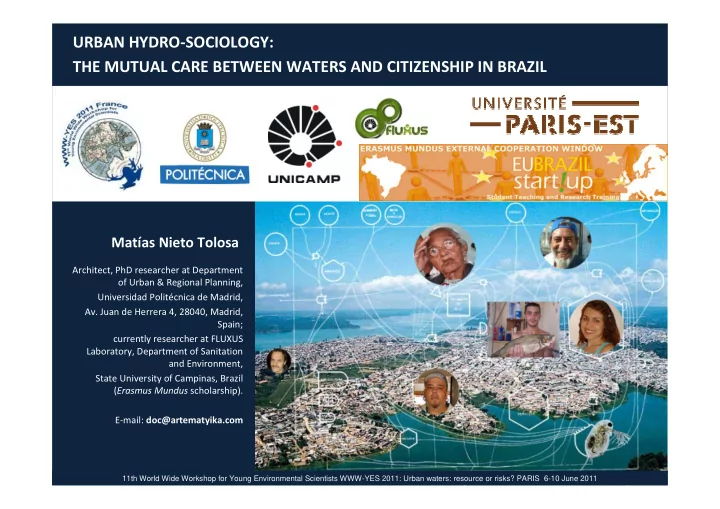
URBAN HYDRO-SOCIOLOGY: THE MUTUAL CARE BETWEEN WATERS AND CITIZENSHIP IN BRAZIL Matas Nieto Tolosa Architect, PhD researcher at Department of Urban & Regional Planning, Universidad Politcnica de Madrid, Av. Juan de Herrera 4, 28040,


slide-1
SLIDE 1

Matías Nieto Tolosa

URBAN HYDRO-SOCIOLOGY: THE MUTUAL CARE BETWEEN WATERS AND CITIZENSHIP IN BRAZIL

11th World Wide Workshop for Young Environmental Scientists WWW-YES 2011: Urban waters: resource or risks? PARIS 6-10 June 2011

Architect, PhD researcher at Department

  • f Urban & Regional Planning,

Universidad Politécnica de Madrid,

  • Av. Juan de Herrera 4, 28040, Madrid,

Spain; currently researcher at FLUXUS Laboratory, Department of Sanitation and Environment, State University of Campinas, Brazil (Erasmus Mundus scholarship). E-mail: doc@artematyika.com

slide-2
SLIDE 2

11th World Wide Workshop for Young Environmental Scientists WWW-YES 2011: Urban waters: resource or risks? PARIS 6-10 June 2011

  • 1. introduction
slide-3
SLIDE 3

INTRODUCTION

Patrick Geddes Reciprocity

11th World Wide Workshop for Young Environmental Scientists WWW-YES 2011: Urban waters: resource or risks? PARIS 6-10 June 2011

slide-4
SLIDE 4

11th World Wide Workshop for Young Environmental Scientists WWW-YES 2011: Urban waters: resource or risks? PARIS 6-10 June 2011

  • 2. material
slide-5
SLIDE 5

MATERIAL

Water Footprint indicator The Anhumas Project

11th World Wide Workshop for Young Environmental Scientists WWW-YES 2011: Urban waters: resource or risks? PARIS 6-10 June 2011

slide-6
SLIDE 6

MATERIAL

Water Footprint indicator The Anhumas Project

  • 11th World Wide Workshop for Young Environmental Scientists WWW-YES 2011: Urban waters: resource or risks? PARIS 6-10 June 2011

Regionaldynamicsofsojaproduction(20022009)

11millha 5,4millha

slide-7
SLIDE 7

MATERIAL

Water Footprint indicator The Anhumas Project

11th World Wide Workshop for Young Environmental Scientists WWW-YES 2011: Urban waters: resource or risks? PARIS 6-10 June 2011

WaterFootprintSpaceTimedynamicof sojaproduction(total=122,5km3,2009)

  • !"#!!$%&'(#!)!*"!"+#!,
  • ./

011234445$#!50"!%!16! 616"#!76*!"1+'7""$#+'8'*"*"'4$"15'8''06!'0#"$9'!%'!' $$'9+%7"!5+'$*"$9+

slide-8
SLIDE 8

MATERIAL

Water Footprint indicator The Anhumas Project

11th World Wide Workshop for Young Environmental Scientists WWW-YES 2011: Urban waters: resource or risks? PARIS 6-10 June 2011

slide-9
SLIDE 9

MATERIAL

Water Footprint indicator The Anhumas Project

11th World Wide Workshop for Young Environmental Scientists WWW-YES 2011: Urban waters: resource or risks? PARIS 6-10 June 2011

slide-10
SLIDE 10

MATERIAL

Water Footprint indicator The Anhumas Project

11th World Wide Workshop for Young Environmental Scientists WWW-YES 2011: Urban waters: resource or risks? PARIS 6-10 June 2011

slide-11
SLIDE 11

11th World Wide Workshop for Young Environmental Scientists WWW-YES 2011: Urban waters: resource or risks? PARIS 6-10 June 2011

  • 3. methods
slide-12
SLIDE 12

METHODS

  • EXPERIMENTAL PHENOMENOLOGY

EDMUND HUSSERL (1859-1938): main foundation and development. FRANCISCO VARELA (1946-2001):

  • n biological basis of cognition, studied

Husserl and Merleau-Ponty and applied it to research in neurobiology (autopoiesis and neurophenomenology).

  • Descriptions in Phenomenology were to take place from a

highly modified "first person" viewpoint, studying phenomena not as they appear to "my" consciousness, but to any consciousness. Husserl believed that phenomenology could thus provide a firm basis for all human knowledge, including scientific knowledge, and could establish philosophy as a "rigorous science" of measurable experience and intention.

  • Phenomenology, in Husserl's conception, is primarily

concerned with the systematic reflection on and analysis of the structures of consciousness, and the phenomena which appear in acts of consciousness.

First phase: Experimental phenomenology Second phase: Application of experimental indicator

  • n urban microbasin

11th World Wide Workshop for Young Environmental Scientists WWW-YES 2011: Urban waters: resource or risks? PARIS 6-10 June 2011

slide-13
SLIDE 13

METHODS

First phase: Experimental phenomenology Second phase: Application of experimental indicator

  • n urban microbasin

11th World Wide Workshop for Young Environmental Scientists WWW-YES 2011: Urban waters: resource or risks? PARIS 6-10 June 2011

The Waters Cycle: (A) inner (B) visible hydrological cycle (C) invisible hydrological cycle, climate (1) wasted waters from the human catabolism (sweat, tears, breathing exhalation, faeces, urine) (2) fresh waters for human metabolism, breathed vapours and waters embedded in foods (3) infiltration and evaporation processes (4) rainfall, spring rising (5) amniotic liquid, sub aquatic immersion, skin permeability, body humors (6) aqueous humor, radiestesy.

slide-14
SLIDE 14

METHODS

First phase: Experimental phenomenology Second phase: Application of experimental indicator

  • n urban microbasin

11th World Wide Workshop for Young Environmental Scientists WWW-YES 2011: Urban waters: resource or risks? PARIS 6-10 June 2011

slide-15
SLIDE 15

METHODS

  • Previous quantitative reflections:

production of traded ... – WF treats movable goods and services for consumption (HOEKSTRA et al.) – ... but can incorporate immovable goods and services (McCORMACK et al.): BUILDINGS, water embodied in construction and real estate 20.000 litres /m2 gross floor area

First phase: Experimental phenomenology Second phase: Application of experimental indicator

  • n urban microbasin

11th World Wide Workshop for Young Environmental Scientists WWW-YES 2011: Urban waters: resource or risks? PARIS 6-10 June 2011

slide-16
SLIDE 16

METHODS

  • PRODUCTION
  • REPRODUCTION
  • MOBILITY
  • NUTRITION
  • HOUSING
  • LEISSURE
  • CULTURE

First phase: Experimental phenomenology Second phase: Application of experimental indicator

  • n urban microbasin

11th World Wide Workshop for Young Environmental Scientists WWW-YES 2011: Urban waters: resource or risks? PARIS 6-10 June 2011

Administrative job 1,5 children and 3,3 indiv./family Volkswagen Gol using 3-lane highway Arroz, feijao, farofa e pao branco Apartment into a 7 floor codominium Watch a football match on TV Reading a book: 31% of population

RECIPROCITY indicators TRANSLATING 7 TOP URBAN HABITS INTO URBAN WATER FOOTPRINT

slide-17
SLIDE 17

METHODS

  • COMPARATION BETWEEN GLOBAL

HYDROLOGICAL BALANCE (water available at basin scale) AND URBAN WATER FOOTPRINT (water effectively used)

  • 7x3 MATRIX:

CONFRONTATION AMONG THE 7 URBAN HABITS AND: health social added value % land use shown on a Waters Cycle Graph

First phase: Experimental phenomenology Second phase: Application of experimental indicator

  • n urban microbasin

11th World Wide Workshop for Young Environmental Scientists WWW-YES 2011: Urban waters: resource or risks? PARIS 6-10 June 2011

slide-18
SLIDE 18

METHODS

First phase: Experimental phenomenology Second phase: Application of experimental indicator

  • n urban microbasin

11th World Wide Workshop for Young Environmental Scientists WWW-YES 2011: Urban waters: resource or risks? PARIS 6-10 June 2011

slide-19
SLIDE 19

11th World Wide Workshop for Young Environmental Scientists WWW-YES 2011: Urban waters: resource or risks? PARIS 6-10 June 2011

  • 4. discussion
slide-20
SLIDE 20

DISCUSSION

  • Lack of qualitative research
  • there is a significant risk in

relying on virtual-water related methods in order to guide policy conclusions

  • water scarcity is a new myth?
  • WF promotes international

trade (geopolitics)

  • price of basic foods and local

speculation (Mexico case)

11th World Wide Workshop for Young Environmental Scientists WWW-YES 2011: Urban waters: resource or risks? PARIS 6-10 June 2011

slide-21
SLIDE 21

DISCUSSION

  • Exist various types of

water, not only H20

  • Green – Blue (by FALKENMARK)
  • Virtual (by ALLAN)
  • Grey, Black, Rain (at URBAN HYDROLOGY)
  • Archetypical (by ILLICH)
  • Depending on tastes (by ARROJO)
  • Mineral-medical (at HYDROGEOLOGY)
  • Citoplasmatic, polarized, pressurized,

ionized (at MEDICINE)

  • Kosmotropic – Chaotropic (by WIGGINS at

BIOMEDICINE RESEARCH)

11th World Wide Workshop for Young Environmental Scientists WWW-YES 2011: Urban waters: resource or risks? PARIS 6-10 June 2011

slide-22
SLIDE 22

11th World Wide Workshop for Young Environmental Scientists WWW-YES 2011: Urban waters: resource or risks? PARIS 6-10 June 2011

  • 5. conclusion
slide-23
SLIDE 23

CONCLUSION

Practical sense of Water Footprint indicator into:

  • Social Actors
  • Public Policies
  • Urbanism & Regional Planning

between Private & Public spheres

11th World Wide Workshop for Young Environmental Scientists WWW-YES 2011: Urban waters: resource or risks? PARIS 6-10 June 2011

  • Waters take care of our

health in an autopoietic and spontaneous way, so what kind of knowledge about Water Footprint Urban Politics should we carefully practice in order to persist in that healthy, wealthy reciprocity?

slide-24
SLIDE 24

REFERENCES & FINAL REFLECTION

Water exploited (as a resource) Water dominated (as a potential risk) Resource vs Reserve Risk vs Resilience

slide-25
SLIDE 25

Matías Nieto Tolosa

URBAN HYDRO-SOCIOLOGY: THE MUTUAL CARE BETWEEN WATERS AND CITIZENSHIP IN BRAZIL E-mail: doc@artematyika.com

11th World Wide Workshop for Young Environmental Scientists WWW-YES 2011: Urban waters: resource or risks? PARIS 6-10 June 2011

Gracias Merci beaucoup Obrigado Terima kasih Tsie-tsie Min fadlic Mulţumiri Thanks ¡!