1/4/2017 Yoga for the Youngest! Mindfulness and Movement for - - PDF document

1 4 2017
SMART_READER_LITE
LIVE PREVIEW

1/4/2017 Yoga for the Youngest! Mindfulness and Movement for - - PDF document

1/4/2017 Yoga for the Youngest! Mindfulness and Movement for Shifting Culture and Practice Jenna Augustine, M.A. & Lori Ryan, Ph. D. Getting Present Mindfulness and Yoga Terminology Mindfulness: moment-by-moment awareness of our


slide-1
SLIDE 1

1/4/2017 1

Yoga for the Youngest! Mindfulness and Movement for Shifting Culture and Practice

Jenna Augustine, M.A. & Lori Ryan, Ph. D.

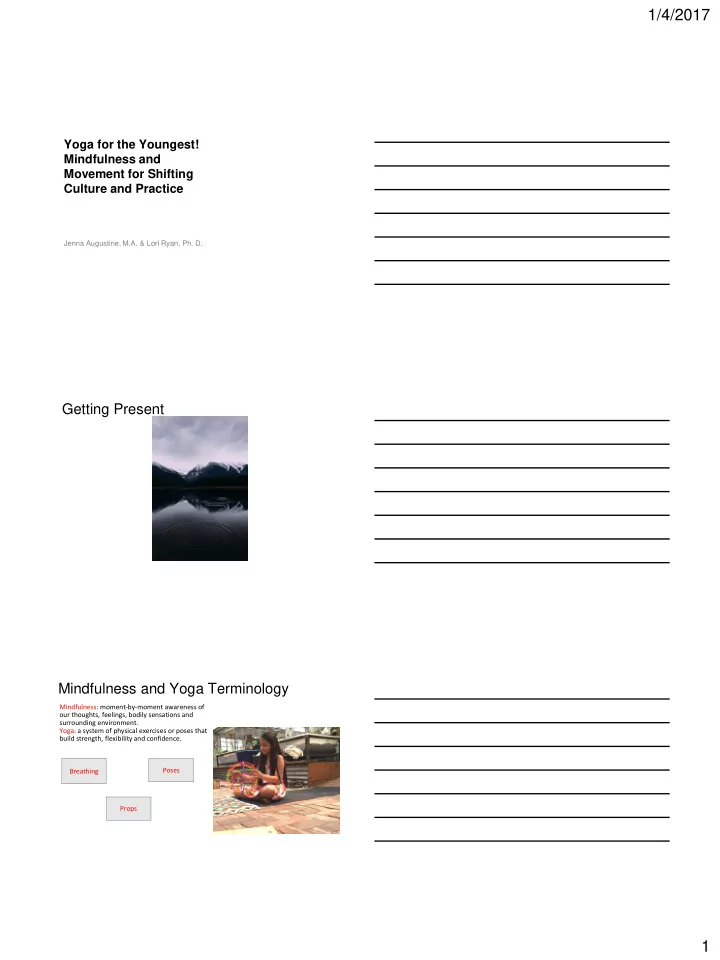
Getting Present Mindfulness and Yoga Terminology

Mindfulness: moment-by-moment awareness of

  • ur thoughts, feelings, bodily sensations and

surrounding environment. Yoga: a system of physical exercises or poses that build strength, flexibility and confidence. Breathing Props Poses

slide-2
SLIDE 2

1/4/2017 2

  • Mind-body connection
  • Fit and healthy life-style
  • Sense of well-being
  • Feeling of belonging
  • Fosters compassion
  • Reduce teacher stress
  • Create a community
  • Challenging behaviors
  • Optimal learning environment
  • Enhances relationships
  • Reduces anger
  • Strong flexible body
  • Balance
  • Posture and alignment
  • Core strength
  • Digestion & circulation
  • Better sleep
  • Boosts immunity
  • Imagination and creativity
  • Reduce stress and anxiety
  • Balance energy (high, low)
  • Less reactive, more present
  • High self-esteem
  • Character development

Mind Body Whole Child Classroom Benefits of Mindfulness and Yoga

Self-regulation

  • When young children effectively manage their thoughts, feelings and actions through

self-regulation they experience positive social outcomes.

  • The ability to shift attention, follow directions and persist in challenging tasks is

considered critically important for young children’s school success.

  • The use of classroom-based yoga programs is an effective way of supporting young

children’s learning, promote positive behavior and nurture self-regulation.

  • Yoga practice provides young children important opportunities to integrate physical,

mental and spiritual development using poses, breath control and relaxation techniques.

  • By stretching and breathing children learn how to focus internally, growing their self-

awareness about their bodies and their breath.

Razza, R. A., Bergen-Cico, D., & Raymond, K. (2013). Enhancing Preschoolers’ Self-Regulation Via Mindful Yoga. Journal of Child and Family Studies, 24(2), 372-385.

Poll Question: Do you practice mindfulness or yoga?

slide-3
SLIDE 3

1/4/2017 3

Bringing Yoga and Mindfulness to Children

Start with your practice Gain knowledge and develop your own practice and remember it’s a practice

  • Start meditation/yoga for short time
  • Incorporate it into another daily habit
  • Keep it simple and easy to follow
  • Experiment. Get curious!
  • Let go of outcomes-attach to the process

With the children Develop intentions (objectives) For example:

  • 1. To develop strong, flexible, healthy

bodies

  • 2. To increase awareness of body and

breath Develop a list of questions that the children would like to investigate For example:

  • 1. What is yoga?
  • 2. Can everyone do yoga?

Create the environment and establish a daily practice

  • Peaceful, supportive, calm, outdoor, indoor
  • Keep it simple, and small.
  • Determine best times to practice (circle time,

before breakfast, before rest time, after rest time)

  • Do it daily!

Video

Adapt yoga practices to fit your children’s developmental characteristics as well as their interests and curiosities. Adapt the poses so you focus on the cultivation of compassion and connection between breath and posture rather than the perfection of the pose.

Mindfulness and Yoga: Birth-Age Eight

Breathing & Movement PreK-2nd Poses Preschool Infants & Toddlers Movement & Songs Creative Expression Advanced Poses Field Experiences

slide-4
SLIDE 4

1/4/2017 4

Resources

1. Purperhart, H. (2008). The Yoga Zoo Adventure: Animal Poses and Games for Little Kids. Alameda, CA: Hunter House. 2. Bersma, D., & Visscher, M. (2003). Yoga Games for Children: Fun and Fitness with Postures, Movements, and

  • Breath. Alameda, CA: Hunter House .

3. Razza, R. A., Raymond, K., & Bergen-Cico, D. (2013, October 15). Enhancing Preschooler's Self Regulation Via Mindful Yoga. 4. Anderson, E. M., EdD. (2014). International Journal of Yoga Therapy . Issues in Yoga Therapy , 24. 5. Hoy, W. K., Gage, C. Q., & Tarter, J. (2006). School Mindfulness and Faculty Trust: Necessary Conditions for Each Other? Educational Administration Quarterly. 6. Kim, K. J., Wee, S., Gilbert, B. B., & Choi, J. (2016, October 27). Young Children's Physical and Psychological Well- Being Through Yoga. Childhood Education, 437-445. 7. Zelazo, P. D., & Lyons, K. E. (2012). The Potential Benefits of Mindfulness Training in Early Childhood: A Developmental Social Cognitive Neuroscience Perspective. Child Development Perspectives, 6(2), 154-160. 8. Yoga Calm: http://www.yogacalm.org 9. Yoga Ed: https://yogaed.com

Mindfulness and Yoga: A Community-Building Practice

Why culture is important?

Mindfulness tools and practices, without residing in a culture of mindfulness will be valuable, but much less transformative when they exist outside of a larger culture of mindfulness.
slide-5
SLIDE 5

1/4/2017 5

Leadership style: shifting toward a culture of mindfulness takes a leadership style that is nurturing and enhancing

Hoy, W.K. et. al (2006). School Mindfulness and Faculty Trust: Necessary Conditions for Each Other? Educational Administration Quarterly. 42, 236.

Leadership role: enhance the continual learning and ongoing refinement of mindfulness so it is increasingly internalized by teachers, staff members and children.

Leadership practices (three of many):

  • Intentionally dedicate time and space to

nurture mindfulness in self and others

  • Co-construct a shared vision and practice
  • f mindfulness
  • Coach for mindfulness, inviting ongoing

reflection and shared learning

slide-6
SLIDE 6

1/4/2017 6

slide-7
SLIDE 7

1/4/2017 7

Intentionally dedicate time and space

How we view and decide to use time is key > time is a resource that

we can give as a gift to the endeavors and people we believe in > time can be created from squandered time > when we spend time with others, we create synergy

> it is essential to reserve time for ourselves

Mindful life balance in ourselves and others

slide-8
SLIDE 8

1/4/2017 8

Dedicating time and space

> silent meditation

> breathing exercises

> stretching > healthy snack > walk around school ground > brain compatible music

Co-construct a shared vision that… > evokes trusting

mindful relationships > leads to practical intentions and actions to realize the vision

slide-9
SLIDE 9

1/4/2017 9

Coach for mindfulness and shared learning

> coaching enables educational innovations to achieve their full potential > when coaching is added to mindfulness, it is more likely to be internalized, valued and practiced > social interaction → new concepts and practices

Listen to one another with curiosity

Mindfulness IS >the openness to new information and different points of view > playful and nimble and avoids the traps of narrow definitions > intentionally searching for and noticing of the new and the different

Keep in mind the present you are

  • constructing. It should be the future that

you want. ~ Alice Walker

slide-10
SLIDE 10

1/4/2017 10

Stay connected with us

Jenna.Augustine@ucdenver.edu Lori.Ryan@ucdenver.edu

Send us a message. Let us know how mindfulness and yoga are growing in your early learning context. Let us know how we can help. We’d love to hear from you!