09/06/2017 Micro-structure and micro-mechanics of Disclosures and - - PowerPoint PPT Presentation

09 06 2017
SMART_READER_LITE
LIVE PREVIEW

09/06/2017 Micro-structure and micro-mechanics of Disclosures and - - PowerPoint PPT Presentation

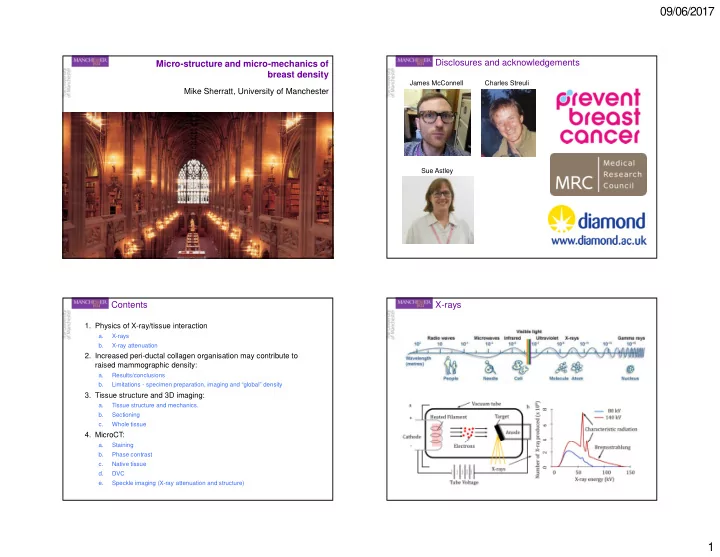
09/06/2017 Micro-structure and micro-mechanics of Disclosures and acknowledgements breast density James McConnell Charles Streuli Mike Sherratt, University of Manchester Sue Astley Contents X-rays 1. Physics of X-ray/tissue interaction a.


slide-1
SLIDE 1

09/06/2017 1

Mike Sherratt, University of Manchester

Micro-structure and micro-mechanics of breast density Disclosures and acknowledgements

James McConnell Charles Streuli Sue Astley

Contents

  • 1. Physics of X-ray/tissue interaction

a. X-rays b. X-ray attenuation

  • 2. Increased peri-ductal collagen organisation may contribute to

raised mammographic density:

a. Results/conclusions b. Limitations - specimen preparation, imaging and “global” density

  • 3. Tissue structure and 3D imaging:

a. Tissue structure and mechanics. b. Sectioning c. Whole tissue

  • 4. MicroCT:

a. Staining b. Phase contrast c. Native tissue d. DVC e. Speckle imaging (X-ray attenuation and structure)

X-rays

slide-2
SLIDE 2

09/06/2017 2

X-ray attenuation

Beer Lambert law:

Probability of photoelectric absorption: Attenuation: Scattering: Elastic Inelastic Absorption: Photoelectric

Why should breast tissue induce X-ray contrast? Contents

  • 1. Physics of X-ray/tissue interaction

a. X-rays b. X-ray attenuation

  • 2. Increased peri-ductal collagen organisation may contribute to

raised mammographic density:

a. Results/conclusions b. Limitations - specimen preparation, imaging and “global” density

  • 3. Tissue structure and 3D imaging:

a. Tissue structure and mechanics. b. Sectioning c. Whole tissue

  • 4. MicroCT:

a. Staining b. Phase contrast c. Native tissue d. DVC e. Speckle imaging (X-ray attenuation and structure)

Study cohort Patient cohort

slide-3
SLIDE 3

09/06/2017 3

Masson’s trichrome

Quantifying collagen – by Masson’s trichrome Quantifying collagen – by picrosirious red and polarised light Quantifying collagen – by picrosirious red and polarised light

Collagen organisation - AFM

High MD tissue is characterised by large collagen bundles.

slide-4
SLIDE 4

09/06/2017 4

Collagen can also be too organised Mass spectrometry suggest that collagen organising proteins (i.e. periostin and collagen XVI) mediate local stiffness Local tissue organisation, mechanics and proteomics correlates with Global tissue X-ray density Local tissue X-ray density Contents

  • 1. Physics of X-ray/tissue interaction

a. X-rays b. X-ray attenuation

  • 2. Increased peri-ductal collagen organisation may contribute to

raised mammographic density:

a. Results/conclusions b. Limitations - specimen preparation, imaging and “global” density

  • 3. Tissue structure and 3D imaging:

a. Tissue structure and mechanics. b. Sectioning c. Whole tissue

  • 4. MicroCT:

a. Staining b. Phase contrast c. Native tissue d. DVC e. Speckle imaging (X-ray attenuation and structure)

slide-5
SLIDE 5

09/06/2017 5

Cells Fibrillar collagens Elastic fibres Network collagens Adhesive glycoproteins Proteoglycans Proteases/ inhibitors Cytokines

Structural Soluble

The mechanical behaviour of ECM-rich tissues is determined by composition and structure

Articular cartilage Elastic arteries Skin Cardiac muscle

Danielson et al., 1997 J. Cell Biol. 136:729-743.

Aberrant ECM structure and disease Decorin “decorates” collagen fibrils

Danielson et al., 1997 J. Cell Biol. 136:729-743.

Decorin KO mice lack collagen organisation

slide-6
SLIDE 6

09/06/2017 6

Tissues are inherently three dimensional 3D Tissues 2D sections 2D sections: sampling issues and sectioning artefacts

Disrupted adventitia Intact media Hole Intact adventitia Hole 50µm

50µm Epidermis Dermis Disrupted stratum corneum Holes Holes

2D sections: sampling issues and sectioning artefacts

Serial sectioning Block face imaging Confocal microscopy X-ray tomography

slide-7
SLIDE 7

09/06/2017 7

Serial sectioning and reconstruction…..ancient Serial sectioning and reconstruction……and modern Serial block face imaging Confocal microscopy

slide-8
SLIDE 8

09/06/2017 8

The ideal imaging technique would enable…..

  • 1. Physics of X-ray/tissue interaction

a. X-rays b. X-ray attenuation

  • 2. Increased peri-ductal collagen organisation may contribute to

raised mammographic density:

a. Results/conclusions b. Limitations - specimen preparation, imaging and “global” density

  • 3. Tissue structure and 3D imaging:

a. Tissue structure and mechanics. b. Sectioning c. Whole tissue

  • 4. MicroCT:

a. Staining b. Phase contrast c. Native tissue d. DVC e. Speckle imaging (X-ray attenuation and structure)

…..rapid, high contrast, 3D visualisation and mechanical characterisation of large volumes of

  • paque native tissues at sub-micrometer length scales

X-ray imaging

Radiography Tomography

Principals of Micro-Computed X-Ray Tomography (microCT or sometimes µCT) X-ray imaging facilities

slide-9
SLIDE 9

09/06/2017 9

Principals of microCT Specimen preparation artefacts Phase contrast MicroCT resolves major recognisable structures in intact arteries

Paraffin Medial layer Adventitial layer

slide-10
SLIDE 10

09/06/2017 10

Segmentation of medial and adventitial layers across 100’s of slices

Artery mounted in bath between two glass cannulas Myograph arms rotate the assembly into a bath of fixative

  • r Liquid N2-cooled pentane.

A pressure servo and peristaltic pump maintain the artery at a set isobaric pressure

Arterial pressurisation apparatus Pressure profoundly affects 3D vessel structure

0mmHg 110mmHg Lumen volume Medial and adventitial layer thickness Elastic lamellae tortuosity / spacing / thickness Intimal & adventitial surface topography

Media CSA (microns^2) 50000 60000 70000 80000 Frequency (%) 5 10 15 20 25 0mmHg 110mmHg

Medial but not adventitial volume is maintained in pressurised vessels

66962µm2 (SD 1603µm2) 65258µm2 (SD 1114µm2)

Adventitia CSA (microns^2) 50000 60000 70000 80000 Frequency (%) 2 4 6 8 10 12 14 16 18 20 0mmHg 110mmHg

56844µm2 (SD 1750µm2) 72658µm2 (SD 4855µm2)

Measurements from 1 rat, 450 slices (338 µm) Mann Whitney U test p<0.0001

slide-11
SLIDE 11

09/06/2017 11

Breast microCT – preliminary scans Breast microCT – preliminary scans 4µm Specimen fixation artefacts

slide-12
SLIDE 12

09/06/2017 12

The ideal imaging technique would enable….. …..rapid, high contrast, 3D visualisation and mechanical characterisation of large volumes of

  • paque native tissues at sub-micrometer length scales

But scans on laboratory instruments take 10 hours. Therefore we need: A higher X-ray flux Which means a bigger machine Which means a synchrotron Synchrotron? Synchroton imaging of native tissue Synchroton imaging of native tissue

slide-13
SLIDE 13

09/06/2017 13

Synchrotron imaging and DVC Synchrotron imaging and digital volume correlation (DVC)

Slice 880

Synchrotron microCT of sequentially compressed disc DVC and 3D strain maps

slide-14
SLIDE 14

09/06/2017 14

DVC and 3D strain maps Speckle imaging: simultaneous absorption, scatteing and phase contrast

  • 1. MicroCT:

a. Staining b. Phase contrast c. Native tissue d. DVC e. Speckle imaging (X-ray attenuation and structure)

Absorption Dark field (scattering) Horizontal phase Vertical phase Combined phase

Summary

  • 1. Physics of X-ray/tissue interaction

X-ray contrast due to scattering and absorption

  • 2. Increased peri-ductal collagen organisation may contribute to

raised mammographic density:

Raised MD correlated with mechanically stiff collagen fibril bundles

  • 3. Tissue structure and 3D imaging:

Tissue and molecular structure is a key mediator of mechanical properties 3D structure can be characterised by sectioning or confocal methods

  • 4. MicroCT:

Image large volumes of native tissue at micron-resolutions Resolve micro-structure and micro-calcifictions in breast tissue Map 3D strain May be able to simultaneously characterise tissue structure and X-ray attenuation

Public awareness

slide-15
SLIDE 15

09/06/2017 15

Public awareness Acknowledgements